

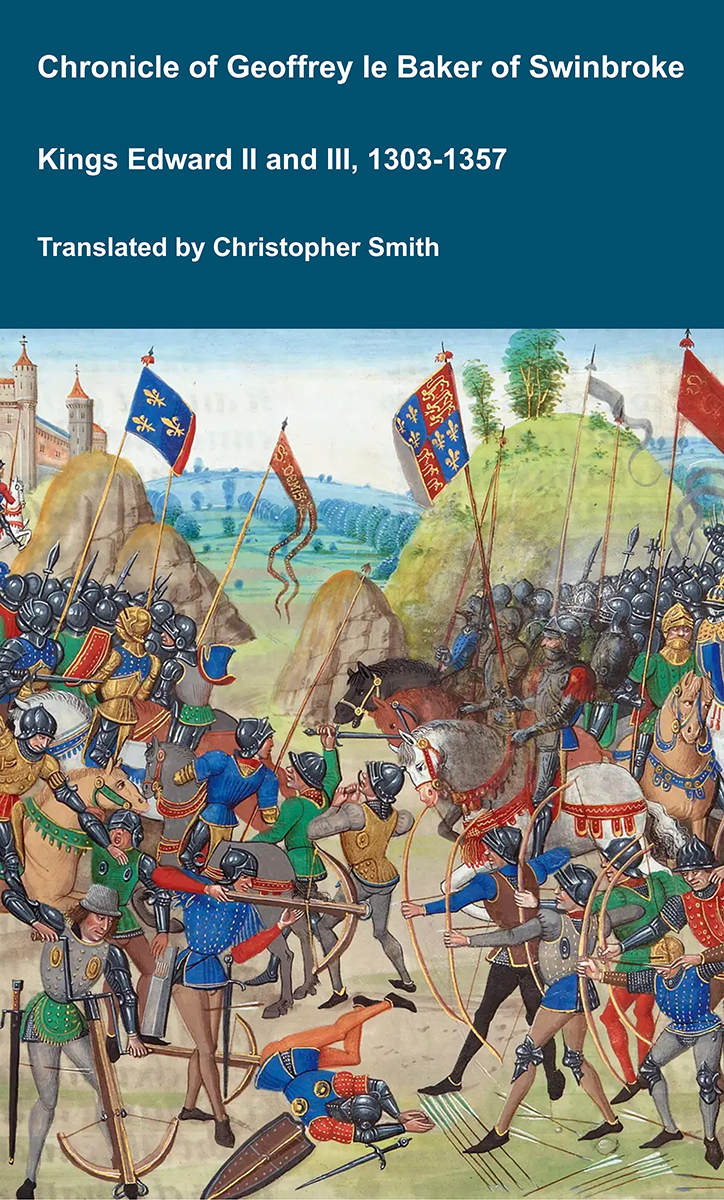
Chronicle of Geoffrey le Baker of Swinbroke
Baker was a secular clerk from Swinbroke, now Swinbrook, an Oxfordshire village two miles east of Burford. His Chronicle describes the events of the period 1303-1356: Gaveston, Bannockburn, Boroughbridge, the murder of King Edward II, the Scottish Wars, Sluys, Crécy, the Black Death, Winchelsea and Poitiers. To quote Herbert Bruce 'it possesses a vigorous and characteristic style, and its value for particular events between 1303 and 1356 has been recognised by its editor and by subsequent writers'. The book provides remarkable detail about the events it describes. Baker's text has been augmented with hundreds of notes, including extracts from other contemporary chronicles, such as the Annales Londonienses, Annales Paulini, Murimuth, Lanercost, Avesbury, Guisborough and Froissart to enrich the reader's understanding. The translation takes as its source the 'Chronicon Galfridi le Baker de Swynebroke' published in 1889, edited by Edward Maunde Thompson.
Available at Amazon in eBook and Paperback format.
Murder is in Death.
In 1210 Maud "Lady of Hay" St Valery Baroness Bramber [aged 55] starved to death at Corfe Castle, Dorset [Map].
In 1210 William de Braose was starved to death at Corfe Castle, Dorset [Map].
In 1213 Maud de Clare [aged 29] starved to death.
In February 1332 Walter Liath de Burgh starved to death whilst imprisoned by his cousin William Donn Burgh 3rd Earl of Ulster [aged 19]. Walter's sister Gylle de Burgh planned William's assassination in revenge.
On 26th March 1402 David Stewart 1st Duke Rothesay [aged 23] starved to death.
In July 1182 Maria Komnene [aged 30] was fatally poisoned, probably on the orders of his wife's step-mother Maria of Antioch, who would also poison her husband Renier of Montferrat [aged 20] a year later.
In 1183 Renier of Montferrat [aged 21] was fatally poisoned, as his wife Maria Komnene had been a year before, probably on the orders of his wife's step-mother Maria of Antioch.
Before 2nd August 1218 Louis II Count Loon was fatally poisoned. His brother Henry [aged 82] succeeded Count Loon.
On 2nd August 1218 Henry Count Loon [aged 82] was fatally poisoned a few days after his brother had been. His brother Arnold succeeded III Count Loon.
The History of William Marshal was commissioned by his son shortly after William’s death in 1219 to celebrate the Marshal’s remarkable life; it is an authentic, contemporary voice. The manuscript was discovered in 1861 by French historian Paul Meyer. Meyer published the manuscript in its original Anglo-French in 1891 in two books. This book is a line by line translation of the first of Meyer’s books; lines 1-10152. Book 1 of the History begins in 1139 and ends in 1194. It describes the events of the Anarchy, the role of William’s father John, John’s marriages, William’s childhood, his role as a hostage at the siege of Newbury, his injury and imprisonment in Poitou where he met Eleanor of Aquitaine and his life as a knight errant. It continues with the accusation against him of an improper relationship with Margaret, wife of Henry the Young King, his exile, and return, the death of Henry the Young King, the rebellion of Richard, the future King Richard I, war with France, the death of King Henry II, and the capture of King Richard, and the rebellion of John, the future King John. It ends with the release of King Richard and the death of John Marshal.
Available at Amazon in eBook and Paperback format.
In 1777 Catherine Bradford was fatally poisoned with arsenic by a servant according to the plaque at a Cheltenham church.
On 29th August 1780 Theodosius Boughton 7th Baronet [aged 20] was was fatally poisoned by his brother-in-law Captain John Donnellan who was subsequently executed for the crime
William de de Clare was fatally poisoned by his steward whilst having breakfast with his brother Richard, who was also poisoned but survived, and Prince Edward.