

Abbot John Whethamstede’s Chronicle of the Abbey of St Albans
Abbot John Whethamstede's Register aka Chronicle of his second term at the Abbey of St Albans, 1451-1461, is a remarkable text that describes his first-hand experience of the beginning of the Wars of the Roses including the First and Second Battles of St Albans, 1455 and 1461, respectively, their cause, and their consequences, not least on the Abbey itself. His text also includes Loveday, Blore Heath, Northampton, the Act of Accord, Wakefield, and Towton, and ends with the Coronation of King Edward IV. In addition to the events of the Wars of the Roses, Abbot John, or his scribes who wrote the Chronicle, include details in the life of the Abbey such as charters, letters, land exchanges, visits by legates, and disputes, which provide a rich insight into the day-to-day life of the Abbey, and the challenges faced by its Abbot.
Available at Amazon in eBook and Paperback format.
Pediment is in Architectural Detail.
See: Broken Pediment, Broken Segmental Pediment, Dentilated Pediment, Scrolled Pediment, Segmental Pediment.
On 3rd September 1634 Edward Coke [aged 82] died. Monument in Church of St Mary the Virgin, Tittleshall [Map]. Simple sarcophagus on pedestal with lying effigy. Pair of flanking Tuscan columns supporting a full entablature with putti on frieze and broken segmental pediment. Carved and painted achievement in and above tympanum flanked by four reclining figures of the Virtues on pediment extrados.
Above. Quarterly of eight:  Coke Arms, Crispin, Folkard, Sparham, Nerford, Yarmouth,
  Knightley Arms and Pawe. The crest is broken. Farrer says it was: On a chapeau Azure, turned up Ermine, an ostrich Argent, holding in its mouth a horseshoe Or. The motto reads Prudens qui Patiens.
The effigy was carved by John Hargrave, the rest of the memorial was made by Nicholas Stone [aged 47].
Below the effigy are three shields. Left Coke Arms implaling  Paston Arms. His first wife Bridget Paston. Middle Coke Arms. Right Coke Arms impaling
  Cecil Arms; his second wife Elizabeth Cecil Countess Berkshire [aged 38].
Bridget Paston: she was born to John Paston. She a great x 4 granddaughter of King Edward III of England. On 13th August 1582 Edward Coke and she were married.


On 29th October 1682 Baptist Noel 3rd Viscount Campden [aged 71] died. His son Edward [aged 41] succeeded 4th Viscount Campden, 4th Baron Hicks of Ilmington in Warwickshire. Elizabeth Wriothesley Countess Gainsborough [aged 36] by marriage Viscountess Campden. He was buried at Church of St Peter and St Paul, Exton, Rutlandshire [Map].
A huge monument in black and white marble, with a tall base on which stand obelisks, on balls capped by two black urns and a large open pediment. Within, are the Viscount and his fourth wife Elizabeth Bertie Viscountess Campden [aged 42] in effigy and various low reliefs, depicting his previous wives and nineteen children, in Roman dress, completed by Grinling Gibbons [aged 34].
Elizabeth Bertie Viscountess Campden: In 1640 she was born to Montagu Bertie 2nd Earl Lindsey and Martha Cockayne Countess Holderness. On 6th July 1655 Baptist Noel 3rd Viscount Campden and she were married. She by marriage Viscountess Campden. The difference in their ages was 29 years. She the daughter of Montagu Bertie 2nd Earl Lindsey and Martha Cockayne Countess Holderness. They were second cousin twice removed. In 1683 Elizabeth Bertie Viscountess Campden died.


After 1708. All Saints Church, Maiden Bradley [Map]. Monument to Edward Seymour 4th Baronet [aged 75]. Sculpted by John Michael Rysbrack [aged 13]; white marble reclining figure in front of tablet with pediment with cherubs, scrolled pediment with arms over. Powdered Wig. Heeled Shoes. Buckled Shoes.

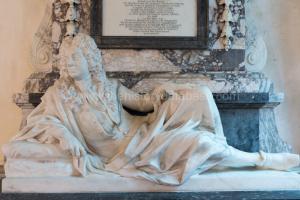


1720. Church of St Rumbold, Stoke Doyle [Map]. Monument to Edward Ward sculpted by John Michael Rysbrack [aged 25] in 1720 and was erected in 1725 during the rebuilding of the church. Elbow Reclining Figure in Judges's Robes. Ionic columns with Pediment. Arms at top being Ward impaled with his wife's Elizabeth Papillon [aged 61]; her arms having three butterflies being a pun on her surname Papillon. Powdered Wig. Heeled Shoes. Buckled Shoes.
Edward Ward: In or before 1714 he and Elizabeth Papillon were married. The difference in their ages was 20 years. In 1638 he was born to William Ward of Preston in Rutlandshire. On 14th July 1714 he died at his house at Essex Street.
Elizabeth Papillon: On 27th July 1658 she was born to Thomas Papillon Merchant and Jane Broadnax.


Before 1736. Monument to Anne Brudenell (wife of Charles Lennox) in St Peter's Church, Deene [Map] by Giovanni Battista Guelphi [aged 45] on the west wall of the transept. Bust set against square surround with flanking caryatids, metope frieze and pediment over.
Giovanni Battista Guelphi: Church of St Peter Kirkthorpe [Map]. The chief merit of the church is a fine collection of C18 wall monuments. The most important of these is the Stringer Monument by Guelfi: 2 detached busts on a sarcophagus with straight tapering sides; background by Kent with inscription, a frame starting from 2 big volutes and crowned by an open-segmental pediment carved coat-or-arms with putti. The Smyth chapel has numerous monuments dating from 1731; including that to John Smyth of 2 putti uncovering his portrait on an oval medallion, that to Lady Georgina Smyth and others signed by Flaxman; 1799. Around 1690 he was born. In 1736 he died.


After 1738. Monument to Joseph Ashley in Saint Leodegarius Church, Ashby St Ledgers [Map]. Grey and white marble architectural wall tablet with Pediment and winged Cherubs heads below. Signed by Nathaniel Hedges.
Joseph Ashley: In 1738 he died.


On 10th March 1774 William Browne [aged 82] died. Church of St Mary, Hillington [Map]. Large mural marble tablet with plain open pilasters open pediment and relief rondal. Inscribed Sir W B Archit. Roundel sculpted by Joseph Wilton [aged 51]. Armorial quartered 1&4 Unknown three leopard's faces jessant de lys 2&3 appears to be  Temple Arms includes an escutcheon for his wife Mary Greene.
William Browne: In 1692 he was born. On 24th August 1717 he and Mary Greene were married.
Mary Greene: On 29th September 1699 she was born to Charles Greene.


St Andrew's Church, Denton [Map]. In ashlar. The latin raised letter inscription is set in an egg and dart surround, flanked by Ionic Pilasters and free standing Composite fluted columns, supporting a pediment containing a pair of naked female figures holding hour glasses leaning on a skull. The frieze is decorated with medallions. The reclining figure of the deceased, his prayer book in hand, lies on a half rolled up mattress on a tomb chest on which are portrayed his wife and six children, all named in raised letters.

After 1627. Monument in the Church of St Leonard, Apethorpe [Map] to John Leigh -1627. Descended from the Leigh family of Addington. Grateful for further information as to his descent; email@twentytrees.co.uk.
Black marble panel flanked by Ionic columns supporting a frieze enriched with fruit and flowers, and an inverted broken pediment on which rest a reclining figure and a cartouche of arms of Leigh quartered with others