

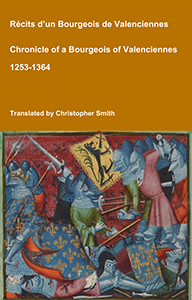
Chronicle of a Bourgeois of Valenciennes
Récits d’un bourgeois de Valenciennes aka The Chronicle of a Bourgeois of Valenciennes is a vivid 14th-century vernacular chronicle written by an anonymous urban chronicler from Valenciennes in the County of Hainaut. It survives in a manuscript that describes local and regional history from about 1253 to 1366, blending chronology, narrative episodes, and eyewitness-style accounts of political, military, and social events in medieval France, Flanders, and the Low Countries. The work begins with a chronological framework of events affecting Valenciennes and its region under rulers such as King Philip VI of France and the shifting allegiances of local nobility. It includes accounts of conflicts, sieges, diplomatic manoeuvres, and the impact of broader struggles like the Hundred Years’ War on urban life in Hainaut. Written from the perspective of a burgher (bourgeois) rather than a monastery or royal court, the chronicle offers a rare lay viewpoint on high politics and warfare, reflecting how merchants, townspeople, and civic institutions experienced the turbulence of the 13th and 14th centuries. Its narrative style combines straightforward reporting of events with moral and civic observations, making it a valuable source for readers interested in medieval urban society, regional politics, and the lived experience of war and governance in pre-modern Europe.
Available at Amazon in eBook and Paperback format.
Prie-Dieu is in Architectural Detail.
Prie-Dieu describes a prayer desk, literally "pray to God", monument.
On 31st August 1568 Humphrey Llwyd aka Lluyd (age 41) died. He was buried at St Marcella's Church, Denbigh [Map]. Victorian Monument to Humphrey Llwyd 1527-1568. Prie-Dieu.


On 24th January 1592 James Harrington (age 81) died. He was buried in the Church of St Peter and St Paul, Exton, Rutlandshire [Map]. Monument to James Harrington and Lucy Sidney. A large standing Elizabethan Period monument with 2 kneeling figures at a prie-dieu in a double aedicule. Wrought in various marbles and enriched with low-relief carving, strapwork etc. surmounted by obelisk, and arms. Stylistically similar to the monument to Robert Keilway. Possibly sculpted by Nicholas Johnson or Nicholas Stone (age 5).
Lucy Sidney: James Harrington and she were married. Around 1520 she was born to William Sidney and Anne Pakenham at Penshurst, Kent [Map]. Around 1591 Lucy Sidney died at Exton, Rutlandshire.


On 27th June 1598 Bridget Paston died. Monument in Church of St Mary the Virgin, Tittleshall [Map]. Arched niche with kneeling effigy at prie-dieu which carries the inscription. Flanking pilasters with partly painted carved trophies surrounded by ribbon-work. Carved achievement in strapwork surround above and eight kneeling weepers below.
Armorials top left  Coke Arms and top right
  Paston Arms.
Above the monument an amorial Quarterly: Coke Arms, Crispin, Folkard and Pawe impaling Quarterly of Seventeen with 1 Paston Arms, 2 Peche 3 Leach 4 Somerton 5 Peyver 6 Walcot 7 Berry 8 Craven 9 Kerdeston 10 Wachesam or Sotherton 11 Hethersett 12 Charles 13 Tatshall 14 Hengrave 15 Gerbridge 16 Mautby 17 Basinges?.
Bridget Paston: she was born to John Paston. On 13th August 1582 Edward Coke and she were married.


Before 1635. Prie-Dieu monument to Edward Waties of Ludlow and his wife Martha Fox at St Laurence's Church, Ludlow [Map]. The monument was erected by Edward in his seventieth year.
Martha Fox: she was born to Charles Fox of Bromfield and Isabella Newport. On 27th February 1593 Edward Waties of Ludlow and she were married. They had three sons and four daughters, of which two survived to adulthood. On 2nd October 1629 she died.

