

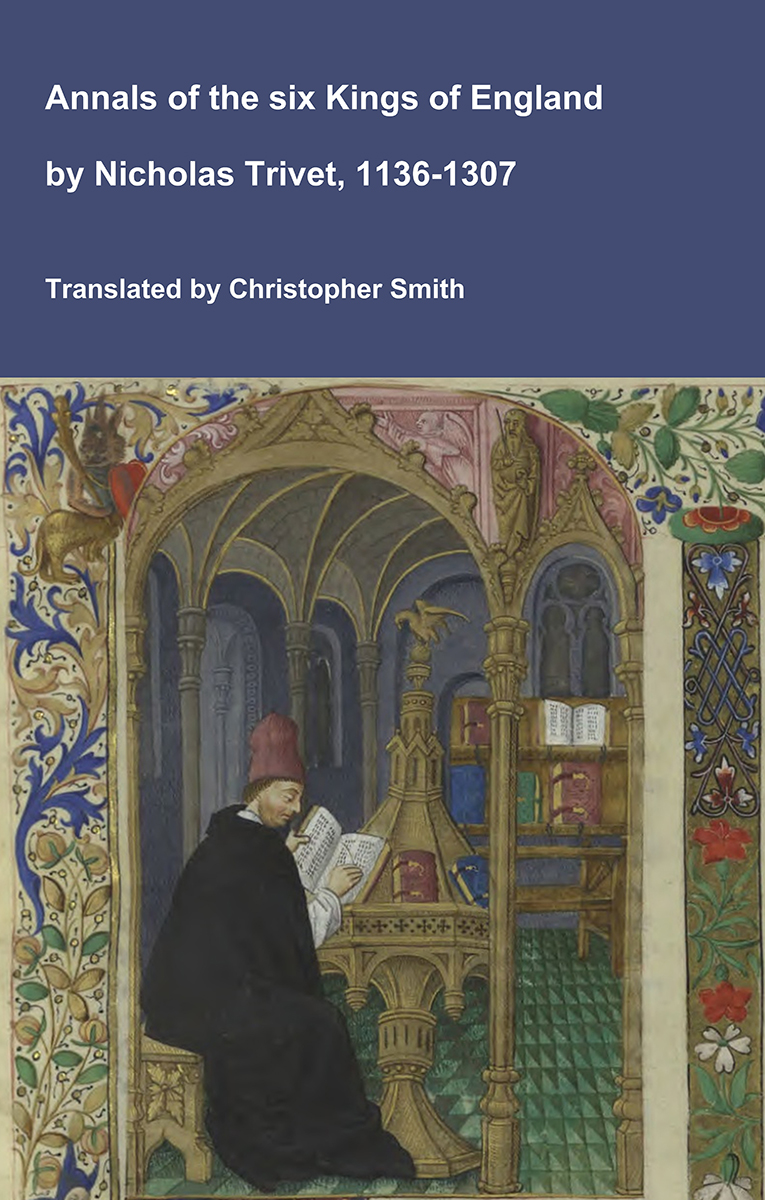
Annals of the six Kings of England by Nicholas Trivet
Translation of the Annals of the Six Kings of England by that traces the rise and rule of the Angevin aka Plantagenet dynasty from the mid-12th to early 14th century. Written by the Dominican scholar Nicholas Trivet, the work offers a vivid account of English history from the reign of King Stephen through to the death of King Edward I, blending political narrative with moral reflection. Covering the reigns of six monarchs—from Stephen to Edward I—the chronicle explores royal authority, rebellion, war, and the shifting balance between crown, church, and nobility. Trivet provides detailed insight into defining moments such as baronial conflicts, Anglo-French rivalry, and the consolidation of royal power under Edward I, whose reign he describes with particular immediacy. The Annals combines careful year-by-year reporting with thoughtful interpretation, presenting history not merely as a sequence of events but as a moral and political lesson. Ideal for readers interested in medieval history, kingship, and the origins of the English state, this chronicle remains a valuable and accessible window into the turbulent world of the Plantagenet kings.
Available at Amazon in eBook and Paperback format.
Third Cousin is in Third Cousin Succession Heading.
In 1676 William Brydges 7th Baron Chandos [aged 55] died of smallpox with no male issue. His third cousin James [aged 33] succeeded 8th Baron Chandos of Sudeley. Elizabeth Barnard Baroness Chandos [aged 33] by marriage Baroness Chandos of Sudeley.
On 10th May 1709 William Hay 6th Earl Kinnoull died. His third cousin Thomas [aged 49] succeeded 7th Earl Kinnoull.
On 8th November 1723 Thomas Palmer 4th Baronet [aged 41] died. His third cousin Charles succeeded 5th Baronet Palmer of Wingham in Kent.
In 1730 James Carnegie 5th Earl Southesk [aged 38] died. His third cousin James [aged 14] de jure 6th Earl Southesk.
On 22nd April 1745 Henry Howard 10th Earl Suffolk [aged 38] died. His third cousin Henry [aged 59] succeeded 11th Earl Suffolk. Catherine Graham Countess Berkshire and Suffolk by marriage Countess Suffolk
On 14th August 1769 William Stewart 1st Earl of Blessington [aged 60] died. He was buried at Silchester, Hampshire [Map]. Earl Blessington, Viscount Mountjoy, Baron Stewart of Ramelton extinct. His third cousin Annesley [aged 44] succeeded 6th Baronet Stewart of Ramelton.

On 16th November 1769 Henry Paget 2nd Earl Uxbridge [aged 50] died. Earl Uxbridge, Baron Burton extinct. His third cousin Henry [aged 25] succeeded 9th Baron Paget Beaudasert.

On 26th January 1782 John Campbell 3rd Earl Breadalbaine and Holland [aged 85] died. His third cousin John [aged 19] succeeded 4th Earl Breadalbaine and Holland.
On 15th November 1786 Richard Temple 7th Baronet [aged 55] died. His third cousin John [aged 55] succeeded 8th Baronet Temple of Stowe. He was buried at Bath Abbey [Map] where his Wall Memorial reads: "In Memory of Sir RICHARD TEMPLE Baronet; Son of Sir PETER TEMPLE Baronet: who was many years a Comissioner of His Majesty's Navy. He married ANN SOPHIA Daughter of Sir WILLIAM TEMPLE Baronet of Kempsey in the County of Worcester: by whom he left no surviving Issue. As the last token of Conjugal affection and regard She hath caused this marble to be erected March 20th. 1787." Below on the floor is "Underneath are deposited the Remains of Sir Richard Temple Baronet of Kempsey in the County of Worcester who died November the 15th 1786 in the 55th Year of his Age."
There is some disagreement as to whether he was legally the 8th Baronet, with some sources, including Cracroft stating:
Following the death of Sir Richard Temple the Baronetcy of Temple of Stow was claimed by his third cousin, John Temple, British Consul-General in Washington 1786-98, a great-grandson of Mary Temple and her husband Robert Nelson. In spite of a letter of support from his kinsman, George [Grenville later Nugent-Temple-Grenville] [aged 33], 1st Marquess of Buckingham, the heir general of the 1st Baronet, Mr John Temple's claim to the Baronetcy cannot be through his mother, as the succession to the baronetcy was restricted to male heirs of the body of the 1st Baronet. His claim must, therefore, be through his father, Capt Robert Temple, of Boston, Massachusetts, British North America (and indeed the Marquess of Buckingham describes him as the "heir male" of the 1st Baronet in his letter from Stowe dated 3 Dec 1786). Without further information it is difficult to see Mr John Temple's placing amongst the male line descendants of the 1st Baronet and the nature of the kinship between his parents, unless he descends, as has been suggested, from the Rev Thomas Temple, Rector of Burton-on-the-Water, and third son of the 1st Baronet.
In addition to Mr John Temple's claim it is possible that there are living male line descendants of Col Edmund Temple, of Sulby Priory, co. Northampton, through his third son, Edmund Temple, of Leicester, and it is for this reason that the Baronetcy of Temple of Stowe is regarded as being dormant rather than extinct.
On 10th October 1794 Archbishop Richard Robinson 1st Baron Rokeby [aged 86] died at Clifton Bristol, Gloucestershire. His third cousin Matthew [aged 81] succeeded 2nd Baron Rokeby.
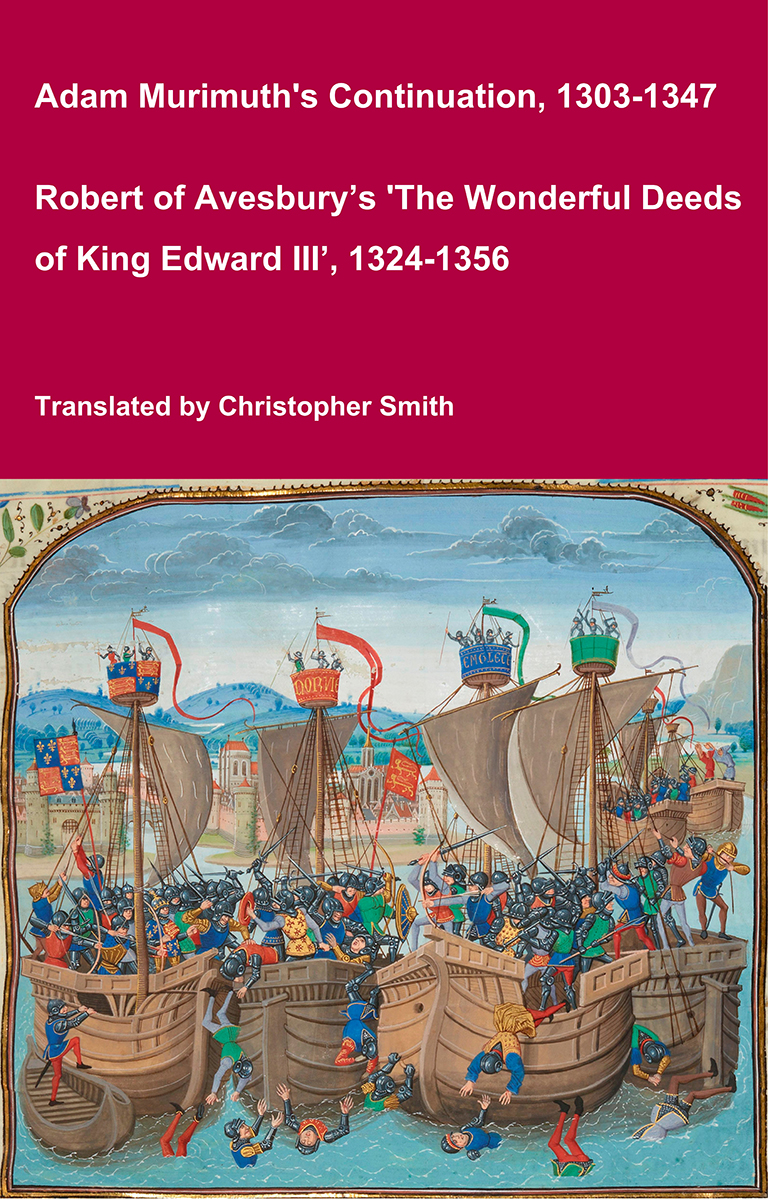
Adam Murimuth's Continuation and Robert of Avesbury’s 'The Wonderful Deeds of King Edward III'
This volume brings together two of the most important contemporary chronicles for the reign of Edward III and the opening phases of the Hundred Years’ War. Written in Latin by English clerical observers, these texts provide a vivid and authoritative window into the political, diplomatic, and military history of fourteenth-century England and its continental ambitions. Adam Murimuth Continuatio's Chronicarum continues an earlier chronicle into the mid-fourteenth century, offering concise but valuable notices on royal policy, foreign relations, and ecclesiastical affairs. Its annalistic structure makes it especially useful for establishing chronology and tracing the development of events year by year. Complementing it, Robert of Avesbury’s De gestis mirabilibus regis Edwardi tertii is a rich documentary chronicle preserving letters, treaties, and official records alongside narrative passages. It is an indispensable source for understanding Edward III’s claim to the French crown, the conduct of war, and the mechanisms of medieval diplomacy. Together, these works offer scholars, students, and enthusiasts a reliable and unembellished account of a transformative period in English and European history. Essential for anyone interested in medieval chronicles, the Hundred Years’ War, or the reign of Edward III.
Available at Amazon in eBook and Paperback format.
On 30th October 1796 Archibald Montgomerie 11th Earl Eglinton [aged 70] died at Eglinton Castle, Kilwinning. His third cousin Hugh [aged 56] succeeded 12th Earl Eglinton.


On 8th February 1809 Brownlow Bertie 5th Duke Ancaster and Kesteven [aged 79] died without male issue at Grimsthorpe, South Kesteven. He was buried at St Mary's Church, Swinstead [Map] on 17th February 1809. Duke Ancaster and Kesteven, Marquess Lindsay extinct. His third cousin Albermarle [aged 64] succeeded 9th Earl Lindsey.
Sculpted by Richard Westmacott [aged 33]. A handsome white marble wall tablet in Grecian style depicting deceased and wife on a catafalque with mourning female figure, flanked by mother, children and angel. Above a scrolled cornice with Ducal coronet and palm. Beneath a rectangular inscription panel, flanked by scrolled brackets.


On 16th December 1815 Charles Howard 11th Duke of Norfolk [aged 69] died. His third cousin Bernard [aged 50] succeeded 12th Duke Norfolk, 23rd or 30th Earl Arundel, 13th Earl Surrey, 10th Earl Norfolk, 20th Baron Maltravers, 20th Baron Arundel. Elizabeth Belasyse Duchess Norfolk [aged 45] by marriage Duchess Norfolk.


On 11th December 1816 Richard Howard 4th Earl of Effingham [aged 68] died. Earl of Effingham extinct. His third cousin Kenneth [aged 49] succeeded 11th Baron Howard of Effingham.
On 1st June 1833 Edmund Mark Winn 7th Baronet [aged 70] died. His third cousin Charles [aged 48] succeeded 8th Baronet Winn of Nostel in Yorkshire.
On 1st December 1871 George Philip Cecil Arthur Stanhope 7th Earl Chesterfield [aged 40] died of typhoid unmarried. His third cousin George [aged 49] succeeded 8th Earl Chesterfield, 8th Baron Stanhope of Shelford in Nottinghamshire. He had been staying at Londesborough Lodge Scarborough with the Prince of Wales [aged 30] who also contracted typhoid but survived.


On 13th August 1884 Charles Barclay-Maitland 12th Earl of Lauderdale [aged 61] was killed by lightning. His third cousin Frederick [aged 43] succeeded 13th Earl Lauderdale, 13th Viscount Maitland, 13th Viscount Lauderdale, 9th Baronet Maitland of Ravelrig in Nova Scotia.
On 10th January 1929 Charles Perceval 9th Earl Egmont [aged 71] died. His third cousin Frederick [aged 55] succeeded 10th Earl Egmont, 10th Viscount Perceval of Kanturk in County Cork, 10th Baron Perceval of Burton in County Cork, 10th Viscount Perceval of Kanturk in County Cork, 10th Baron Perceval of Burton in County Cork, 7th Baron Arden of Lohort Castle in County Cork, 6th Baron Arden of Arden in Warwickshire, 13th Baronet Perceval of Kanturk in County Cork, 9th Baron Lovel and Holland of Enmore in Somerset.
On 10th March 1934 Alexander Bannerman 11th Baronet [aged 62] died. His third cousin Arthur [aged 68] succeeded 12th Baronet Bannerman of Elsick in Kincardineshire.
In 1937 Ernest Hay Stonhouse 16th and 13th Baronet [aged 81] died. His third cousin Arthur [aged 51] succeeded 17th Baronet Stonhouse of Radley, 14th Baronet Stonhouse of Radley.
On 26th August 1953 Edward Manners Nightingale 14th Baronet [aged 64] died. His third cousin Geoffrey [aged 48] succeeded 15th Baronet Nightingale of Newport Pond in Essex.
On 23rd April 1958 Anthony Myles Cholmeley Dering 11th Baronet [aged 56] died. His third cousin Rupert [aged 42] succeeded 12th Baronet Dering of Surrenden Dering in Kent.
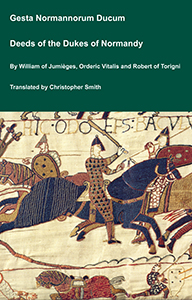
The Deeds of the Dukes of Normandy
The Gesta Normannorum Ducum [The Deeds of the Dukes of Normandy] is a landmark medieval chronicle tracing the rise and fall of the Norman dynasty from its early roots through the pivotal events surrounding the Norman Conquest of England. Originally penned in Latin by the monk William of Jumièges shortly before 1060 and later expanded at the behest of William the Conqueror, the work chronicles the deeds, politics, battles, and leadership of the Norman dukes, especially William’s own claim to the English throne. The narrative combines earlier historical sources with firsthand information and oral testimony to present an authoritative account of Normandy’s transformation from a Viking settlement into one of medieval Europe’s most powerful realms. William’s history emphasizes the legitimacy, military prowess, and governance of the Norman line, framing their expansion, including the conquest of England, as both divinely sanctioned and noble in purpose. Later chroniclers such as Orderic Vitalis and Robert of Torigni continued the history, extending the coverage into the 12th century, providing broader context on ducal rule and its impact. Today this classic work remains a foundational source for understanding Norman identity, medieval statesmanship, and the historical forces that reshaped England and Western Europe between 800AD and 1100AD.
Available at Amazon in eBook and Paperback format.
On 29th November 1965 Verus Arundell Maunder St John-Mildmay 11th Baronet [aged 59] died. His third cousin Michael [aged 64] succeeded 12th Baronet St John-Mildmay of Farley in Southampton.
On 21st March 1977 William Arthur Henry Cavendish-Bentinck 7th Duke Portland [aged 84] died. He was buried at St Winifred's Church, Holbeck. His third cousin Ferdinand [aged 87] succeeded 8th Duke Portland, 9th Earl of Portland. Baron Bolsover of Bolsover in Derbyshire extinct.
The heir to the Duke's titles was a distant cousin. Rather than allow the entailed estates to pass with the titles, the Duke arranged to break the entails and thus enrich his own daughters. The family seat of Welbeck Abbey [Map] passed to his elder daughter, Lady Anne [aged 60], who never married; upon her death, it passed to the son of her deceased younger sister, Lady Margaret, who had died in 1955
In 1986 Geoffrey William Pennington-Ramsden 7th Baronet [aged 82] died. His third cousin Caryl [aged 70] succeeded 8th Baronet Ramsden of Byram in Yorkshire.