

Chronicle of a Bourgeois of Valenciennes
Récits d’un bourgeois de Valenciennes aka The Chronicle of a Bourgeois of Valenciennes is a vivid 14th-century vernacular chronicle written by an anonymous urban chronicler from Valenciennes in the County of Hainaut. It survives in a manuscript that describes local and regional history from about 1253 to 1366, blending chronology, narrative episodes, and eyewitness-style accounts of political, military, and social events in medieval France, Flanders, and the Low Countries. The work begins with a chronological framework of events affecting Valenciennes and its region under rulers such as King Philip VI of France and the shifting allegiances of local nobility. It includes accounts of conflicts, sieges, diplomatic manoeuvres, and the impact of broader struggles like the Hundred Years’ War on urban life in Hainaut. Written from the perspective of a burgher (bourgeois) rather than a monastery or royal court, the chronicle offers a rare lay viewpoint on high politics and warfare, reflecting how merchants, townspeople, and civic institutions experienced the turbulence of the 13th and 14th centuries. Its narrative style combines straightforward reporting of events with moral and civic observations, making it a valuable source for readers interested in medieval urban society, regional politics, and the lived experience of war and governance in pre-modern Europe.
Available at Amazon in eBook and Paperback format.
John Lavery is in Painters.
On 20th March 1856 John Lavery was born. He was baptised at St Patrick's Church Belfast.

1885. John Lavery (age 28). "Under the Cheery Tree". Painted at Grez-sur-Loing, a small village on the river Loing, south of Fontainbleu, near Paris, where artists had gathered since the 1860s. Lavery worked there in 1883 and 1884

1889. John Lavery (age 32). "Eileen, Her First Communion". Portrait of [his daughter] Eileen Lavery.
In 1889 John Lavery (age 32) and Kathleen MacDermott were married.

1889. John Lavery (age 32). Portrait of Charles Tennant 1st Baronet (age 65).

Around 1889. John Lavery (age 32). Portrait of William Scott 6th Duke Buccleuch 8th Duke Queensberry (age 57).

1889. John Lavery (age 32). Portrait of Schomberg Henry Kerr Kerr 9th Marquess Lothian (age 55).
Schomberg Henry Kerr Kerr 9th Marquess Lothian: On 2nd December 1833 he was born to John Kerr 7th Marquess Lothian and Cecil Chetwynd-Talbot Marchioness Lothian. In 1865 Schomberg Henry Kerr Kerr 9th Marquess Lothian and Victoria Alexandrina Montagu-Douglas-Scott Marchioness Lothian were married. She the daughter of Walter Scott 5th Duke Buccleuch 7th Duke Queensberry and Charlotte Anne Thynne Duchess Buccleuch Duchess Queensbury. He the son of John Kerr 7th Marquess Lothian and Cecil Chetwynd-Talbot Marchioness Lothian. They were sixth cousins. On 17th January 1900 Schomberg Henry Kerr Kerr 9th Marquess Lothian died. His daughter Robert succeeded 10th Marchioness Lothian, 12th Countess Lothian, 10th Countess Lothian.
In or before 1891 [his daughter] Eileen Lavery was born to John Lavery (age 34) and [his wife] Kathleen MacDermott. She married (1) 1912 James Dickinson (2) 1919 William Francis Forbes-Sempill 10th Baronet 19th Lord Sempill and had issue.
In 1891 [his wife] Kathleen MacDermott died of tuberculosis.
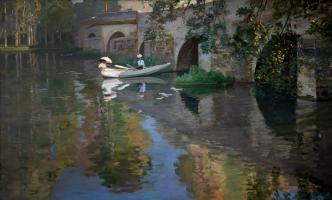
1901. John Lavery (age 44). "The Bridge at Grès".
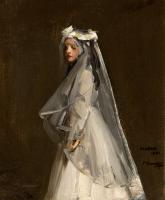
1901. John Lavery (age 44). "[his daughter] Eileen (age 10), her first communion".
Abbot John Whethamstede’s Chronicle of the Abbey of St Albans
Abbot John Whethamstede's Register aka Chronicle of his second term at the Abbey of St Albans, 1451-1461, is a remarkable text that describes his first-hand experience of the beginning of the Wars of the Roses including the First and Second Battles of St Albans, 1455 and 1461, respectively, their cause, and their consequences, not least on the Abbey itself. His text also includes Loveday, Blore Heath, Northampton, the Act of Accord, Wakefield, and Towton, and ends with the Coronation of King Edward IV. In addition to the events of the Wars of the Roses, Abbot John, or his scribes who wrote the Chronicle, include details in the life of the Abbey such as charters, letters, land exchanges, visits by legates, and disputes, which provide a rich insight into the day-to-day life of the Abbey, and the challenges faced by its Abbot.
Available at Amazon in eBook and Paperback format.
In 1903 Edward Livingston Trudeau Junior and [his future wife] Hazel Martyn (age 22) were married. He died five months later. They had one daughter, Alice, born 10 October 1904.
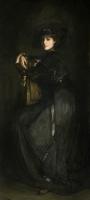
Around 1908. John Lavery (age 51). Lady in Black.
In 1909 John Lavery (age 52) and Hazel Martyn (age 28) were married. The difference in their ages was 23 years.

1909. John Lavery (age 52). "The Mother", showing the artist's daughter Eileen (age 18) with her child.

1910 . John Lavery (age 53). Portrait of Priscilla Cecilia Moore Countess Annesley.
Priscilla Cecilia Moore Countess Annesley: she was born to William Armitage Moore. On 2nd July 1892 Lieutenant-Colonel Hugh Annesley 5th Earl Annesley and she were married at St Marylebone Church. She by marriage Countess Annesley of Castlewellan in County Down. He the son of William Richard Annesley 3rd Earl Annesley and Priscilla Cecilia Moore. They were first cousins. On 9th October 1941 she died.
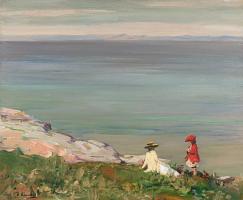
1911. John Lavery (age 54). "On the Cliffs".
In 1912 [his son-in-law] James Dickinson and Eileen Lavery (age 21) were married. They were divorced before 1920. She the daughter of John Lavery (age 55) and Kathleen MacDermott.

1913. John Lavery (age 56). "Loch Katrine".

7th July 1917. John Lavery (age 61). "Daylight raid from my studio window", records the afternoon of 7th July 1917, when twenty-one German biplanes appeared in the skies above London and were engaged by British aircraft. The ensuing combat could be seen from the large window of Lavery’s studio in Cromwell Place, London. The artist’s wife Hazel (age 37), her head outlined against a blackout curtain, is watching the scene

1919 . John Lavery (age 62). Portrait of Violet Keppel (age 24).
The Deeds of the Dukes of Normandy
The Gesta Normannorum Ducum [The Deeds of the Dukes of Normandy] is a landmark medieval chronicle tracing the rise and fall of the Norman dynasty from its early roots through the pivotal events surrounding the Norman Conquest of England. Originally penned in Latin by the monk William of Jumièges shortly before 1060 and later expanded at the behest of William the Conqueror, the work chronicles the deeds, politics, battles, and leadership of the Norman dukes, especially William’s own claim to the English throne. The narrative combines earlier historical sources with firsthand information and oral testimony to present an authoritative account of Normandy’s transformation from a Viking settlement into one of medieval Europe’s most powerful realms. William’s history emphasizes the legitimacy, military prowess, and governance of the Norman line, framing their expansion, including the conquest of England, as both divinely sanctioned and noble in purpose. Later chroniclers such as Orderic Vitalis and Robert of Torigni continued the history, extending the coverage into the 12th century, providing broader context on ducal rule and its impact. Today this classic work remains a foundational source for understanding Norman identity, medieval statesmanship, and the historical forces that reshaped England and Western Europe between 800AD and 1100AD.
Available at Amazon in eBook and Paperback format.
In 1919 [his son-in-law] William Francis Forbes-Sempill 10th Baronet 19th Lord Sempill (age 25) and Eileen Lavery (age 28) were married. She the daughter of John Lavery (age 62) and Kathleen MacDermott.

1920. John Lavery (age 63). "His Eminence Cardinal Logue".

1920. John Lavery (age 63). Portrait of James Craig 1st Viscount Craigavon (age 48).
James Craig 1st Viscount Craigavon: On 8th January 1871 he was born. In 1918 James Craig 1st Viscount Craigavon was created 1st Baronet Craig. In 1927 James Craig 1st Viscount Craigavon was created 1st Viscount Craigavon of Stormont in County Down. On 24th November 1940 he died.
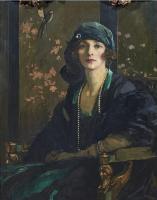
1920. John Lavery (age 63). "The Lady in Black and Green" aka Portrait of Mrs Dudley Ward aka Winifred "Freda" May Birkin (age 25).

1920. John Lavery (age 63). "The Green Coat". Portrait of [his wife] Hazel Martyn (age 39).
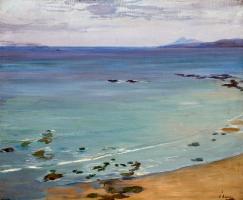
1920. John Lavery (age 63). "Tangier Bay Sunshine".

1920. John Lavery (age 63). "The Red Hammock". Portrait of the artist's wife Hazel Martyn (age 39).

1922. John Lavery (age 65). Portrait of Sybil Sassoon Marchioness Cholmondeley (age 27).

1922. John Lavery (age 65). "Lady Lavery". Portrait of the artist's second wife Hazel Martyn (age 41).

Around 1924. John Lavery (age 67). "Mrs Forbes-Semphill". Portrait of the artist's daughter Eileen Lavery (age 33) and his grand-daughter Ann Moira Forbes-Semphill (age 4).
Ann Moira Forbes-Semphill: In 1920 she was born to William Francis Forbes-Sempill 10th Baronet 19th Lord Sempill and Eileen Lavery. On 30th December 1965 William Francis Forbes-Sempill 10th Baronet 19th Lord Sempill died. Ann Moira Forbes-Semphill inherited the Semphill peerage. The Baronetcy passed to his younger sibling Ewans Forbes who had been registered at birth and raised as female, but lived as a man, and had his birth re-registered as male. This inheritance was challenged on grounds of sex by a cousin, John Forbes-Sempill, but upheld in the courts.
Adam Murimuth's Continuation and Robert of Avesbury’s 'The Wonderful Deeds of King Edward III'
This volume brings together two of the most important contemporary chronicles for the reign of Edward III and the opening phases of the Hundred Years’ War. Written in Latin by English clerical observers, these texts provide a vivid and authoritative window into the political, diplomatic, and military history of fourteenth-century England and its continental ambitions. Adam Murimuth Continuatio's Chronicarum continues an earlier chronicle into the mid-fourteenth century, offering concise but valuable notices on royal policy, foreign relations, and ecclesiastical affairs. Its annalistic structure makes it especially useful for establishing chronology and tracing the development of events year by year. Complementing it, Robert of Avesbury’s De gestis mirabilibus regis Edwardi tertii is a rich documentary chronicle preserving letters, treaties, and official records alongside narrative passages. It is an indispensable source for understanding Edward III’s claim to the French crown, the conduct of war, and the mechanisms of medieval diplomacy. Together, these works offer scholars, students, and enthusiasts a reliable and unembellished account of a transformative period in English and European history. Essential for anyone interested in medieval chronicles, the Hundred Years’ War, or the reign of Edward III.
Available at Amazon in eBook and Paperback format.

1924. John Lavery (age 67). "Twilight, Lake of Geneva".

Around 1924. John Lavery (age 67). Portrait of Charles Vane-Tempest-Stewart 7th Marquess of Londonderry (age 45).

Around 1924. John Lavery (age 67). "Hazel in Black and Gold". Portrait of the artist's second wife Hazel Martyn (age 43).

1924 . John Lavery (age 67). Portrait of Charles Vane-Tempest-Stewart 7th Marquess of Londonderry (age 45).
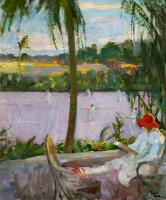
1927. John Lavery (age 70). "Florida in Winter".
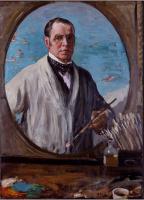
1928. John Lavery (age 71). Self-portrait.
The Times. 24th October 1928. The King was represented by Sir Harry Verney, and the Prince of Wales by the Hon Bruce Ogilvy, and Princess Louise, Duchess of Argyll by Col B. W. L. MacMahon at the service for Sir Frank Dicksee which took place yesterday in Westminster Abbey. The Dean of Westminster officiated, assisted by Canon Storr, and the Reverend H. L. Nixon. A procession was formed at the West Door, and proceeded through the nave headed by the full choir and clergy.
The Pall Bearers were all titled with the exception of J. W. MacKail the distinguished academic and son-in-law of Sir Edward Burne-Jones. Amongst the mourners were many members of the Dicksee family, including Miss Mary Dicksee (sister), and Mr Herbert Thomas Dicksee. Official representatives included The French Ambassador, the Belgian Ambassador. The Brazilian Ambassador, the Swedish Minister, the High Commissioners for Australia and New Zealand, and (the 2nd) Lord Leverhume. Also present were many Academicians including W. Ouless, Sir John Lavery (age 72), W. Goscombe-John (age 68). Mrs Blair Leighton, widow of Edmund, and Lady East (age 83), widow of Sir Alfred were also among the mourners. The list of mourners in The Times includes many of the most distinguished people of the day.

1929. John Lavery (age 72). Portrait of the artist's wife Hazel Martyn (age 48).
In 1935 [his daughter] Eileen Lavery (age 44) died.
In 1935 [his wife] Hazel Martyn (age 54) died. Her funeral mass took place at the Brompton Oratory in Knightsbridge. She was buried with her husband in Putney Vale Cemetery.
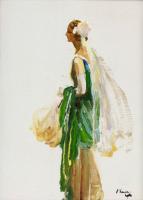
Before 1941 . John Lavery (age 84). Portrait of Miss Diana Chamberlain. Possibly Diane Chamberlain.
Diane Chamberlain: she was born to Austen Chamberlain.
Chronicle of Walter of Guisborough
A canon regular of the Augustinian Guisborough Priory, Yorkshire, formerly known as The Chronicle of Walter of Hemingburgh, describes the period from 1066 to 1346. Before 1274 the Chronicle is based on other works. Thereafter, the Chronicle is original, and a remarkable source for the events of the time. This book provides a translation of the Chronicle from that date. The Latin source for our translation is the 1849 work edited by Hans Claude Hamilton. Hamilton, in his preface, says: 'In the present work we behold perhaps one of the finest samples of our early chronicles, both as regards the value of the events recorded, and the correctness with which they are detailed; Nor will the pleasing style of composition be lightly passed over by those capable of seeing reflected from it the tokens of a vigorous and cultivated mind, and a favourable specimen of the learning and taste of the age in which it was framed.'
Available at Amazon in eBook and Paperback format.
On 10th January 1941 John Lavery (age 84) died.