

The Deeds of the Dukes of Normandy
The Gesta Normannorum Ducum [The Deeds of the Dukes of Normandy] is a landmark medieval chronicle tracing the rise and fall of the Norman dynasty from its early roots through the pivotal events surrounding the Norman Conquest of England. Originally penned in Latin by the monk William of Jumièges shortly before 1060 and later expanded at the behest of William the Conqueror, the work chronicles the deeds, politics, battles, and leadership of the Norman dukes, especially William’s own claim to the English throne. The narrative combines earlier historical sources with firsthand information and oral testimony to present an authoritative account of Normandy’s transformation from a Viking settlement into one of medieval Europe’s most powerful realms. William’s history emphasizes the legitimacy, military prowess, and governance of the Norman line, framing their expansion, including the conquest of England, as both divinely sanctioned and noble in purpose. Later chroniclers such as Orderic Vitalis and Robert of Torigni continued the history, extending the coverage into the 12th century, providing broader context on ducal rule and its impact. Today this classic work remains a foundational source for understanding Norman identity, medieval statesmanship, and the historical forces that reshaped England and Western Europe between 800AD and 1100AD.
Available at Amazon in eBook and Paperback format.
Martin Archer Shee is in Painters.

Circle of Martin Archer Shee. Portrait of Maria Elizabeth Tollemache Marchioness Ailesbury.
Maria Elizabeth Tollemache Marchioness Ailesbury: On 27th October 1809 she was born to Charles Manners aka Tollemache. On 20th August 1833 Charles Brudenell 1st Marquess Ailesbury and she were married at Ham House, Richmond, Surrey. She by marriage Marchioness Ailesbury. The difference in their ages was 36 years. He the son of Thomas Brudenell 1st Earl Ailesbury and Susanna Hoare Countess Ailesbury. On 7th May 1893 Maria Elizabeth Tollemache Marchioness Ailesbury died at Petersham, Surrey.

In 1788 Martin Archer Shee (age 18) was introduced by Edmund Burke to Joshua Reynolds (age 64).
In 1789 Martin Archer Shee (age 19) and Mary Power were married.
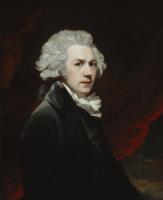
1794. Martin Archer Shee (age 24). Self-Portrait.
In 1798 Martin Archer Shee (age 28) was elected Associate of the Royal Academy.
Around 1800 Martin Archer Shee (age 30) moved to 32 Cavendish Square Marylebone the former house of George Romney (age 65).
In 1800 Martin Archer Shee (age 30) was elected Fellow of the Royal Academy.

Around 1814. Attributed to Martin Archer Shee (age 44). Portrait of General Edward Paget (age 38). A three-quarter-length potrait in military uniform, against a background of sky. The painting shows him without his right arm which he lost at the First Battle of Oporto. Probably painted shortly after his release from the French, 1814.
General Edward Paget: On 3rd November 1775 he was born to Henry Bayly-Paget 1st Earl Uxbridge and Jane Champagné Countess Uxbridge. On 22nd May 1805 General Edward Paget and Frances Bagot were married at St George's Church, Hanover Square. He the son of Henry Bayly-Paget 1st Earl Uxbridge and Jane Champagné Countess Uxbridge. On 22nd February 1815 General Edward Paget and Harriet Legge were married. She the daughter of George Legge 3rd Earl Dartmouth and Frances Finch Countess Dartmouth. He the son of Henry Bayly-Paget 1st Earl Uxbridge and Jane Champagné Countess Uxbridge. On 13th May 1849 General Edward Paget died.

1828. Martin Archer Shee (age 58). Portrait of Archbishop William Howley (age 61).
Chronicle of Walter of Guisborough
A canon regular of the Augustinian Guisborough Priory, Yorkshire, formerly known as The Chronicle of Walter of Hemingburgh, describes the period from 1066 to 1346. Before 1274 the Chronicle is based on other works. Thereafter, the Chronicle is original, and a remarkable source for the events of the time. This book provides a translation of the Chronicle from that date. The Latin source for our translation is the 1849 work edited by Hans Claude Hamilton. Hamilton, in his preface, says: 'In the present work we behold perhaps one of the finest samples of our early chronicles, both as regards the value of the events recorded, and the correctness with which they are detailed; Nor will the pleasing style of composition be lightly passed over by those capable of seeing reflected from it the tokens of a vigorous and cultivated mind, and a favourable specimen of the learning and taste of the age in which it was framed.'
Available at Amazon in eBook and Paperback format.

In 1830 Martin Archer Shee (age 60) was elected President of the Royal Academy following the death of Thomas Lawrence (age 60).
In 1831 Martin Archer Shee (age 61) was elected Fellow of the Royal Society.

1833. Martin Archer Shee (age 63). Portrait of Bishop Charles Richard Sumner in the Robes of the Order of the Garter. Bishop Charles Sumner was not a Garter Knight. He is wearing the Robes probably in his capacity as Chaplain, or Register, of the Order of the Garter.
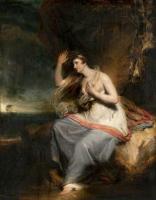
Around 1834. Martin Archer Shee (age 64). "Ariadne deserted by Theseus".

Around 1834. Martin Archer Shee (age 64). Portrait of John Rawdon 1st Earl Moira.

Around 1834. Martin Archer Shee (age 64). Portrait of Francis Leggatt Chantrey (age 52).

Around 1834. Martin Archer Shee (age 64). Portrait of Francis Leggatt Chantrey (age 52).

1835. Martin Archer Shee (age 65). Portrait of John Cust 1st Earl Brownlow (age 55).

Around 1838. Martin Archer Shee (age 68). Portrait of George Hamilton-Gordon 4th Earl Aberdeen (age 53).

Before 11th October 1843. Martin Archer Shee (age 73). Portrait of Bishop James Bowstead (age 42).
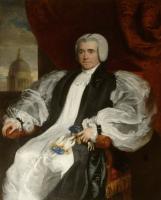
Before 13th August 1849 Martin Archer Shee (age 79). Portrait of Bishop Edward Coplestone (age 73).

Before 13th August 1850 Martin Archer Shee (age 80). Portrait of Charles Henry Cust (age 37).
Charles Henry Cust: In 1813 he was born to John Cust 1st Earl Brownlow and Amelia Sophia Hume. In 1875 Charles Henry Cust died.
Abbot John Whethamstede’s Chronicle of the Abbey of St Albans
Abbot John Whethamstede's Register aka Chronicle of his second term at the Abbey of St Albans, 1451-1461, is a remarkable text that describes his first-hand experience of the beginning of the Wars of the Roses including the First and Second Battles of St Albans, 1455 and 1461, respectively, their cause, and their consequences, not least on the Abbey itself. His text also includes Loveday, Blore Heath, Northampton, the Act of Accord, Wakefield, and Towton, and ends with the Coronation of King Edward IV. In addition to the events of the Wars of the Roses, Abbot John, or his scribes who wrote the Chronicle, include details in the life of the Abbey such as charters, letters, land exchanges, visits by legates, and disputes, which provide a rich insight into the day-to-day life of the Abbey, and the challenges faced by its Abbot.
Available at Amazon in eBook and Paperback format.
On 13th August 1850 Martin Archer Shee (age 80) died at Brighton.