


Text this colour links to Pages. Text this colour links to Family Trees. Text this colour are links that are disabled for Guests.
Place the mouse over images to see a larger image. Click on paintings to see the painter's Biography Page. Mouse over links for a preview. Move the mouse off the painting or link to close the popup.
Cairn L, Lough Crew is in Lough Crew, Prehistoric Ireland.
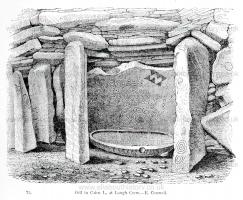
Rude Stone Monuments in all Countries Chapter V. Cairn L [Map] (woodcut No. 75), a little further west, is 135 feet in diameter, and surrounded by forty-two stones, similar to those in Cairn T. The same curve inwards of these stones marks the entrance here, which is placed 18 feet from the outward line of the circle. The chamber here is nearly of the same dimensions as that last described, being 29 feet deep and 13 across its greatest width. In one of the side chambers lies the largest of the mysterious flat basins that have yet been discovered, 5 feet 9 inches long by 3 feet 1 inch broad, the whole being tooled and picked with as much care and skill as if executed by a modern mason. This one has a curious nick in its rim, but as it does not go through, it could hardly be intended as a spout. Till some unrifled tomb is found, or something analogous in other countries, it is extremely difScult to say what the exact use of these great stone saucers may have been. That the body or ashes were laid on them is more than probable, and they may then have been covered over with a lid like a dish-cover, such as are found on tombs in Southern Babylonia.1 Under this basin were found great quantities of charred liuniiiu bones and forty-eight human teeth, besides a perfectly rounded syenite ball, still preserving its original polish, also some jet and other ornaments. In other parts were found quantities of charred bones, some rude pottery and bone implements, but no objects in metal. The woodcut representing the cell, with large basin, gives a fair idea of the general style of sculpture in this and the neighbouring cairns. The parts cross-hatched seem to have been engraved with a sharp metal tool. The ordinary forms, however, both here and on the Boyne are picked; but whether they were executed with a hammer, or pick direct, or by a chisel driven by a hammer, is by no means clear. My own impression is, that it would be very difficult indeed to execute these patterns with a hammer of any sort, and that a chisel must have been used, but whether of flint, bronze, or iron, there is no evidence to show.
Note 1. 'Journal Royal Archæological Society,' xv. p. 270.
 Become a Member via our Buy Me a Coffee page to read complete text.