

Text this colour links to Pages. Text this colour links to Family Trees. Text this colour are links that are disabled for Guests.
Place the mouse over images to see a larger image. Click on paintings to see the painter's Biography Page. Mouse over links for a preview. Move the mouse off the painting or link to close the popup.
Cairn T, Lough Crew is in Lough Crew, Prehistoric Ireland.
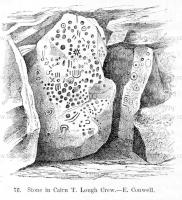
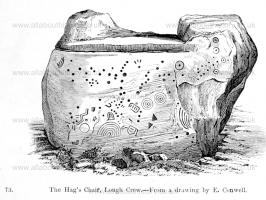
Rude Stone Monuments in all Countries Chapter V. The character of the sculptures in the two groups of monuments fully bears out this view. The carvings at Lough Crew are ruder and less artistic than those at Brugh. They are more disconnected, and oftener mere cup markings. The three stones represented in the preceding and following woodcuts (Nos. 75 and 76), are selected from a groat many in the Conwell portfolios as fair average specimens of the style of sculpture common at Louch Crew, and with the woodcut No. 73, representing the Hag-'s Chair, and No. 75, the chamber in cairn L, will convey a fair notion of the whole. In no one instance does it seem possible to guess what these figures were meant to represent. No animal or vegetable form can be recognized, even after allowing the utmost latitude to the imagination ; nor do the circles or waving lines seem intended to convey any pictorial ideas. Beauty of form, as a decoration, seems to have been all the old Celt aimed at, and he may have been thought successful at the time, though it hardly conveys the same impression to modern minds. The graceful scrolls and spirals and the foliage of New Grange and Dowth do not occur there, nor anything in the least approaching to them. Indeed, when Mr. Conwell's book is published, in which they will all be drawn in more or less detail, I believe it will be easy to arrange the whole into a progressive series illustrative of the artistic history of Ireland for five centuries before the advent of St. Patrick.
76. Stone in Cairn T, Lough Crew [Map]. E. Conwell.
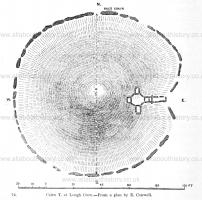
Rude Stone Monuments in all Countries Chapter V. One of the most perfect of these tumuli is that distinguished by Mr. Conwell as Cairn T [Map] (woodcut No. 72). It stands on the highest point of the hill, and is consequently the most conspicuous. It is a truncated cone, 116 feet in diameter at base, and with a sloping side, between 60 and 70 feet in length. Around its base are thirty-seven stones, laid on edge, and varying from 6 to 12 feet in length. They are not detached, as at New Grange, but form a retaining wall to the mound. On the north, and set about 4 feet back from the circle, is a large stone, 10 feet long by 6 high, and 2 feet thick, weighing consequently above 10 tons. The upper part is fashioned as a rude seat, from which it derives its name of the Hag's Chair (woodcut No. 73), and there can be little doubt but that it was intended as a seat or throne; but whether by the king who erected the sepulchre, or for what purpose, it is difficult now to say.