

The History of William Marshal was commissioned by his son shortly after William’s death in 1219 to celebrate the Marshal’s remarkable life; it is an authentic, contemporary voice. The manuscript was discovered in 1861 by French historian Paul Meyer. Meyer published the manuscript in its original Anglo-French in 1891 in two books. This book is a line by line translation of the first of Meyer’s books; lines 1-10152. Book 1 of the History begins in 1139 and ends in 1194. It describes the events of the Anarchy, the role of William’s father John, John’s marriages, William’s childhood, his role as a hostage at the siege of Newbury, his injury and imprisonment in Poitou where he met Eleanor of Aquitaine and his life as a knight errant. It continues with the accusation against him of an improper relationship with Margaret, wife of Henry the Young King, his exile, and return, the death of Henry the Young King, the rebellion of Richard, the future King Richard I, war with France, the death of King Henry II, and the capture of King Richard, and the rebellion of John, the future King John. It ends with the release of King Richard and the death of John Marshal.
Available at Amazon in eBook and Paperback format.
Gaulstown Portal Tomb is in County Waterford, Prehistoric Ireland.
Llewellynn Jewitt 1870. Other excellent examples of Irish cromlechs and chambers are those at Monasterboise ("Calliagh Dirras House") [Map]; Drumloghan (full of Oghams) [Map]; Kells; Knockeen [Map] (figs. 47 and 48); where the right supporting stones are six in number, and arranged rectangularly, so as to form a distinct chamber at the S.E. end, the large covering stone being 12 feet inches by 8 feet, and weighing about four tons, and the smaller one about half that size; Gaulstown [Map] (figs. 49 and 50, the inner chamber of which measures 7 feet by 6 feet 4 inches, and is seven feet in height); Ballynageerah [Map] (figs. 51, 52, and 53), the capstone of which is cleverly and curiously poised on two only of the upright stones, as will be seen by the engravings1; Howth, Shandanagh, Brennanstown, Glencullen, Kilternan, Mount Brown, Rath-kenny, Mount Venus, and Knock Mary, Phoenix Park, as well as at many omer places.
Note 1. For the loan of these seven engravings I am indebted to the Council of the "Historical and Archaeological Association of Ireland," (formerly the "Kilkenny and South-east of Ireland Archaeo'ogical Society,") in whose journal one of the most valuable of antiquarian publications they have appeared. This Association is one of the most useful that has ever been established, and deserves the best support, not only of Irish, but of English antiquaries.


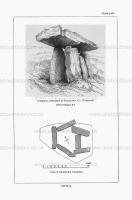
Journal of the Kilkenny and South-East of Ireland Archaeological Society Volume 5 1866 Pages 476-482. The illustration, Plate II, is that of the cromleac in the townland of Gauls town [Gaulstown Portal Tomb [Map]], in the same county, on the northern flank of Carrick-a-roirk Hill.1
Here we have a structure very similar to the former in general design, though different from it in some details, viz. : — The absence of the lower and supplemental covering slab ; and the open end of the chamber facing to the S. of E., while the inner chamber is rudely hexagonal in plan, owing to the peculiar way in which the upright slabs have been arranged (see plan).
The inner chamber measures 7 feet x 6 feet 4 inches at its maximum width, having a height of 7 feet ; the diaphragm stone being 3 feet 3 inches wide ; the outer open space being 2 feet deep, and narrowing to 2 feet 6 inches at its external edge. The covering or table stone is 12 feet x 7 feet at its S. E. end, with an average thickness of one foot, which thus gives a weight of about 3 tons ; the height of the supporting stones at the E. S. E. or open end of the structure is about 8 feet 6 inches. These blocks, like those forming the other cromleac, have been derived from the local trappean rocks. At the distance of 31 feet N. W. from this cromleac there occurs a true kistaen, constructed in the soil ; this chamber is formed of several large slabs set on edge, and measures 1 6 feet or 1 7 feet in length, by about 4 feet 6 inches or 5 feet in width ; it was originally covered horizontally by three flags, one of which yet remains, and measures 8 feet x 5 feet 6 inches in width-.
Here we have clear evidence to show that the kistvaen was a structure very distinct from the cromleac.
Note 1. Anglice, the Rock of the Prospect.