

Henrici Quinti, Angliæ Regis, Gesta, is a first-hand account of the Agincourt Campaign, and subsequent events to his death in 1422. The author of the first part was a Chaplain in King Henry's retinue who was present from King Henry's departure at Southampton in 1415, at the siege of Harfleur, the battle of Agincourt, and the celebrations on King Henry's return to London. The second part, by another writer, relates the events that took place including the negotiations at Troye, Henry's marriage and his death in 1422.
Available at Amazon in eBook and Paperback format.
Knockmany Passage Grave is in County Tyrone, Prehistoric Ireland.
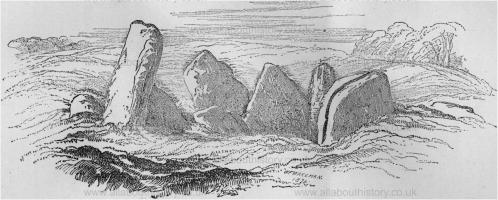
Knockmany [Map] in County Tyrone, illustrated by William Wakeman in 1876.
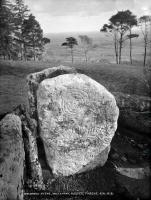
1918 of an Inscribed Stone at Knockmany Passage Grave [Map].
Plans of the Knockmany passage-grave [Map] in County Tyrone, from the 1952 excavations.
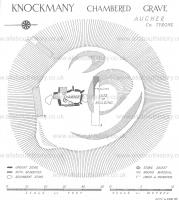
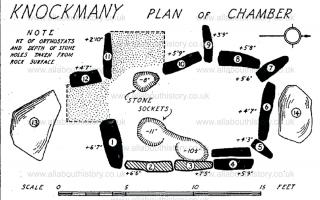
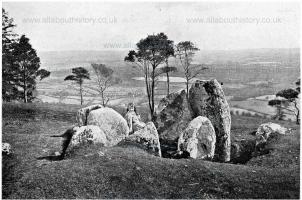
Handbook of Irish Antiquities by Wakeman Chapter 1. Knockmany Chamber [Map]. This interesting sepulchral monument, which is illustrated in the frontispiece to this work, is on the summit of a wooded hill, about76 two and a half miles north of Clogher, County Tyrone. The chamber is of the type known as the 'giant's grave'; it lies nearly due north and south, and consists of thirteen stones, most of which are mill-stone grit. None of the covering stones now remain, having probably been removed for building purposes. The tomb seems to have been originally covered by a mound. The internal measurement is 10 feet 3 inches by 6 feet 6 inches; two of the blocks of the east side have fallen inwards. Four of the stones have markings, consisting of cup-hollows, zigzag lines, concentric circles, and other curved patterns. Expert opinion, from an examination of their forms, is inclined to associate the markings with the later Bronze Age of Scandinavia, and to give a probable date of this sepulchral chamber as 500 B.C. The tomb is known locally as 'Aynia's Cove,' popular superstition associating it with a witch or hag named Aynia or Ainé. It is also called Knoc Baine, as being the supposed burial-place of Baine, mother of Feidhlimidh Reachtmhar, who was king of Ireland early in the second century. This would bring the monument to the Late Celtic period, which is difficult to reconcile with the archæological evidence already mentioned, associating it with the Bronze Age.35
Note 35. Journal Roy. Soc. of Antiq. Ir., 1896, p. 93; and 1876, p. 95.