


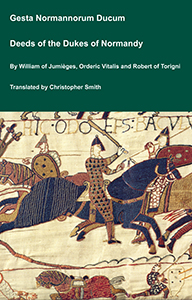
The Deeds of the Dukes of Normandy
The Gesta Normannorum Ducum [The Deeds of the Dukes of Normandy] is a landmark medieval chronicle tracing the rise and fall of the Norman dynasty from its early roots through the pivotal events surrounding the Norman Conquest of England. Originally penned in Latin by the monk William of Jumièges shortly before 1060 and later expanded at the behest of William the Conqueror, the work chronicles the deeds, politics, battles, and leadership of the Norman dukes, especially William’s own claim to the English throne. The narrative combines earlier historical sources with firsthand information and oral testimony to present an authoritative account of Normandy’s transformation from a Viking settlement into one of medieval Europe’s most powerful realms. William’s history emphasizes the legitimacy, military prowess, and governance of the Norman line, framing their expansion, including the conquest of England, as both divinely sanctioned and noble in purpose. Later chroniclers such as Orderic Vitalis and Robert of Torigni continued the history, extending the coverage into the 12th century, providing broader context on ducal rule and its impact. Today this classic work remains a foundational source for understanding Norman identity, medieval statesmanship, and the historical forces that reshaped England and Western Europe between 800AD and 1100AD.
Available at Amazon in eBook and Paperback format.
On 6th June 1646 Hortense Mancini Duchess of Mazarin was born to [her father] Lorenzo Mancini (age 44).
In 1650 [her father] Lorenzo Mancini (age 48) died.
On 1st March 1661 Armand Charles de La Porte Duc de La Meilleraye (age 29) and Hortense Mancini Duchess of Mazarin (age 14) were married.
Samuel Pepys' Diary. 27th January 1667. Here we met with Mr. May (age 45), and he and we to talk of several things, of building, and such like matters; and so walked to White Hall, and there I skewed my cozen Roger (age 49) the Duchesse of York (age 29) sitting in state, while her own mother (age 49) stands by her; he had a desire, and I shewed him my Baroness Castlemayne (age 26), whom he approves to be very handsome, and wonders that she cannot be as good within as she is fair without. Her little black boy came by him; and, a dog being in his way, the little boy called to the dog: "Pox of this dog!"-"Now", says he, blessing himself, "would I whip this child till the blood come, if it were my child!" and I believe he would. But he do by no means like the liberty of the Court, and did come with expectation of finding them playing at cards to-night, though Sunday; for such stories he is told, but how true I know not1.
Note 1. There is little reason to doubt that it was such as Evelyn describes it at a later time. "I can never forget the inexpressible luxury and prophaneness, gaming, and all dissoluteness, and, as it were, total forgetfulness of God (it being Sunday evening) which this day se'nnight I was witness of; the King (age 36) sitting and toying with his concubines, Portsmouth (age 17), Cleveland, Mazarin (age 20), &c. A French boy singing love songs in that glorious gallery, whilst about twenty of the great courtiers and other dissolute persons were at basset round a large table, a bank of at least £2,000 in gold before them; upon which two gentlemen who were with me made reflexions with astonishment. Six days after was all in the dust". B.

Around 1671 Godfrey Kneller (age 24). Portrait of Hortense Mancini Duchess of Mazarin (age 24).
Around June 1676 Hortense Mancini Duchess of Mazarin (age 29) had become the mistress of King Charles II of England Scotland and Ireland (age 46) for whom he had provided a pension of £4000 each year.


John Evelyn's Diary. 6th September 1676. Supped at the Lord Chamberlain's (age 58), where also supped the famous beauty and errant lady, the Duchess of Mazarine (age 30) (all the world knows her story), the Duke of Monmouth (age 27), Countess of Sussex (age 15) (both natural children of the King (age 46) by the Duchess of Cleveland (age 35)) [Note. A mistake by Evelyn. Jame's Scott's mother was Lucy Walter, Anne Fitzroy's mother was Barbara Villiers 1st Duchess of Cleveland], and the Countess of Derby (age 16), a virtuous lady, daughter to my best friend, the Earl of Ossory (age 42).
John Evelyn's Diary. 4th February 1685. I can never forget the inexpressible luxury and prophanenesse, gaming and all dissoluteness, and as it were total forgetfullnesse of God (it being Sunday evening) which this day se'nnight I was witnesse of, the King (age 54) sitting and toying with his concubines, Portsmouth (age 35), Cleaveland (age 44), and Mazarine (age 38), &c a French boy singing love songs, in that glorious gallery, whilst about 20 of the greate courtiers and other dissolute persons were at Basset round a large table, a bank of at least 2000 in gold before them, upon which two gentlemen who were with me made reflexions with astonishment. Six days after was all in the dust! It was enjoyn'd that those who put on mourning should wear it as for a father, in ye most solemn manner.
John Evelyn's Diary. 11th June 1699. After a long drought, we had a refreshing shower. The day before, there was a dreadful fire at Rotherhithe [Map], near the Thames side, which burned divers ships, and consumed nearly three hundred houses. Now died the famous Duchess of Mazarin (age 53); she had been the richest lady in Europe. She was niece of Cardinal Mazarin, and was married to the [her husband] richest subject in Europe (age 67), as is said. She was born at Rome, Italy [Map], educated in France, and was an extraordinary beauty and wit but dissolute and impatient of matrimonial restraint, so as to be abandoned by her husband, and banished, when she came into England for shelter, lived on a pension given her here, and is reported to have hastened her death by intemperate drinking strong spirits. She has written her own story and adventures, and so has her other extravagant [her sister] sister (age 59), wife to the noble family of Colonna.
The Deeds of the Dukes of Normandy
The Gesta Normannorum Ducum [The Deeds of the Dukes of Normandy] is a landmark medieval chronicle tracing the rise and fall of the Norman dynasty from its early roots through the pivotal events surrounding the Norman Conquest of England. Originally penned in Latin by the monk William of Jumièges shortly before 1060 and later expanded at the behest of William the Conqueror, the work chronicles the deeds, politics, battles, and leadership of the Norman dukes, especially William’s own claim to the English throne. The narrative combines earlier historical sources with firsthand information and oral testimony to present an authoritative account of Normandy’s transformation from a Viking settlement into one of medieval Europe’s most powerful realms. William’s history emphasizes the legitimacy, military prowess, and governance of the Norman line, framing their expansion, including the conquest of England, as both divinely sanctioned and noble in purpose. Later chroniclers such as Orderic Vitalis and Robert of Torigni continued the history, extending the coverage into the 12th century, providing broader context on ducal rule and its impact. Today this classic work remains a foundational source for understanding Norman identity, medieval statesmanship, and the historical forces that reshaped England and Western Europe between 800AD and 1100AD.
Available at Amazon in eBook and Paperback format.
On 2nd July 1699 Hortense Mancini Duchess of Mazarin (age 53) died.
On 9th November 1713 [her former husband] Armand Charles de La Porte Duc de La Meilleraye (age 81) died.