

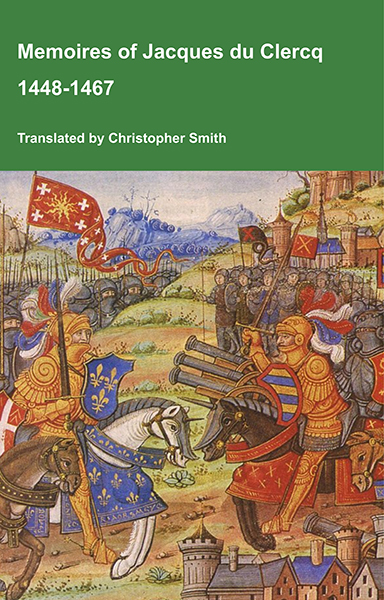
This is a translation of the 'Memoires of Jacques du Clercq', published in 1823 in two volumes, edited by Frederic, Baron de Reissenberg. In his introduction Reissenberg writes: 'Jacques du Clercq tells us that he was born in 1424, and that he was a licentiate in law and a counsellor to Philip the Good, Duke of Burgundy, in the castellany of Douai, Lille, and Orchies. It appears that he established his residence at Arras. In 1446, he married the daughter of Baldwin de la Lacherie, a gentleman who lived in Lille. We read in the fifth book of his Memoirs that his father, also named Jacques du Clercq, had married a lady of the Le Camelin family, from Compiègne. His ancestors, always attached to the counts of Flanders, had constantly served them, whether in their councils or in their armies.' The Memoires cover a period of nineteen years beginning in in 1448, ending in in 1467. It appears that the author had intended to extend the Memoirs beyond that date; no doubt illness or death prevented him from carrying out this plan. As Reissenberg writes the 'merit of this work lies in the simplicity of its narrative, in its tone of good faith, and in a certain air of frankness which naturally wins the reader’s confidence.' Du Clercq ranges from events of national and international importance, including events of the Wars of the Roses in England, to simple, everyday local events such as marriages, robberies, murders, trials and deaths, including that of his own father in Book 5; one of his last entries.
Available at Amazon in eBook and Paperback format.
On 8th January 1297 John Gerulfing I Count Holland and [his mother] Princess Elizabeth of Rhuddlan Countess Essex, Hereford and Holland were married at Ipswich, Suffolk. She by marriage Countess Holland. The wedding was attended by her sister [his aunt] Margaret Plantagenet Duchess Brabant, her father [his grandfather] King Edward I, her brother [his uncle] Edward and her future second husband Humphrey Bohun 4th Earl Hereford 3rd Earl Essex. She the daughter of King Edward I of England and Eleanor of Castile Queen Consort England. He the son of Floris Gerulfing V Count Holland and Beatrix Dampierre.
On 14th November 1302 [his father] Humphrey Bohun 4th Earl Hereford 3rd Earl Essex and [his mother] Princess Elizabeth of Rhuddlan Countess Essex, Hereford and Holland were married. She by marriage Countess Essex, Countess Hereford. Westminster Abbey. She the daughter of [his grandfather] King Edward I of England and [his grandmother] Eleanor of Castile Queen Consort England. He the son of Humphrey Bohun 3rd Earl Hereford 2nd Earl Essex and Maud Fiennes Countess Essex and Hereford.
In 1310 Edward Bohun was born to [his father] Humphrey Bohun 4th Earl Hereford 3rd Earl Essex and [his mother] Princess Elizabeth of Rhuddlan Countess Essex, Hereford and Holland at Caldicot Castle.
On 5th May 1316 [his sister] Isabel Bohun was born to [his father] Humphrey Bohun 4th Earl Hereford 3rd Earl Essex and Princess Elizabeth of Rhuddlan Countess Essex, Hereford and Holland. His mother Princess Elizabeth of Rhuddlan Countess Essex, Hereford and Holland died in childbirth. She was buried at Waldon Priory and Abbey.
On 16th March 1322 the rebel army led by Thomas Plantagenet 2nd Earl of Leicester, 2nd Earl Lancaster, Earl of Salisbury and Lincoln attempted to cross the bridge over the River Ure (between Ripon and York) at Boroughbridge Bridge. Their path was blocked by forces loyal to the King led by Andrew Harclay 1st Earl Carlisle. Bartholomew Badlesmere 1st Baron Badlesmere, Roger Mortimer 1st Earl March, John Botetort 1st Baron Botetort and John Maltravers 1st Baron Maltravers fought for the rebels. Roger Clifford 2nd Baron Clifford, Nicholas Longford, Thomas Plantagenet 2nd Earl of Leicester, 2nd Earl Lancaster, Earl of Salisbury and Lincoln, John Mowbray 2nd Baron Mowbray were captured.
Warin Lisle was hanged after the battle at Pontefract.
Following the battle Hugh Audley 1st Earl Gloucester and his wife Margaret Clare Countess Gloucester were both imprisoned. He in Nottingham Castle and she in Sempringham Priory.
John Clinton 2nd Baron Clinton, Ralph Greystoke 1st Baron Greystoke, William Latimer 2nd Baron Latimer of Corby, Robert Lisle 1st Baron Lisle, Domhnall Mar II Earl of Mar and Peter Saltmarsh fought for the King.
Adam Everingham 1st Baron Everingham of Laxton was captured.
[his father] Humphrey Bohun 4th Earl Hereford 3rd Earl Essex was killed. [his brother] John Bohun 5th Earl Hereford 4th Earl Essex succeeded 5th Earl Hereford, 4th Earl Essex.
Piers Grandison 2nd Baron Grandison fough for the rebels, and was captured.
Hugh Audley 1st Baron Audley of Stratton Audley surrendered before the battle and was imprisoned in Wallingford Castle for the rest of his life
John Giffard 2nd Baron Giffard Brimpsfield was captured.
Roger Mortimer 1st Earl March was imprisoned at Tower of London.


 Become a Member via our Buy Me a Coffee page to read more.
In 1325 [his brother] John Bohun 5th Earl Hereford 4th Earl Essex and [his sister-in-law] Alice Fitzalan Countess Essex and Hereford were married. She by marriage Countess Essex, Countess Hereford. She the daughter of Edmund Fitzalan 2nd or 9th Earl of Arundel and Alice Warenne Countess Arundel. He the son of [his father] Humphrey Bohun 4th Earl Hereford 3rd Earl Essex and [his mother] Princess Elizabeth of Rhuddlan Countess Essex, Hereford and Holland.
After 1325 [his brother] John Bohun 5th Earl Hereford 4th Earl Essex and [his sister-in-law] Margaret Basset Countess Essex and Hereford were married. She by marriage Countess Essex, Countess Hereford. He the son of [his father] Humphrey Bohun 4th Earl Hereford 3rd Earl Essex and [his mother] Princess Elizabeth of Rhuddlan Countess Essex, Hereford and Holland.
On 11th August 1325 [his brother-in-law] Hugh Courtenay 2nd or 10th Earl Devon and [his sister] Margaret Bohun Countess Devon were married. She the daughter of [his father] Humphrey Bohun 4th Earl Hereford 3rd Earl Essex and [his mother] Princess Elizabeth of Rhuddlan Countess Essex, Hereford and Holland. He the son of Hugh Courtenay 1st or 9th Earl Devon and Agnes St John Countess Devon.
In 1327 [his brother-in-law] James Butler 1st Earl Ormonde and [his sister] Eleanor Bohun Countess Ormonde were married. She the daughter of [his father] Humphrey Bohun 4th Earl Hereford 3rd Earl Essex and [his mother] Princess Elizabeth of Rhuddlan Countess Essex, Hereford and Holland. He the son of Edmund Butler 1st Earl Carrick.
In 1328 [his brother-in-law] James Butler 1st Earl Ormonde was created 1st Earl Ormonde. [his sister] Eleanor Bohun Countess Ormonde by marriage Countess Ormonde.
Patent Rolls. 20th January 1330. The like to Edward de Bohun, the king's kinsman, and others for the Westminster, death of Hugh de Turpliton, knight, and Richard de Monemuth accidentally killed by them while arresting Roger de Mortuo Mari, earl of March, in Nottingham Castle pursuant to the king's orders. By K. & C.
On 27th January 1332 Edward Bohun and Margaret Ros were married. He the son of Humphrey Bohun 4th Earl Hereford 3rd Earl Essex and Princess Elizabeth of Rhuddlan Countess Essex, Hereford and Holland.
Murimuth and Avesbury. In this year, around the feast of Saint Martin [11th November], Edward Bohun was drownedENDNOTE 1 on the Scottish march while trying to rescue his squire who was pursuing stolen livestock, and neither of them escaped.
Hoc anno, circa festum sancti Martini, dominus Edwardus le Boun fuit submersus in marchia Scociæ, dum voluit liberare domicellum suum fugantem prædam animalium, ita quod neuter evasit.
Note 1. 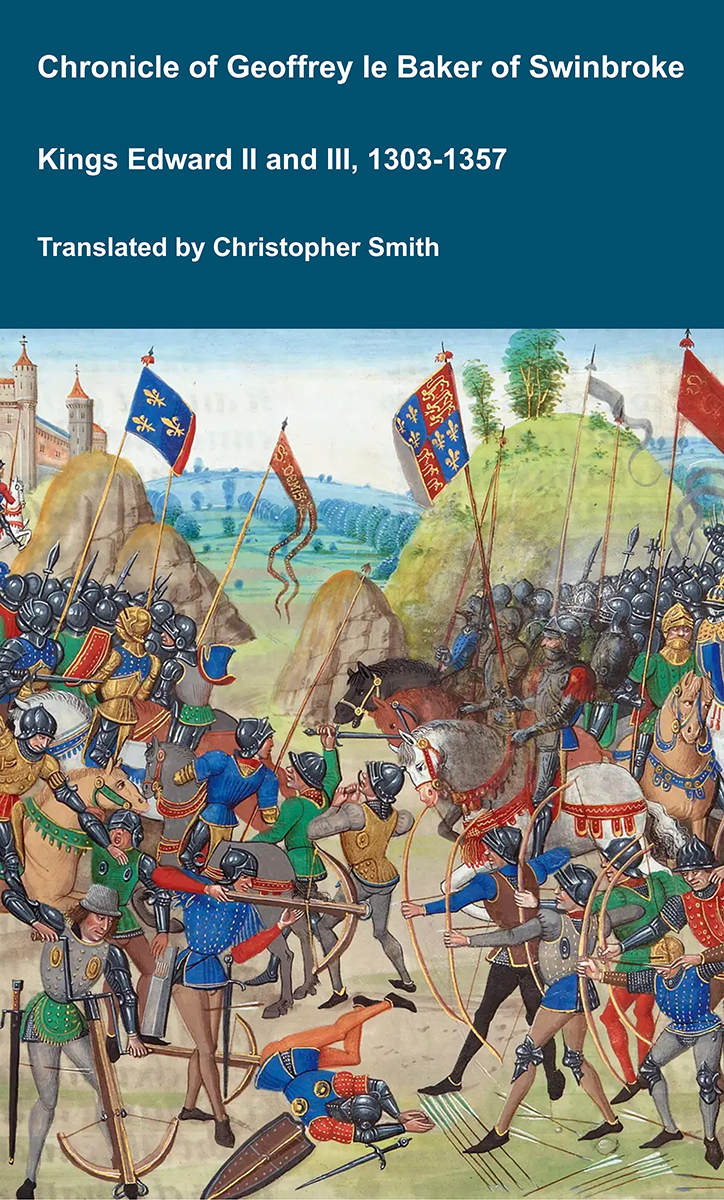 Geoffrey the Baker of Swinbroke: "In this year [1334], around the feast of Saint Martin, Lord Edward le Bohun, a nobleman of high character, was drowned in the Scottish March. He saw his young squire in danger, attempting to drive a herd of livestock across a river. To aid him, he directed his warhorse into the riverbed. But because of the slipperiness of large, round stones over which the water flowed, the horse, unable to keep its footing, fell along with his armoured master. Before anyone could come to his aid, he was submerged in the depths and drowned."
Chronicle of Geoffrey le Baker of Swinbroke. In this year [1334], around the feast of Saint Martin [11th November], Lord Edward le Bohun,1 a nobleman of high character, was drowned in the Scottish March. He saw his young squire in danger, attempting to drive a herd of livestock across a river. To aid him, he directed his warhorse into the riverbed. But because of the slipperiness of large, round stones over which the water flowed, the horse, unable to keep its footing, fell along with his armoured master. Before anyone could come to his aid, he was submerged in the depths and drowned.
Hoc anno, circa festum sancti Martini, dominus Edwardus le Bohun, nobilis indolis, fuit in marchia Scocie submersus. Domicellum nempe suum volentem predam pecudum trans flumen fugare percepit periclitantem, in cuius adiutorium dextrarium suum in alveum direxit, ubi, pre limpitudine lapidum grossorum et spericorum super quos aqua decurrebat, dextrarius impotens stabilire pedem cecidit cum domino suo armato, antequam aliquis poterat iuvare, submerso in profundum.
Note 1. Brother of John, earl of Hereford, and son of Humphrey, earl of Hereford, who was slain at Boroughbridge.
Around 11th November 1334 Edward Bohun drowned; see
Chronicle of Geoffrey le Baker
In 1341 [his former wife] Margaret Ros died in Musgrave.
Chronicle of Geoffrey le Baker of Swinbroke. They consulted Robert de Holland, who had long served as watchman in the castle and knew all the most secret passageways. He showed them how, by night, the king and his friends might reach the queen's chamber in the castle's outer precincts without the gatekeepers knowing. Guided by torches, the watchman led the king through a certain underground passage that began in a remote area outside the castle and ended in the middle of the kitchen or great hall of the main tower, where the queen was lodged. From the depths of this tunnel, the king's friends emerged armed, with drawn swords, and made their way to the queen's chamber, which by God's grace they found open. The king himself, also armed, waited outside the door so that his mother would not see him. Inside, they encountered Sir Hugh de Turpington,1 who tried to resist them but was killed, the blow struck by Lord John de Neville of Hornby. Then they found the queen nearly ready to retire to bed, and with her was the Earl of March, whom they had come to arrest. They seized him and led him out into the great hall, while the queen cried aloud: 'Fair son, fair son, have pity on gentle Mortimer!' suspecting her son's presence, though she did not see him with her own eyes. They quickly sent for the keys of the castle and took control of all the strongholds into the king's hands, all done so secretly that no one outside the castle was aware, except the king's closest friends.
Consulunt sibi adiuratum Robertum de Heland, qui speculator extitit in castro per multos annos et cui omnia diverticula castri secretissima nota fuerunt, quomodo de nocte ad cameram regine de territorio extra castrum, sine scitu ianitorum, rex et sui amici aditum haberent. Speculator predictus torticibus accensis duxit dominum suum regem per quoddam iter secretum subterraneum, quod incipit a remotis extra castrum et terminatur ad medium coquine vel aule turris principalis, ubi fuit ospitata regina. De medio igitur fundo et tramite subterraneo prosilientes, regis amici ad cameram regine, quam per Dei graciam invenerunt apertam, armati strictis ensibus proficissebantur, rege eciam armato extra hostium camere, ne a matre sua videretur, expectante. Ingressi occiderunt Hugonem de Turpintone militem, resistenciam eiis inferre conantem, domino Iohanne de Neville de Horneby ictum dirigente. Deinde invenerunt reginam matrem quasi paratam ad lecti soporem, et comitem Marchie quem volebant; et captum secum abducebant in aulam, clamante regina: 'Beal fitz, beal fitz, ejez pitie de gentil Mortymer'. Suspectam enim habuit filii presenciam, quam oculo non percepit. Mittunt celeriter pro clavibus castri, omnem firmaturam loci in manus regias capientes, set ita secrete quod hoc nulli patuit extra castrum, nisi regis amicis.
Note 1. A pardon was issued to Edward Bohun and others for the slaying of Hugh de Turpington and Richard de Monmouth; Calendar Patent Rolls, (4 Edward III), 108.