

Jean de Waurin's Chronicle of England Volume 6 Books 3-6: The Wars of the Roses
Jean de Waurin was a French Chronicler, from the Artois region, who was born around 1400, and died around 1474. Waurin’s Chronicle of England, Volume 6, covering the period 1450 to 1471, from which we have selected and translated Chapters relating to the Wars of the Roses, provides a vivid, original, contemporary description of key events some of which he witnessed first-hand, some of which he was told by the key people involved with whom Waurin had a personal relationship.
Available at Amazon in eBook and Paperback format.
Paternal Family Tree: Daubigny
Maternal Family Tree: Alice Hales Countess Norfolk 1330
1397 Legitimation of the Beauforts
1397 Murder of Thomas of Woodstock
On 25th March 1349 [his father] John Mowbray 4th Baron Mowbray Baron Segrave [aged 8] and [his mother] Elizabeth Segrave 5th Baroness Segrave Baroness Mowbray [aged 10] were married. She by marriage Baroness Mowbray. He by marriage Baron Segrave. She the daughter of [his grandfather] John Segrave 4th Baron Segrave [aged 33] and [his grandmother] Margaret Plantagenet 1st Duchess of Norfolk. They were third cousins. He a great x 2 grandson of King Henry III of England. She a great granddaughter of King Edward I of England.
Before 1368 [his mother] Elizabeth Segrave 5th Baroness Segrave Baroness Mowbray [aged 29] died. Her son [his brother] John [aged 2] succeeded 6th Baron Segrave. The date somewhat uncertain but consistent with John Mowbray 1st Earl Nottingham succeeding.
In 1368 [his father] John Mowbray 4th Baron Mowbray Baron Segrave [aged 27] died at Constantinople aka Istanbul, Turkey. His son [his brother] John [aged 2] succeeded 5th Baron Mowbray.
On 22nd March 1368 Thomas Mowbray 1st Duke of Norfolk was born to [his father] John Mowbray 4th Baron Mowbray Baron Segrave and [his mother] Elizabeth Segrave 5th Baroness Segrave Baroness Mowbray. He a great x 2 grandson of King Edward I of England.
In 1382 John Strange 5th Baron Strange Blackmere [aged 29] died. His sister [his future wife] Elizabeth [aged 20] succeeded 6th Baroness Strange Blackmere.
In or before 1383 William Montagu and [his future wife] Elizabeth Fitzalan Duchess Norfolk [aged 16] were married. She the daughter of [his future father-in-law] Richard Fitzalan 9th Earl of Surrey 4th or 11th Earl of Arundel [aged 36] and Elizabeth Bohun Countess Arundel and Surrey [aged 32]. He the son of William Montagu 2nd Earl Salisbury [aged 54] and Elizabeth Mohun Countess of Salisbury. They were third cousin once removed. She a great x 2 granddaughter of King Edward I of England.
In 1383 Thomas Mowbray 1st Duke of Norfolk [aged 14] was appointed 72nd Knight of the Garter by King Richard II of England [aged 15].
On 10th February 1383 John Mowbray 1st Earl Nottingham [aged 17] died. He was buried at Whitefriars. Earl Nottingham extinct. His brother Thomas [aged 14] succeeded 6th Baron Mowbray, 7th Baron Segrave.
On 12th February 1383 Thomas Mowbray 1st Duke of Norfolk [aged 14] was created 1st Earl Nottingham.
The History of William Marshal was commissioned by his son shortly after William’s death in 1219 to celebrate the Marshal’s remarkable life; it is an authentic, contemporary voice. The manuscript was discovered in 1861 by French historian Paul Meyer. Meyer published the manuscript in its original Anglo-French in 1891 in two books. This book is a line by line translation of the first of Meyer’s books; lines 1-10152. Book 1 of the History begins in 1139 and ends in 1194. It describes the events of the Anarchy, the role of William’s father John, John’s marriages, William’s childhood, his role as a hostage at the siege of Newbury, his injury and imprisonment in Poitou where he met Eleanor of Aquitaine and his life as a knight errant. It continues with the accusation against him of an improper relationship with Margaret, wife of Henry the Young King, his exile, and return, the death of Henry the Young King, the rebellion of Richard, the future King Richard I, war with France, the death of King Henry II, and the capture of King Richard, and the rebellion of John, the future King John. It ends with the release of King Richard and the death of John Marshal.
Available at Amazon in eBook and Paperback format.
On 20th February 1383 Thomas Mowbray 1st Duke of Norfolk [aged 14] and Elizabeth Strange Countess Nottingham [aged 21] were married. She by marriage Countess Nottingham. They were second cousin once removed. He a great x 2 grandson of King Edward I of England. She a great x 5 granddaughter of King John of England.
On 23rd August 1383 [his wife] Elizabeth Strange Countess Nottingham [aged 21] died. Her sister [his sister-in-law] Ankaret [aged 22] succeeded 7th Baroness Strange Blackmere. Richard Talbot 7th Baron Strange Blackmere 4th Baron Talbot [aged 22] by marriage Baron Strange Blackmere.
In or before 1385 [his brother-in-law] John Welles 5th Baron Welles [aged 32] and [his sister] Eleanor Mowbray Countess Rockingham [aged 24] were married. They were fourth cousins. She a great x 2 granddaughter of King Edward I of England.
Patent Rolls. 12th February 1385. Commission to W. Bishop of Winchester [aged 65], Thomas, Bishop of Exeter, [his future father-in-law] Richard, Earl of Arundel [aged 39], Robert, Earl of Oxford [aged 23], Thomas, Earl of Nottingham [aged 16], Hugh de Segrave [aged 89], treasurer of England, Simon de Burley [aged 45], under-chamberlain, Nicholas Brembre, mayor of London, John Clanvowe and Robert Plesyngton, knights, Master Walter Skirlawe, keeper of the privy seal, John Waltham, keeper of the rolls of Chancery, John Appelby, dean of St. Paul's, London, Richard Rounhale and Thomas Bacton, clerks,
On 13th June 1385 Thomas Mowbray 1st Duke of Norfolk [aged 17] as appointed Earl Marshal.
Before 17th September 1385 Thomas Mowbray 1st Duke of Norfolk [aged 17] and Elizabeth Fitzalan Duchess Norfolk [aged 19] were married. She by marriage Countess Nottingham. She the daughter of Richard Fitzalan 9th Earl of Surrey 4th or 11th Earl of Arundel [aged 39] and Elizabeth Bohun Countess Arundel and Surrey. They were second cousins. He a great x 2 grandson of King Edward I of England. She a great x 2 granddaughter of King Edward I of England.
On 17th September 1385 [his son] Thomas Mowbray 4th Earl Norfolk 2nd Earl Nottingham was born to Thomas Mowbray 1st Duke of Norfolk [aged 17] and [his wife] Elizabeth Fitzalan Duchess Norfolk [aged 19]. He a great x 3 grandson of King Edward I of England. Coefficient of inbreeding 2.69%. He married before 1st June 1402 his third cousin Constance Holland Countess Norfolk and Nottingham, daughter of John Holland 1st Duke Exeter and Elizabeth Lancaster Duchess Exeter.
In 1388 [his daughter] Margaret Mowbray Baroness Grey Ruthyn was born to Thomas Mowbray 1st Duke of Norfolk [aged 19] and [his wife] Elizabeth Fitzalan Duchess Norfolk [aged 22] at Epworth. She a great x 3 granddaughter of King Edward I of England. Coefficient of inbreeding 2.69%. She married (1) in or before 1425 her fourth cousin twice removed Robert Howard and had issue (2) before 27th August 1439 her third cousin John Grey, son of Reginald Grey 3rd Baron Grey Ruthyn and Margaret Ros Baroness Grey Ruthyn.
In 1389 Thomas Mowbray 1st Duke of Norfolk [aged 20] was appointed Warden of the East Marches.
In 1392 [his son] John Mowbray 2nd Duke of Norfolk was born to Thomas Mowbray 1st Duke of Norfolk [aged 23] and [his wife] Elizabeth Fitzalan Duchess Norfolk [aged 26]. He a great x 3 grandson of King Edward I of England. Coefficient of inbreeding 2.69%. He married 12th January 1412 his fourth cousin Katherine Neville Duchess Norfolk, daughter of Ralph Neville 1st Earl of Westmoreland and Joan Beaufort Countess of Westmoreland, and had issue.
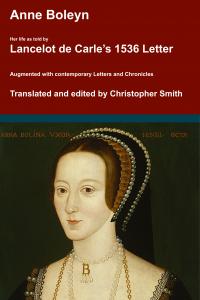
Anne Boleyn. Her Life as told by Lancelot de Carle's 1536 Letter.
In 1536, two weeks after the execution of Anne Boleyn, her brother George and four others, Lancelot du Carle, wrote an extraordinary letter that described Anne's life, and her trial and execution, to which he was a witness. This book presents a new translation of that letter, with additional material from other contemporary sources such as Letters, Hall's and Wriothesley's Chronicles, the pamphlets of Wynkyn the Worde, the Memorial of George Constantyne, the Portuguese Letter and the Baga de Secrets, all of which are provided in Appendices.
Available at Amazon in eBook and Paperback format.
In 1394 [his daughter] Elizabeth Mowbray Countess Suffolk was born to Thomas Mowbray 1st Duke of Norfolk [aged 25] and [his wife] Elizabeth Fitzalan Duchess Norfolk [aged 28] in Thetford, Norfolk [Map]. She a great x 3 granddaughter of King Edward I of England. Coefficient of inbreeding 2.69%. She married before 6th May 1410 her half fourth cousin once removed Michael de la Pole 3rd Earl Suffolk, son of Michael de la Pole 2nd Earl Suffolk and Katherine Stafford Countess Suffolk, and had issue.
Parliament Rolls Richard II. 32. The king [aged 30] to his archbishops, bishops, abbots, priors, dukes, earls, barons, justices, sheriffs, reeves, ministers, and other his bailiffs and faithful men, greeting. Know that we, considering the strenuous probity and prudent mind, distinguished conduct and nobility of birth of our beloved and faithful kinsman John Beaufort [aged 24], knight, son of our beloved uncle John duke of Aquitaine and Lancaster [aged 56], and willing therefore deservedly to exalt the same John Beaufort with the prerogative of honour, we do appoint and create John Beaufort earl of Somerset in our present parliament, and invest him with the style and name and honour of the aforesaid earl by girding him with the sword, to have to him and his male heirs issuing from his body in perpetuity. And that the same earl and his aforesaid heirs, given such name and honour, may the better and more honourably support the burdens incumbent upon the same, of our special grace in our present parliament we have given and granted, and by this our charter confirmed, to the same earl and his aforesaid heirs twenty pounds to be received each year from the issues of the aforesaid county by the hand of the sheriff of that county for the time being, at the terms of Easter and Michaelmas [29 September] in equal portions, in perpetuity. Witnessed by these, the venerable father Thomas archbishop of Canterbury [aged 44] primate of all England, John of Aquitaine and Lancaster, and Edmund of York [aged 55], dukes; Robert of London, William of Winchester [aged 77], John of Ely, Edmund of Exeter, our chancellor [aged 53], bishops; Henry of Derby [aged 29], Edward of Rutland [aged 24], Thomas of Nottingham and marshal of England [aged 28], earls; Reginald Grey [aged 35], Ralph Neville [aged 33], John Lovell, knights; Roger Walden dean of York, our treasurer, Thomas Percy [aged 54], steward of our household, Guy Mone, keeper of our privy seal, and others. Given by our hand at Westminster on 10 February in the twentieth year of our reign [10th February 1397].


Parliament Rolls Richard II. 31. Whereupon the said Sir John was brought before the king in parliament between two earls, namely Huntingdon and the marshal, dressed in a cloth as a dress of honour, and his sword carried before him, the hilt uppermost. And then the king's charter of the said creation was read aloud before the king, lords, and commons in parliament. And afterwards the king himself girded the said earl with his sword and took his homage, and caused him to sit in his place in parliament, that is to say, between the earls marshal and Warwick. The tenor of which charter follows:
Betrayal and Death of King Richard II. [Around 25th July 1397] Afterwards he [Thomas of Woodstock 1st Duke of Gloucester [aged 42]] sent to the Earl Marshal,1 who was captain of Calais, to the Earl of Warwick, and to the Archbishop of Canterbury [aged 44],2 and desired that they would come to Arundel on a certain day; and he also sent to the Earl of Arundel to say that he would come to dine there with him, and that he would bring with him all the other lords. The [his father-in-law] Earl of Arundel [aged 51] returned him answer, that he would be right welcome, and all the lords it would please him to bring with him in his company. It is true that the Duke of Gloucester arrived at Arundel the eighth day before the month of August in the year thirteen hundred fourscore and sixteen,3 as well as the Earl of Derby, the Earl Marshal, the Archbishop of Canterbury, the Abbot of St. Albans, and the Prior of Westminster. As these lords were seated at dinner, there arrived the Earl of Warwick [aged 59];4 and when he joined the company of the lords, the Duke of Gloucester said to him, 'My brave man, you must take the same oath as we have taken:' and the Earl replied, 'My lord, what do you wish me to swear?' The Duke said, 'You will swear as we have done, if you please, to be true and faithful to the realm, and also to be true and faithful to each other.'
Note 1. Thomas of Mowbray [aged 29], Earl of Nottingham, the first hereditary Earl Marshal, shortly afterwards created Duke of Norfolk. He was then absent from Calais on furlough. His leave of absence is dated Oct, 3, 1396, extending for one year. The assigned reason is, that he might travel into Picardy for matters relating to the safe custody of the city. (Rymer, Fœdera,) Chastelnin's version calls him 'fustre cappitaine de Calleys.' I have not been able to obtain a satisfactory explanation of this word, The Earl could boast of royal descent by his mother Elizabeth, daughter and heiress of John Lord Segrave by Margaret Plantagenet, daughter and heiress of Thomas de Brotherton, Earl of Norfolk and Marshal of England, youngest son of Edward the First by his second consort, Margaret of France, (Dugdale, Baronage.)
Note 2. Thomas Fitzalan, third son of the Iate Earl of Arundel, he had been Bishop of Ely, and Chancellor, during the prosecution of Richard's favourites. He was afterwards translated to York, and succeeded Archbishop Courtenay in the see of Canterbury in August 1397, according to the Monk of Evesham, but in 1395 according to Spelman, (Concilia).
Note 3. As Brest was not given up till June 1397, this is undoubtedly a wrong date. It should have been August 1397, and I think it very probable that it was so in the original MS. The Monk of St. Denys in his chronicles corrects the error, 'At the head of the factions (anno 1397) was the King's uncle, the Duke of Gloucester, the Earl Arundel, and the Earl Warwick, who, as we have related, conspired the preceding year against the King.' (Chronicles of the Monk of St. Denys, chap. v. b. xviii.) (It must never be forgotten that the year commenced at Easter.) The London Chronicle places Gloucester's arrest on the 21st of July. The conspiracy was revealed before the middle of the month, and probably before the meeting at Arundel; for, on the 13th of July 1397, an order wns made out for the arrest of Gloucester, Arundel, and Warwick, (Rymer, Fœdera.) This order, agreed upon at Windsor, does not appear to have been issued, as a second order was made and published from Westminster on the 28th of the month, (Fœdera.)
Note 4. Thomas, son of Thomas Beauchamp, Earl of Warwick, by Catherine, daughter of Roger Mortemer, first Earl of March. Perhaps the Earl was the more readily induced to join the conspirators, as he would naturally be incensed at the loss of the honour of Gower, recovered at this time by the Earl Marshal. See Otterbourne, Scriptores Veleres, p. 189.
Thomas Walsingham [~1422]. [8th September 1397] Meanwhile, because it did not seem safe to the king that the Duke of Gloucester [aged 42] should make his defense publicly, on account of the favor of the people, who were excessively devoted to him, the king ordered the Earl Marshal [aged 29] to have him secretly killed. And he, having sent instruments of wickedness, caused him to be suffocated, mattresses and feather-beds being heaped over his face. Thus perished that most noble man, both the king's son and the king's uncle, in whom had been placed the hopes and consolation of the whole community of the realm. Afterwards the king craftily arranged for that parliament to be postponed until after Christmas, when it was to be resumed, or rather continued, at Shrewsbury, on the borders of Wales.
Interea, quia non videbatur tutum Regi ut Dux Gloverniæ responsis astaret publice, propter favorem populi, qui ei nimis afficiebatur, Rex jussit Comiti Marescallo, ut eum occulte occideret; qui, missis iniquitatis ministris, fecit eum suffocari, superjectis culcitris et lectis, pluma refertis, super os ejus: sic que mortuus est ille vir optimus, Regis filius et Regis patruus, in quo posita fuere spes et solatium totius regni communitatis. Postea Rex astute fecit illud Parliamentum differri usque post Natale Domini, quod reincipitur, vel potius, continuaretur apud Salopian in confinibus Walliarum.
On 29th September 1397 King Richard II [aged 30] rewarded his relations with Dukedoms, possibly for their part in downfall of Thomas of Woodstock 1st Duke of Gloucester [deceased], Thomas Beauchamp 12th Earl Warwick [aged 59] and [his father-in-law] Richard Fitzalan 9th Earl of Surrey 4th or 11th Earl of Arundel [deceased]...
His older half-brother John Holland 1st Duke Exeter [aged 45] was created 1st Duke Exeter. Elizabeth Lancaster Duchess Exeter [aged 34] by marriage Duchess Exeter.
His nephew Thomas Holland 1st Duke Surrey [aged 23] was created 1st Duke Surrey.
His first cousin once-removed [his grandmother] Margaret was created 1st Duchess Norfolk - for life only. On the same day her grandson Thomas [aged 29] was also created Duke of Norfolk - see below.
His second cousin once removed Thomas Mowbray 1st Duke of Norfolk was created 1st Duke Norfolk. [his wife] Elizabeth Fitzalan Duchess Norfolk [aged 31] by marriage Duchess Norfolk.
His first cousin Edward 2nd Duke of York 1st Duke Albemarle [aged 24] was created 1st Duke Albemarle. Beatrice Burgundy Countess Rutland and Cork [aged 24] by marriage Duchess Albemarle.
His illegitimate first cousin John Beaufort 1st Marquess Somerset and Dorset [aged 24] was created 1st Marquess Somerset, 1st Marquess Dorset. Margaret Holland Duchess Clarence [aged 12] by marriage Marchioness Somerset, Marchioness Dorset.
Ralph Neville 1st Earl of Westmoreland [aged 33] was created 1st Earl of Westmoreland. Joan Beaufort Countess of Westmoreland [aged 18] by marriage Countess of Westmoreland.
Before 15th September 1398 the future Henry IV [aged 31] reported to King Richard II [aged 31] that Thomas Mowbray 1st Duke of Norfolk [aged 30] had made a treasonous remark regarding Richard's rule. Richard II proposed a duel of honour at Gosford Green, Caludon, Coventry [Map], near Mowbray's home Caludon Castle.
On 15th September 1398 the future Henry IV [aged 31] spent the night at Baginton Castle, Warwickshire [Map], the home of his friend William Bagot. Thomas Mowbray [aged 30] spent the night at his home Caludon Castle, Warwickshire [Map].
On 16th September 1398 King Richard II [aged 31], the nobility and thousands of spectators assembled at Gosford Green [Map] to witness the duel between the future Henry IV [aged 31] and Thomas Mowbray 1st Duke of Norfolk [aged 30]. the future Henry IV had new armour constructed. Edward 2nd Duke of York 1st Duke Albemarle [aged 25] and Thomas Holland 1st Duke Surrey [aged 24] managed the proceedings. Just as the duel was to commence King Richard II stopped it. After two hours of deliberation King Richard II had his decision announced; both men were to be exiled. The future Henry IV for ten years,Thomas Mowbray 1st Duke of Norfolk forever.
On 19th October 1398 Thomas Mowbray 1st Duke of Norfolk left England never to return.
Chronicle of Adam of Usk [~1352-1430]. [Before 16th September 1398]. In the same parliament, the duke of Hereford [aged 31], son of the said duke of Lancaster, appealed the duke of Norfolk [aged 30] of treason. Wherefore the king appointed to them the morrow of the Exaltation of the Holy Cross1 next following to fight in that quarrel. The duke of Hereford meanwhile, finding pledges, went whither he would. But the duke of Norfolk being delivered into custody at Windsor, his offices were given over to his other co-appellors, that is, the office of marshal of England to the duke of Surrey [aged 24], and that of captain of Calais to the duke of Exeter; on account of which grants, by His righteous judgement, God did send between him and them great confusion of strife, according to what the prophecy says in the verse:
"By the Judge of Heaven's decree
The wicked throng shall bursten be."2
Note 1. This day would fall on the 15th September; the 16th was the actual day appointed.
Note 2. Bridlington, dist. ij. cap. vj.
Thomas Walsingham [~1422]. Around this time [16th September 1398] the Duke of Hereford [aged 31] brought a formal charge against the Duke of Norfolk [aged 30] for certain words he had spoken which reflected disgrace upon the king. For this cause a duel was appointed between them at Coventry. When at length they had entered the lists, as boldly as splendidly, the king took the matter into his own hands and had it proclaimed that the Duke of Hereford had honourably discharged his duty. Nevertheless, almost immediately afterward, the king, without any lawful cause, ordered the said Duke of Hereford to be banished for ten years, and commanded this contrary to justice, the laws of chivalry, and the customs of this realm. He also condemned the Duke of Norfolk to perpetual exile, mercilessly decreeing under heavy penalties that no one should ask or presume to intercede with the king for grace to be shown to the aforesaid dukes. These things were done on the very day, a year to the day, on which that same Duke of Norfolk had caused the Duke of Gloucester to be suffocated.
Circa praesens tempus appellavit Dux Herfordiæ Ducem Nortfolchiæ, de quibusdam verbis per eum dictis, quae in Regis dedecus redundabant. Ob quam causam indictum fuit eis duellum apud Coventre. Tandem cum listas intrassent tam animose quam magnifice, Rex in manu sua causam suscepit, et fecit proclamari quod Dux Herfordiæ debitum suum honorifice adimplesset. Sed tamen, vebut immediate postea, Rex, sine causa quacunque legitima, dictum Ducem Herfordiæ ad decennium relegari fecit, et mandavit, contra justitiam et jura militaria, et consuetudines hujus regni. Ducem quoque Northfolchæ perpetuo damnavit exilio, immisericorditer statuens, sub pœnis gravibus, quod nullus rogaret, vel apud ipsum Regem intercedere praesumeret, pro gratia facienda Ducibus supradictis. Facta sunt haec ea die ad annum, quo idem Dux Northfolchæ Ducem Gloverniæ fecerat suffocari.
Chronicle of Adam of Usk [~1352-1430]. And on the day of battle [16th September 1398] they both came in great state to the appointed place, which was fenced with a wet ditch. But the duke of Hereford [aged 31] appeared far more gloriously distinguished with diverse equipments of seven horses1. And, because the king had it by divination that the duke of Norfolk [aged 30] should then prevail, he rejoiced much, eagerly striving after the destruction of the duke of Hereford. But when they joined battle, it seemed to him that the duke of Hereford would prevail. And so the king ordered the combat to be stayed, laying perpetual exile on the duke of Norfolk, yet being minded, when he should find occasion, to restore him. But the duke of Hereford he banished the realm for ten years, The one died at Venice in exile; the other within a year came back in triumph to the kingdom, and, deposing him who had banished him, reigned therein with might.
Note 1. The combatants made a great display of arms and trappings. Henry was assisted by armourers sent by the duke of Milan; Mowbray received his arms from Germany.—Froissart, iv. 63; Archæologia, 20.102.
Froissart Book 4 Chapter 95. 16th September 1398. Not long after this, the king of England [aged 31] summoned a large council of the great nobles and prelates at Eltham [Map]. On their arrival, he placed his two uncles of Lancaster [aged 58] and York [aged 57] beside him, with the earls of Northumberland [aged 56], Salisbury [aged 48] and Huntingdon [aged 46]. The earl of Derby [aged 31] and the earl marshal [aged 30] were sent for, and put into separate chambers, for it had been ordered they were not to meet. The king showed he wished to mediate between them, notwithstanding their words had been very displeasing to him, and ought not to be lightly pardoned. He required therefore that they should submit themselves to his decision; and to this end sent the constable of England, with four great barons, to oblige them to promise punctually to obey it. The constable and the lords waited on the two earls, and explained the king's intentions. They both bound themselves, in their presence, to abide by whatever sentence the king should give. They having reported this, the king said, "Well then, I order that the earl marshal, for having caused trouble in this kingdom, by uttering words which he could not prove otherwise than by common report, be banished the realm: he may seek any other land he pleases to dwell in, but he must give over all hope of returning hither, as I banish him for life. I also order, that the earl of Derby, our cousin, for having angered us, and because he has been, in some measure, the cause of the earl marshal's crime and punishment, prepare to leave the kingdom within fifteen days, and be banished hence for the term of ten years, without daring to return unless recalled by us; but we shall reserve to ourself the power of abridging this term in part or altogether." The sentence was satisfactory to the lords present, who said: "The earl of Derby may readily go two or three years and amuse himself in foreign parts, for he is young enough; and, although he has already travelled to Prussia, the Holy Sepulchre, Cairo and Saint Catherine's1, he will find other places to visit. He has two sisters, queens of Castillo [aged 25] and of Portugal [aged 38], and may cheerfully pass his time with them. The lords, knights and squires of those countries, will make him welcome, for at this moment all warfare is at an end. On his arrival in Castille, as he is very active, he may put them in motion, and lead them against the infidels of Granada, which will employ his time better than remaining idle in England. Or he may go to Hainault, where his cousin, and brother in arms, the count d'Ostrevant, will be happily to see him, and gladly entertain him, that he may assist him in his war against the Frieslanders. If he go to Hainault, lie can have frequent intelligence from his own country and children. He therefore cannot fail of doing well, whithersoever he goes; and the king may speedily recall him, through means of the good friends he will leave behind, for he is the finest feather in his cap; and he must not therefore suffer him to be too long absent, if he wish to gain the love of his subjects. The earl marshal has had hard treatment, for he is banished without hope of ever being recalled; but, to say the truth, he has deserved it, for all this mischief has been caused by him and his foolish talking: he must therefore pay for it." Thus conversed many English knights with each other, the day the king passed sentence on the earl of Derby and the earl marshal.
Note 1. The monastery on Mount Sinai. - Ed.
Froissart Book 4 Chapter 94. Before 19th October 1398. At this time, a conversation passed between the earl of Derby [aged 31] and the earl-marshal [aged 30], in which the state of the king [aged 31] and the counsellors whom he trusted became the subject of discussion. The earl marshal caught at the following words the other had made use of, with a good intent, thinking they would never have been mentioned again, for they were neither arrogant nor traitorous: "Holy Mary! fair cousin, what does the king next intend to do? Will he drive all the nobles out of England? There will soon be none left; and he plainly shows he is not desirous to add to the honour of his realm." The earl marshal made no reply, but treasured this speech in his mind, as he considered it very impertinent, in regard to the king, and thought within himself that the earl of Derby was well inclined to excite troubles in England, for he was marvellously beloved by the Londoners. He therefore determined (for the devil entered his brain, and what has been ordained to happen must come to pass), to report this speech in the presence of the king and his nobility.
Chronicle of a Bourgeois of Valenciennes
Récits d’un bourgeois de Valenciennes aka The Chronicle of a Bourgeois of Valenciennes is a vivid 14th-century vernacular chronicle written by an anonymous urban chronicler from Valenciennes in the County of Hainaut. It survives in a manuscript that describes local and regional history from about 1253 to 1366, blending chronology, narrative episodes, and eyewitness-style accounts of political, military, and social events in medieval France, Flanders, and the Low Countries. The work begins with a chronological framework of events affecting Valenciennes and its region under rulers such as King Philip VI of France and the shifting allegiances of local nobility. It includes accounts of conflicts, sieges, diplomatic manoeuvres, and the impact of broader struggles like the Hundred Years’ War on urban life in Hainaut. Written from the perspective of a burgher (bourgeois) rather than a monastery or royal court, the chronicle offers a rare lay viewpoint on high politics and warfare, reflecting how merchants, townspeople, and civic institutions experienced the turbulence of the 13th and 14th centuries. Its narrative style combines straightforward reporting of events with moral and civic observations, making it a valuable source for readers interested in medieval urban society, regional politics, and the lived experience of war and governance in pre-modern Europe.
Available at Amazon in eBook and Paperback format.
Froissart Book 4 Chapter 96. 19th October 1398. When the two earls heard the sentence the king [aged 31] had passed on them, they were much cast down, and not without cause. The earl marshal [aged 30] bitterly repented what he had said and done, but he could not foresee its consequences: he had firmly relied on being otherwise supported by the king than he was, or he would not have thought of it. It was, however, necessary to make his preparations for banishment. He settled the payments of his income through the Lombards of Bruges, and, quitting England, arrived at Calais, where he had been governor. He staid there a short time, to receive part of his equipage which had been left behind. On his departure he took leave of the townsmen of Calais, and having fixed his route, would not go to France nor Hainault, for he had not any business at these places, but went to Bruges [Map], where he staid fifteen days. On leaving this town, he visited Ghent, Mechlin, Louvain, St. Tron, Utrecht, Aix and Cologne, where we will leave him, and speak of the earl of Derby [aged 31], who in like manner made his preparations for obeying his sentence of banishment.
On 24th March 1399 [his grandmother] Margaret Plantagenet 1st Duchess of Norfolk died. Duke Norfolk extinct since it was created for life only. She was buried in the choir of Christ Church, Greyfriars [Map]. Her grandson Thomas [aged 31] succeeded 3rd Earl Norfolk. [his wife] Elizabeth Fitzalan Duchess Norfolk [aged 33] by marriage Countess Norfolk.
On 22nd September 1399 Thomas Mowbray 1st Duke of Norfolk [aged 31] died of plague in Venice [Map] whilst in exile. He was buried at St Mark's Cathedral, Venice [Map]. Duke Norfolk forfeit. His son Thomas [aged 14] succeeded 4th Earl Norfolk, 2nd Earl Nottingham, 7th Baron Mowbray, 8th Baron Segrave and Earl Marshal.
In 1400 [his daughter] Isabel Mowbray Baroness Berkeley was born to Thomas Mowbray 1st Duke of Norfolk and [his former wife] Elizabeth Fitzalan Duchess Norfolk [aged 34]. She a great x 3 granddaughter of King Edward I of England. Coefficient of inbreeding 2.69%. She married (1) before 1419 her fourth cousin Henry Ferrers, son of William Ferrers 5th Baron Ferrers of Groby and Philippa Clifford, and had issue (2) 1424 her half third cousin once removed James Berkeley 11th and 1st Baron Berkeley and had issue.
Before August 1401 Robert Goushill and [his former wife] Elizabeth Fitzalan Duchess Norfolk [aged 35] were married. She the daughter of [his former father-in-law] Richard Fitzalan 9th Earl of Surrey 4th or 11th Earl of Arundel and Elizabeth Bohun Countess Arundel and Surrey.
On 8th July 1425 [his former wife] Elizabeth Fitzalan Duchess Norfolk [aged 59] died at Wighill. She was buried at St Michael's Church, Hoveringham. Her son John Mowbray 2nd Duke of Norfolk [aged 33] inherited her estates including Framlingham Castle, Suffolk [Map].
Duo Rerum Anglicarum Scriptores Veteres. Thomas Nottingham recovered the lands of Gower.
In this year Thomas Nottingham, by a bill of error which he brought against Thomas, Earl of Warwick, recovered the lands of Gower.
Tho. Nottingham recuperavit terras de Gower.
Hoc anno Tho. Nottingham per billam erroris, quam tulit contra Tho. comitem Warwici, recuperavit terras de Gower.
Parliament Rolls Richard II. 33. Also, on the same Saturday [10 February 1397], a charter of the king made to the earl marshal touching his office of marshal of England, and the gold staff adorned with the emblem of the king's arms which he will carry in his office, was read and delivered to the said earl. The tenor of which charter follows:
The king to the same, greeting. Know that whereas recently by our letters patent of our special grace we granted to our beloved kinsman Thomas, Earl of Nottingham, the office of marshal of England, together with the name and honour of earl marshal, to have to him and his male heirs issuing from his body, with all the fees, profits, and appurtenances whatsoever pertaining in any way to the said office, in perpetuity; as is fully contained in the same letters. We, mindful of the gracious and laudable services often performed by the aforementioned earl, on either side of the sea, for the benefit and honour of us and our kingdom, at no small effort, cost, and charge to him; and wishing therefore to provide for the estate and honour of that earl, of our special grace have granted in our present parliament for us and our heirs to the same earl the said office, and the name, title, and honour of earl marshal of England, to have to him and his male heirs issuing from his body, together with all offices, commodities, profits and other appurtenances whatsoever, both in our courts and elsewhere, relating or pertaining in any way to the same office, in the same manner and as fully, freely, wholly, and peacefully as Thomas Brotherton, lately Earl of Norfolk and marshal of England, father of our beloved kinswoman [his grandmother] Margaret Countess of Norfolk, [widow] of the aforesaid late earl, or Roger Bigod sometime Earl of Norfolk and marshal of England, or any other after the death of the same former earl, or the same present earl, had or held the said office of marshal of England in their time.
Willing further and granting for us and our heirs, that the office of marshal of our Bench before us, which John Wicks holds for the term of his life by our grant, and the office of marshal in our treasury which Richard Gascoigne holds for his life by grant of our beloved brother Thomas Earl of Kent, lately marshal of England, by our confirmation; and also the office of herald of the marshal before the steward and marshal of our household, which Guy Allesley holds for his life by grant of the lord Edward [III], late king of England, our grandfather, and by our confirmation; which offices after the death of the aforesaid John, Richard and Guy should revert to us and our heirs, after the death of the same John, Richard, and Guy shall remain to the aforementioned earl marshal, to have to him and his male heirs in perpetuity. And that the same offices, and all other offices in any of our courts and elsewhere, which pertained, and used to pertain to the said office of marshal of England in times past, shall be fully restored, annexed, and reunited to the said office of marshal of England in perpetuity. And that the same earl and his male heirs may give, grant, or confer those offices on any suitable persons freely and without hindrance as soon as they shall have fallen vacant by death, demise, resignation, surrender, or in any other way, notwithstanding any of our letters patent made to the contrary.
Considering also the vigour and nobility of that earl, and that he may in future the more fittingly and honourably perform and exercise the aforesaid office, we have granted for us and our heirs to the same present earl that he and his said male heirs, marshals of England, by virtue of their aforesaid office should have, carry, and bear, as well in the presence as in the absence of us and our heirs, a certain gold staff, with both ends enamelled in black, and with the emblem of our arms decorating the top of the said staff, and with the emblem of the arms of that earl decorating the bottom of the said staff; notwithstanding that the same present earl in his time, or the aforementioned former earls, or any other who had the said office of marshal of England before this time, used to carry or bear a wooden staff. Witnessed by these, the venerable fathers Thomas archbishop of Canterbury, primate of all England, Robert of London, William of Winchester, John of Ely, Edmund of Exeter, our chancellor, bishops; John of Aquitaine and Lancaster, Edmund of York, dukes, our beloved uncles; Henry of Derby, Edward of Rutland, Henry of Northumberland, earls; Reginald Grey of Ruthin, Ralph Neville, John Lovell, knights; Roger Walden, dean of York, our treasurer, Thomas Percy, steward of our household, and others. Given by our hand at Westminster on 10 February 1397.
Parliament Rolls Richard II. 6. The following are assigned to be triers of petitions from Gascony and from other lands and countries overseas, and from the Channel Islands:
The archbishop of York.
The Bishop of Chester.
The Abbot of Waltham.
The earl marshal.
Lord Despenser.
John Hull.
Hugh Huls.
to act all together, or six of the aforesaid prelates and lords; consulting with the chancellor, treasurer, steward, and chamberlain, and also the king's serjeants when necessary. And they shall hold their session in the Marcolf Chamber.
And those who wish to submit petitions should hand them in between now and next Friday evening [26 January 1397].
Parliament Rolls Richard II. 27. Be it remembered that the venerable father Thomas, archbishop of Canterbury, primate of all England, earnestly prayed to the lord king in the present parliament that whereas his church of Canterbury, by the gift and grant of his noble and holy progenitors, which the same king graciously confirmed, had such prerogative over the other churches of England that whatsoever archbishop of Canterbury for the time being had custody of all lordships, manors, tenements, and rents with appurtenances which were held of the same church in chief during the minority of the heirs of their tenants, even though the same tenants elsewhere held in chief of the lord king; and now concerning the castle and manor of Tonbridge, Kent [Map], which by virtue of this prerogative were in the custody of William de Courtenay, late archbishop of Canterbury now deceased, predecessor of the present archbishop, on the day on which he died, by reason of the minority of the heir of the earl of Stafford deceased, who held the aforesaid castle and manor from the aforesaid former archbishop in chief, dispute and controversy between the present archbishop and the executors of the will of the aforesaid late archbishop are pending at present. And whereas a certain composition was drawn up a short while ago between the archbishop of Canterbury and the prior and chapter of the church of Canterbury on the matter, it pleased the lord king, having inspected and examined that composition, to order a view and settlement of the matter for the peace and right of his said church of Canterbury, as should seem best to his royal majesty, to whose ordinance and decree on the foregoing the same archbishop proclaimed himself to be firmly obedient in all things, whereupon the same lord king immediately appointed the venerable fathers Robert archbishop of York, Robert Bishop of London and John Bishop of Ely, and John duke of Aquitaine and Lancaster, and John Earl of Huntingdon, and Thomas the earl marshal, to inspect and examine that composition, and further to discuss and settle the matter at their discretion, and fully to inform the lord king of what their deed and action should be. And later on Monday, the last day of the aforesaid parliament [10 February 1397], the archbishop of York, and the bishops, and the aforesaid duke and earls thus appointed by order of the lord king in the same parliament returned their decree and ordinance on the aforesaid matter by Walter Clopton, the lord king's justice, in this form - namely, that the third part of all manors, lands, and tenements of the inheritance of the aforesaid heir, and the issues, profits, and revenues of the same from the time of the death of the aforesaid late archbishop, should, according to the form of the aforesaid composition, remain and be in the hands of the aforesaid prior and chapter, to be used for their own purposes; and that two parts of the aforesaid lands and tenements, with the issues, profits, and revenues of the same two parts, should remain likewise in the hands of that prior and chapter, safely and securely to keep until the lord king shall have ordained to whom those said two parts of the issues, profits, and revenues shall be delivered and has declared his will thereon. And the castle of Tonbridge [Map] will be delivered to the aforesaid present archbishop of Canterbury without delay, to remain in his hands and keeping until the the coming of age of the aforesaid heir. The which ordinance and decree thus rendered by the archbishop of York, bishops, duke and earls, the aforesaid lord king, approving thereof, ordered to be placed on record on the roll of parliament at the request of the aforesaid present archbishop of Canterbury.
Parliament Rolls Richard II. 9. Also, on the following Thursday, the commons came before the king and lords in parliament and explained to the king that although the archbishop of Canterbury and the earl of Rutland and the earl marshal had told them that the king had heard that there were some who intended to oppose the expedition of the said earls promised to his honourable compeer of France towards the parts of Lombardy, and had incited and procured the commons to request of the king our lord that the said expedition be prevented, and that he break the promise thereon made by him to his said compeer of France, the same commons excused themselves, for that neither they nor any one of them had ever had such purpose nor intent, nor had they spoken amongst themselves, nor had any others instructed them to make a request about nor to influence our lord the king contrary to the honourable promise aforesaid; but that they thanked him most wholeheartedly for the his honourable bearing, for the honour of himself and his kingdom, both in that matter and in others with his said compeer on his last expedition to France, as is well known to a great part of Christendom. And although the said lords in relating it explained to the said commons the gracious intent of our lord the king, that neither the commons nor the realm would be bound nor charged by virtue of that expedition; nevertheless the said commons prayed and protested that although the king of his own authority and will had granted such an expedition, that neither in this expedition nor in anything else which might arise in future, would they be a party, nor suffer loss, but be wholly excused. To which the king replied in his own words in full parliament, and said to the commons that they should not marvel at the said promise; and he kindly explained to them certain reasons which encouraged him to make the promise of the said expedition.
Kings Wessex: Great x 10 Grand Son of King Edmund "Ironside" I of England
Kings Gwynedd: Great x 7 Grand Son of Owain "Great" King Gwynedd
Kings Seisyllwg: Great x 13 Grand Son of Hywel "Dda aka Good" King Seisyllwg King Deheubarth
Kings Powys: Great x 8 Grand Son of Maredudd ap Bleddyn King Powys
Kings England: Great x 2 Grand Son of King Edward I of England
Kings Scotland: Great x 9 Grand Son of King Duncan I of Scotland
Kings Franks: Great x 17 Grand Son of Charles "Charlemagne aka Great" King of the Franks King Lombardy Holy Roman Emperor
Kings France: Great x 11 Grand Son of Hugh I King of the Franks
Kings Duke Aquitaine: Great x 14 Grand Son of Ranulf I Duke Aquitaine
Great x 4 Grandfather: William Mowbray 6th Baron Thirsk 
Great x 3 Grandfather: Roger Mowbray 4 x Great Grand Son of King Henry I "Beauclerc" England
Great x 4 Grandmother: Avice D'Aubigny Baroness Okehampton Baroness Mowbray  3 x Great Grand Daughter of King Henry I "Beauclerc" England
Great x 2 Grandfather: Roger Mowbray 1st Baron Mowbray 2 x Great Grand Son of King Henry "Curtmantle" II of England
Great x 4 Grandfather: William Beauchamp 
Great x 3 Grandmother: Maud Beauchamp Great Grand Daughter of King Henry "Curtmantle" II of England
Great x 4 Grandmother: Ida Longespée  Grand Daughter of King Henry "Curtmantle" II of England
Great x 1 Grandfather: John Mowbray 2nd Baron Mowbray 3 x Great Grand Son of King Henry "Curtmantle" II of England
Great x 4 Grandfather: Gilbert Clare 5th Earl Gloucester 4th Earl Hertford  2 x Great Grand Son of King Henry I "Beauclerc" England
Great x 3 Grandfather: Richard de Clare 6th Earl Gloucester 5th Earl Hertford 3 x Great Grand Son of King Henry I "Beauclerc" England
Great x 4 Grandmother: Isabel Marshal Countess Cornwall, Gloucester and Hertford 
Great x 2 Grandmother: Rohese Clare Baroness Mowbray 4 x Great Grand Daughter of King Henry I "Beauclerc" England
Great x 4 Grandfather: John Lacy Earl Lincoln 
Great x 3 Grandmother: Maud Lacy Countess Gloucester and Hertford 4 x Great Grand Daughter of King Henry I "Beauclerc" England
Great x 4 Grandmother: Margaret Quincy 3rd Countess Lincoln and Pembroke 3 x Great Grand Daughter of King Henry I "Beauclerc" England
GrandFather: John Mowbray 3rd Baron Mowbray 4 x Great Grand Son of King Henry "Curtmantle" II of England
Great x 4 Grandfather: John "Tadody aka Fatherless" Braose 8th Baron Bramber  3 x Great Grand Son of King Henry I "Beauclerc" England
Great x 3 Grandfather: William de Braose 1st Baron de Braose 9th Baron Bramber Great Grand Son of King John of England
Great x 4 Grandmother: Margred verch Llewellyn Baroness Clifford Grand Daughter of King John of England
Great x 2 Grandfather: William de Braose 2nd Baron de Braose 10th Baron Bramber 2 x Great Grand Son of King John of England
Great x 4 Grandfather: Thomas Multon 
Great x 3 Grandmother: Aline Multon
Great x 1 Grandmother: Aline de Braose Baroness Mowbray 3 x Great Grand Daughter of King John of England
Father: John Mowbray 4th Baron Mowbray Baron Segrave 2 x Great Grand Son of King Henry III of England
Great x 4 Grandfather: King John of England Son of King Henry "Curtmantle" II of England
Great x 3 Grandfather: King Henry III of England Son of King John of England
Great x 4 Grandmother: Isabella of Angoulême Queen Consort England
Great x 2 Grandfather: Edmund "Crouchback" Plantagenet 1st Earl of Leicester 1st Earl Lancaster Son of King Henry III of England
Great x 4 Grandfather: Raymond IV Count Provence 
Great x 3 Grandmother: Eleanor of Provence Queen Consort England
Great x 4 Grandmother: Beatrice Savoy Countess Provence
Great x 1 Grandfather: Henry Plantagenet 3rd Earl of Leicester 3rd Earl Lancaster Grand Son of King Henry III of England
Great x 4 Grandfather: King Louis VIII of France  3 x Great Grand Son of King William "Conqueror" I of England
Great x 3 Grandfather: Robert Capet Count of Artois Great Grand Son of King Henry "Curtmantle" II of England
Great x 4 Grandmother: Blanche Ivrea Queen Consort France  Grand Daughter of King Henry "Curtmantle" II of England
Great x 2 Grandmother: Blanche Capet Queen Navarre 2 x Great Grand Daughter of King Henry "Curtmantle" II of England
Great x 4 Grandfather: Henry Reginar II Duke Brabant Great Grand Son of King Stephen I England
Great x 3 Grandmother: Matilda Reginar Countess Saint Pol 2 x Great Grand Daughter of King Stephen I England
Great x 4 Grandmother: Marie Swabia Duchess Brabant
GrandMother: Joan Plantagenet Baroness Mowbray  Great Grand Daughter of King Henry III of England
Great x 3 Grandfather: Patrick Chaworth 
Great x 2 Grandfather: Patrick Chaworth
Great x 1 Grandmother: Maud Chaworth
Great x 4 Grandfather: William Beauchamp
Great x 3 Grandfather: William Beauchamp 9th Earl Warwick
Great x 4 Grandmother: Isabel Maudit
Great x 2 Grandmother: Isabella Beauchamp
Great x 4 Grandfather: John Fitzgeoffrey
Great x 3 Grandmother: Maud Fitzjohn Countess Warwick
Great x 4 Grandmother: Isabel Bigod 
Thomas Mowbray 1st Duke of Norfolk 2 x Great Grand Son of King Edward I of England
Great x 4 Grandfather: Gilbert Segrave 
Great x 3 Grandfather: Nicholas Segrave 1st Baron Segrave
Great x 2 Grandfather: John Segrave 2nd Baron Segrave
Great x 4 Grandfather: Geoffrey de Lucy of Newington in Kent 
Great x 3 Grandmother: Maud de Lucy
Great x 4 Grandmother: Nichole Cantilupe 
Great x 1 Grandfather: Stephen Segrave 3rd Baron Segrave
Great x 2 Grandmother: Christiana Plessey Baroness Segrave
GrandFather: John Segrave 4th Baron Segrave 5 x Great Grand Son of King John of England
Great x 4 Grandfather: John Fitzalan 6th Earl of Arundel  4 x Great Grand Son of King Henry I "Beauclerc" England
Great x 3 Grandfather: John Fitzalan 7th Earl of Arundel 5 x Great Grand Son of King Henry I "Beauclerc" England
Great x 4 Grandmother: Maud Verdun Countess Arundel 
Great x 2 Grandfather: Richard Fitzalan 1st or 8th Earl of Arundel 3 x Great Grand Son of King John of England
Great x 4 Grandfather: Roger Mortimer 1st Baron Mortimer of Wigmore  Great Grand Son of King John of England
Great x 3 Grandmother: Isabella Mortimer Countess Arundel 2 x Great Grand Daughter of King John of England
Great x 4 Grandmother: Maud de Braose
Great x 1 Grandmother: Alice Fitzalan Baroness Segrave 4 x Great Grand Daughter of King John of England
Great x 4 Grandfather: Manfred III Marquess Saluzzo 
Great x 3 Grandfather: Thomas I Marquess Saluzzo 5 x Great Grand Son of King William "Conqueror" I of England
Great x 4 Grandmother: Beatrice Savoy Marchioness of Saluzzo 4 x Great Grand Daughter of King William "Conqueror" I of England
Great x 2 Grandmother: Alice Saluzzo Countess Arundel 6 x Great Grand Daughter of King William "Conqueror" I of England
Mother: Elizabeth Segrave 5th Baroness Segrave Baroness Mowbray Great Grand Daughter of King Edward I of England
Great x 4 Grandfather: King John of England Son of King Henry "Curtmantle" II of England
Great x 3 Grandfather: King Henry III of England Son of King John of England
Great x 4 Grandmother: Isabella of Angoulême Queen Consort England
Great x 2 Grandfather: King Edward I of England Son of King Henry III of England
Great x 4 Grandfather: Raymond IV Count Provence
Great x 3 Grandmother: Eleanor of Provence Queen Consort England
Great x 4 Grandmother: Beatrice Savoy Countess Provence
Great x 1 Grandfather: Thomas of Brotherton 1st Earl Norfolk Son of King Edward I of England
Great x 4 Grandfather: King Louis IX of France Great Grand Son of King Henry "Curtmantle" II of England
Great x 3 Grandfather: King Philip III of France 2 x Great Grand Son of King Henry "Curtmantle" II of England
Great x 4 Grandmother: Margaret Provence Queen Consort France
Great x 2 Grandmother: Margaret of France Queen Consort England 3 x Great Grand Daughter of King Henry "Curtmantle" II of England
Great x 4 Grandfather: Henry Reginar III Duke Brabant 2 x Great Grand Son of King Stephen I England
Great x 3 Grandmother: Maria of Brabant Queen Consort France 3 x Great Grand Daughter of King Stephen I England
Great x 4 Grandmother: Adelaide Burgundy Duchess Brabant 5 x Great Grand Daughter of King William "Conqueror" I of England
GrandMother: Margaret Plantagenet 1st Duchess of Norfolk Grand Daughter of King Edward I of England
Great x 2 Grandfather: Roger Hales
Great x 1 Grandmother: Alice Hales Countess Norfolk