

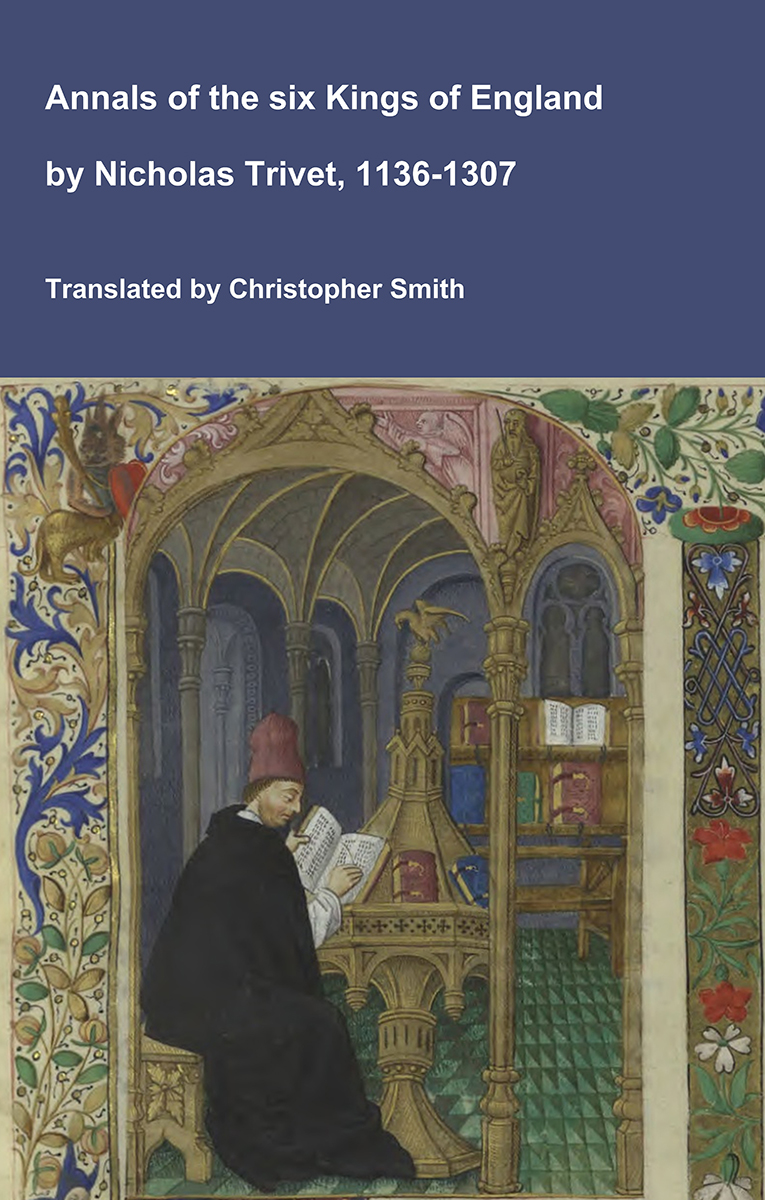
Annals of the six Kings of England by Nicholas Trivet
Translation of the Annals of the Six Kings of England by that traces the rise and rule of the Angevin aka Plantagenet dynasty from the mid-12th to early 14th century. Written by the Dominican scholar Nicholas Trivet, the work offers a vivid account of English history from the reign of King Stephen through to the death of King Edward I, blending political narrative with moral reflection. Covering the reigns of six monarchs—from Stephen to Edward I—the chronicle explores royal authority, rebellion, war, and the shifting balance between crown, church, and nobility. Trivet provides detailed insight into defining moments such as baronial conflicts, Anglo-French rivalry, and the consolidation of royal power under Edward I, whose reign he describes with particular immediacy. The Annals combines careful year-by-year reporting with thoughtful interpretation, presenting history not merely as a sequence of events but as a moral and political lesson. Ideal for readers interested in medieval history, kingship, and the origins of the English state, this chronicle remains a valuable and accessible window into the turbulent world of the Plantagenet kings.
Available at Amazon in eBook and Paperback format.
Cushion Stones is in Tools.
Cushion Stones are belived to have acted as a portable anvil for copper working.
The Amesbury Archer [Map] is the remains of a man aged around forty at the time of his death from the Alps who was buried in Amesbury around 2300BC and discovered in May 2002 during the development of new housing. He is named 'The Archer' as a consequence of the large number of arrowheads found with him. His grave contained the largest number of artefacts of any grave of a similar period including the earliest known gold objects in England, five beaker funerary pots, three tiny copper knives, sixteen barbed flint arrowheads, a kit of flint-knapping, metalworking tools including cushion stones and some boar tusks. On his forearm was a black stone wrist guard. A similar red wrist guard was by his knees with a shale belt ring and a pair of earrings, the oldest gold objects found in England. An eroded hole in his jaw showed that he had suffered from an abscess, and his missing left kneecap suggests that he had an injury that left him with a painful lingering bone infection. His remains are on display in the Salisbury and South Wiltshire Museum [Map].
The Amesbury Archer's Companion is the remains of a man raised locally aged between twenty-five and thirty at the time of his death buried around 2300BC near to the Amesbury Archer. He appears to be related to the Amesbury Archer as they shared a rare hereditary anomaly, calcaneonavicular coalition, fusing of the calcaneus and of the navicular tarsal (foot bones). Inside his jaw were found a pair of gold earrings or hair ornaments in the same style as the Amesbury Archer's.
Photos sourced from Salisbury and South Wiltshire Museum [Map] and Wessex Archaeology.


