

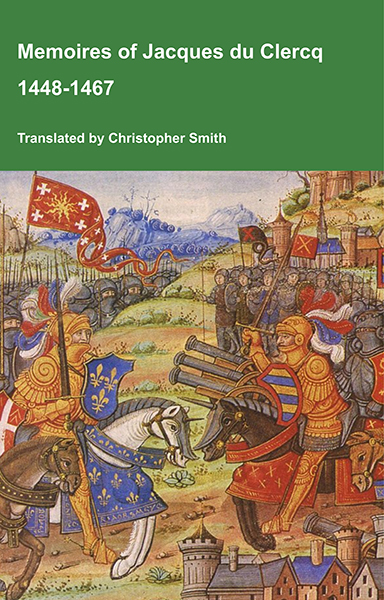
This is a translation of the 'Memoires of Jacques du Clercq', published in 1823 in two volumes, edited by Frederic, Baron de Reissenberg. In his introduction Reissenberg writes: 'Jacques du Clercq tells us that he was born in 1424, and that he was a licentiate in law and a counsellor to Philip the Good, Duke of Burgundy, in the castellany of Douai, Lille, and Orchies. It appears that he established his residence at Arras. In 1446, he married the daughter of Baldwin de la Lacherie, a gentleman who lived in Lille. We read in the fifth book of his Memoirs that his father, also named Jacques du Clercq, had married a lady of the Le Camelin family, from Compiègne. His ancestors, always attached to the counts of Flanders, had constantly served them, whether in their councils or in their armies.' The Memoires cover a period of nineteen years beginning in in 1448, ending in in 1467. It appears that the author had intended to extend the Memoirs beyond that date; no doubt illness or death prevented him from carrying out this plan. As Reissenberg writes the 'merit of this work lies in the simplicity of its narrative, in its tone of good faith, and in a certain air of frankness which naturally wins the reader’s confidence.' Du Clercq ranges from events of national and international importance, including events of the Wars of the Roses in England, to simple, everyday local events such as marriages, robberies, murders, trials and deaths, including that of his own father in Book 5; one of his last entries.
Available at Amazon in eBook and Paperback format.
Macehead is in Prehistoric Artefacts.
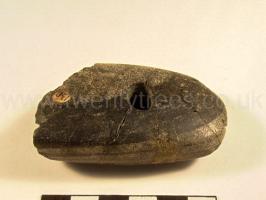
Wiltshire Museum. DZSWS:STHEAD.130. 1 polished stone macehead of greenstone, ground to an oblong oval shape and pierced by a small, almost central, hole (unfinished), from material in Bowl Barrow G13 Winterbourne Stoke [Map], excavated by William Cunnington.
Bush Barrow aka Normanton 158 aka Wilsford G5 [Map] is a Bronze Age Round Barrow. In 1808 Bush Barrow [Map] was excavated by William Cunnington. It contained a male skeleton with a collection of funerary goods that make it one of the richest burials in Britain. The grave goods include a large 'lozenge'-shaped sheet of gold, a sheet gold belt plate, three bronze daggers, a bronze axe, a stone macehead and bronze rivets.
All the following items are in the collection of [Map] and normally on display. The photographs and information is sourced from Devizes Museum website.
Bronze flanged axehead with traces of coarse cloth visible on the blade, found with a primary male inhumation (near the shoulders). Length 159 mm; width 67 mm; height 10 mm.
Gold lozenge-shaped breast plate made of thin gold covering a wooden plaque and decorated with four nested lozenge-shaped bands of four engraved lines each, the central one of which contains a chequered design with a zigzag design between the outer two bands, perforated at both ends, found with a primary male inhumation (over chest). Length 184 mm; width 156 mm; height 5 mm.
Polished oval macehead made from a fossil coral, perforated through the middle and containing traces of bronze. Found with a male inhumation (by right side) and possibly forming a sceptre. Length 100 mm; width 44 mm; height 40 mm.
Miniature gold lozenge-shaped ornament decorated with three nested lozenge-shaped lines (engraved), found with a primary male inhumation (by right side). Length 31 mm; width 19 mm; height 2 mm.
Copper dagger (Amorico British Class 1a) with a small tang, six rivets and parts of a wooden sheath adhering to the blade (originally with a handle inset with thousands of gold pins), found with a primary male inhumation (near right arm). Length 272 mm; width 80 mm; height 21 mm.
Gold belt hook decorated with four nested rectangular bands of three engraved lines, found with a primary male inhumation (near right arm). Length 77 mm; width 71 mm; height 16 mm.
Bronze dagger (the largest found in Wiltshire) with 6 rivet holes (three remaining) and parts of a wooden sheath adhereing to the blade, decorated with a rounded ridge. Length 330 mm; width 65 mm; height 20mm.


