

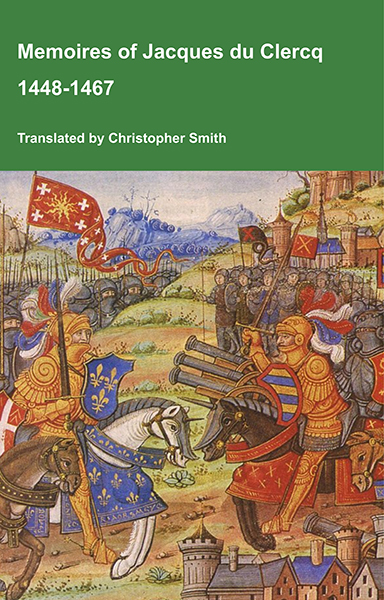
This is a translation of the 'Memoires of Jacques du Clercq', published in 1823 in two volumes, edited by Frederic, Baron de Reissenberg. In his introduction Reissenberg writes: 'Jacques du Clercq tells us that he was born in 1424, and that he was a licentiate in law and a counsellor to Philip the Good, Duke of Burgundy, in the castellany of Douai, Lille, and Orchies. It appears that he established his residence at Arras. In 1446, he married the daughter of Baldwin de la Lacherie, a gentleman who lived in Lille. We read in the fifth book of his Memoirs that his father, also named Jacques du Clercq, had married a lady of the Le Camelin family, from Compiègne. His ancestors, always attached to the counts of Flanders, had constantly served them, whether in their councils or in their armies.' The Memoires cover a period of nineteen years beginning in in 1448, ending in in 1467. It appears that the author had intended to extend the Memoirs beyond that date; no doubt illness or death prevented him from carrying out this plan. As Reissenberg writes the 'merit of this work lies in the simplicity of its narrative, in its tone of good faith, and in a certain air of frankness which naturally wins the reader’s confidence.' Du Clercq ranges from events of national and international importance, including events of the Wars of the Roses in England, to simple, everyday local events such as marriages, robberies, murders, trials and deaths, including that of his own father in Book 5; one of his last entries.
Available at Amazon in eBook and Paperback format.
Around 1040 King Harald III of Denmark was born illegitimately to [his father] King Sweyn II of Denmark [aged 21].
In 1047 [his father] King Sweyn II of Denmark [aged 28] was appointed II King of Denmark.
Flowers of History. 1069. Between the time of the two festivals of the blessed Virgin Mary, in the autumn, the two sons of [his father] Sweyn [aged 50] [King Harald III of Denmark [aged 29] and [his brother] King Canute "The Holy" IV of Denmark [aged 27]] came with three hundred ships from Denmark into England, in order to subdue it in a hostile manner, and to take king William prisoner [aged 41], or else expel him from England. But when their arrival was noised abroad, the counts, and barons, and nobles of the land went forth to meet them, being oppressed by the intolerable arrogance of the Normans; and they made a treaty with them, and so joined the army of the Danes, in order to overthrow king William. But William, that most prudent king, when he saw the danger that threatened him, humbled himself to them, and checked the insolence of the Normans; and having in this way recalled many of the English nobles to their allegiance, and having sagaciously made a treaty with them all, he took the city of York [Map] by storm, which was a great rendezvous of the Danes, and made himself master of every thing in it, and slew many thousand men there.
Historia Regum by Simeon of Durham. In this year, before the Nativity of St. Mary [8th September 1069], Harold [aged 29] and [his brother] Cnut [aged 27], sons of [his father] Suane [aged 50], king of the Danes, and their uncle, earl Osbern, and their bishop, Christian, and earl Turkill, coming with two hundred and forty ships from Denmark, landed at the mouth of the river Humber. There they were met by Eadgar Atheling, earl Walthev, and Marlesswein, and many others, with a fleet which they had provided. Earl Cospatric was there also, with the whole strength of the Northumbrians, who all assembled with one consent against the Normans.
Chronicon ex Chronicis by Florence and John of Worcester. 8th September 1069. Before the Nativity of St. Mary [8th September] Harold [aged 29] and [his brother] Canute [aged 27], sons of [his father] Sweyn [aged 50], king of Denmark, and their uncle, earl Asbiorn, with earl Thurkill, arriving from Denmark with two hundred and forty ships, landed at the mouth of the river Humber, where they were met by Edgar [aged 18] the etheling, earl Waltheof, Marlesweyn, and many others, with a fleet they had assembled. Aldred, archbishop of York, was so distressed at their arrival, that he fell dangerously sick, and departed this life, as he besought of God, on Friday the third of the ides [the 11th] of September, in the tenth year after he became archbishop, and was buried in the church of St. Peter on the eighth day afterwards, namely, on Saturday the thirteenth of the calends of October [19th September]. The Normans, who garrisoned the forts, set fire to the adjacent houses, fearing that they might be of service to the Danes in filling up the trenches; and the flames spreading, destroyed the whole city, together with the monastery of St. Peter. But they were speedily punished for this by an infliction of the divine vengeance; for on Monday the Danish fleet arrived before the city was entirely consumed, and the forts being stormed the same day, and more than three thousand of the Normans killed (the lives of William Malet and his wife and two children, with very few others, being spared), the ships drew off laden with plunder.
Anglo-Saxon Chronicle. 1076. This year died [his father] Sweyne, King of Denmark [aged 57]; and Harold [aged 36] his son took to the kingdom. And the king [aged 48] gave the abbacy of Westminster to Abbot Vitalis, who had been Abbot of Bernay.
On 28th April 1076 [his father] King Sweyn II of Denmark [aged 57] died. His son Harald [aged 36] succeeded III King of Denmark.
In 1080 [his brother] King Canute "The Holy" IV of Denmark [aged 38] and [his sister-in-law] Adela Flanders Queen Consort Denmark [aged 16] were married. She by marriage Queen Consort Denmark. The difference in their ages was 22 years. She the daughter of Robert "The Frisian" I Count Flanders [aged 47] and Gertrude Billung Countess Holland [aged 50]. He the son of [his father] King Sweyn II of Denmark.
On 17th April 1080 King Harald III of Denmark [aged 40] died. [his brother] King Canute "The Holy" IV of Denmark [aged 38] was appointed IV King of Denmark.
Great x 1 Grandfather: Thorgil "Sprakling aka Strut Leg" Estrigen
GrandFather: Ulf Estrigen
Father: King Sweyn II of Denmark
Great x 1 Grandfather: Sweyn "Forkbeard" King of Denmark, Norway and England
GrandMother: Estrid Svendsdatter Knytlinga