

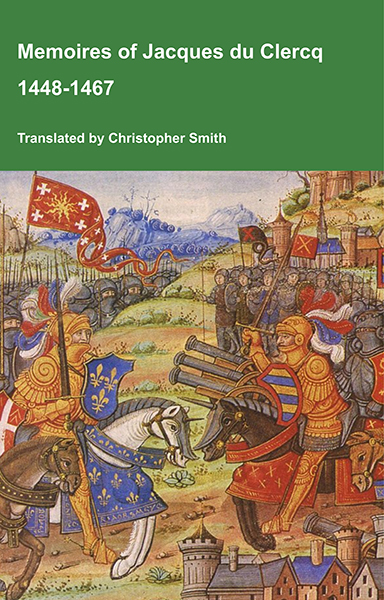
This is a translation of the 'Memoires of Jacques du Clercq', published in 1823 in two volumes, edited by Frederic, Baron de Reissenberg. In his introduction Reissenberg writes: 'Jacques du Clercq tells us that he was born in 1424, and that he was a licentiate in law and a counsellor to Philip the Good, Duke of Burgundy, in the castellany of Douai, Lille, and Orchies. It appears that he established his residence at Arras. In 1446, he married the daughter of Baldwin de la Lacherie, a gentleman who lived in Lille. We read in the fifth book of his Memoirs that his father, also named Jacques du Clercq, had married a lady of the Le Camelin family, from Compiègne. His ancestors, always attached to the counts of Flanders, had constantly served them, whether in their councils or in their armies.' The Memoires cover a period of nineteen years beginning in in 1448, ending in in 1467. It appears that the author had intended to extend the Memoirs beyond that date; no doubt illness or death prevented him from carrying out this plan. As Reissenberg writes the 'merit of this work lies in the simplicity of its narrative, in its tone of good faith, and in a certain air of frankness which naturally wins the reader’s confidence.' Du Clercq ranges from events of national and international importance, including events of the Wars of the Roses in England, to simple, everyday local events such as marriages, robberies, murders, trials and deaths, including that of his own father in Book 5; one of his last entries.
Available at Amazon in eBook and Paperback format.
Before 994 [his father] King Harald Grenske of Vestfold and Agder and [his mother] Åsta Gudbrandsdatter (age 18) were married.
Around 995 [his father] King Harald Grenske of Vestfold and Agder was killed by the sons of Sigrid "The Haughty" who had him burnt to death inside a great hall following a feast to discourage other suitors.
Around 995 King Olaf II of Norway was born to [his father] King Harald Grenske of Vestfold and Agder and [his mother] Åsta Gudbrandsdatter (age 20).
In 1015 King Olaf II of Norway (age 20) was appointed King Norway.
Around 1020 to 1030 [his mother] Åsta Gudbrandsdatter (age 45) died.
Around 1024 [his son] King Magnus "The Good" of Norway was born to King Olaf II of Norway (age 29).
Chronicon ex Chronicis by Florence and John of Worcester. 1027. Canute (age 32), king of England and Denmark, received intelligence that the Norwegians held their king Olaf (age 32) in contempt on account of his meekness and simplicity, his justice and piety. In consequence, he sent large sums of gold and silver to certain of them, earnestly entreating them to reject and depose Olaf, and submitting to him, accept him for their king. They greedily accepted his bribes, and caused a message to be returned to Canute that they were prepared to receive him whenever he chose to come.
Anglo-Saxon Chronicle. 1028. This year went King Knute (age 33) from England to Norway with fifty ships manned with English thanes, and drove King Olave (age 33) from the land, which he entirely secured to himself.
Chronicon ex Chronicis by Florence and John of Worcester. 1028. Canute (age 33), king of England and Denmark, went over to Norway with fifty stout ships, and expelled king Olaf (age 33) from the kingdom, which he subjugated to himself.
The same year was born Marianus, of Ireland, the celebrated Scot, by whose study and pains this excellent Chronicle was compiled from various books.
Anglo-Saxon Chronicle. 1030. This year returned King Olave (age 35) into Norway; but the people gathered together against him, and fought against him; and he was there slain, in Norway, by his own people, and was afterwards canonised. Before this, in the same year, died Hacon the doughty earl, at sea.
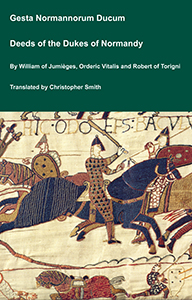
The Deeds of the Dukes of Normandy
The Gesta Normannorum Ducum [The Deeds of the Dukes of Normandy] is a landmark medieval chronicle tracing the rise and fall of the Norman dynasty from its early roots through the pivotal events surrounding the Norman Conquest of England. Originally penned in Latin by the monk William of Jumièges shortly before 1060 and later expanded at the behest of William the Conqueror, the work chronicles the deeds, politics, battles, and leadership of the Norman dukes, especially William’s own claim to the English throne. The narrative combines earlier historical sources with firsthand information and oral testimony to present an authoritative account of Normandy’s transformation from a Viking settlement into one of medieval Europe’s most powerful realms. William’s history emphasizes the legitimacy, military prowess, and governance of the Norman line, framing their expansion, including the conquest of England, as both divinely sanctioned and noble in purpose. Later chroniclers such as Orderic Vitalis and Robert of Torigni continued the history, extending the coverage into the 12th century, providing broader context on ducal rule and its impact. Today this classic work remains a foundational source for understanding Norman identity, medieval statesmanship, and the historical forces that reshaped England and Western Europe between 800AD and 1100AD.
Available at Amazon in eBook and Paperback format.
Chronicon ex Chronicis by Florence and John of Worcester. 1030. The before-mentioned earl Haco perished at sea: some, however, say that he was killed in the islands of Orkney. Olaf (age 35), king and martyr, son of [his father] Harold, king of Norway, was wickedly slain by the Norwegians.
On 29th July 1030 King Olaf II of Norway (age 35) was killed by his own people.
GrandFather: Gudrød Bjørnsson
Father: King Harald Grenske of Vestfold and Agder
Mother: Åsta Gudbrandsdatter