


The History of William Marshal was commissioned by his son shortly after William’s death in 1219 to celebrate the Marshal’s remarkable life; it is an authentic, contemporary voice. The manuscript was discovered in 1861 by French historian Paul Meyer. Meyer published the manuscript in its original Anglo-French in 1891 in two books. This book is a line by line translation of the first of Meyer’s books; lines 1-10152. Book 1 of the History begins in 1139 and ends in 1194. It describes the events of the Anarchy, the role of William’s father John, John’s marriages, William’s childhood, his role as a hostage at the siege of Newbury, his injury and imprisonment in Poitou where he met Eleanor of Aquitaine and his life as a knight errant. It continues with the accusation against him of an improper relationship with Margaret, wife of Henry the Young King, his exile, and return, the death of Henry the Young King, the rebellion of Richard, the future King Richard I, war with France, the death of King Henry II, and the capture of King Richard, and the rebellion of John, the future King John. It ends with the release of King Richard and the death of John Marshal.
Available at Amazon in eBook and Paperback format.
On 19th September 1778 Henry Brougham 1st Baron Brougham and Vaux was born to [his father] Henry Brougham [aged 36] in Edinburgh.
On 19th December 1807 John Spalding [aged 44] and [his future wife] Mary Eden Baroness Brougham and Vaux [aged 22] were married. The difference in their ages was 22 years.
On 13th February 1810 [his father] Henry Brougham [aged 67] died.
Letters and Journals of Lord Byron by Moore 10 March 1814. 10th March 1814. Thor's day. On Tuesday dined with Rogers [aged 50],-Mackintosh, Sheridan [aged 62], Sharpe,-much talk, and good,-all, except my own little prattlement. Much of old times-Horne Tooke-the Trials-evidence of Sheridan, and anecdotes of those times, when I, alas! was an infant. If I had been a man, I would have made an English Lord Edward Fitzgerald.
Set down Sheridan at Brookes's,-where, by the by, he could not have well set down himself, as he and I were the only drinkers. Sherry means to stand for Westminster, as Cochrane [aged 38]1 (the stock-jobbing hoaxer) must vacate. Brougham [aged 35]2 is a candidate. I fear for poor dear Sherry. Both have talents of the highest order, but the youngster has yet a character. We shall see, if he lives to Sherry's age, how he will pass over the red-hot ploughshares of public life. I don't know why, but I hate to see the old ones lose; particularly Sheridan, notwithstanding all his méchanceté.
Received many, and the kindest, thanks from Lady Portsmouth, père and mère, for my match-making. I don't regret it, as she looks the countess well, and is a very good girl. It is odd how well she carries her new honours. She looks a different woman, and high-bred, too. I had no idea that I could make so good a peeress.
Went to the play with Hobbouse [aged 27]. Mrs. Jordan [aged 52] superlative in Hoyden3, and Jones well enough in Foppington. What plays! what wit!-helas! Congreve and Vanbrugh are your only comedy. Our society is too insipid now for the like copy. Would not go to Lady Keith's [aged 49]. Hobhouse thought it odd. I wonder he should like parties. If one is in love, and wants to break a commandment and covet any thing that is there, they do very well. But to go out amongst the mere herd, without a motive, pleasure, or pursuit-'sdeath! 'I'll none of it.' He told me an odd report,-that I am the actual Conrad, the veritable Corsair, and that part of my travels are supposed to have passed in privacy. Um!-people sometimes hit near the truth; but never the whole truth. H. don't know what I was about the year after he left the Levant; nor does any one-nor-nor-nor-however, it is a lie-but, 'I doubt the equivocation of the fiend that lies like truth!
I shall have letters of importance to-morrow. Which, **, **, or **? heigho!-** is in my heart, ** in my head, ** in my eye, and the single one, Heaven knows where. All write, and will be answered. 'Since I have crept in favour with myself, I must maintain it;' but I never 'mistook my person,' though I think others have.
** called to-day in great despair about his mistress, who has taken a freak of ***. He began a letter to her, but was obliged to stop short-I finished it for him, and he copied and sent it. If he holds out and keeps to my instructions of affected indifference, she will lower her colours. If she don't, he will, at least, get rid of her, and she don't seem much worth keeping. But the poor lad is in love-if that is the case, she will win. When they once discover their power, finita è la musica.
Sleepy, and must go to bed.
Note 1. Thomas, Lord Cochrane (1775-1860), eldest son of the ninth Earl of Dundonald, a captain in the Royal Navy, and M. P. for Westminster, had done brilliant service in his successive commands-the Speedy, Pallas, Impérieuse, and the flotilla of fire-ships at Basque Roads in 1809. In the House of Commons he had been a strong opponent of the Government, an advocate of Parliamentary Reform, and a vigorous critic of naval administration. In February, 1814, he had been appointed to the Tonnant for the American Station, and it was while he was on a week's leave of absence in London, before sailing, that the stock-jobbing hoax occurred.
During the days February 8-26, 1814, it seemed possible that Napoleon might defeat the Allied Armies, and the Funds were sensitive to every rumour. At midnight on Sunday, February 20, a man calling himself Du Bourg brought news to Admiral Foley, at Dover, that Napoleon had been killed by a party of Cossacks. Hurrying towards London, Du Bourg, whose real name was Berenger, spread the news as he went. Arrived in London soon after daybreak, he went to Cochrane's house, and there changed his uniform. When the Stock Exchange opened at ten on February 21, 1814, the Funds rose rapidly, and among those who sold on the rise was Cochrane. The next day, when the swindle had been discovered, the Stocks fell.
A Stock Exchange Committee sat to investigate the case, and their report (March 7) threw grave suspicion on Cochrane. He, his uncle, Cochrane Johnstone, a Mr. Butt, and Berenger, were indicted for a conspiracy, tried before Lord Ellenborough, June 8-9, and convicted. Cochrane was sentenced to a year's imprisonment and a fine of £1000. On the back of the note for £1000 (still kept in the Bank of England) with which he paid his fine on July 3, 1815, he wrote:
My health having suffered by long and close confinement, and my oppressors being resolved to deprive me of property or life, I submit to robbery to protect myself from murder, in the hope that I shall live to bring the delinquents to justice."
Cochrane was also expelled from the House of Commons and from the Order of the Bath. There is little doubt that the circumstances were extremely suspicious. Those who wish to form an opinion as to Cochrane's guilt or innocence will find the subject of the trial exhaustively treated in Mr. J.B. Atlay's Lord Cochrane's Trial before Lord Ellenborough (1897).
Note 2. Henry, Lord Brougham (1778-1868) acknowledged that he wrote the famous article on Byron's Hours of Idleness in the Edinburgh Review (Sir M.E. Grant-Duff's Notes from a Diary, vol. ii. p. 189). He lost his seat for Camelford in September, 1812, and did not re-enter the House till July, 1815, when he sat for Winchelsea. In the postscript of a letter written by him to Douglas Kinnaird, December 9, 1814, he speaks of Byron thus:
Your friend, Lord B., is, in my opinion, a singularly agreeable person, which is very rarely the case with eminent men. His independent principles give him a great additional charm."
But the part which Brougham played in the separation, both as counsel and in society, infuriated Byron, who wrote of him in his letters with the utmost bitterness. (See also the passage, now for the first time published, from Byron's Detached Thoughts, on his Parliamentary experiences, p. 198, first paragraph of note.)
Note 3. Dorothy Jordan (1762-1816) first appeared as "Phoebe" in As You Like It at the Crow Street Theatre, Dublin, in 1777. After acting in provincial theatres, she made her début on the London stage at Drury Lane (October 18, 1785) as "Peggy" in Garrick's Country Girl, an expurgated version of Wycherley's Country Wife. During the season she appeared also in six of her best parts: "Miss Hoyden" in The Trip to Scarborough, "Priscilla Tomboy" in The Romp, "Hypolita" in She would and she would not, "Mrs. Brady" in The Irish Widow, "Viola" in Twelfth Night, and "Rosalind" in As You Like It. Her last appearance on the London stage was as "Lady Teazle" in The School for Scandal, at Covent Garden, June 1, 1814. A list of her principal characters is given by Genest (English Stage, vol. viii. pp. 432-434). As a comic actress, Mrs. Jordan was unrivalled; her voice was perfect; and her natural gaiety irresistible. Sir Joshua Reynolds preferred her to all other actresses as a being "who ran upon the stage as a playground, and laughed from sincere wildness of delight." In genteel comedy, critics like Genest (English Stage, vol. viii. p. 431) and Leigh Hunt (Dramatic Essays, ed. 1894, p. 82) agree that she failed, perhaps, as the latter suggests, because she was so "perpetually employed" in "broad and romping characters."
In private life Mrs. Jordan was chiefly known as the mistress of the Duke of Clarence, to whom she bore ten children. She died at St. Cloud, July 3, 1816.
The play acted at Covent Garden, March 10, 1814, was Sheridan's Trip to Scarborough, which is a close adaptation of Vanbrugh's Relapse. The performance is thus described in the Courier, March 11, 1814:
"Mrs. Jordan, the only Miss Hoyden on the stage, supported that character with unabated spirit. In every scene, from her soliloquy on being locked up, which was delivered with extraordinary naïveté, both with reference to her tones, her emphasis, and her action, until the consummation of the piece, the house was shaken by loud and quick-succeeding peals of laughter. The style in which she expressed Hoyden's rustic arithmetic, 'Now, Nursey, if he gives me six hundred pounds a-year to buy pins, what will he give me to buy petticoats?' was uncommonly fine. The frock waving in her hand, the backward bound of two or three steps, the gravity of countenance, induced by a mental glance at the magnitude of the sum, all spoke expectation, delight, and astonishment."


 Become a Member via our Buy Me a Coffee page to read more.
On 1st April 1819 Henry Brougham 1st Baron Brougham and Vaux [aged 40] and Mary Eden Baroness Brougham and Vaux [aged 33] were married.
In October 1822 [his daughter] Eleanor Brougham was born to Henry Brougham 1st Baron Brougham and Vaux [aged 44].
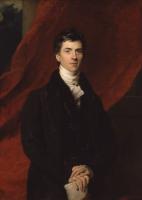
In 1825. Thomas Lawrence [aged 55]. Portrait of Henry Brougham 1st Baron Brougham and Vaux [aged 46].
In 1830 Henry Brougham 1st Baron Brougham and Vaux [aged 51] was appointed Lord Chancellor.
The London Gazette 18748. Whitehall, November 22, 1830. The King has been pleased to grant the dignity of a Baron of the United Kingdom of Great Britain and Ireland unto the Right Honourable Henry Brougham [aged 52], and the heirs male of his body lawfully begotten, by the name, stile, and title of Baron Brougham and Vaux, of Brougham, in the county of Westmorland. [[his wife] Mary Eden Baroness Brougham and Vaux [aged 45] by marriage Baroness Brougham and Vaux.]
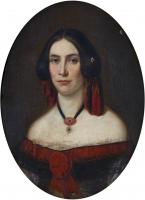
In 1834 Alexander Malet 2nd Baronet [aged 33] and [his step-daughter] Marianne Dora Spalding Lady Malet [aged 24] were married. She by marriage Lady Malet of Wilbury in Wiltshire.
In 1834 [his brother] William Brougham 2nd Baron Brougham and Vaux [aged 38] and [his sister-in-law] Emily Frances Taylor Lady Brougham were married.
On 30th November 1839 [his daughter] Eleanor Brougham [aged 17] died.

Adeline Horsey Recollections. My last recollection of Cassiobury was in 1849, when I stayed there after the announcement of my engagement to the Count Montemolin [aged 25]. The great Lord Brougham [aged 65] was included in the house-party, and one day when he was walking in the gardens, talking about my approaching marriage, he suddenly dropped on one knee, and taking my hand, kissed it, saying as he did so, "Let me be the first to kiss your hand as future Queen of Spain".
This somewhat theatrical behaviour was exactly what Lord Brougham delighted in. He was a very ugly man, and like most ugly people he was very vain. He was a wonderful speaker, and few cared to provoke his powers of sarcasm; Hazlitt describes him as "a man of inordinate ambition and little heart"; but he certainly possessed some heart, for he adored his daughter Eleanor, who died at Cannes when she was only nineteen. The poor girl was an invalid all her short life, and her father resided at Cannes solely on her account. He built the Villa Eleanor for her, and until Lord Brougham's death her bedroom was always known as "Eleanor's room", and kept exactly as it had been when she occupied it.
The Villa is now an hotel, and Cannes is very different to what it was when Lord Brougham settled there. He told me that the town had only one hotel and one street when he first saw it.
Eleanor Brougham's body was brought to England, and she was buried in the small graveyard which belongs to Lincoln's Inn Chapel. I do not think any other woman has ever been interred there. The Marquis of Wellesley wrote her epitaph, and I believe it is a very beautiful and touching one.
The Deeds of the Dukes of Normandy
The Gesta Normannorum Ducum [The Deeds of the Dukes of Normandy] is a landmark medieval chronicle tracing the rise and fall of the Norman dynasty from its early roots through the pivotal events surrounding the Norman Conquest of England. Originally penned in Latin by the monk William of Jumièges shortly before 1060 and later expanded at the behest of William the Conqueror, the work chronicles the deeds, politics, battles, and leadership of the Norman dukes, especially William’s own claim to the English throne. The narrative combines earlier historical sources with firsthand information and oral testimony to present an authoritative account of Normandy’s transformation from a Viking settlement into one of medieval Europe’s most powerful realms. William’s history emphasizes the legitimacy, military prowess, and governance of the Norman line, framing their expansion, including the conquest of England, as both divinely sanctioned and noble in purpose. Later chroniclers such as Orderic Vitalis and Robert of Torigni continued the history, extending the coverage into the 12th century, providing broader context on ducal rule and its impact. Today this classic work remains a foundational source for understanding Norman identity, medieval statesmanship, and the historical forces that reshaped England and Western Europe between 800AD and 1100AD.
Available at Amazon in eBook and Paperback format.
The London Gazette 22367. 15th March 1860. Whitehall, March 15, 1860. The Queen has been pleased to direct letters patent to be passed under the Great Seal, granting the dignity of a Baron of the United Kingdom of Great Britain and Ireland unto Henry [aged 81], Baron Brougham and Vaux, and the heirs male of his body lawfully begotten, by the name, style, and title of Baron Brougham and Vaux, of Brougham, in the county of Westmorland, and of Highhead Castle, in the county of Cumberland, with remainder, in default of such heirs male, to his brother, William Brougham [aged 64], Esq., and the heirs male of his body lawfully begotten.
On 12th January 1865 [his wife] Mary Eden Baroness Brougham and Vaux [aged 79] died.
On 7th May 1868 Henry Brougham 1st Baron Brougham and Vaux [aged 89] died. Baron Brougham and Vaux extinct. His brother William [aged 72] succeeded 2nd Baron Brougham and Vaux. Emily Frances Taylor Lady Brougham by marriage Baroness Brougham and Vaux.