

Chronicle of Abbot Ralph of Coggeshall
The Chronicle of Abbot Ralph of Coggeshall (Chronicon Anglicanum) is an indispensable medieval history that brings to life centuries of English and European affairs through the eyes of a learned Cistercian monk. Ralph of Coggeshall, abbot of the Abbey of Coggeshall in Essex in the early 13th century, continued and expanded his community’s chronicle, documenting events from the Norman Conquest of 1066 into the tumultuous reign of King Henry III. Blending eyewitness testimony, careful compilation, and the monastic commitment to record-keeping, this chronicle offers a rare narrative of political intrigue, royal power struggles, and social upheaval in England and beyond. Ralph’s work captures the reigns of pivotal figures such as Richard I and King John, providing invaluable insights into their characters, decisions, and the forces that shaped medieval rule. More than a simple annal, Chronicon Anglicanum conveys the texture of medieval life and governance, making it a rich source for scholars and readers fascinated by English history, monastic authorship, and the shaping of the medieval world.
Available at Amazon in eBook and Paperback format.
Paternal Family Tree: Stewart
Maternal Family Tree: Sophie Mecklenburg-Schwerin Queen Consort Denmark 1557-1631
On 23rd November 1589 [his father] King James I of England and Ireland and VI of Scotland [aged 23] and [his mother] Anne of Denmark Queen Consort Scotland England and Ireland [aged 14] were married at Bishop's Palace. She by marriage Queen Consort Scotland. She the daughter of [his grandfather] Frederick II King of Denmark and [his grandmother] Sophie Mecklenburg-Schwerin Queen Consort Denmark [aged 32]. He the son of Henry "Lord Darnley" Stewart and Mary Queen of Scots. They were third cousin once removed. He a great x 2 grandson of King Henry VII of England and Ireland.


On 19th November 1600 King Charles I of England, Scotland and Ireland was born to [his father] King James I of England and Ireland and VI of Scotland [aged 34] and [his mother] Anne of Denmark Queen Consort Scotland England and Ireland [aged 25] at Dunfermline Palace, Dunfermline.
On 23rd December 1600 the future King Charles I was baptised at Holyrood Palace [Map]. He was created Duke Albany.
On 24th March 1603 Elizabeth I [aged 69] died at Richmond Palace [Map] around three in the morning. Her first cousin twice removed [his father] James [aged 36] succeeded I King England Scotland and Ireland.
Immediately following her death Robert Carey 1st Earl Monmouth [aged 43] started on horseback for Edinburgh to inform King James I of England and Ireland and VI of Scotland arriving at Holyrood Palace [Map] late on the 26 Mar 1603. His conduct met with general disapproval and merited censure as contrary to all decency, good manners and respect. George Carew and Thomas Lake [aged 35] were sent by the Council to formally inform James of her death.




On 21st July 1603 [his father] King James I of England and Ireland and VI of Scotland [aged 37] created a number of new Baronies...
Thomas Egerton [aged 63] was created 1st Baron Ellesmere. Alice Spencer Countess Derby [aged 54] by marriage Baroness Ellesmere.
Robert Spencer [aged 33] was created 1st Baron Spencer Wormleighton.
John Harrington [aged 63] was created 1st Baron Harington of Exton. Anne Keilway Baroness Harington [aged 49] by marriage Baroness Harington of Exton.

On 15th August 1604 and 16th August 1604 Prince Charles [aged 3] and Alexander Seton [aged 49] lodged at the Leicester townhouse of William Skipwith [aged 40] on their way to London.
On 5th January 1605 King Charles I of England, Scotland and Ireland [aged 4] was created 1st Duke York and Knight of the Bath by his father King James I of England and Ireland and VI of Scotland [aged 38]
Francis Manners 6th Earl of Rutland [aged 27] and Thomas Somerset 1st Viscount Somerset [aged 26] was @@appointed Knight of the Bath.

Memorials of affairs of state in the reigns of Q Elizabeth and K James I Volume 2. On Twelfth-Day we had the Creation of Duke Charles [aged 4] now Duke of York; the Interim was entertained with making Knights of the Bath, which was three Days Work. They were eleven in Number, besides the little Duke, all of the King's Choice; namely, the Lords Willoby, Compton, Chandois, and Norres; William Cecyll, Allen Percy, Thomas Somerset [aged 26], Francis Manners [aged 27], Clifford, young Howard, second Son of my Lord Chamberlaine, and Harrington. The Solemnity of the Creation was kept in the Hall, where first the Duke was brought in accompanyed with his Knights, then carried out againe, and brought back by Earles in their Robes of the Garter. My Lord Admiral bare him, two others went as Supporters, and six marched before with the Ornaments. The Patent was read by my Lord of Cranborne [aged 13], and drawn in most eloquent Law Latin by Mr. Attorney; but so, that we have a Duke of York in Title, but not in Substance. There was a publick Dinner in the great Chamber, where there was one Table for the Duke and his Earls Assistants, another for his Fellow Knights of the Bath.
On 27th December 1605 Philip Herbert 4th Earl Pembroke 1st Earl Montgomery [aged 21] and Susan Vere Countess Montgomery [aged 18] were married at Whitehall. The bride was escorted into the church by the [his mother] Queen's [aged 31] brother [his uncle] Prince Ulrik Oldenburg [aged 26] and her son Henry Frederick Stewart Prince of Wales [aged 11]. She the daughter of Edward de Vere 17th Earl of Oxford and Anne Cecil Countess of Oxford. He the son of Henry Herbert 2nd Earl Pembroke and Mary Sidney Countess Pembroke [aged 44].


On 16th September 1607 [his sister] Princess Mary Stewart [aged 2] died of pneumonia at the Stanwell Park Stanwell, Surrey home of Thomas Knyvet 1st Baron Knyvet [aged 62] in whose care she had been placed. As soon as Mary died, the Earl of Worcester [aged 57], the Earl of Leicester [aged 43] and the Earl of Totnes [aged 52] went to Hampton Court Palace [Map], to inform the [his mother] Queen [aged 32] of her daughter's death. Seeing the three men before her, Queen Anne realized what had happened and spared the men the task of telling her.


On 1st June 1610 [his brother] Prince Frederick [aged 16] was created Prince of Wales and 1st Earl Chester. Peregrine Bertie [aged 26] was appointed Knight of the Bath.
On 5th June 1610 the Tethy's Festival Masque was performed at Whitehall Palace [Map] to celebrate the investiture of [his brother] Prince Frederick [aged 16] as Prince of Wales. The script was written by Samuel Daniel at the request of the [his mother] Queen [aged 35], who appeared in person as Tethys a goddess of the sea. Inigo Jones [aged 36] designed the staging and scenery.
Prince Charles [aged 9] took the part of Zephyrus,.
Princess Elizabeth Stewart Queen Bohemia [aged 13] appeared as the companion or daughter of Tethys, the "Nymph of Thames",.
Arabella Stewart [aged 35] took the part of the "Nymph of Trent",.
Alethea Talbot Countess Arundel, Surrey and Norfolk [aged 25] as "Nymph of Arun".
Elizabeth Vere Countess Derby [aged 34] as "Nymph of Derwent",.
Frances Howard Countess Essex and Somerset [aged 20] as "Nymph of Lee",.
Anne Clifford Countess Dorset and Pembroke [aged 20] as "Nymph of Air",.
Susan Vere Countess Montgomery [aged 23] as "Nymph of Severn",.
Elizabeth Radclyffe Viscountess Haddington as "Nymph of Rother",.
Elizabeth Talbot Countess Kent [aged 28] as "Nymph of Medway",.
Four sisters, daughters of Edward Somerset 4th Earl of Worcester [aged 60] and Elizabeth Hastings Countess of Worcester [aged 64], danced as the rivers of Monmouthshire:
Catherine Somerset Baroness Windsor [aged 35] the "Nymph of Usk".
Katherine Somerset Baroness Petre [aged 35] the "Nymph of Olwy".
Elizabeth Somerset [aged 20] the "Nymph of Dulesse" (Dulas), and.
Mary Wintour the "Nymph of Wye".


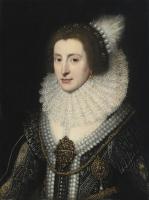


 Become a Member via our Buy Me a Coffee page to read more.
On 22nd June 1610 William Seymour 2nd Duke of Somerset [aged 22] and Arabella Stewart [aged 35] were married in secret at Palace of Placentia, Greenwich [Map]. For having married without permission [his father] King James I of England and Ireland and VI of Scotland [aged 44] had Arabella Stewart imprisoned in Sir Thomas Perry's House, Lambeth and he in the Tower of London [Map]. She the daughter of Charles Stewart 5th Earl Lennox and Elizabeth Cavendish Countess Lennox. They were third cousin once removed. He a great x 3 grandson of King Henry VII of England and Ireland. She a great x 2 granddaughter of King Henry VII of England and Ireland.
In 1611 King Charles I of England, Scotland and Ireland [aged 10] was appointed 405th Knight of the Garter by [his father] King James I of England and Ireland and VI of Scotland [aged 44].
In 1611 Maximilian Colt [aged 36] carved 'a crown on the head of the Duke of York's [aged 10] barge,' and in the following years he was employed in decorating the king's and queen's private barges. The last payment for this work was made on 14th October 1624.

In 1611 Robert "The Elder" Peake [aged 60]. Portrait of King Charles I of England, Scotland and Ireland [aged 10] in his Garter Robes and Leg Garter.
The Deeds of the Dukes of Normandy
The Gesta Normannorum Ducum [The Deeds of the Dukes of Normandy] is a landmark medieval chronicle tracing the rise and fall of the Norman dynasty from its early roots through the pivotal events surrounding the Norman Conquest of England. Originally penned in Latin by the monk William of Jumièges shortly before 1060 and later expanded at the behest of William the Conqueror, the work chronicles the deeds, politics, battles, and leadership of the Norman dukes, especially William’s own claim to the English throne. The narrative combines earlier historical sources with firsthand information and oral testimony to present an authoritative account of Normandy’s transformation from a Viking settlement into one of medieval Europe’s most powerful realms. William’s history emphasizes the legitimacy, military prowess, and governance of the Norman line, framing their expansion, including the conquest of England, as both divinely sanctioned and noble in purpose. Later chroniclers such as Orderic Vitalis and Robert of Torigni continued the history, extending the coverage into the 12th century, providing broader context on ducal rule and its impact. Today this classic work remains a foundational source for understanding Norman identity, medieval statesmanship, and the historical forces that reshaped England and Western Europe between 800AD and 1100AD.
Available at Amazon in eBook and Paperback format.

On 24th March 1611 Robert Carr 1st Earl Somerset [aged 24] was created 1st Viscount Rochester and admitted to the Privy Council. Robert Carr 1st Earl Somerset was now the [his father] Kings [aged 44] favourite.
Around 1612 Henry Vane "The Elder" [aged 22] and Frances Darcy [aged 21] were married. She being one of the heirs, possibly the only heir, of her father Thomas Darcy. She brought considerable wealth to the marriage as evidenced by Henry's subsequent spending on court positions. Immediately after the marriage Vane writes... I put myself into court, and bought a carver's place by means of the friendship of Sir Thomas Overbury [aged 31], which cost me £5,000.' Next year he devoted the £3,000 of his wife's portion to purchasing from Sir Edward Gorges a third part of the subpoena office in chancery, and later so ingratiated himself with the king [aged 45] that James gave him the reversion of the whole office for forty years.
On 6th November 1612 [his brother] Henry Frederick Stewart Prince of Wales [aged 18] died. Earl Chester extinct. The death of the heir to the throne significant; compare William Adelin Duke Normandy, Edward "Black Prince", Prince Arthur Tudor, Frederick Louis Hanover Prince of Wales, perhaps Edward York Prince of Wales.
On 14th February 1613 [his brother-in-law] Frederick Palatinate Simmern V Elector Palatine Rhine [aged 16] and [his sister] Princess Elizabeth Stewart Queen Bohemia [aged 16] were married at Chapel Royal, Whitehall Palace. She the daughter of [his father] King James I of England and Ireland and VI of Scotland [aged 46] and [his mother] Anne of Denmark Queen Consort Scotland England and Ireland [aged 38]. He the son of Frederick IV Elector Palatine and Electress Louise Juliana of the Palatine Rhine [aged 36]. They were fourth cousin once removed.
A grand occasion that saw more royalty than ever visit the court of England. The marriage was an enormously popular match and was the occasion for an outpouring of public affection with the ceremony described as "a wonder of ceremonial and magnificence even for that extravagant age".
It was celebrated with lavish and sophisticated festivities both in London and Heidelberg, including mass feasts and lavish furnishings that cost nearly £50,000, and nearly bankrupted King James. Among many celebratory writings of the events was John Donne's [aged 41] "Epithalamion, Or Marriage Song on the Lady Elizabeth, and Count Palatine being married on St Valentine's Day".


On 10th July 1613 Robert "The Elder" Peake [aged 62] was paid £13.6s.8d. by the vice-chancellor of the University of Cambridge, "in full satisfaction for Prince Charles [aged 12] his picture", for a full-length portrait which is still in the Cambridge University Library.
1614. The "Spanish Match" was the proposed marriage between Prince Charles [aged 13], the son of [his father] King James I of Great Britain [aged 47], and Infanta Maria Anna of Spain [aged 7], the daughter of Philip III of Spain [aged 35]. Negotiations took place over the period 1614 to 1623, and during this time became closely related to aspects of British foreign and religious policy, before breaking down completely.


On 3rd February 1614 Robert Ker 1st Earl Roxburghe [aged 44] and Jean Drummond Countess Roxburghe [aged 29] were married at Somerset House [Map]. She, Jean, was the sister of his son-in-law John Drummond 2nd Earl Perth [aged 26] who had married his daughter Jean Ker Countess Perth. The wedding was attended by the [his father] King [aged 47] and [his mother] Queen [aged 39]. There was a masque Hymen's Triumph written by Samuel Daniel.
On 4th November 1616 King Charles I of England, Scotland and Ireland [aged 15] was created Prince of Wales. Robert Radclyffe 5th Earl of Sussex [aged 43] carried the Purple Ermined Robe.
James Wriothesley [aged 11], brothers Robert Howard [aged 32] and William Howard, George Berkeley 8th Baron Berkeley [aged 15], Henry Carey 1st Viscount Falkland [aged 41] and John Cavendish were appointed Knight of the Bath.


In 1617 Sir David Foulis sold Henry Vane "The Elder" [aged 27] the post of cofferer to the Prince of Wales [aged 16], and he continued to hold this office after Charles had become king.
On 5th January 1617 George Villiers 1st Duke of Buckingham [aged 24] was created 1st Earl Buckingham by [his father] King James I of England and Ireland and VI of Scotland [aged 50]; his favourite.
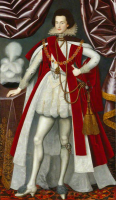


On 29th September 1617 John Villiers 1st Viscount Purbeck [aged 26] and Frances Coke Viscountess Purbeck [aged 15] were married at Hampton Court Palace, Richmond [Map]. [his father] King James I of England and Ireland and VI of Scotland [aged 51] gave away the bride. He the son of George Villiers of Brokesby and Mary Beaumont 1st Countess Buckingham [aged 47].
On 2nd March 1619 [his mother] Anne of Denmark Queen Consort Scotland England and Ireland [aged 44] died.

In 1621 Archbishop John Williams [aged 38] was appointed Bishop of Lincoln by [his father] King James I [aged 54].
On 4th January 1621 Charles Wilmot 1st Viscount Wilmot [aged 49] was created 1st Viscount Wilmot of Athlone by King Charles I [aged 20] as a reward for his activities in Ireland.
Anne Boleyn. Her Life as told by Lancelot de Carle's 1536 Letter.
In 1536, two weeks after the execution of Anne Boleyn, her brother George and four others, Lancelot du Carle, wrote an extraordinary letter that described Anne's life, and her trial and execution, to which he was a witness. This book presents a new translation of that letter, with additional material from other contemporary sources such as Letters, Hall's and Wriothesley's Chronicles, the pamphlets of Wynkyn the Worde, the Memorial of George Constantyne, the Portuguese Letter and the Baga de Secrets, all of which are provided in Appendices.
Available at Amazon in eBook and Paperback format.
On 8th January 1621 Mountjoy Blount 1st Earl Newport [aged 24] took part in a Masque before King Charles I of England, Scotland and Ireland [aged 20] staged by James Hay 1st Earl Carlisle [aged 41] at Essex House.


On 22nd January 1621 John Ramsay 1st Earl Holderness [aged 41] was created 1st Earl Holderness by [his father] King James I [aged 54].
On 7th March 1623 King Charles I of England, Scotland and Ireland [aged 22], accompanied by George Villiers 1st Duke of Buckingham [aged 30], Endymion Porter [aged 36] and Richard Wynn 2nd Baronet [aged 35], arrived in Madrid [Map], incognito, in an attempt to bring to a conclusion his betrothal to Maria Anna of Spain Holy Roman Empress [aged 16], much to the surprise of her brother Philip IV King Spain [aged 17] and the English ambassador John Digby 1st Earl Bristol [aged 43]. The negotiations ultimately failed.


Autobiography Simon D'Ewes. 17th February 1623. There happened on Monday, the 17th day of the month, so strange an accident as after ages will scarce believe it. For Charles Prince of Wales [aged 22] began his journey from London into Spain on Monday, the 17th day of February, with the beloved Marquis of Buckingham [aged 30], Sir Francis Cottington [aged 44], and Mr. Endimion Porter [aged 36], only in his campaign; who only, besides the King himself, were the alone men aquainted with the Prince's resolution. Their going was so secretly carried as none, I believe, knew of it in England till they were landed in France, through which kingdom they passed by posthorse into Spain.1 The journey was thought so dangerous, being above 1100 English miles by land, besides the crossing of the seas between Dover and Calais, as all men were generally ensaddened at the ad- venture, often wishing it had been better advised upon; although they knew the Spaniards durst do the Prince no harm, so long as his royal sister and her illustrious oflspring survived. Soon after followed the Lord Hays [aged 43], Earl of Carlisle, and passed into France to excuse to that King the Prince's sudden and secret passing through his kingdom without giving him a visit. All men now took it for granted, that the Prince's marriage with the Infanta Maria, the King of Spain's sister, was concluded on, and that he went over only to consummate it; no man imagining that he would take up such a resolution upon uncertainties, especially occasioning so vast and unnecessary expense at a time when the King's wants pressed him much. But God, whose decree binds princes as well as peasants, had otherwise disposed, so as our royal suitor, arriving at Madrid in Spain on Friday the 7th (or 17th) of March, about three weeks later his departure from London, and taking ship for his return to England on the 18th (or 28th) of September, then next ensuing, stayed in Spain about seven months; in all which time he seldom saw or spoke with the Spanish Princess, nor could ever receive a fair or sincere denial from her brother, although her marriage had been absolutely disposed of by her father's last will and testament; he bequeathing her to Ferdinand, son and heir of Ferdinand the Second, Emperor of Germany, who afterwards did accordingly espouse her.
Note 1. "And now behold a, strange adventure and enterprise! The Prince and the Marquis of Buckingham, accompanied with Cottington and Endimion Porter, post in disgiuse to Spain to accelerate the marriage. The 17th of February they went privately from Court, and the next day came to Dover, where they embarked for Boulogne, and from thence rode post to Paris, where they made some atop. The Prince, shadowed under a bushy peruque, beheld the splendour of that court, and had a full view of the [his future wife] Princess Henrietta Maria [aged 13], who was afterwards his royal consort. For, besides the great privacy of the journey, they had so laid the English ports, that none should follow or give the least advertisement, until they had got the start of intelligencers, and passed the bounds of France. Howbeit they escaped narrowly, and a swift intelligence sent to the King of Spain from Don Carlos Coloma was even at their heels before they arrived at Madrid. The Prince and Buckingham being in the territories of Spain, to make but little noise, rode post before their company.


Become a Member via our Buy Me a Coffee page to read more.

On 18th May 1623 George Villiers 1st Duke of Buckingham [aged 30] was created 1st Duke of Buckingham by [his father] King James I of England and Ireland and VI of Scotland [aged 56] for being his favourite; what favourite means is open to debate. Katherine Manners Duchess Buckingham [aged 21] by marriage Duchess of Buckingham.
In 1625 Robert Heath [aged 49] was appointed Attorney General by King Charles I of England, Scotland and Ireland [aged 24].
On 27th March 1625 [his father] King James I of England and Ireland and VI of Scotland [aged 58] died at Theobalds House, Hertfordshire. His son Charles [aged 24] succeeded I King England Scotland and Ireland. Duke York merged with the Crown.
On 2nd April 1625 the first Parliament of King Charles I of England, Scotland and Ireland [aged 24] known as the Useless Parliament sat.
On 1st May 1625 King Charles I of England, Scotland and Ireland [aged 24] and Henrietta Maria Bourbon Queen Consort England [aged 15] were married by proxy at Notre Dame de Paris Cathedral [Map]. She by marriage Queen Consort England. She the daughter of Henry IV King France and Marie de Medici Queen Consort France [aged 50]. He the son of King James I of England and Ireland and VI of Scotland and Anne of Denmark Queen Consort Scotland England and Ireland. They were third cousin once removed.
On 13th June 1625 King Charles I of England, Scotland and Ireland [aged 24] and [his wife] Henrietta Maria Bourbon Queen Consort England [aged 15] met for the first time at St Augustine's Abbey [Map].
On 2nd February 1626 King Charles I of England, Scotland and Ireland [aged 25] was crowned I King England Scotland and Ireland at Westminster Abbey [Map] by Archbishop George Abbott [aged 63]. His wife Henrietta Maria [aged 16] was not crowned since she being Catholic refused to attend an Anglican service. She watched Charles at a discreet distance.
Robert Radclyffe 5th Earl of Sussex [aged 52] carried the Orb.
Francis Talbot 11th Earl of Shrewsbury [aged 3] bore the Second Sword of State.
Philip Herbert 4th Earl Pembroke 1st Earl Montgomery [aged 41] carried the Spurs.
Francis Manners 6th Earl of Rutland [aged 48] bore the Rod with the Dove.
William Cavendish 3rd Earl Devonshire [aged 8], James Stanley 7th Earl of Derby [aged 19], James Howard 3rd Earl Suffolk [aged 6], Roger Palmer [aged 49] and Mildmay Fane 2nd Earl of Westmoreland [aged 24], John Maynard [aged 34] were appointed Knight of the Bath.
John Rayney 1st Baronet [aged 25] was knighted.


Become a Member via our Buy Me a Coffee page to read more.
On 5th February 1626 James Ley 1st Earl of Marlborough [aged 74] was created 1st Earl Marlborough by King Charles I of England, Scotland and Ireland [aged 25]. Jane Boteler Countess Marlborough by marriage Countess Marlborough.
In 1627 William Armine 1st Baronet [aged 33] refused to collect an arbitrary "loan" which the King [aged 26] had attempted to impose on Lincolnshire, and was imprisoned as a result.
In 3rd March 1627 Bryan Maguire 1st Baron of Enniskillen [aged 38] was created 1st Baron Enniskillen by [his father] King James I of England and Ireland and VI of Scotland.
On 13th May 1629 [his son] Charles James Stewart was born to King Charles I of England, Scotland and Ireland [aged 28] and [his wife] Henrietta Maria Bourbon Queen Consort England [aged 19]. He died the same day.
On 10th August 1629 Henry Carey 1st Viscount Falkland [aged 54] was directed to hand over his authority as Lord Deputy of Ireland to the lords justices on the pretext that his services were required in England. King Charles I [aged 28], recognising his good intentions, continued to hold him in favour.
Chronicle of Geoffrey le Baker of Swinbroke
Baker was a secular clerk from Swinbroke, now Swinbrook, an Oxfordshire village two miles east of Burford. His Chronicle describes the events of the period 1303-1356: Gaveston, Bannockburn, Boroughbridge, the murder of King Edward II, the Scottish Wars, Sluys, Crécy, the Black Death, Winchelsea and Poitiers. To quote Herbert Bruce 'it possesses a vigorous and characteristic style, and its value for particular events between 1303 and 1356 has been recognised by its editor and by subsequent writers'. The book provides remarkable detail about the events it describes. Baker's text has been augmented with hundreds of notes, including extracts from other contemporary chronicles, such as the Annales Londonienses, Annales Paulini, Murimuth, Lanercost, Avesbury, Guisborough and Froissart to enrich the reader's understanding. The translation takes as its source the 'Chronicon Galfridi le Baker de Swynebroke' published in 1889, edited by Edward Maunde Thompson.
Available at Amazon in eBook and Paperback format.
In 1630 Ralph Dutton [aged 55] was appointed Gentleman of the Privy Chamber to King Charles I of England, Scotland and Ireland [aged 29].
In 1630 King Charles I of England, Scotland and Ireland [aged 29] created four Knights of the Garter..
428th Richard Weston 1st Earl of Portland [aged 52].
429th Robert Bertie 1st Earl Lindsey [aged 47].
430th William Cecil 2nd Earl Exeter [aged 64].
431st James Hamilton 1st Duke Hamilton [aged 23].


On 29th May 1630 [his son] King Charles II of England Scotland and Ireland was born to King Charles I of England, Scotland and Ireland [aged 29] and [his wife] Henrietta Maria Bourbon Queen Consort England [aged 20] at St James's Palace [Map]. He was created Duke of Cornwall and Duke Rothesay the same day. He married 21st May 1662 Catherine of Braganza Queen Consort England, daughter of John IV King Portugal and Luisa de Guzman Queen Consort Portugal.


On 27th June 1630 the future [his son] Charles II was baptised by Archbishop William Laud [aged 56] at Chapel Royal, St James's Palace. [his brother-in-law] Louis XIII King France [aged 28] and [his mother-in-law] Marie de Medici Queen Consort France [aged 55] were godparents.
Robert Kerr 1st Earl Ancram [aged 52] was created 1st Earl Ancram.


In January 1631 Frederick Cornwallis 1st Baron Cornwallis [aged 19] and Elizabeth Ashburnham [aged 18] were married. After the wedding King Charles I [aged 30], [his wife] Henrietta Maria [aged 21] and Susan Feilding, Countess of Denbigh [aged 48] wrote to congratulate his mother Jane, Baroness Cornwallis Bacon [aged 50], and ask her to forgive him for his disobedience and return him to her favour. Denbigh said Ashburnham was her cousin "though her family be unfortunate".


On 5th July 1631 Edmund Waller [aged 25] and Anne Banks were married in defiance of orders of the Privy Council of England and the Court of Aldermen of the City of London whose ward she was. Her father had left her £8000 when he died a year earlier. The Aldermen made a complaint to the Star Chamber, seeking that for the offence of marrying Anne without the court's permission the whole of the Banks fortune should be forfeited to the City of London, but they were denied such an outcome by a pardon from King Charles [aged 30], who took a more tolerant view of the matter. Waller was then summoned to appear before the Court of Aldermen in December 1631, when he agreed to make a jointure of £1,000 a year to his wife, also giving her the power to spend £2,000 of her inheritance, and the Court accepted this proposal but fined him 500 marks.
On 4th November 1631 [his daughter] Mary Stewart Princess Orange was born to King Charles I of England, Scotland and Ireland [aged 30] and [his wife] Henrietta Maria Bourbon Queen Consort England [aged 21]. She married 2nd May 1641 William Orange Nassau II Prince Orange and had issue.


In 1633 Anthony Van Dyck [aged 33]. Portrait of King Charles I of England, Scotland and Ireland [aged 32] known as Charles I with M.De St Antoine.
In 1633 King Charles I of England, Scotland and Ireland [aged 32] created four Knights of the Garter..
423nd [his nephew] Charles Louis Palatinate Simmern [aged 15].
433rd James Stewart 4th Duke Lennox 1st Duke Richmond [aged 20].
434th Henry Danvers 1st Earl Danby [aged 59].
435th William Douglas 7th Earl Morton [aged 51].

On 14th October 1633 [his son] James, Duke of York was born to King Charles I of England, Scotland and Ireland [aged 32] and [his wife] Henrietta Maria Bourbon Queen Consort England [aged 23] at St James's Palace [Map]. He was created 1st Duke York at birth by his father. He married (1) 3rd September 1660 Anne Hyde Duchess of York, daughter of Edward Hyde 1st Earl Clarendon and Frances Aylesbury Countess Clarendon, and had issue (2) 20th September 1673 Mary of Modena Queen Consort England Scotland and Ireland and had issue.
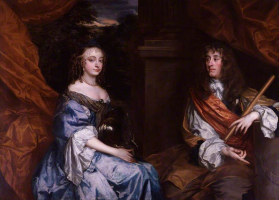


On 19th December 1635 Mary Witham 1st Baronetess Bolles [aged 56] was created 1st Lady Bolles by King Charles I of England, Scotland and Ireland [aged 35] with remainder to her heirs male and assignees. The only creation of a Baronetess in history. Bolles the name of her late husband Thomas Bolles who had died nine months before.
On 28th December 1635 [his daughter] Elizabeth Stewart was born to King Charles I of England, Scotland and Ireland [aged 35] and [his wife] Henrietta Maria Bourbon Queen Consort England [aged 26].
In 1636 Stephen Goffe [aged 31] was appointed chaplain to King Charles I of England, Scotland and Ireland [aged 35] on the recommendation of Henry Jermyn 1st Earl St Albans [aged 30].
Jean de Waurin's Chronicle of England Volume 6 Books 3-6: The Wars of the Roses
Jean de Waurin was a French Chronicler, from the Artois region, who was born around 1400, and died around 1474. Waurin’s Chronicle of England, Volume 6, covering the period 1450 to 1471, from which we have selected and translated Chapters relating to the Wars of the Roses, provides a vivid, original, contemporary description of key events some of which he witnessed first-hand, some of which he was told by the key people involved with whom Waurin had a personal relationship.
Available at Amazon in eBook and Paperback format.

Around 1637 Anthony Van Dyck [aged 37]. Portrait of King Charles I of England, Scotland and Ireland [aged 36].

In May 1638 George Stewart 9th Seigneur D'Aubigny [aged 19] and Catherine Howard Countess Newburgh were married. They married in secret against the wishes of King Charles I of England, Scotland and Ireland [aged 37]. She the daughter of Theophilus Howard 2nd Earl Suffolk [aged 55] and Elizabeth Home Countess Suffolk. He the son of Esmé Stewart 3rd Duke Lennox and Katherine Clifton Duchess Lennox. They were half fifth cousin once removed.
In 1640 Robert Heath [aged 64] was appointed Lord Chief Justice by King Charles I of England, Scotland and Ireland [aged 39].
On 21st January 1640 Mountjoy Blount 1st Earl Newport [aged 43] participated with King Charles I of England, Scotland and Ireland [aged 39] in the extravagant masque on the theme of Philogenes, royal Lover of the People.
On 5th May 1640 King Charles I of England, Scotland and Ireland [aged 39] dissolved the Short Parliament.
John Evelyn's Diary. 11th April 1640. I went to London to see the solemnity of his Majesty's [aged 39] riding through the city in state to the Short Parliament, which began the 13th following,-a very glorious and magnificent sight, the King circled with his royal diadem and the affections of his people: but the day after I returned to Wotton, Surrey [Map] again, where I stayed, my father's [aged 53] indisposition suffering great intervals, till April 27th, when I was sent to London to be first resident at the Middle Temple: so as my being at the University, in regard of these avocations, was of very small benefit to me. Upon May the 5th following, was the Parliament unhappily dissolved; and, on the 20th I returned with my brother George to Wotton, Surrey [Map], who, on the 28th of the same month, was married at Albury to Mrs. Caldwell (an heiress of an ancient Leicestershire family1, where part of the nuptials were celebrated.
Note 1. A daughter of Daniel Caldwell, Esq., by Mary, daughter of George Duncomb, Esq., of Albury. She died 15th May, 1644, and he afterwards married the widow of Sir John Cotton.
Between June 1640 and October 1640 the Second Bishop's War was an attack by the Scottish Covenanters into England against King Charles I of England, Scotland and Ireland [aged 39]. The Scots crossed into Northumberland reaching Newcastle upon Tyne, Northumberland [Map]. In October 1640 King Charles I of England, Scotland and Ireland sued for peace.

On 8th July 1640 [his son] Henry Stewart 1st Duke Gloucester was born to King Charles I of England, Scotland and Ireland [aged 39] and [his wife] Henrietta Maria Bourbon Queen Consort England [aged 30].
On 26th October 1640 the Treaty of Ripon was a peace treaty signed by King Charles I of England, Scotland and Ireland [aged 39] to cease the war with Scotland in the North. Charles agreed the Scots could retain large parts of northern England, and to pay them £850 per day until the August 1641 1641 Treaty of London.
John Evelyn's Diary. 30th December 1640. I saw his Majesty [aged 40] (coming from his Northern Expedition) ride in pomp and a kind of ovation, with all the marks of a happy peace, restored to the affections of his people, being conducted through London with a most splendid cavalcade; and on the 3d of November following (a day never to be mentioned without a curse), to that long ungrateful, foolish, and fatal Parliament, the beginning of all our sorrows for twenty years after, and the period of the most happy monarch in the world: Quis talia fando!
In 1641 Alexander Leslie 1st Earl Leven [aged 61] was created 1st Earl Leven by King Charles I of England, Scotland and Ireland [aged 40].

In 1641 Charles Cotterell [aged 25] was appointed Master of the Ceremonies by King Charles I of England, Scotland and Ireland [aged 40].
In 1641 James Stewart 4th Duke Lennox 1st Duke Richmond [aged 28] was created 1st Duke Richmond by King Charles I of England, Scotland and Ireland [aged 40]. Mary Villiers Duchess Lennox Duchess Richmond [aged 19] by marriage Duchess Richmond.
Abbot John Whethamstede’s Chronicle of the Abbey of St Albans
Abbot John Whethamstede's Register aka Chronicle of his second term at the Abbey of St Albans, 1451-1461, is a remarkable text that describes his first-hand experience of the beginning of the Wars of the Roses including the First and Second Battles of St Albans, 1455 and 1461, respectively, their cause, and their consequences, not least on the Abbey itself. His text also includes Loveday, Blore Heath, Northampton, the Act of Accord, Wakefield, and Towton, and ends with the Coronation of King Edward IV. In addition to the events of the Wars of the Roses, Abbot John, or his scribes who wrote the Chronicle, include details in the life of the Abbey such as charters, letters, land exchanges, visits by legates, and disputes, which provide a rich insight into the day-to-day life of the Abbey, and the challenges faced by its Abbot.
Available at Amazon in eBook and Paperback format.
In 1641 Philip Herbert 4th Earl Pembroke 1st Earl Montgomery [aged 56] struck Henry Howard 15th or 22nd Earl of Arundel 5th Earl of Surrey 2nd Earl Norfolk [aged 32] with a cane during a Meeting in the House of Lords. King Charles I of England, Scotland and Ireland [aged 40] replaced him as Lord Chamberlain with Robert Devereux 3rd Earl Essex [aged 49].
In 1641 Elizabeth Darcy 1st Countess Rivers [aged 60] was created 1st Countess Rivers for life by King Charles I of England, Scotland and Ireland [aged 40] since she had been passed over when her father's Earldom Countess Rivers passed from her father to her eldest son John Savage 2nd Earl Rivers [aged 37].

On 13th April 1641 Thomas Wentworth 1st Earl Strafford [aged 48] was attainted by 204 votes to 59 ostensibly for his authoritarian rule as Lord Deputy of Ireland. Despite his promise not to King Charles I of England, Scotland and Ireland [aged 40] signed the death warrant on the 10th May 1641 in the light of increasing pressure from Parliament and the commons.
Wenceslaus Hollar [aged 33]. Engraving of the Trial of Thomas Wentworth 1st Earl Strafford with the following marked:
A. King Charles I of England, Scotland and Ireland.
C. [his wife] Henrietta Maria Bourbon Queen Consort England [aged 31].
D. [his son] King Charles II of England Scotland and Ireland [aged 10].
E. Thomas Howard 14th or 21st Earl of Arundel 4th Earl of Surrey 1st Earl Norfolk [aged 55], Lord High Steward.
F. Henry Montagu 1st Earl Manchester [aged 78], Lord Keeper of the Great Seal.
G. John Paulet 5th Marquess Winchester [aged 43].
H. Robert Bertie 1st Earl Lindsey [aged 58], Lord Chamberlain.
I. Philip Herbert 4th Earl Pembroke 1st Earl Montgomery [aged 56], Lord Chamberlain of the Household.
V. Thomas Wentworth 1st Earl Strafford.
Z. Alethea Talbot Countess Arundel, Surrey and Norfolk [aged 56].
John Evelyn's Diary. 15th April 1641 I repaired to London to hear and see the famous trial of the Earl of Strafford, Lord-Deputy of Ireland [aged 48], who, on the 22nd of March, had been summoned before both Houses of Parliament, and now appeared in Westminster Hall [Map], which was prepared with scaffolds for the Lords and Commons, who, together with the King [aged 40], [his wife] Queen [aged 31], [his son] Prince [aged 10], and flower of the noblesse, were spectators and auditors of the greatest malice and the greatest innocency that ever met before so illustrious an assembly. It was Thomas Earl of Arundel and Surrey [aged 55], Earl Marshal of England, who was made High Steward upon this occasion; and the sequel is too well known to need any notice of the event.


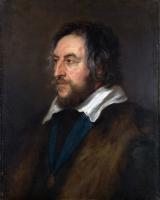

John Evelyn's Diary. 12th May 1641. I beheld on Tower-hill [Map] the fatal stroke which severed the wisest head in England from the shoulders of the Earl of Strafford [aged 48], whose crime coming under the cognizance of no human law, or statute, a new one was made, not to be a precedent, but his destruction. With what reluctancy the King [aged 40] signed the execution, he has sufficiently expressed; to which he imputes his own unjust suffering - to such exorbitancy were things arrived.
On 2nd May 1641 [his son-in-law] William Orange Nassau II Prince Orange [aged 14] and Mary Stewart Princess Orange [aged 9] were married. She the daughter of King Charles I of England, Scotland and Ireland [aged 40] and Henrietta Maria Bourbon Queen Consort England [aged 31].
On 14th July 1641 King Charles I of England, Scotland and Ireland [aged 40] created new Baronets:
John Cotton 1st Baronet [aged 25] was created 1st Baronet Cotton of Landwade in Cambridgeshire.
Thomas Abdy 1st Baronet [aged 29] was created 1st Baronet Abdy of Felix Hall in Kelveden in Essex.
John Bampfylde 1st Baronet [aged 31] was created 1st Baronet Bampfylde of Poltimore in Devon.
On 29 or 30th July 1641 William Strickland 1st Baronet [aged 45] was created 1st Baronet Strickland of Boynton in Yorkshire. Frances Finch Lady Strickland by marriage Lady Strickland of Boynton in Yorkshire.
John Evelyn's Diary. 23rd November 1641. I returned to London; and, on the 25th, saw his Majesty [aged 41] ride through the City after his coming out of Scotland, and a Peace proclaimed, with great acclamations and joy of the giddy people.
In 1642 [his nephew] Prince Rupert Palatinate Simmern 1st Duke Cumberland [aged 22] was appointed 440th Knight of the Garter by his uncle King Charles I of England, Scotland and Ireland [aged 41].


On 4th January 1642 King Charles I of England, Scotland and Ireland [aged 41] sent soldiers into Parliament to arrest a five MPs: Pym, John Hampden [aged 46], Hazlerigg, Holies and Strode [aged 44]. They had received warning and sought safety. After this Civil War was certain, and men began to choose their side.
In June 1642 William Cavendish 3rd Earl Devonshire [aged 24] was with King Charles I [aged 41] at York [Map].
On 13th October 1642 King Charles I [aged 41] stayed the night at the house of William Cavendish 3rd Earl Devonshire [aged 25] at Latimer House, Chesham.
On 14th October 1642 Richard Newport 1st Baron Newport [aged 55] was created 1st Baron Newport of High Ercall in Shropshire; by King Charles I of England, Scotland and Ireland [aged 41] in return for having provided £6000 for the purchase of artillery before the Battle of Edge Hill.
On 23rd October 1642 the Battle of Edge Hill was fought at Edge Hill [Map]. The Royal army was commanded by King Charles I of England, Scotland and Ireland [aged 41] (with his son King Charles II of England Scotland and Ireland [aged 12] present), Prince Rupert Palatinate Simmern 1st Duke Cumberland [aged 22] and Richard Spencer [aged 49] commanded the army that included Maurice Palatinate Simmern [aged 21], Richard Byron 2nd Baron Byron [aged 36], Lucius Carey 2nd Viscount Falkland [aged 32], Charles Cavendish [aged 22], Henry Newton aka Puckering 3rd Baronet [aged 24], Spencer Compton 2nd Earl of Northampton [aged 41], Thomas Salusbury 2nd Baronet [aged 30], John Byron 1st Baron Byron [aged 43] and William Feilding 1st Earl Denbigh [aged 55].
George Stewart 9th Seigneur D'Aubigny [aged 24] was killed.
Of the Parliamentary army Basil Feilding 2nd Earl Denbigh [aged 34] and Robert Devereux 3rd Earl Essex [aged 51]. Oliver St John 5th Baron St John [aged 39] was wounded.
Samuel Sandes [aged 27] commanded a troop of horse.
Richard Sandes [aged 26] was killed.
Thomas Strickland [aged 20] was knighted on the field for his gallantry.
Henry Hunloke 1st Baronet [aged 24] was knighted by King Charles I of England, Scotland and Ireland.
William Dugdale [aged 37] witnessed the battle and subsequently surveyed the battlefield.
John Hinton [aged 38] was present.
Edward Verney [aged 52] was killed.
John Assheton [aged 29] was killed.
Robert Bertie 1st Earl Lindsey [aged 59] was killed. His son Montagu [aged 34] succeeded 2nd Earl Lindsey, 15th Baron Willoughby de Eresby.
William Pennyman 1st Baronet [aged 35] commanded a regiment, of which he served as Colonel, which he led for the King.
Edward Stradling 2nd Baronet [aged 42] fought for the King, was captured imprisoned for seven months, and died a month after his release.


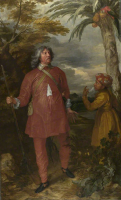

Become a Member via our Buy Me a Coffee page to read more.
On 18th October 1642 King Charles I of England, Scotland and Ireland [aged 41] stayed at Aston Hall, Warwickshire.
Henrici Quinti, Angliæ Regis, Gesta, is a first-hand account of the Agincourt Campaign, and subsequent events to his death in 1422. The author of the first part was a Chaplain in King Henry's retinue who was present from King Henry's departure at Southampton in 1415, at the siege of Harfleur, the battle of Agincourt, and the celebrations on King Henry's return to London. The second part, by another writer, relates the events that took place including the negotiations at Troye, Henry's marriage and his death in 1422.
Available at Amazon in eBook and Paperback format.
On 28th February 1643 Henry Hunloke 1st Baronet [aged 25] was created 1st Baronet Hunloke of Wingerworth in Derbyshire by King Charles I of England, Scotland and Ireland [aged 42].
On 14th May 1643 [his brother-in-law] Louis XIII King France [aged 41] died. His son Louis [aged 4] succeeded XIV King France: Capet Valois Bourbon.
On 20th September 1643 the First Battle of Newbury was fought at Newbury, Berkshire [Map] with King Charles I of England, Scotland and Ireland [aged 42] commanding the Royalist army and Robert Devereux 3rd Earl Essex [aged 52] commanding the victorious Parliamentary army. For King Charles I of England, Scotland and Ireland John Byron 1st Baron Byron [aged 44] fought with distinction.
Henry Bertie was killed.
Robert Dormer 1st Earl Carnarvon [aged 33] was killed. His son Charles [aged 10] succeeded 2nd Earl Carnarvon, 3rd Baron Dormer of Wyng in Buckinghamshire, 3rd Baronet Dormer of Wyng in Buckinghamshire.
William Villiers 2nd Viscount Grandison [aged 29] was killed. His brother John succeeded 3rd Viscount Grandison.
Edward Villiers [aged 23] fought.
Lucius Carey 2nd Viscount Falkland [aged 33] was killed. His son Lucius [aged 11] succeeded 3rd Viscount Falkland.
Richard Neville [aged 28] served under the Earl Carnarvon. Carnarvon was killed and Neville took up the command as a Colonel of Horse.
Major General Charles Fleetwood [aged 25] was wounded.


Become a Member via our Buy Me a Coffee page to read more.
In 1644 [his nephew] Prince Rupert Palatinate Simmern 1st Duke Cumberland [aged 24] was created 1st Duke Cumberland, 1st Earl Holderness by King Charles I of England, Scotland and Ireland [aged 43].
On 23rd May 1644 Alice Leigh 1st Duchess Dudley [aged 66] was created 1st Duchess Dudley by King Charles I of England, Scotland and Ireland [aged 43] for life. Her husband Robert Dudley [aged 69] had claimed to be the legitimate son of Robert Dudley 1st Earl of Leicester but the Star Chamber found against him. King Charles I of England, Scotland and Ireland disagreed with their verdict and, in compensation of her subsequent treatment, awarded her the Dukedom... See Patent of Creation.


On 16th June 1644 [his daughter] Princess Henrietta Stewart Duchess Orléans was born to King Charles I of England, Scotland and Ireland [aged 43] and [his wife] Henrietta Maria Bourbon Queen Consort England [aged 34] at Bedford House Exeter, Devon. John Hinton [aged 40] was in attendance. She married 31st March 1661 her first cousin Philip Bourbon I Duke Orléans, son of Louis XIII King France and Anne of Austria Spain Queen Consort France, and had issue.


On 6th October 1644 [his sister-in-law] Elisabeth Bourbon Queen Consort Spain [aged 41] died.
On 3rd January 1645 King Charles I [aged 44] rewarded his supporters with Baronies...
John Brooke 1st Baron Cobham [aged 69] was created 1st Baron Cobham. Frances Bampfield Baroness Cobham by marriage Baroness Cobham.
John Lucas 1st Baron Lucas Shenfield [aged 38] was created 1st Baron Lucas of Shenfield with special remainder to the male issue of his brother Thomas Lucas [aged 66].

On 12th April 1645 Colonel William Legge was appointed Groom of the Bedchamber to King Charles I of England, Scotland and Ireland [aged 44].
On 8th July 1645 Francis Hawley 1st Baron Hawley [aged 37] was created 1st Baron Hawley of Donsmore by King Charles I of England, Scotland and Ireland [aged 44].
Archaeologia Cambrensis 1820 Page 464. Sept. 21. "The King [aged 44] passed through Mountgomeryshyre, and lay that night at Llan Fyllin. The next day, the 22d Sept., the King marched from Llan Fyllin by Brithdir, where he dined? and gave proclamation among his souldiers, that they should not plunder any thing in Denbyshire, and thence through Mochnant to Cevn hir Fynydd, and so along the tops of the mountains to Chirk Castle [Map]. The rest of the forces marched to Llan-Silin. The next day after, being Tuesday, the King advanced towards Chester.
On 24th September 1645 the Battle of Rowton Heath aka Moor was a significant defeat for the Royalists, commanded in person by King Charles [aged 44] with heavy losses and prevented Charles from relieving the siege of Chester.
In May 1646 King Charles I of England, Scotland and Ireland [aged 45] surrendered.
After January 1647 John Coke [aged 40] was one of the nine commissioners appointed to take charge of King Charles I [aged 46] at Holdenby House, Northamptonshire [Map].
On 10th November 1647 King Charles I of England, Scotland and Ireland [aged 46] escaped from Hampton Court Palace, Richmond [Map] with John Berkeley 1st Baron Berkeley [aged 45].
Chronicle of Geoffrey le Baker of Swinbroke
Baker was a secular clerk from Swinbroke, now Swinbrook, an Oxfordshire village two miles east of Burford. His Chronicle describes the events of the period 1303-1356: Gaveston, Bannockburn, Boroughbridge, the murder of King Edward II, the Scottish Wars, Sluys, Crécy, the Black Death, Winchelsea and Poitiers. To quote Herbert Bruce 'it possesses a vigorous and characteristic style, and its value for particular events between 1303 and 1356 has been recognised by its editor and by subsequent writers'. The book provides remarkable detail about the events it describes. Baker's text has been augmented with hundreds of notes, including extracts from other contemporary chronicles, such as the Annales Londonienses, Annales Paulini, Murimuth, Lanercost, Avesbury, Guisborough and Froissart to enrich the reader's understanding. The translation takes as its source the 'Chronicon Galfridi le Baker de Swynebroke' published in 1889, edited by Edward Maunde Thompson.
Available at Amazon in eBook and Paperback format.
On 19th May 1648 Colonel William Legge was imprisoned at Arundel Castle [Map] for having supported King Charles I of England, Scotland and Ireland [aged 47] in his escape from Hampton Court Palace, Richmond [Map].
Between 15th September 1648 and 27th November 1648 the Treaty of Newport attempted to reconcile King Charles I of England, Scotland and Ireland [aged 47] (who was imprisoned at nearby Carisbrooke Castle [Map]) with Parliament. Denzil Holles 1st Baron Holles [aged 48] and Henry Vane "The Younger" [aged 35] represented Parliament. James Butler 1st Duke Ormonde [aged 37] represented King Charles. The Treaty eventually came to nothing.
Parliament was also represented by John Crew 1st Baron Crew [aged 50], John Glynne [aged 46], Nathaniel Fiennes [aged 40], William Pierrepont of Thoresby [aged 40], Algernon Percy 10th Earl of Northumberland [aged 45], William Fiennes 1st Viscount Saye and Sele [aged 66], Philip Herbert 4th Earl Pembroke 1st Earl Montgomery [aged 63], William Cecil 2nd Earl Salisbury [aged 57], James Cranfield 2nd Earl Middlesex [aged 27] and Thomas Wenman 2nd Viscount Wenman [aged 52].


On 29th January 1649 King Charles I of England, Scotland and Ireland [aged 48] fifty-seven commissioners signed King Charles' Death Warrant at Westminster Hall [Map]. Two further names were added subsequently.
10 Thomas Maulever 1st Baronet
14 Major-General William Goffe
21 Admiral Richard Deane
42 John Jones
45 Major General Charles Fleetwood
55 John Downes
57 Thomas Scot
58 John Carew
The commissioners who sat at the trial but did not sign the Death Warrant included:
William Monson 1st Viscount Monson [aged 50]
James Harington 3rd Baronet [aged 41]
The Captain of the Guard was Daniel Axtell [aged 27]. The guards included Francis Hacker, Matthew Tomlinson [aged 31].
The Solicitor-General was John Cook [aged 41].


Become a Member via our Buy Me a Coffee page to read more.
On 29th January 1649. In Echard's England (vol. ii, p. 639, edit. 1718) it is stated that early in the rebellion King Charles I of England, Scotland and Ireland [aged 48] confided to Elizabeth Cole Lady Wheler, his former laundres, a casket, which she restored to him the night before his execution.

On 30th January 1649 Charles I [aged 48] was beheaded with one clean stroke outside the Banqueting House, Whitehall Palace [Map]. He put his head on the block and, after saying a prayer, he signalled the executioner when he was ready by stretching out his hands.
In 1649 William Heveningham [aged 45] refused to sign the death warrant of King Charles I of England, Scotland and Ireland [aged 48].
Journal of Robert Leicester. The King [aged 48] lay at Whytehall on Sunday night, on Monday night he lay at St. Jameses, and on Tuesday 30th January [1649] about 10 o'clock in the morning the King was brought from St. Jameses walking on foote through the Parke, with a regiment of foote, part before and part behinde him, with coulers flying, drums beating, his private guard of partisans with some of his gentlemen before and some behinde, bareheaded, — Doctor Juxon [aged 67] next behinde him, and Collonell Tomlinson (who had the charge of him) talking with the King bareheaded, from the Parke up the staires into the Gallerye, and so into the chamber where he used to lye, where, he continued at his devotion, refusing to dine, (having before taken the sacrament) about an hour before he came forth only, he dranke a glass of claret wine, and eat a piece of bread, about twelve at noone. From thence he was accompanyed by Bishop Juxon, Coll. Tomlinson, and other officers formerly appointed to attend him, and the private guard of partisans, with musqueteers on each syde, through the Banquetting house [Map], adjoining to which the scaffold was erected, between Whitehall gate and the gallery leading to St. Jameses, &c. The King being come upon the scaffold, looked very earnestly upon the block, and asked Collonell Hacker if there were no higher, and then spake thus (directing his speech chiefly to Collonell Tomlinson, &c.)
"I declare before you all, that I dye a Christian according to the profession of the Church of England, as I found it left me by my father; and this honest man, pointing to Dr. Juxon, I thinke will witness it," &c. Many other things being sayd, the King layd his head down, and the executioner at one blow severed it from his body, which the second executioner held up, and shewed it to the spectators.
The executioners were two, and disguised in saylors clothes, with visards and peruques unknown; yet some have a conceit that he that gave the stroke, was one Collonell Foxe, and the other Captain Joyce, who took the King from Holmby, but that is not beleeved. This I heard for certain, that Gregory Brandon, the common hangman of London, refused absolutely to do it, and professed that he would be shott or otherways killed rather than do it.
The body was putt in a coffin, covered with black velvet, and layed in his lodging chamber in Whitehall.
Become a Member via our Buy Me a Coffee page to read more.
Diary of Philip Henry. On the day of his [King Charles I [aged 48]] execution, which was Tuesday, Jan. 30 [1649], I stood amongst the crowd in the street before Whitehal gate, where the scaffold was erected, and saw what was done, but was not so near as to hear any thing. The Blow I saw given, & can truly say with a sad heart; at the instant whereof, I remember wel, there was such a Grone by the Thousands then present, as I never heard before & desire I may never hear again. There was according to Order one Troop immediately marching from-wards Charing-cross to Westm' & another from-wards Westm' to charing-cross purposely to masker the people, & to disperse & scatter them, so that I had much adoe amongst the jrest to escape home without hurt.
On 4th January 1649 King Charles I of England, Scotland and Ireland [aged 48] was committed for trial by the Rump Parliament.
On 6th January 1649 Thomas Pride, on behalf of Thomas Fairfax 3rd Lord Fairfax [aged 36] and Henry Ireton [aged 38], supported by two regiments, and Nathaniel Rich's [aged 24] Regiment of Horse, with Thomas Grey [aged 26], prevented MPs opposed to the trial of King Charles I [aged 48] from entering Parliament including...
James Herbert [aged 26].
Robert Pye [aged 29].
Denzil Holles 1st Baron Holles [aged 49].
John Spelman [aged 42].
On 9th February 1649 King Charles I of England, Scotland and Ireland [deceased] was buried in the Henry VIII Vault, St George's Chapel, Windsor Castle [Map] without ceremony.
Memoirs of Jean Francois Paul de Gondi Cardinal de Retz Book 1. The 24th of February, 1649, the Parliament's deputies waited on the Queen [aged 10] with an account of the audience granted to the envoy of the Archduke. The Queen told them that they should not have given audience to the envoy, but that, seeing they had done it, it was absolutely necessary to think of a good peace, that she was entirely well disposed; and the Duc d'Orléans and the Prince de Conde promised the deputies to throw open all the passages as soon as the Parliament should name commissioners for the treaty.
Flamarin being sent at the same time into the city from the Duc d'Orléans to condole with the [his former wife] Queen of England [aged 39] on the death of her husband [deceased] (King Charles I.), went, at La Riviere's solicitation, to M. de La Rochefoucault, whom he found in his bed on account of his wounds and quite wearied with the civil war, and persuaded him to come over to the Court interest. He told Flamarin that he had been drawn into this war much against his inclinations, and that, had he returned from Poitou two months before the siege of Paris, he would have prevented Madame de Longueville engaging in so vile a cause, but that I had taken the opportunity of his absence to engage both her and the Prince de Conti, that he found the engagements too far advanced to be possibly dissolved, that the diabolical Coadjutor would not bear of any terms of peace, and also stopped the ears of the Prince de Conti and Madame de Longueville, and that he himself could not act as he would because of his bad state of health. I was informed of Flamarin's negotiations for the Court interest, and, as the term of his passport had expired, ordered the 'prevot des marchands' to command him to depart from the city.


On 13th May 1659 [his son] Henry Stewart 1st Duke Gloucester [aged 18] was created 1st Duke Gloucester, 1st Earl Cambridge by King Charles I of England, Scotland and Ireland.
On 9th July 1659 Colonel Roger Whitley of Peel in Cheshire [aged 41] was granted arms by King Charles I of England, Scotland and Ireland.

In 1660 Thomas Howard 5th Duke of Norfolk [aged 32] was restored 5th Duke Norfolk by King Charles I of England, Scotland and Ireland in response to a petition by Parliament it having previously been forfeited in 1572 by his great-great-grandfather Thomas Howard 4th Duke of Norfolk who had been executed for his involvement in the Ridolphi Plot.

In July 1661 [his son] King Charles II of England Scotland and Ireland [aged 31] created new Baronetcies and Peerages...
10th July 1661 Christopher Guise 1st Baronet [aged 44] was created 1st Baronet Guise of Elmore in Gloucestershire.
16th July 1661 Philip Parker 1st Baronet [aged 43] was created 1st Baronet Parker of Arwarton in Suffolk. Rebecca Long Lady Parker by marriage Lady Parker of Arwarton in Suffolk.
21st July 1661 Charles Hussey 1st Baronet [aged 35] was created 1st Baronet Hussey of Caythorpe in Lincolnshire.
21st July 1661 Edward Barkham 1st Baronet [aged 31] was created 1st Baronet Barkham Waynflete.
25th July 1661 John Banks 1st Baronet [aged 34] was created 1st Baronet Banks of London by King Charles I of England, Scotland and Ireland.
In 1666 [his grandson] Charles Stewart 1st Duke Kendal was created 1st Duke Kendal by King Charles I of England, Scotland and Ireland. No patent was ever enrolled
On 10th September 1669 [his former wife] Henrietta Maria Bourbon Queen Consort England [aged 59] died at the Château de Colombes [Map]. She was buried at the Basilica of St Denis [Map].
On 3rd May 1682 the [his son] Duke of York [aged 48] and his retinue including John Churchill 1st Duke of Marlborough [aged 31] and George Legge 1st Baron Dartmouth [aged 35] were seen off on their journey north by King Charles I of England, Scotland and Ireland from Margate Roads, Kent [Map]. James was possibly travelling to Edinburgh to collect his six months pregnant wife [his daughter-in-law] Mary of Modena [aged 23] to ensure their child was born in England.


Vesta Monumenta. 1739. Plate 1.55. Eight numismatic objects associated with the Stuarts: a gold coin of [his grandmother] Mary, Queen of Scots 1555; a silver medal commemorating Mary's marriage to [his grandfather] Lord Darnely, featuring Darnley's name before Mary's from 1565; a silver coronation medal around 1604 for [his granddaughter] Queen Anne; a silver medal for [his brother] Prince Henry from 1612; two milled gold proof pieces minted for Charles I, around 1630 and 1631-32, and two gold medals based on the same (1639 and unknown). Engraving by George Vertue [aged 55] after his own drawings in at least four states between 1723 and 1739.
William of Worcester's Chronicle of England
William of Worcester, born around 1415, and died around 1482 was secretary to John Fastolf, the renowned soldier of the Hundred Years War, during which time he collected documents, letters, and wrote a record of events. Following their return to England in 1440 William was witness to major events. Twice in his chronicle he uses the first person: 1. when writing about the murder of Thomas, 7th Baron Scales, in 1460, he writes '… and I saw him lying naked in the cemetery near the porch of the church of St. Mary Overie in Southwark …' and 2. describing King Edward IV's entry into London in 1461 he writes '… proclaimed that all the people themselves were to recognize and acknowledge Edward as king. I was present and heard this, and immediately went down with them into the city'. William’s Chronicle is rich in detail. It is the source of much information about the Wars of the Roses, including the term 'Diabolical Marriage' to describe the marriage of Queen Elizabeth Woodville’s brother John’s marriage to Katherine, Dowager Duchess of Norfolk, he aged twenty, she sixty-five or more, and the story about a paper crown being placed in mockery on the severed head of Richard, 3rd Duke of York.
Available at Amazon in eBook and Paperback format.

Around 1763. Canaletto [aged 65]. Northumberland House looking towards Strand [Map]. Note the Percy Lion; crest of the Duke Northumberland. And the statue of King Charles I of England, Scotland and Ireland which remains in situ on the corner of what is now the south-east corner of .

Adeline Horsey Recollections. Sir Thomas, who was a hospitable and generous man, died in 1549, and Deene [Map] passed to his son Edmund, who married Agnes Bussey, a member of the great Lincolnshire family. Sir Edmund Brudenell carried out extensive building operations at Deene, and the numerous initials of E. and A. and the many shields with the Brudenell and Bussey arms show that he considered his alliance with their family an important one. Camden mentions that Sir Edmund had literary and antiquarian tastes, which were also possessed by his nephew Thomas, who succeeded to the estates in 1606. He also built largely, but the great Tower was not finished until about 1628. Sir Thomas was a staunch cavalier, who raised soldiers for the King's garrisons, and he was made a Baron by Charles I. After the Royal cause was lost he suffered the penalty of his loyalty and was imprisoned in the Tower [Map] for twenty years. The brave old cavalier kept a most interesting diary during his imprisonment, which is still preserved in the library at Deene; it consists of about 30 or 40 volumes of MS., which give interesting details of his confinement and the principal events of the time.
Grammont. The necessity of affairs had exposed [his son] Charles II from his earliest youth to the toils and perils of a bloody war. The fate of the king his father had left him for inheritance nothing but his misfortunes and disgraces. They overtook him everywhere; but it was not until he had struggled with his ill-fortune to the last extremity that he submitted to the decrees of Providence.
All those who were either great on account of their birth or their loyalty had followed him into exile; and all the young persons of the greatest distinction having afterwards joined him, composed a court worthy of a better fate.
Plenty and prosperity, which are thought to tend only to corrupt manners, found nothing to spoil in an indigent and wandering court. Necessity, on the contrary, which produces a thousand advantages whether we will or no, served them for education; and nothing was to be seen among them but an emulation in glory, politeness, and virtue.
With this little court, in such high esteem for merit, the King of England returned two years prior to the period we mention, to ascend a throne which, to all appearances, he was to fill as worthily as the most glorious of his predecessors. The magnificence displayed on thus occasion was renewed at his coronation.
The death of the Duke of Gloucester, and of the Princess Royal, which followed soon after, had interrupted the course of this splendour by a tedious mourning, which they quitted at last to prepare for the reception of the Infanta of Portugal.


Henry Murray of Berkhampstead was appointed Groom of the Bedchamber to King Charles I of England, Scotland and Ireland.
Kings Wessex: Great x 16 Grand Son of King Edmund "Ironside" I of England
Kings Gwynedd: Great x 13 Grand Son of Owain "Great" King Gwynedd
Kings Seisyllwg: Great x 19 Grand Son of Hywel "Dda aka Good" King Seisyllwg King Deheubarth
Kings Powys: Great x 14 Grand Son of Maredudd ap Bleddyn King Powys
Kings Godwinson: Great x 17 Grand Son of King Harold II of England
Kings England: Son of King James I of England and Ireland and VI of Scotland
Kings Scotland: Great x 15 Grand Son of King Duncan I of Scotland
Kings Franks: Great x 23 Grand Son of Charles "Charlemagne aka Great" King of the Franks King Lombardy Holy Roman Emperor
Kings France: Great x 6 Grand Son of Charles "Beloved Mad" VI King France
Kings Duke Aquitaine: Great x 21 Grand Son of Ranulf I Duke Aquitaine
Great x 4 Grandfather: John Stewart 1st Earl Lennox  10 x Great Grand Son of King John of England
Great x 3 Grandfather: Matthew Stewart 2nd Earl Lennox 11 x Great Grand Son of King John of England
Great x 4 Grandmother: Margaret Montgomerie Countess Lennox
Great x 2 Grandfather: John Stewart 3rd Earl Lennox 5 x Great Grand Son of King Edward III of England
Great x 4 Grandfather: James Hamilton 1st Lord Hamilton
Great x 3 Grandmother: Elizabeth Hamilton Countess Lennox 4 x Great Grand Daughter of King Edward III of England
Great x 4 Grandmother: Mary Stewart Countess Arran  3 x Great Grand Daughter of King Edward III of England
Great x 1 Grandfather: Matthew Stewart 4th Earl Lennox 4 x Great Grand Son of King Edward III of England
Great x 4 Grandfather: James "Black Knight of Lorn" Stewart
Great x 3 Grandfather: John Stewart 1st Earl Atholl 2 x Great Grand Son of King Edward III of England
Great x 4 Grandmother: Joan Beaufort Queen Consort Scotland  Great Grand Daughter of King Edward III of England
Great x 2 Grandmother: Isabel or Elizabeth Stewart Countess Lennox 3 x Great Grand Daughter of King Edward III of England
Great x 4 Grandfather: William Sinclair 3rd Earl Orkney 1st Earl Caithness 6 x Great Grand Son of King John of England
Great x 3 Grandmother: Eleanor Sinclair Countess Atholl 7 x Great Grand Daughter of King John of England
Great x 4 Grandmother: Marjory Sutherland Countess Orkney and Caithness
GrandFather: Henry "Lord Darnley" Stewart Great Grand Son of King Henry VII of England and Ireland
Great x 4 Grandfather: Archibald "Bell the Cat" Douglas 5th Earl Angus  8 x Great Grand Son of King John of England
Great x 3 Grandfather: George Douglas 9 x Great Grand Son of King John of England
Great x 4 Grandmother: Elizabeth Boyd Countess Angus
Great x 2 Grandfather: Archibald Douglas 6th Earl Angus 10 x Great Grand Son of King John of England
Great x 4 Grandfather: John Drummond 1st Lord Drummond
Great x 3 Grandmother: Elizabeth Drummond m Douglas
Great x 1 Grandmother: Margaret Douglas Countess Lennox Grand Daughter of King Henry VII of England and Ireland
Great x 4 Grandfather: Edmund Tudor 1st Earl Richmond 5 x Great Grand Son of King Edward I of England
Great x 3 Grandfather: King Henry VII of England and Ireland  3 x Great Grand Son of King Edward III of England
Great x 4 Grandmother: Margaret Beaufort Countess Richmond 2 x Great Grand Daughter of King Edward III of England
Great x 2 Grandmother: Margaret Tudor Queen Scotland Daughter of King Henry VII of England and Ireland
Great x 4 Grandfather: King Edward IV of England 2 x Great Grand Son of King Edward III of England
Great x 3 Grandmother: Elizabeth York Queen Consort England Daughter of King Edward IV of England
Great x 4 Grandmother: Elizabeth Woodville Queen Consort England  6 x Great Grand Daughter of King Henry III of England
Father: King James I of England and Ireland and VI of Scotland 2 x Great Grand Son of King Henry VII of England and Ireland
Great x 4 Grandfather: King James II of Scotland 2 x Great Grand Son of King Edward III of England
Great x 3 Grandfather: King James III of Scotland 3 x Great Grand Son of King Edward III of England
Great x 4 Grandmother: Mary of Guelders Queen Consort Scotland 6 x Great Grand Daughter of King Edward I of England
Great x 2 Grandfather: King James IV of Scotland 4 x Great Grand Son of King Edward III of England
Great x 4 Grandfather: Christian I King of Denmark 
Great x 3 Grandmother: Margaret Oldenburg Queen Consort Scotland
Great x 4 Grandmother: Dorothea of Brandenburg
Great x 1 Grandfather: King James V of Scotland Grand Son of King Henry VII of England and Ireland
Great x 4 Grandfather: Edmund Tudor 1st Earl Richmond 5 x Great Grand Son of King Edward I of England
Great x 3 Grandfather: King Henry VII of England and Ireland 3 x Great Grand Son of King Edward III of England
Great x 4 Grandmother: Margaret Beaufort Countess Richmond 2 x Great Grand Daughter of King Edward III of England
Great x 2 Grandmother: Margaret Tudor Queen Scotland Daughter of King Henry VII of England and Ireland
Great x 4 Grandfather: King Edward IV of England 2 x Great Grand Son of King Edward III of England
Great x 3 Grandmother: Elizabeth York Queen Consort England Daughter of King Edward IV of England
Great x 4 Grandmother: Elizabeth Woodville Queen Consort England 6 x Great Grand Daughter of King Henry III of England
GrandMother: Mary Queen of Scots Great Grand Daughter of King Henry VII of England and Ireland
Great x 4 Grandfather: Frederick Lorraine Count Vaudémont 9 x Great Grand Son of King Stephen I England
Great x 3 Grandfather: René Lorraine II Duke Lorraine Duke of Bar 7 x Great Grand Son of King Henry III of England
Great x 4 Grandmother: Yolande Valois Anjou  6 x Great Grand Daughter of King Henry III of England
Great x 2 Grandfather: Claude Lorraine 1st Duke Guise 7 x Great Grand Son of King Edward I of England
Great x 4 Grandfather: Adolf Egmont 2nd Duke Guelders 6 x Great Grand Son of King Edward I of England
Great x 3 Grandmother: Philippa Egmont Duchess of Bar Duchess Lorraine 6 x Great Grand Daughter of King Edward I of England
Great x 4 Grandmother: Catherine Bourbon Duchess Guelders 5 x Great Grand Daughter of King Edward I of England
Great x 1 Grandmother: Mary of Guise Queen Consort Scotland 6 x Great Grand Daughter of King Edward III of England
Great x 4 Grandfather: John Bourbon VIII Count Vendôme 5 x Great Grand Son of King Henry III of England
Great x 3 Grandfather: Francis Bourbon Count Vendôme and Soissons 6 x Great Grand Son of King Henry III of England
Great x 4 Grandmother: Isabelle Beauvau Countess Vendôme
Great x 2 Grandmother: Antoinette Bourbon Duchess of Guise 5 x Great Grand Daughter of King Edward III of England
Great x 4 Grandfather: Peter Luxemburg II Count Saint Pol and Soissons  3 x Great Grand Son of King Edward III of England
Great x 3 Grandmother: Marie Luxemburg Countess Vendôme and Soissons 4 x Great Grand Daughter of King Edward III of England
Great x 4 Grandmother: Margaret Savoy Countess Saint Pol 5 x Great Grand Daughter of King Edward I of England
King Charles I of England, Scotland and Ireland  Son of King James I of England and Ireland and VI of Scotland
Great x 4 Grandfather: Dietrich Count of Oldenburg
Great x 3 Grandfather: Christian I King of Denmark
Great x 4 Grandmother: Helvig of Schauenburg
Great x 2 Grandfather: King Frederick I of Denmark
Great x 4 Grandfather: John "The Alchemist" Margrave of Brandenburg-Kulmbach
Great x 3 Grandmother: Dorothea of Brandenburg
Great x 4 Grandmother: Barbara of Saxe-Wittenberg
Great x 1 Grandfather: Christian III King of Denmark 10 x Great Grand Son of King Henry "Curtmantle" II of England
Great x 4 Grandfather: Albert "Achilles" Elector Brandenburg
Great x 3 Grandfather: John "Cicero" Hohenzollern Elector Brandenburg
Great x 2 Grandmother: Anna of Brandenburg 9 x Great Grand Daughter of King Henry "Curtmantle" II of England
Great x 4 Grandfather: William III Duke of Luxemburg 7 x Great Grand Son of King Henry "Curtmantle" II of England
Great x 3 Grandmother: Margaret of Thuringia 8 x Great Grand Daughter of King Henry "Curtmantle" II of England
Great x 4 Grandmother: Anne Habsburg 7 x Great Grand Daughter of King Henry "Curtmantle" II of England
GrandFather: Frederick II King of Denmark 11 x Great Grand Son of King Henry "Curtmantle" II of England
Great x 1 Grandmother: Dorothea of Saxe Lauenburg Queen Consort Denmark and Norway
Mother: Anne of Denmark Queen Consort Scotland England and Ireland 12 x Great Grand Daughter of King Henry "Curtmantle" II of England
Great x 4 Grandfather: Henry IV Duke of Mecklenburg
Great x 3 Grandfather: Magnus II Duke of Mecklenburg
Great x 2 Grandfather: Albrecht VII Duke Mecklenburg
Great x 1 Grandfather: Ulrich Mecklenburg-Schwerin 11 x Great Grand Son of King Henry "Curtmantle" II of England
Great x 4 Grandfather: John "Cicero" Hohenzollern Elector Brandenburg
Great x 3 Grandfather: Joachim "Nestor" Hohenzollern Elector Brandenburg 9 x Great Grand Son of King Henry "Curtmantle" II of England
Great x 4 Grandmother: Margaret of Thuringia 8 x Great Grand Daughter of King Henry "Curtmantle" II of England
Great x 2 Grandmother: Anna Hohenzollern Duchess Mecklenburg 10 x Great Grand Daughter of King Henry "Curtmantle" II of England
GrandMother: Sophie Mecklenburg-Schwerin Queen Consort Denmark 12 x Great Grand Daughter of King Henry "Curtmantle" II of England
