

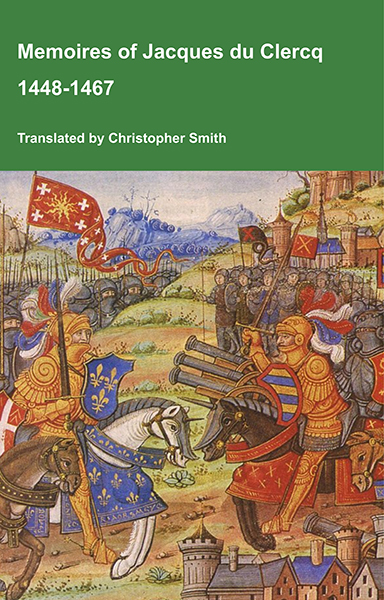
This is a translation of the 'Memoires of Jacques du Clercq', published in 1823 in two volumes, edited by Frederic, Baron de Reissenberg. In his introduction Reissenberg writes: 'Jacques du Clercq tells us that he was born in 1424, and that he was a licentiate in law and a counsellor to Philip the Good, Duke of Burgundy, in the castellany of Douai, Lille, and Orchies. It appears that he established his residence at Arras. In 1446, he married the daughter of Baldwin de la Lacherie, a gentleman who lived in Lille. We read in the fifth book of his Memoirs that his father, also named Jacques du Clercq, had married a lady of the Le Camelin family, from Compiègne. His ancestors, always attached to the counts of Flanders, had constantly served them, whether in their councils or in their armies.' The Memoires cover a period of nineteen years beginning in in 1448, ending in in 1467. It appears that the author had intended to extend the Memoirs beyond that date; no doubt illness or death prevented him from carrying out this plan. As Reissenberg writes the 'merit of this work lies in the simplicity of its narrative, in its tone of good faith, and in a certain air of frankness which naturally wins the reader’s confidence.' Du Clercq ranges from events of national and international importance, including events of the Wars of the Roses in England, to simple, everyday local events such as marriages, robberies, murders, trials and deaths, including that of his own father in Book 5; one of his last entries.
Available at Amazon in eBook and Paperback format.
Paternal Family Tree: Bruce of Annandale
Maternal Family Tree: Adela Valois Countess Blois and Vermandois
Descendants Family Tree: King Robert the Bruce I of Scotland 1274-1329
In 1271 [his father] Robert Bruce Earl Carrick [aged 27] and [his mother] Marjorie Carrick 3rd Countess Carrick [aged 18] were married at Turnberry Castle. He by marriage Earl Carrick. She the daughter of [his grandfather] Niall Carrick 2nd Earl Carrick and [his grandmother] Margaret Stewart Countess Carrick. They were third cousins. He a great x 4 grandson of King Henry I "Beauclerc" England.
On 11th July 1274 King Robert the Bruce I of Scotland was born to [his father] Robert Bruce Earl Carrick [aged 31] and [his mother] Marjorie Carrick 3rd Countess Carrick [aged 21] at Turnberry Castle.
Before 9th November 1292 [his mother] Marjorie Carrick 3rd Countess Carrick [aged 39] died.
In 1293 [his brother-in-law] Eric II King Norway [aged 25] and [his sister] Isabel Bruce Queen Norway [aged 21] were married. She by marriage Queen Norway. She the daughter of [his father] Robert Bruce Earl Carrick [aged 49] and [his mother] Marjorie Carrick 3rd Countess Carrick. He the son of King Magnus VI of Norway and Queen Ingeborg of Norway.
On 31st March 1295 [his grandfather] Robert Bruce 5th Lord Annandale [aged 80] died. He was buried at Guisborough Priory [Map]. His son [his father] Robert [aged 51] succeeded 6th Lord Annandale.
In 1296 King Robert the Bruce I of Scotland [aged 21] and Isabella Mar [aged 43] were married. The difference in their ages was 21 years; she, unusually, being older than him. She the daughter of Donald Mar 7th Earl of Mar and Elen ferch Llewellyn Aberffraw Countess Huntingdon and Mar. He the son of Robert Bruce Earl Carrick [aged 52] and Marjorie Carrick 3rd Countess Carrick. They were fifth cousins. He a great x 5 grandson of King Henry I "Beauclerc" England. She a great granddaughter of King John of England.
In 1296 [his daughter] Marjorie Bruce was born to King Robert the Bruce I of Scotland [aged 21] and [his wife] Isabella Mar [aged 43]. She a great x 2 granddaughter of King John of England. She married 1315 her second cousin once removed Walter Stewart 6th High Steward and had issue.
On 12th December 1296 [his wife] Isabella Mar [aged 43] died. She was buried at Paisley Abbey.
In 1302 King Robert the Bruce I of Scotland [aged 27] and Elizabeth Burgh Queen Consort Scotland [aged 18] were married. She the daughter of Richard "Red Earl" Burgh 2nd Earl of Ulster [aged 43] and Margaret Burgh Countess Ulster. He the son of Robert Bruce Earl Carrick [aged 58] and Marjorie Carrick 3rd Countess Carrick. They were fifth cousin once removed. He a great x 5 grandson of King Henry I "Beauclerc" England.
Around 20th February 1304 a chevauchée of English knights including Robert Clifford 1st Baron Clifford [aged 29], William Latimer 2nd Baron Latimer of Corby [aged 28], John Mohun 1st Baron Dunster [aged 35], John Segrave 2nd Baron Segrave [aged 48] and the future King Robert the Bruce I of Scotland [aged 29] attempted, unsuccessfully, to capture Simon Fraser and William Wallace at Happrew, Peebles.
Abbot John Whethamstede’s Chronicle of the Abbey of St Albans
Abbot John Whethamstede's Register aka Chronicle of his second term at the Abbey of St Albans, 1451-1461, is a remarkable text that describes his first-hand experience of the beginning of the Wars of the Roses including the First and Second Battles of St Albans, 1455 and 1461, respectively, their cause, and their consequences, not least on the Abbey itself. His text also includes Loveday, Blore Heath, Northampton, the Act of Accord, Wakefield, and Towton, and ends with the Coronation of King Edward IV. In addition to the events of the Wars of the Roses, Abbot John, or his scribes who wrote the Chronicle, include details in the life of the Abbey such as charters, letters, land exchanges, visits by legates, and disputes, which provide a rich insight into the day-to-day life of the Abbey, and the challenges faced by its Abbot.
Available at Amazon in eBook and Paperback format.
Before 4th March 1304 [his father] Robert Bruce Earl Carrick [aged 60] died. He was buried at Holme Cultram Abbey, Cumberland [Map].
On 10th February 1306 John Comyn 3rd Lord Baddenoch [aged 37] was murdered by Robert the Bruce [aged 31], future King of Scotland, before the High Altar of the Greyfriars Monastery [Map]. Robert Comyn, John's uncle, was killed by Christopher Seton [aged 28]. Christopher's brother John Seton [aged 28] was also present.
Murder, in a church, in front of the altar, regarded as a terrible crime. The act gave King Edward I of England [aged 66] cause to invade Scotland. Robert the Bruce was ex-communicated by the Pope for his actions.
King Edward I of England charged Bishop David de Moravia as being complicit in the murder.
John of Fordun's Chronicle. 117. John Comyn's Death
1305. The same year, after the aforesaid Robert [aged 30] had left the king of England [aged 65] and returned home, no less miraculously than by God's grace, a day is appointed for him and the aforesaid John [aged 36] to meet together at Dumfries [Map]; and both sides repair to the above-named place. John Comyn is twitted with his treachery and belied troth. The lie is at once given. The evil-speaker is stabbed, and wounded unto death, in the church of the Friars [Map]; and the wounded man is, by the friars, laid behind the altar. On being asked by those around whether he could live, straightway his answer is: - "I can." His foes, hearing this, give him another wound; - and thus was he taken away from this world on the 10th of February.
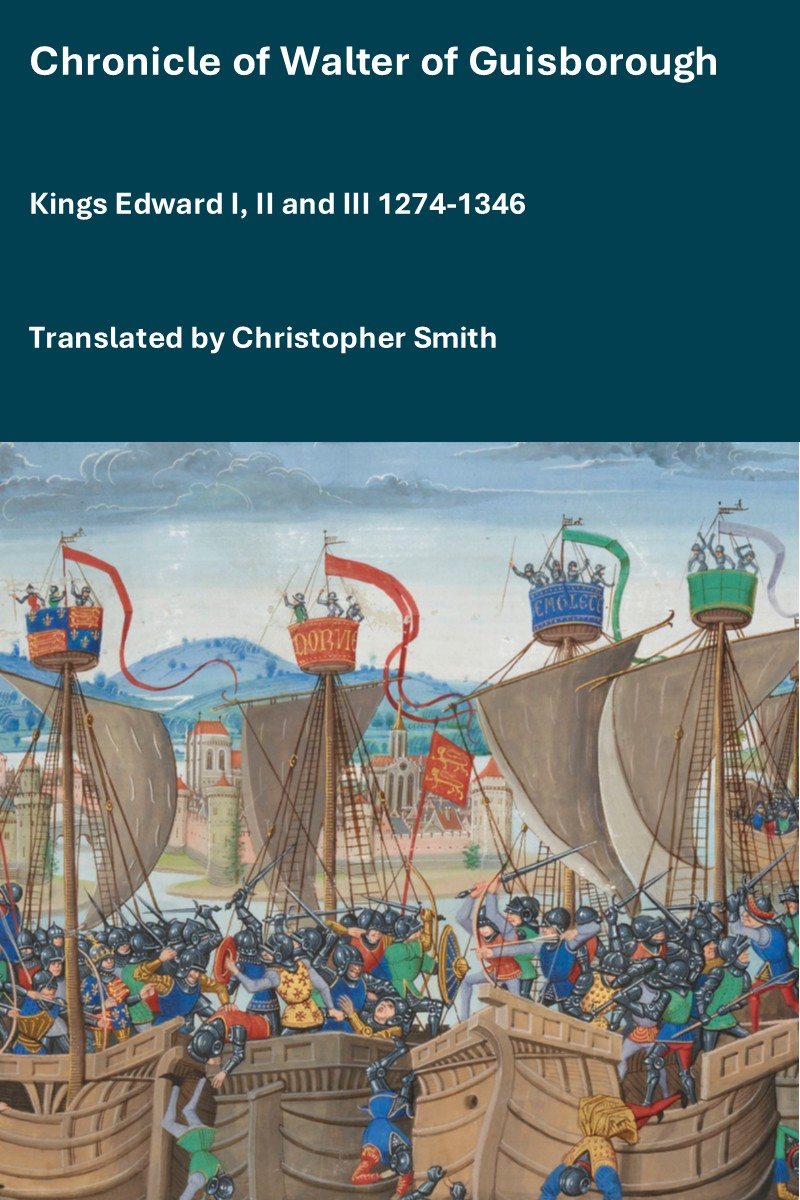 Chronicle of Walter of Guisborough. In the year of our Lord 1306, Robert de Brus [aged 31], the fifth son of the son of that Robert de Brus who, as mentioned above, disputed with John de Balliol before the King of England over the kingdom of Scotland, and was, as has been shown, judicially dismissed from his claim, relying on wicked counsel, aspired to the kingdom of Scotland. Fearing Lord John Comyn [aged 37], Earl of Badenoch, who was a powerful man in that land and loyal to the lord King of England, to whom he had done homage, and knowing that he could be hindered by him, sent to him deceitfully two of his brothers, namely Thomas de Brus [aged 22] and Nigel [aged 21], asking that he would deign to come to him at Dumfries to discuss certain matters which concerned them both. Now the justices of the lord King of England were sitting that same day in the castle, namely, on the fourth day before the Ides of February [10th February 1306] Comyn, suspecting no evil, came to him with a few companions, and they exchanged the kiss [of greeting], but not of peace, in the cloister of the Friars Minor [Franciscans] [Map]. When they were speaking together, in words that appeared peaceable, [Bruce] suddenly turned his face, twisted his words, and began to reproach him for his treachery, that he had accused him before the King of England and worsened his position to his harm. Comyn, speaking calmly and making excuses for himself, was not listened to; but Bruce, as he had conspired, struck him with his foot and sword, and stepped back. Then his men, following him, threw Comyn down on the floor of the altar, leaving him for dead. But a certain knight of Comyn's, Lord Robert Comyn, his uncle, ran to bring him aid; yet Christopher Seton [aged 28], who had married the sister [aged 33] of Lord Robert de Brus, met him and struck his head with a sword, and he died. Lord Robert de Brus then went out, and seeing Comyn's fine warhorse, mounted it; his men mounted likewise and they went on to the castle and seized it. When what had happened became known, the Scots flocked to him. The justices, fearing for themselves, shut the doors of the hall in which they sat with the few English who were with them. Hearing this, Bruce ordered fire to be set to it unless they at once surrendered; and they gave themselves up, asking for their lives and safe departure from the land, which he granted. When these things had been done, certain ill-wishers told him that Lord John Comyn was still alive; for the friars had carried him into the vestibule of the altar to tend to him and hear his confession. When he had confessed and was truly penitent, by order of the tyrant he was dragged from the vestibule and killed on the steps of the high altar, so that his blood touched the altar slab and the altar itself. After this Bruce went around the greater part of Scotland, occupying and fortifying castles and plundering the lands of the dead man; and the relatives of the deceased fled from his face, and all the English returned to their own land.
Anno Domini MCCCV Robertus de Brus, quintus filius filii illius Roberti de Brus qui, ut supradictum est, disceptavit cum Johanne de Balliolo coram rege Angliæ circa regnum Scotia, et judicialiter, ut supra patet, a sua petitione absolutus est, perverso fretus consilio ad regnum Scotia aspiravit; timensque dominum Johannem Cumyn, comitem de Badenach, qui erat homo potens in terra illa, et fidelis domino regi Angliæ, cui homagium fecerat; et sciens se impediri posse per eum, misit ad eum in dolo duos ex fratribus suis, Thomam videlicet de Brus et Nigellum, rogans ut dignaretur venire ad se apud Dunfres, super quibusdam negotiis tractaturus cum eo quæ tangebant utrosque. Sedebant enim justitiarii domini regis Angliæ eodem die in castro, IV scilicet idus Februarii. Qui, nihil mali suspicans, venit ad eum cum paucis, et mutuo se receperunt in osculum, sed non pacis, in claustro fratrum Minorum. Cumque mutuo loquerentur ad invicem, verbis, ut videbatur, pacificis, statim convertens faciem, et verba pervertens, cœpit improperare ei de seditione sua, quod eum accusaverat apud regem Angliæ, et suam conditionem deterioraverat in damnum ipsius. Qui cum pacifice loqueretur et excusaret se, noluit exaudire sermonem ejus, sed, ut conspiraverat, percussit eum pede et gladio, et retrorsum abiit. At sui extunc insequentes eum, prostraverunt eum in pavimento altaris, pro mortuo dimittentes. Cucurrit autem quidam miles ex suis, dominus Robertus Comyn avunculus ejus, ut auxilium ferret ei; sed occurrit ei Christoforus de Sethon, qui sororem domini Roberti de Brus duxerat in uxorem, et percussit caput ejus in gladio, et mortuus est. Egressusque est dominus Robertus de Brus, et videns dextrarium domini Johannis elegantem, ascendit in eum; ascenderuntque sui cum eo, et profecti sunt usque in castrum, et ceperunt illud. Cumque divulgaretur quod factum fuerat, cucurrerunt ad eum Scoti. Et justitiarii timentes sibi, clauserunt ostia aulæ in qua sedebant cum paucis Anglicis qui erant cum eis: quod audiens ipse, jussit ignem apponi, nisi confestim redderent eos; at illi dederunt se, vitam postulantes et salvum egressum a terra, quod et ipse concessit eis. Quibus ita gestis, nunciaverunt ei quidam malevoli quod dominus Johannes Comyn adhuc viveret; fratres enim asportaverant eum infra vestibulum altaris, ut medicarentur ei et confiteretur peccata sua. Qui cum confessus esset et vere pœnitens, jussu tyranni extractus est a vestibulo, et in gradibus majoris altaris interfectus, ita quod sanguis ipsius tabulam altaris tetigit, et etiam ipsum altare. Circuivit extunc the principal terram Scotia, occupando et muniendo castra, et deprædando terras mortui, fugeruntque a facie ipsius parentes defuncti, et omnes Anglici reversi sunt in terram suam.
 Become a Member via our Buy Me a Coffee page to read more.
Scalaronica. At this same time Robert de Brus [aged 31], Earl of Carrick, who retained a strong following through kinsmanship and alliance, always hoping for the establishment of his claim of succession to the realm of Scotland, on the 4th of the kalends of February [29th January 1306] in the year of grace 1306 sent his two brothers, Thomas and Neil, from Lochmaben to Dalswinton to John Comyn, begging that he would meet him [Robert] at Dumfries [Map] at the [church of the] Minorite Friars, so that they might have a conversation. Now he had plotted with his two brothers aforesaid that they should kill the said John Comyn on the way. But they were received in such a friendly manner by the said John Comyn that they could not bring themselves to do him any harm, but agreed between themselves that their brother himself might do his best. The said John Comyn, suspecting no ill, set out with the two brothers of the said Robert de Brus in order to speak with him [Robert] at Dumfries, went to the Friars [Church] where he found the said Robert, who came to meet him and led him to the high altar. The two brothers of the said Robert told him secretly — 'Sir,' they said, 'he gave us such a fair reception, and with such generous gifts, and won upon us so much by his frankness, that we could by no means do him an injury.' — 'See!' quoth he, 'you are right lazy: let me settle with him.'
On 25th March 1306, King Robert the Bruce I of Scotland [aged 31] was crowned King Scotland at Scone Abbey [Map] by Bishop of St Andrews and Bishop Robert Wishart. [his wife] Elizabeth Burgh Queen Consort Scotland [aged 22] was crowned Queen Consort Scotland. Christopher Seton [aged 28] and Bishop David de Moravia were present. He was wearing royal robes and vestments previously hidden from the English by Bishop Robert Wishart.
The following day, 26th March 1306, King Robert the Bruce I of Scotland was crowned by Isabella Countess Buchan whose family held the hereditary right to place the crown on the King's head; she had arrived too late for the coronation the day before. The right was held by her brother Duncan Fife 4th Earl Fife [aged 18] who was under-age and held by the English so she assumed the right in his place.
On 19th June 1306 the forces of Aymer de Valence 2nd Earl Pembroke [aged 31], including Robert Pierrepont, ambushed and routed the Scottish army of King Robert the Bruce I of Scotland [aged 31] including Simon Fraser, Christopher Seton and John Strathbogie 9th Earl Atholl [aged 40] at Methven. John Strathbogie 9th Earl Atholl was captured as well as many others.
On 9th February 1307 the Battle of Loch Ryan was a victory of local forces, led by Dungal MacDowall, supporter of King Edward I, over a force consisting of 1000 men and eighteen galleys led by Thomas Bruce [aged 23] and Alexander Bruce [aged 22], brothers of King Robert the Bruce I of Scotland [aged 32], supported by Malcolm McQuillan, Lord of Kintyre, and Sir Reginald Crawford. Only two galleys escaped. Malcolm McQuillan was captured an summarily executed.
Thomas Bruce, Alexander Bruce and Reginald Crawford were hanged (possibly hanged, drawn and quartered) at Carlisle, Cumberland [Map].
Close Rolls Edward II 1307-1313. 12th December 1307 King Edward II of England [aged 23]. Westminster Palace [Map]. To John de Brittania, Earl of Richmond, [keeper] of Scotland. Order to restore to Aymer de Valencia [aged 32], Earl of Pembrok, his lands, etc., in the counties of Sellekyrk [Selkirkshire] and Twedale and in the forest of Sellekyrk, which he has seized into the king's hands because the men and tenants of the same had late traitoroursly adhered to Robert de Brus [aged 33], the king's enemy and rebel.
In 1308 [his brother-in-law] Hugh 4th Earl Ross [aged 11] and [his sister] Matilda Bruce Countess Ross [aged 21] were married. She by marriage Countess Ross. She the daughter of [his father] Robert Bruce Earl Carrick and [his mother] Marjorie Carrick 3rd Countess Carrick.
In 1310 Robert the Bruce [aged 35] captured Harbottle Castle, Northumberland [Map].
On 16th August 1312 Thomas Fitzgerald 2nd Earl of Kildare and [his sister-in-law] Joan Burgh Countess Kildare [aged 12] were married at Greencastle, County Down. She by marriage Countess Kildare. She the daughter of [his father-in-law] Richard "Red Earl" Burgh 2nd Earl of Ulster [aged 53] and Margaret Burgh Countess Ulster. He the son of John Fitzgerald 1st Earl of Kildare [aged 62] and Blanche La Roche Countess Kildare [aged 57].
On 24th June 1314 the Scottish army of King Robert the Bruce I of Scotland [aged 39] including, James "Black" Douglas [aged 28], heavily defeated the English army led by King Edward II of England [aged 30] at the Battle of Bannockburn.
Gilbert de Clare 8th Earl Gloucester 7th Earl Hertford [aged 23] was killed. Earl Gloucester, Earl Hertford extinct.
John Comyn 4th Lord Baddenoch [aged 20], Robert Felton 1st Baron Felton [aged 44] and William Vesci were killed.
William Marshal 1st Baron Marshal [aged 36] was killed. His son John [aged 22] succeeded 2nd Baron Marshal.
Robert Clifford 1st Baron Clifford [aged 40] was killed. His son Roger [aged 14] succeeded 2nd Baron de Clifford.
John Lovell 2nd Baron Lovel [aged 25] was killed. His son John succeeded 3rd Baron Lovel of Titchmarsh.
Henry Bohun was killed by King Robert the Bruce I of Scotland. He was buried in Llanthony Secunda Priory, Gloucestershire [Map].
Walter Fauconberg 2nd Baron Fauconberg [aged 50] possilby died although his death is also reported as being on 31 Dec 1318.
Bartholomew Badlesmere 1st Baron Badlesmere [aged 38], Humphrey Bohun 4th Earl Hereford 3rd Earl Essex [aged 38], Goronwy ap Tudur Hen Tudor, Henry Beaumont Earl Buchan [aged 35], Aymer de Valence 2nd Earl Pembroke [aged 39] and Robert Umfraville 8th Earl Angus [aged 37] fought.
Pain Tiptoft 1st Baron Tibetot [aged 34] was killed. His son John succeeded 2nd Baron Tibetot.
John Montfort 2nd Baron Montfort [aged 23] was killed. Peter Montfort 3rd Baron Montfort [aged 23] succeeded 3rd Baron Montfort.
Thomas Grey [aged 34] undertook a suicidal charge that contributed to the English defeat and subsequently blemished his career.
William Latimer 2nd Baron Latimer of Corby [aged 38] was captured.
Michael Poynings [aged 44] was killed.
Become a Member via our Buy Me a Coffee page to read more.
In 1315 [his son-in-law] Walter Stewart 6th High Steward [aged 19] and Marjorie Bruce [aged 19] were married. She the daughter of King Robert the Bruce I of Scotland [aged 40] and Isabella Mar. They were second cousin once removed. She a great x 2 granddaughter of King John of England.
On 2nd March 1316 King Robert II of Scotland was born to Walter Stewart 6th High Steward [aged 20] and Marjorie Bruce [aged 20] at Paisley Abbey. His mother Marjorie Bruce died in childbirth. He a great x 3 grandson of King John of England. He married (1) 1336 Elizabeth Mure Queen Consort Scotland and had issue (2) 1356 Euphemia Ross Queen Consort Scotland, daughter of Hugh 4th Earl Ross and Margaret Graham Countess Ross, and had issue.
The History of William Marshal was commissioned by his son shortly after William’s death in 1219 to celebrate the Marshal’s remarkable life; it is an authentic, contemporary voice. The manuscript was discovered in 1861 by French historian Paul Meyer. Meyer published the manuscript in its original Anglo-French in 1891 in two books. This book is a line by line translation of the first of Meyer’s books; lines 1-10152. Book 1 of the History begins in 1139 and ends in 1194. It describes the events of the Anarchy, the role of William’s father John, John’s marriages, William’s childhood, his role as a hostage at the siege of Newbury, his injury and imprisonment in Poitou where he met Eleanor of Aquitaine and his life as a knight errant. It continues with the accusation against him of an improper relationship with Margaret, wife of Henry the Young King, his exile, and return, the death of Henry the Young King, the rebellion of Richard, the future King Richard I, war with France, the death of King Henry II, and the capture of King Richard, and the rebellion of John, the future King John. It ends with the release of King Richard and the death of John Marshal.
Available at Amazon in eBook and Paperback format.
In 1320 [his sister-in-law] Matilda Burgh Countess Gloucester and Hertford [aged 32] died.
On 17th June 1320 Bishop David de Moravia and King Robert the Bruce I of Scotland [aged 45] and other Scottish nobles and clergy, by Pope John XXII, as an enemy of King Edward II of England.
After 1323 [his sister] Matilda Bruce Countess Ross [deceased] died.
On 5th March 1324 twins [his son] King David II of Scotland and John Bruce were born to King Robert the Bruce I of Scotland [aged 49] and Elizabeth Burgh Queen Consort Scotland [aged 40] at Dunfermline Abbey [Map].
Before 1327 [his son] John Bruce [aged 2] died.
On 26th October 1327 [his wife] Elizabeth Burgh Queen Consort Scotland [aged 43] died.
On 17th March 1328 Robert the Bruce [aged 53] signed the Treaty of Edinburgh Northampton bringing to an end the First Scottish War of Independence. The English Parliament signed at Northampton [Map] on 03 May 1328. The terms of the Treaty included:
Scotland to pay England £100,000 sterling,
The Kingdom of Scotland as fully independent,
Robert the Bruce, and his heirs and successors, as the rightful rulers of Scotland, and.
The border between Scotland and England as that recognised under the reign of Alexander III (1249-1286).
The Treaty lasted four years only being regarded by the English nobility as humiliating; the work of Edward's [aged 15] mother Isabella of France Queen Consort England [aged 33] and Roger Mortimer 1st Earl March [aged 40] rather than King Edward. Two years after King Edward commenced his personal reign he commenced the Second War of Scottish Independence in Aug 1332.
On 17th July 1328 King David II of Scotland [aged 4] and Joan of the Tower Queen Consort Scotland [aged 7] were married at Berwick-upon-Tweed, Northumberland [Map]. She the daughter of King Edward II of England and Isabella of France Queen Consort England [aged 33]. He the son of King Robert the Bruce I of Scotland [aged 54] and Elizabeth Burgh Queen Consort Scotland.
After 1329 [his daughter] Christina Bruce was born to King Robert the Bruce I of Scotland [aged 54].
On 7th June 1329 King Robert the Bruce I of Scotland [aged 54] died at Cardross Manor, Argyll. He was buried at Dunfermline Abbey [Map]. His son David [aged 5] succeeded II King Scotland. Joan of the Tower Queen Consort Scotland [aged 7] by marriage Queen Consort Scotland.
On 25th August 1330 James "Black" Douglas [aged 44] was killed during the Battle of Teba at Teba whilst en route to the Holy Land with the heart of King Robert the Bruce I of Scotland.
On 12th August 1332 Battle of Dupplin Moor was fought between the supporters of the infant King David II of Scotland [aged 8], son of King Robert the Bruce I of Scotland, and the supporters of King Edward I of Scotland [aged 49], supported by the English. The Bruce army included Robert Bruce Lord of Liddesdale and Domhnall Mar II Earl of Mar [aged 39]. The Balliol army included David III Strathbogie 11th Earl Atholl [aged 23], Ralph Stafford 1st Earl Stafford [aged 30], Thomas Ughtred 1st Baron Ughtred [aged 40] and Walter Manny 1st Baron Manny [aged 22]. The battle is notable for being the first to use dismounted men-at-arms supported by archers; a formation that would bring repeated success to the English both in Scotland and France.
Robert Bruce Lord of Liddesdale was killed leading a charge.
Nicholas Hay [aged 47] was killed.
Thomas Randolph 2nd Earl Moray was killed. His brother John [aged 26] succeeded 3rd Earl Moray.
Domhnall Mar II Earl of Mar was killed.
On 16th December 1332 the Battle of Annan Moor was fought between the supporters of the seven year old King David II of Scotland [aged 8], son of King Robert the Bruce I of Scotland, and the supporters of King Edward I of Scotland [aged 49], supported by the English. The Bruce army, led by, Archibald Douglas [aged 34], supported by John Randolph 3rd Earl of Moray [aged 26] and King Robert II of Scotland [aged 16] surprised King Edward I of Scotland and his supporters at Annan and threw them out of Scotland.
On 25th March 1333 the Battle of Dornock was fought between the supporters of the seven year old King David II of Scotland [aged 9], son of King Robert the Bruce I of Scotland, and the supporters of King Edward I of Scotland [aged 50], supported by the English, commanded by Ralph Dacre 1st Baron Dacre Gilsland [aged 43]. The English army quickly overwhelmed the Scottish force. William "Flower of Chivalry and Knight Liddesdale" Douglas 1st Earl Atholl [aged 33] was captured and spent two years in prison.
John of Fordun's Chronicle. 112. Rise of Bohert of Bruce King of Scotland
After the withdrawal of the king of England, the English nation lorded it in all parts of the kingdom of Scotland, ruthlessly harrying the Scots in sundry and manifold ways, by insults, stripes, and slaughter, under the awful yoke of slavery. But God, in His mercy, as is the wont of His fatherly goodness, had compassion on the woes, the ceaseless crying and sorrow, of the Scots; so He raised up a saviour and champion unto them - one of their own fellows, to wit, named Robert of Bruce. This man, seeing them stretched in the slough of woe, and reft of all hope of salvation and help, was inwardly touched with sorrow of heart; and, putting forth his hand unto force, underwent the countless and unbearable toils of the heat of day, of cold and hunger, by land and sea, gladly welcoming weariness, fasting, dangers, and the snares not only of foes, but also of false friends, for the sake of freeing his brethren.
[his son] Elizabeth Bruce was born to King Robert the Bruce I of Scotland.
John of Fordun's Chronicle. 114. King Robert accused before the King of England by John Comyn
As the said John's accusations were repeated, at length, one night, while the wine glittered in the bowl, and that king was hastening to sit down with his secretaries, he talked over Robert's death in earnest, - and shortly determined that he would deprive him of life on the morrow. But when the Earl of Gloucester, who was Robert's true and tried friend in his utmost need, heard of this, he hastily, that same night, sent the aforesaid Robert, by his keeper of the wardrobe, twelve pence and a pair of spurs. So the keeper of the wardrobe, who guessed his lord's wishes, presented these things to Robert, from his lord, and added these words: "My lord sends these to you, in return for what he, on his side, got from you yesterday." Robert understood, from the tokens offered him, that he was threatened by the danger of death; so he discreetly gave the pence to the keeper of the wardrobe, and forthwith sent him back to the Earl with greeting in answer, and with thanks.
Then, when twilight came on, that night, after having ostentatiously ordered his servants to meet him at Carlisle [Map], with his trappings, on the evening of the following day, he straightway hastened towards Scotland, without delay, and never stopped travelling, day or night, until he was safe from the aforesaid king's spite. Tor he was under the guidance of One of whom it is written: - "There is no wisdom, no foresight, no understanding against the Lord, who knoweth how to snatch the good from trial, and mercifully to deliver from danger those that trust in Him.".
William of Worcester's Chronicle of England
William of Worcester, born around 1415, and died around 1482 was secretary to John Fastolf, the renowned soldier of the Hundred Years War, during which time he collected documents, letters, and wrote a record of events. Following their return to England in 1440 William was witness to major events. Twice in his chronicle he uses the first person: 1. when writing about the murder of Thomas, 7th Baron Scales, in 1460, he writes '… and I saw him lying naked in the cemetery near the porch of the church of St. Mary Overie in Southwark …' and 2. describing King Edward IV's entry into London in 1461 he writes '… proclaimed that all the people themselves were to recognize and acknowledge Edward as king. I was present and heard this, and immediately went down with them into the city'. William’s Chronicle is rich in detail. It is the source of much information about the Wars of the Roses, including the term 'Diabolical Marriage' to describe the marriage of Queen Elizabeth Woodville’s brother John’s marriage to Katherine, Dowager Duchess of Norfolk, he aged twenty, she sixty-five or more, and the story about a paper crown being placed in mockery on the severed head of Richard, 3rd Duke of York.
Available at Amazon in eBook and Paperback format.
[his daughter] Margaret Bruce was born to King Robert the Bruce I of Scotland and Elizabeth Burgh Queen Consort Scotland. She married 1345 her sixth cousin William de Moravia Sutherland 5th Earl Sutherland, son of Kenneth de Moravia Sutherland 4th Earl Sutherland and Mary or Marjorie Mar Countess Sutherland, and had issue.
John of Fordun's Chronicle. 113. League of King Bohert with John Comyn
So, in order that he might actually give effect to what he had gladly set his heart upon, for the good of the commonwealth, he humbly approached a certain noble, named John Comyn (who was then the most powerful man in the country), and faithfully laid before him the unworthy thraldom of the country, the cruel and endless tormenting of the people, and his own kind-hearted plan for giving them relief. Though, by right, and according to the laws and customs of the country, the honour of the kingly office and the succession to the governance of the kingdom were known to belong to him before any one else, yet, setting the public advantage before his own, Robert, in all purity and sincerity of purpose, gave John the choice of one of two courses: either that the latter should reign, and wholly take unto himself the kingdom, with its pertinents and royal honours, for ever, granting to the former all his own lands and possessions; or that all Robert's lands and possessions should come into the possession of John and his for ever, while the kingdom and the kingly honour were left to Robert. Thus, by their mutual advice as well as help, was to be brought to maturity the deliverance of the Scottish nation from the house of bondage and unworthy thraldom; and an indissoluble treaty of friendship and peace was to last between them. John was perfectly satisfied with the latter of the aforesaid courses; and thereupon a covenant was made between them, and guaranteed by means of sworn pledges, and by their indentures with their seals attached thereto. But John broke his word; and, heedless of the sacredness of his oath, kept accusing Robert before the king of England, through his ambassadors and private letters, and wickedly revealing that Robert's secrets. Although, however, Robert was more than once sounded thereupon by the aforesaid king, who even showed him the letters of his adversary who accused him, yet, inspired by God, he always returned an answer such that he over and over again softened the king's rage by his pleasant sayings and skilful words. The king, however, both because he was himself very wily and shrewd, and knew full well how to feign a sham friendship, and also because Robert was the true heir of the kingdom of Scotland, looked upon the latter with mistrust, - the more so because of John's accusations. So, because of his aforesaid grounds for mistrust, Edward bade Robert stay always at court; and he delayed putting him to death - or, at least, in prison - only until he could get the rest of this Robert's brothers together, and punish them and him at once, in one day, with sentence of death.
Become a Member via our Buy Me a Coffee page to read more.
[his son] Robert Bruce Lord of Liddesdale was born to King Robert the Bruce I of Scotland.
John of Fordun's Chronicle. 115. Death of John Comyn's messenger
Now, when Robert was nearing the borders of the marches, there met him a messenger whom, when he sighted him afar off, he suspected, both from the fellow's gait and from his dress, to be a Scot. So, when he got nearer, he asked him whence he came and whither he was making his way. The messenger began to pour forth excuses for his sins; but Robert ordered his vassals to search him. Letters, sealed with Robert's seal about the covenant entered into between him and John Comyn, were found addressed to the king of England through this messenger, and were forthwith pulled out. The messenger's head was thereupon struck off, and God very much be praised for His guidance in this prosperous journey.
[his father] Robert Bruce Earl Carrick and Matilda aka Maud Fitzalan were married. She the daughter of John Fitzalan 7th Earl of Arundel and Isabella Mortimer Countess Arundel. They were second cousin once removed. He a great x 4 grandson of King Henry I "Beauclerc" England. She a great x 3 granddaughter of King John of England.
Froissart Book 1: 1307-1340. 2. This English king, of whom I was just speaking, who suffered that great loss in Scotland, had two half-brothers. One was called the Earl Marshal and was of a wild and unruly nature; the other was named Sir Edmund and was Earl of Kent, a very worthy, gentle, and courteous man, much loved by good people. This king had, by his wife, daughter of the noble King Philip, two sons and two daughters. Of these sons, the elder was named Edward and became King of England by the agreement of all the barons during his father's lifetime, as you will hear later in this book. The second son was named John of Eltham and died young. The elder of the two daughters was named Isabella and was married to the young King David of Scotland, son of King Robert the Bruce. She was given to him in marriage while still very young, by agreement between the kingdoms of England and Scotland, as part of a peace treaty. The other daughter [Eleanor of Woodstock Plantagenet] was married to the Duke of Gelderland. These two (Edward and Isabella) had two sons and two daughters: Reynold and Edward; and the daughters, one became Countess of Blois through her husband Sir John of Blois, and the other became Duchess of Jülich.
2. Chilz rois englès, dont je parloie maintenant, qui reçut ce grant damage en Escoce, avoit deus frères de remariage. Si fu li uns nommés li contes Mareschaus et fu de diverse et de sauvage manière; li autres fu appellés messires Aymes et estoit contes de Kent, moult preudons, douls et debonnaires et moult amés des bonnes gens. Chils rois eut de madame sa femme, fille au biau roy Phelippe, deus filz et deus filles. Des quelz filz li ainsnés eut nom Edouwars, et fu rois d'Engleterre par l'acort de tous les barons très le vivant son père, si com vous orés avant en ce livre. Li secons des filz eut nom Jehans de Eltem et morut jones. Li ainsnée des deus filles eut nom Ysabel et fu mariée au jone roy David d'Escoce, filz au roi Robert de Brus. Et li fu donnée en mariage de jonèce par l'acord de[s] deus royaumes d'Engleterre et d'Escoce et par pais faisant. Li autre fille fu mariée au duch de Guerle. Chilz eurent deus filz et deus filles, Renault et Edowart; et les filles, li une fu contesse de Blois de par monsigneur Jehan de Blois son mari, et li aultre duçoise de Jullers.
Become a Member via our Buy Me a Coffee page to read more.
[his son] Walter Bruce was born to King Robert the Bruce I of Scotland.
[his daughter] Margaret Bruce was born to King Robert the Bruce I of Scotland.
[his son] Neil Bruce was born to King Robert the Bruce I of Scotland.
[his daughter] Matilda Bruce was born to King Robert the Bruce I of Scotland and Elizabeth Burgh Queen Consort Scotland.
Kings Wessex: Great x 7 Grand Son of King Edmund "Ironside" I of England
Kings England: Great x 5 Grand Son of King Henry I "Beauclerc" England
Kings Scotland: Great x 6 Grand Son of King Duncan I of Scotland
Kings Franks: Great x 15 Grand Son of Charles "Charlemagne aka Great" King of the Franks King Lombardy Holy Roman Emperor
Kings France: Great x 8 Grand Son of Hugh I King of the Franks
Kings Duke Aquitaine: Great x 12 Grand Son of Ranulf I Duke Aquitaine
Great x 4 Grandfather: Robert Bruce 1st Lord Annandale 1st Lord Skelton
Great x 3 Grandfather: William Bruce 2nd Lord Annandale
Great x 4 Grandmother: Agnes Paynel Lady Annandale Lady Skelton
Great x 2 Grandfather: William Bruce 3rd Lord Annandale
Great x 3 Grandmother: Euphemia Crosebi Lady Annandale
Great x 1 Grandfather: Robert Bruce 4th Lord Annandale
Great x 2 Grandmother: Christina Unknown Lady Annandale
GrandFather: Robert Bruce 5th Lord Annandale 4 x Great Grand Son of King Henry I "Beauclerc" England
Great x 4 Grandfather: King David I of Scotland 
Great x 3 Grandfather: Henry Dunkeld 3rd Earl Huntingdon 1st Earl of Northumbria
Great x 4 Grandmother: Maud Queen Consort Scotland
Great x 2 Grandfather: David Dunkeld 8th Earl Huntingdon
Great x 4 Grandfather: William Warenne 2nd Earl of Surrey 
Great x 3 Grandmother: Ada Warenne Countess Huntingdon and Northumbria
Great x 4 Grandmother: Elizabeth Capet Countess Leicester, Meulan and Surrey 
Great x 1 Grandmother: Isabel "the Scot" Dunkeld Lady Annandale 3 x Great Grand Daughter of King Henry I "Beauclerc" England
Great x 4 Grandfather: Ranulf Gernon 4th Earl Chester
Great x 3 Grandfather: Hugh de Kevelioc Gernon 5th Earl Chester Great Grand Son of King Henry I "Beauclerc" England
Great x 4 Grandmother: Matilda Fitzrobert Countess Chester  Grand Daughter of King Henry I "Beauclerc" England
Great x 2 Grandmother: Matilda Gernon Countess Huntingdon 2 x Great Grand Daughter of King Henry I "Beauclerc" England
Great x 4 Grandfather: Simon "Chauve" Montfort 4th Count Évreux
Great x 3 Grandmother: Bertrade Montfort Countess Chester
Great x 4 Grandmother: Mathilde Unknown Countess Évreux
Father: Robert Bruce Earl Carrick 4 x Great Grand Son of King Henry I "Beauclerc" England
Great x 4 Grandfather: Richard de Clare
Great x 3 Grandfather: Roger Clare 2nd Earl Hertford
Great x 4 Grandmother: Alice Gernon
Great x 2 Grandfather: Richard Clare 3rd Earl Hertford
Great x 3 Grandmother: Maud St Hilary Countess Hertford
Great x 1 Grandfather: Gilbert Clare 5th Earl Gloucester 4th Earl Hertford 2 x Great Grand Son of King Henry I "Beauclerc" England
Great x 4 Grandfather: Robert Normandy 1st Earl Gloucester Son of King Henry I "Beauclerc" England
Great x 3 Grandfather: William Fitzrobert 2nd Earl Gloucester Grand Son of King Henry I "Beauclerc" England
Great x 4 Grandmother: Mabel Fitzhamon Countess Gloucester
Great x 2 Grandmother: Amice Fitzrobert Countess Hertford Great Grand Daughter of King Henry I "Beauclerc" England
Great x 4 Grandfather: Robert Beaumont 2nd Earl of Leicester 
Great x 3 Grandmother: Hawise Beaumont Countess Gloucester
Great x 4 Grandmother: Amice Gael Countess Leicester
GrandMother: Isabel Clare Lady Annandale 3 x Great Grand Daughter of King Henry I "Beauclerc" England
Great x 4 Grandfather: Gilbert Giffard 
Great x 3 Grandfather: John Fitzgilbert
Great x 2 Grandfather: William Marshal 1st Earl Pembroke
Great x 4 Grandfather: Walter of Salisbury 2nd Baron Chitterne
Great x 3 Grandmother: Sybil of Salisbury
Great x 4 Grandmother: Sybilla Chaworth Baroness Chitterne 
Great x 1 Grandmother: Isabel Marshal Countess Cornwall, Gloucester and Hertford
Great x 4 Grandfather: Gilbert de Clare 1st Earl Pembroke
Great x 3 Grandfather: Richard "Strongbow" Clare 2nd Earl Pembroke
Great x 4 Grandmother: Isabel Beaumont Countess Pembroke
Great x 2 Grandmother: Isabel Clare Countess Pembroke
Great x 4 Grandfather: Diarmait Macmurrough
Great x 3 Grandmother: Aoife ni Diarmait Macmurrough Countess Pembroke and Buckingham
King Robert the Bruce I of Scotland 5 x Great Grand Son of King Henry I "Beauclerc" England
GrandFather: Niall Carrick 2nd Earl Carrick
Mother: Marjorie Carrick 3rd Countess Carrick
Great x 3 Grandfather: Walter Fitzalan 1st High Steward 
Great x 2 Grandfather: Alan Fitzwalter 2nd High Steward 
Great x 1 Grandfather: Walter Stewart 3rd High Steward
GrandMother: Margaret Stewart Countess Carrick
Great x 2 Grandfather: Gille Críst Angus 4th Earl Angus
Great x 1 Grandmother: Bethóc Angus
Great x 4 Grandfather: King David I of Scotland
Great x 3 Grandfather: Henry Dunkeld 3rd Earl Huntingdon 1st Earl of Northumbria
Great x 4 Grandmother: Maud Queen Consort Scotland
Great x 2 Grandmother: Marjorie Dunkeld Countess Angus
Great x 4 Grandfather: William Warenne 2nd Earl of Surrey
Great x 3 Grandmother: Ada Warenne Countess Huntingdon and Northumbria
Great x 4 Grandmother: Elizabeth Capet Countess Leicester, Meulan and Surrey