William of Worcester's Chronicle of England
William of Worcester, born around 1415, and died around 1482 was secretary to John Fastolf, the renowned soldier of the Hundred Years War, during which time he collected documents, letters, and wrote a record of events. Following their return to England in 1440 William was witness to major events. Twice in his chronicle he uses the first person: 1. when writing about the murder of Thomas, 7th Baron Scales, in 1460, he writes '… and I saw him lying naked in the cemetery near the porch of the church of St. Mary Overie in Southwark …' and 2. describing King Edward IV's entry into London in 1461 he writes '… proclaimed that all the people themselves were to recognize and acknowledge Edward as king. I was present and heard this, and immediately went down with them into the city'. William’s Chronicle is rich in detail. It is the source of much information about the Wars of the Roses, including the term 'Diabolical Marriage' to describe the marriage of Queen Elizabeth Woodville’s brother John’s marriage to Katherine, Dowager Duchess of Norfolk, he aged twenty, she sixty-five or more, and the story about a paper crown being placed in mockery on the severed head of Richard, 3rd Duke of York.
Available at Amazon in eBook and Paperback format.
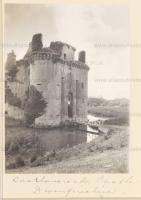
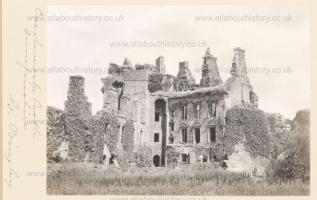
Caerlaverock Castle is in Caerlaverock.
In 1297 Simon Clifford (age 21) died at Caerlaverock Castle [Map].
Around 1304 William le Boteler 7th Baron Warrington (age 73) died at Caerlaverock Castle [Map].
In 1335 Elizabeth Maxwell Countess Atholl was born to John Maxwell (age 20) at Caerlaverock Castle [Map]. She married (1) before 1340 William "Flower of Chivalry and Knight Liddesdale" Douglas 1st Earl Atholl and had issue (2) before 1357 Hugh Dacre 4th Baron Dacre of Gilsland, Baron Multon of Gilsand, son of Ralph Dacre 1st Baron Dacre Gilsland and Margaret "Flower of Gillesland" Multon Baroness Dacre of Gilsland 2nd Baroness Multon Gilsland, and had issue.
Around 1340 Robert Maxwell of Caerlaverock was born to John Maxwell (age 25) at Caerlaverock Castle [Map].
Around 1388 Herbert Maxwell 1st Lord Maxwell was born to Herbert Maxwell and Katherine Stewart Lady Maxwell at Caerlaverock Castle [Map]. He married (1) before 9th March 1439 Janet Herries and had issue (2) after 9th March 1439 his fourth cousin twice removed Catherine Seton and had issue.
On 8th February 1410 Robert Maxwell of Caerlaverock (age 70) died at Caerlaverock Castle [Map].
Before 18th May 1425 Murdoch Stewart 2nd Duke Albany (age 63) and his younger son Alexander Stewart were arrested and confined in St Andrew's Castle then moved to Caerlaverock Castle [Map]. His wife was arrested at the family's home of Doune Castle and imprisoned at Tantallon Castle.
Murdoch's son James "Fat aka Seamas Mòr" Stewart led the men of Lennox and Argyll in open rebellion against the crown. He attacked and burned the burgh of Dumbarton with much loss of life.
Around 1456 John Maxwell 4th Lord Maxwell was born to John Maxwell 3rd Lord Maxwell and Janet Crichton Lady Maxwell (age 20) at Caerlaverock Castle [Map]. He married 1491 Agnes Stewart and had issue.
On 7th February 1478 Catherine Seton (age 68) died at Caerlaverock Castle [Map].
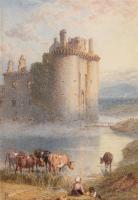
Before 1825. Myles Birket Foster. "Caerlaverock Castle [Map]".
Chronicle of a Bourgeois of Valenciennes
Récits d’un bourgeois de Valenciennes aka The Chronicle of a Bourgeois of Valenciennes is a vivid 14th-century vernacular chronicle written by an anonymous urban chronicler from Valenciennes in the County of Hainaut. It survives in a manuscript that describes local and regional history from about 1253 to 1366, blending chronology, narrative episodes, and eyewitness-style accounts of political, military, and social events in medieval France, Flanders, and the Low Countries. The work begins with a chronological framework of events affecting Valenciennes and its region under rulers such as King Philip VI of France and the shifting allegiances of local nobility. It includes accounts of conflicts, sieges, diplomatic manoeuvres, and the impact of broader struggles like the Hundred Years’ War on urban life in Hainaut. Written from the perspective of a burgher (bourgeois) rather than a monastery or royal court, the chronicle offers a rare lay viewpoint on high politics and warfare, reflecting how merchants, townspeople, and civic institutions experienced the turbulence of the 13th and 14th centuries. Its narrative style combines straightforward reporting of events with moral and civic observations, making it a valuable source for readers interested in medieval urban society, regional politics, and the lived experience of war and governance in pre-modern Europe.
Available at Amazon in eBook and Paperback format.
18th July 1899. Godfrey Bingley (age 57). Caerlaverock Castle [Map].