This is a translation of the 'Memoires of Jacques du Clercq', published in 1823 in two volumes, edited by Frederic, Baron de Reissenberg. In his introduction Reissenberg writes: 'Jacques du Clercq tells us that he was born in 1424, and that he was a licentiate in law and a counsellor to Philip the Good, Duke of Burgundy, in the castellany of Douai, Lille, and Orchies. It appears that he established his residence at Arras. In 1446, he married the daughter of Baldwin de la Lacherie, a gentleman who lived in Lille. We read in the fifth book of his Memoirs that his father, also named Jacques du Clercq, had married a lady of the Le Camelin family, from Compiègne. His ancestors, always attached to the counts of Flanders, had constantly served them, whether in their councils or in their armies.' The Memoires cover a period of nineteen years beginning in in 1448, ending in in 1467. It appears that the author had intended to extend the Memoirs beyond that date; no doubt illness or death prevented him from carrying out this plan. As Reissenberg writes the 'merit of this work lies in the simplicity of its narrative, in its tone of good faith, and in a certain air of frankness which naturally wins the reader’s confidence.' Du Clercq ranges from events of national and international importance, including events of the Wars of the Roses in England, to simple, everyday local events such as marriages, robberies, murders, trials and deaths, including that of his own father in Book 5; one of his last entries.
Available at Amazon in eBook and Paperback format.
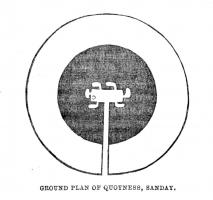
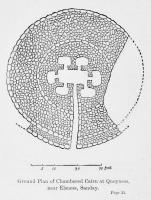
Quoyness Chambered Cairn is in Quoyness, Sanday, Maeshowe Type Chambered Cairn.
Quoyness Chambered Cairn [Map]:
(HY 6766 3779) Quoyness Brough (NR)
A Maes-Howe-type chambered cairn, measuring 67' by 56', the intact chamber being enclosed within a complex cairn and surrounded by a platform. It was excavated by Farrer and Petrie in 1867, in the belief that it was a broch, but was subsequently recognised as a chambered cairn and re-excavated by Childe in 1951-2 for the MoW in whose guardianship it has been placed.
The roughly rectangular chamber, with six cells, is enclosed within an ovoid cairn, supported by two retaining walls, the whole being covered with cairn material supported by a third wall, standing on a raised platform.
Sherds of Neolithic pottery found on the floor show affinity with the Rinyo (HY43SW 20) and Skara Brae (HY21NW 12) settlements
Carbon Date. 2265BC. Early Bronze Age Carbon Dates
Report: Bone, id as femur, Sample C from Quoyness, Sanday [Map], Orkney, Scotland.
ID: 4441, C14 ID: SRR-753 Date BP: 4265 +/- 50, Start Date BP: 4215, End BP: 4315
OS Letter: HY, OS East: 677, OS North: 378
Archaeologist Name: Childe
Reference Name: Antiquity, 50, 1976, 194-203; C Renfrew (ed), 'The prehistory of Orkney' (1985)
Council for British Archaeology (2012) Archaeological Site Index to Radiocarbon Dates from Great Britain and Ireland [data-set]. York: Archaeology Data Service [distributor] https://doi.org/10.5284/1017767
Carbon Date. 2190BC. Early Bronze Age Carbon Dates
Report: Bone, id as tibia, Sample A from Quoyness, Sanday [Map], Orkney, Scotland.
ID: 4442, C14 ID: SRR-752 Date BP: 4190 +/- 50, Start Date BP: 4140, End BP: 4240
OS Letter: HY, OS East: 677, OS North: 378
Archaeologist Name: Childe
Reference Name: Antiquity, 50, 1976, 194-203; C Renfrew (ed), 'The prehistory of Orkney' (1985)
Council for British Archaeology (2012) Archaeological Site Index to Radiocarbon Dates from Great Britain and Ireland [data-set]. York: Archaeology Data Service [distributor] https://doi.org/10.5284/1017767
Rambles in the Far North Chapter 11. At Quoyness, in Elsness, there is what appears to be a large brough [Quoyness Chambered Cairn [Map]] — a mound which was opened in the summer of 1867 by Mr. Farrer, M.P. At the present time its diameter is about 63 feet, and its height 12½ feet. Inside a building about 32 feet in diameter several cists were found. A passage about 12 feet long by 21 inches wide — of a nature similar to that at Maes-Howe — runs along from the south-east side of the mound. A number of decayed human skulls, which do not seem to have belonged to a very high type of man, were found here. In the course of the excavations many decayed bones were turned up. Four cists of a semi-circular shape were discovered within this brough — two of which contained skulls and a few human bones. The other two were empty. Three other cists of smaller dimensions and containing human remains were discovered. Some of the teeth found in them still preserved the enamel, and others bore evidenceto the fact that toothache must have made itself felt amongst that ancient people. In the midst of the rubbish a bone dagger, 7 inches long, a battle-axe of basalt, and a stone used for pounding corn, were found. One of the thigh bones measured 17½ inches long, and was fairly well preserved. It is not yet precisely ascertained whether this mound was originally a burial place or not. Some of the excavated bones were forwarded by Mr. Farrer to Dr. Thurnam of Devizes ; but that learned gentleman could only say they were of great antiquity — some male, some female, and some of children. Standing stones, Picts ' houses, and tumuli, are to be seen in almost every island of any size, and afford food for reflection to all who have a taste for such antiquarian relics.
The Orkneys in Early Celtic Times. The cairn of Quoyness [Map], in Sanday, has been a large circular mound fully 60 feet in diameter, with an average height, even now, of nearly 10 feet ; while, from the accumulation of debris, it must have been much higher originally. The passage leading into the interior was about 24 feet in length, and led directly to an oblong shaped chamber, nearly rectangular, 124 feet in length, 5½ feet in width, with walls upwards of 12 feet in height. From this there were six passages leading to an equal number of irregularly-formed oval cells, two on each side, and one on each end of the central chamber. Fragments of upwards of twelve human skulls were found in these cells, of all ages; one or more had the appearance of having been cleft prior to being interred. With these fractured skulls were found some animal bones, supposed to be those of the ox. No pottery was found, but two stone implements of unknown use, and a third, made of bone, resembling an elongated borer, 7 inches in length.
It has been suggested that possibly this cairn was originally a broch, and that within its central area the building just described was subsequently constructed. But the essential features of a broch are conspicuous by their absence, and the relics found are those associated with the chambered sepulchral cairns. Its design, and the character of its contents, clearly indicate its typical relationship.