

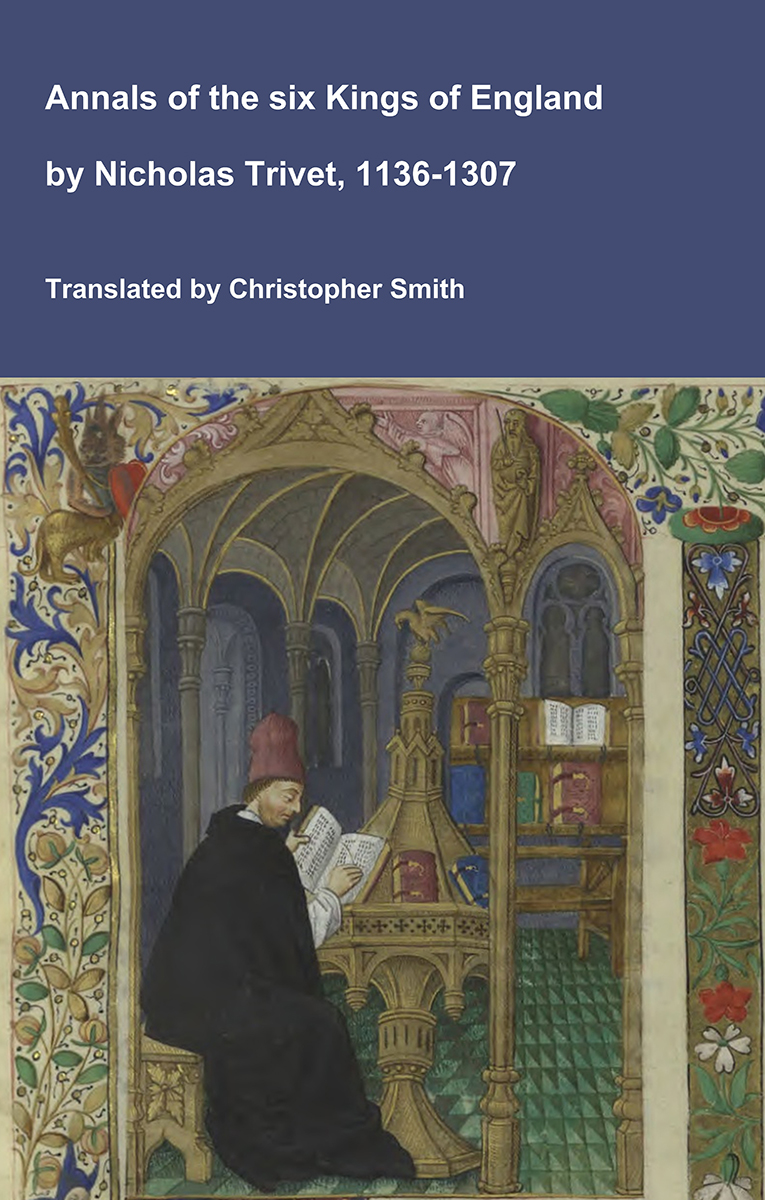
Annals of the six Kings of England by Nicholas Trivet
Translation of the Annals of the Six Kings of England by that traces the rise and rule of the Angevin aka Plantagenet dynasty from the mid-12th to early 14th century. Written by the Dominican scholar Nicholas Trivet, the work offers a vivid account of English history from the reign of King Stephen through to the death of King Edward I, blending political narrative with moral reflection. Covering the reigns of six monarchs—from Stephen to Edward I—the chronicle explores royal authority, rebellion, war, and the shifting balance between crown, church, and nobility. Trivet provides detailed insight into defining moments such as baronial conflicts, Anglo-French rivalry, and the consolidation of royal power under Edward I, whose reign he describes with particular immediacy. The Annals combines careful year-by-year reporting with thoughtful interpretation, presenting history not merely as a sequence of events but as a moral and political lesson. Ideal for readers interested in medieval history, kingship, and the origins of the English state, this chronicle remains a valuable and accessible window into the turbulent world of the Plantagenet kings.
Available at Amazon in eBook and Paperback format.
 Blackhammer Chambered Cairn
 Knowe of Ramsay, Rousay
 Knowe of Rowiegar, Rousay
 Knowe of Yarso Chambered Cairn
 Midhowe Chambered Cairn
 Taversoe Tuick
Rousay is in Orkney Northern Islands.
Blackhammer Chambered Cairn is also in Orkney Cromarty Type Chambered Cairn.
3000BC. Blackhammer Chambered Cairn [Map] is a Neolithic chambered cairn located on the island of Rousay, in Orkney, Scotland. The tomb, constructed around 3000 BC, is a Orkney–Cromarty chambered cairn, characterized by stalled burial compartments. The oblong tomb measures 22.5 m (74 ft) by 8.9 m (29 ft) externally. The cairn encloses a long burial chamber measuring 13.5 m (44 ft) by 2.0 m (6 ft 7 in), and 2.0 m (6 ft 7 in) in height.
Knowe of Ramsay, Rousay is also in Orkney Cromarty Type Chambered Cairn.
Knowe of Ramsay, Rousay [Map]. An Orkney-Cromarty stalled cairn, near the edge of one of the natural terraces above the shore overlooking the "Knowe of Lairo" (HY32NE 6). It is now a low grass-grown mound with a hollow down the centre from which some flagstones protrude . It had much the same appearance before excavation in 1935, when it was found that it had already been severely robbed and disturbed. The cairn, with its major axis NW-SE, is 103' long; the SE end, which contains the entrance passage, is square, 15' in width. The sides diverge to give a maximum width of 24' and then converge into the rounded NW end. It is edged by a wall face of horizontally laid stones, greatly dilapidated but surviving to a height of 4'2" on the SW side; there is no second wall-face. Against the W side of the NW end is a rough block of masonry, possibly part of an unfinished outer casing to the cairn, and at the SE end on the E side a wall 7'9" long abuts the cairn at right angles. The passage is 6'5" long and 1' 8" wide, with a maximum height of 2'4". The chamber, 88' long and from 3'11" to 6'8" wide, is divided into 14 compartments by pairs of transverse slabs, 2'6" - 4'9" high. The end of the chamber is formed by a large stone on edge. A small stone cist was found near the SW corner of the fifth compartment from the entrance. Finds from the site included: about 6 small sherds of reddish ware, a scraper and 5 pieces of flint, human bones very broken and decayed and numerous animal bones.
Carbon Date. 2340BC. Early Bronze Age Carbon Dates
Report: Bone, id as?bovine ribs, from Knowe of Ramsay [Map], Rousay, Orkney, Scotland.
ID: 4436, C14 ID: Q-1223 Date BP: 4340 +/- 65, Start Date BP: 4275, End BP: 4405
OS Letter: HY, OS East: 400, OS North: 280
Archaeologist Name: Callander and Grant 1936
Reference Name: Antiquity, 50, 1976, 194-203; C Renfrew (ed), 'The prehistory of Orkney' (1985)
Council for British Archaeology (2012) Archaeological Site Index to Radiocarbon Dates from Great Britain and Ireland [data-set]. York: Archaeology Data Service [distributor] https://doi.org/10.5284/1017767
Carbon Date. 2300BC. Early Bronze Age Carbon Dates
Report: Bone, id as red deer humerus, metacarpals and radius, from Knowe of Ramsay [Map], Rousay, Orkney, Scotland.
ID: 4437, C14 ID: Q-1224 Date BP: 4300 +/- 60, Start Date BP: 4240, End BP: 4360
OS Letter: HY, OS East: 400, OS North: 280
Archaeologist Name: Callander and Grant 1936
Reference Name: Antiquity, 50, 1976, 194-203; C Renfrew (ed), 'The prehistory of Orkney' (1985)
Council for British Archaeology (2012) Archaeological Site Index to Radiocarbon Dates from Great Britain and Ireland [data-set]. York: Archaeology Data Service [distributor] https://doi.org/10.5284/1017767
Carbon Date. 2010BC. Early Bronze Age Carbon Dates
Report: Bone, id as Bos metacarpals, tibiae and ulna, from Knowe of Ramsay [Map], Rousay, Orkney, Scotland.
ID: 4438, C14 ID: Q-1222 Date BP: 4010 +/- 60, Start Date BP: 3950, End BP: 4070
OS Letter: HY, OS East: 400, OS North: 280
Archaeologist Name: Callander and Grant 1936
Reference Name: Antiquity, 50, 1976, 194-203; C Renfrew (ed), 'The prehistory of Orkney' (1985)
Council for British Archaeology (2012) Archaeological Site Index to Radiocarbon Dates from Great Britain and Ireland [data-set]. York: Archaeology Data Service [distributor] https://doi.org/10.5284/1017767
Knowe of Rowiegar, Rousay is also in Orkney Cromarty Type Chambered Cairn.
Knowe of Rowiegar, Rousay [Map]Knowe of Rowiegar, an Orkney-Cromarty type stalled cairn, now a grass-covered mound with a few slabs projecting near the centre.
The mound was excavated by W G Grant in 1937, who found that the SE end had been so badly damaged that it obscured all trace of the entrance, and that an earth-house had been constructed in the easternmost half of the cairn. Other Iron Age building, datable by pottery (J Phemister 1942) and other relics, lay on and around the cairn.
Carbon Date. 2305BC. Early Bronze Age Carbon Dates
Report: Bone, id as Bos tibia and radius, from Knowe of Rowiegar [Map], Rousay, Orkney, Scotland.
ID: 4439, C14 ID: Q-1221 Date BP: 4305 +/- 60, Start Date BP: 4245, End BP: 4365
OS Letter: HY, OS East: 373, OS North: 298
Archaeologist Name: W G Grant c 1940s
Reference Name: Antiquity, 50, 1976, 194-203; C Renfrew (ed), 'The prehistory of Orkney' (1985)
Council for British Archaeology (2012) Archaeological Site Index to Radiocarbon Dates from Great Britain and Ireland [data-set]. York: Archaeology Data Service [distributor] https://doi.org/10.5284/1017767
Carbon Date. 2005BC. Early Bronze Age Carbon Dates
Report: Charcoal, id as red deer femur, tibia and humerus, from Knowe of Rowiegar [Map], Rousay, Orkney, Scotland.
ID: 4440, C14 ID: Q-1227 Date BP: 4005 +/- 60, Start Date BP: 3945, End BP: 4065
OS Letter: HY, OS East: 373, OS North: 298
Archaeologist Name: W G Grant c 1940s
Reference Name: Antiquity, 50, 1976, 194-203; C Renfrew (ed), 'The prehistory of Orkney' (1985)
Council for British Archaeology (2012) Archaeological Site Index to Radiocarbon Dates from Great Britain and Ireland [data-set]. York: Archaeology Data Service [distributor] https://doi.org/10.5284/1017767
Knowe of Yarso Chambered Cairn is also in Orkney Cromarty Type Chambered Cairn.
3500BC. Knowe of Yarso Chambered Cairn [Map] is a Neolithic burial monument located on the island of Rousay in Orkney, Scotland. The site was excavated in the 1930s, and uncovered human and animal bones as well as pottery sherds, flint and bone tools, and arrowheads. The tomb, dating to the period between 3500 and 2500 BC, is a stalled chambered cairn. Archaeological excavation during the 1930s revealed a rectangular-shaped cairn measuring 15 m (49 ft) by 8 m (26 ft) externally and situated northwest-southeast. The cairn encloses a burial monument measuring 8 m (26 ft) by 2 m (6 ft 7 in) with a surviving height of 2 m (6 ft 7 in). The roof to the tomb had been removed at some point when the tomb was robbed. The exterior walls of the tomb display decorative stonework which can be seen near the entrance.
Carbon Date. 2225BC. Early Bronze Age Carbon Dates
Report: Bone, id as?red deer tibiae, from Knowe of Yarso [Map], Rousay, Orkney, Scotland.
ID: 4443, C14 ID: Q-1225 Date BP: 4225 +/- 60, Start Date BP: 4165, End BP: 4285
OS Letter: HY, OS East: 404, OS North: 281
Archaeologist Name: Callander and Grant 1935
Reference Name: Antiquity, 50, 1976, 194-203; Proc Soc Antiq Scot, 69, 1935, 325-51; C Renfrew (ed), 'The prehistory of Orkney' (1985)
Council for British Archaeology (2012) Archaeological Site Index to Radiocarbon Dates from Great Britain and Ireland [data-set]. York: Archaeology Data Service [distributor] https://doi.org/10.5284/1017767
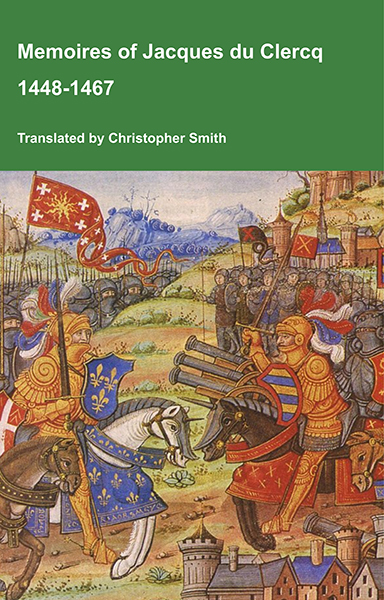
This is a translation of the 'Memoires of Jacques du Clercq', published in 1823 in two volumes, edited by Frederic, Baron de Reissenberg. In his introduction Reissenberg writes: 'Jacques du Clercq tells us that he was born in 1424, and that he was a licentiate in law and a counsellor to Philip the Good, Duke of Burgundy, in the castellany of Douai, Lille, and Orchies. It appears that he established his residence at Arras. In 1446, he married the daughter of Baldwin de la Lacherie, a gentleman who lived in Lille. We read in the fifth book of his Memoirs that his father, also named Jacques du Clercq, had married a lady of the Le Camelin family, from Compiègne. His ancestors, always attached to the counts of Flanders, had constantly served them, whether in their councils or in their armies.' The Memoires cover a period of nineteen years beginning in in 1448, ending in in 1467. It appears that the author had intended to extend the Memoirs beyond that date; no doubt illness or death prevented him from carrying out this plan. As Reissenberg writes the 'merit of this work lies in the simplicity of its narrative, in its tone of good faith, and in a certain air of frankness which naturally wins the reader’s confidence.' Du Clercq ranges from events of national and international importance, including events of the Wars of the Roses in England, to simple, everyday local events such as marriages, robberies, murders, trials and deaths, including that of his own father in Book 5; one of his last entries.
Available at Amazon in eBook and Paperback format.
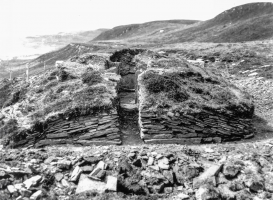
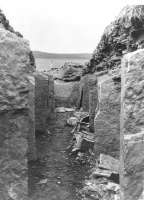
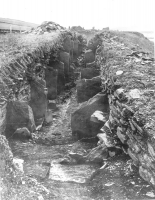
Knowe of Yarso Chambered Cairn [Map]. During excavation in 1934.
Midhowe Chambered Cairn is also in Orkney Cromarty Type Chambered Cairn.
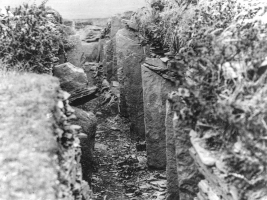
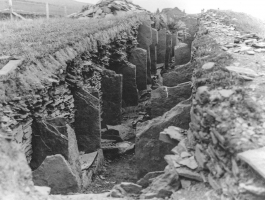
Midhowe Chambered Cairn [Map] is a particularly well preserved example of the Orkney-Cromarty type of chambered cairn. Tombs of this type are often referred to as "stalled" cairns due to their distinctive internal structure. Stalled cairns have a central passageway flanked by a series of paired transverse stones that separate the side spaces into compartments that reminded early investigators of horse stalls.
Unstan Ware is finely decorated early Neolithic Pottery from the 4th Millenium BC and the 3rd Millenium BC; elegant shallow bowls with a groove-pattern around the rim, or undecorated round bottomed bowls. The name is from the Unstan Chambered Cairn [Map] where the pottery was first found in 1884. Unstan Ware is found in tombs: Midhowe Chambered Cairn [Map], Tomb of the Eagles [Map], Taversoe Tuick [Map] as well as farmsteads: Knap of Howar [Map].
Midhowe Chambered Cairn [Map]. During excavation 1832.
Carbon Date. 1850BC. Middle Bronze Age Carbon Dates
Report: Bone, id as Bos humerus and femur, from Rinyo, Rousay, Orkney, Scotland.
ID: 4308, C14 ID: Q-1226 Date BP: 3850 +/- 70, Start Date BP: 3780, End BP: 3920
OS Letter: HY, OS East: 440, OS North: 321
Archaeologist Name: Childe and Grant 1939/48
Reference Name: Antiquity, 50, 1976, 194-203; Proc Soc Antiq Scot, 73, 1939, 6-31; Renfrew (ed), Prehistory of Orkney (1985) [synth & calibrn]
Council for British Archaeology (2012) Archaeological Site Index to Radiocarbon Dates from Great Britain and Ireland [data-set]. York: Archaeology Data Service [distributor] https://doi.org/10.5284/1017767
Taversoe Tuick is also in Orkney Chambered Cairns Unspecified Type.
Unstan Ware is finely decorated early Neolithic Pottery from the 4th Millenium BC and the 3rd Millenium BC; elegant shallow bowls with a groove-pattern around the rim, or undecorated round bottomed bowls. The name is from the Unstan Chambered Cairn [Map] where the pottery was first found in 1884. Unstan Ware is found in tombs: Midhowe Chambered Cairn [Map], Tomb of the Eagles [Map], Taversoe Tuick [Map] as well as farmsteads: Knap of Howar [Map].