

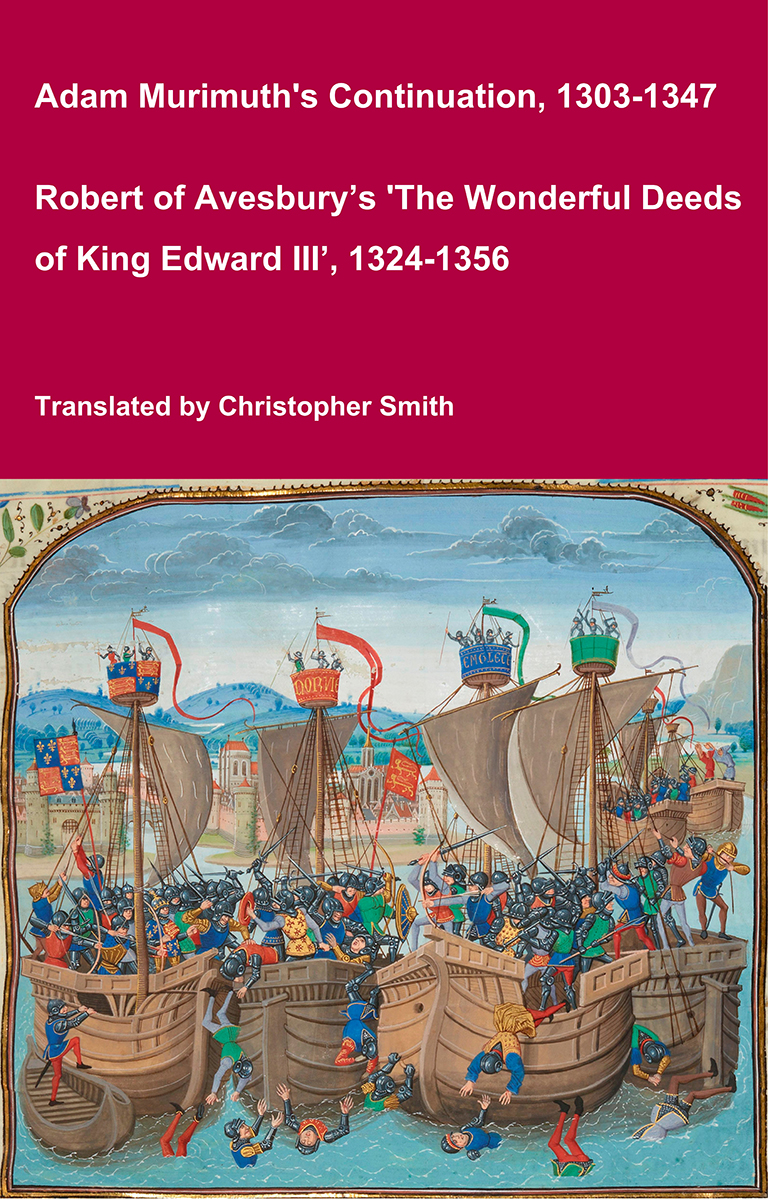
Adam Murimuth's Continuation and Robert of Avesbury’s 'The Wonderful Deeds of King Edward III'
This volume brings together two of the most important contemporary chronicles for the reign of Edward III and the opening phases of the Hundred Years’ War. Written in Latin by English clerical observers, these texts provide a vivid and authoritative window into the political, diplomatic, and military history of fourteenth-century England and its continental ambitions. Adam Murimuth Continuatio's Chronicarum continues an earlier chronicle into the mid-fourteenth century, offering concise but valuable notices on royal policy, foreign relations, and ecclesiastical affairs. Its annalistic structure makes it especially useful for establishing chronology and tracing the development of events year by year. Complementing it, Robert of Avesbury’s De gestis mirabilibus regis Edwardi tertii is a rich documentary chronicle preserving letters, treaties, and official records alongside narrative passages. It is an indispensable source for understanding Edward III’s claim to the French crown, the conduct of war, and the mechanisms of medieval diplomacy. Together, these works offer scholars, students, and enthusiasts a reliable and unembellished account of a transformative period in English and European history. Essential for anyone interested in medieval chronicles, the Hundred Years’ War, or the reign of Edward III.
Available at Amazon in eBook and Paperback format.
Earl Moray is in Earl.
In 1312 Thomas Randolph 1st Earl of Moray [aged 34] was created 1st Earl Moray. Isabella Stewart Countess Moray by marriage Countess Moray.
On 20th July 1332 Thomas Randolph 1st Earl of Moray [aged 54] died. His son Thomas succeeded 2nd Earl Moray. He would be Earl for twenty days only.
On 12th August 1332 Battle of Dupplin Moor was fought between the supporters of the infant King David II of Scotland [aged 8], son of King Robert the Bruce I of Scotland, and the supporters of King Edward I of Scotland [aged 49], supported by the English. The Bruce army included Robert Bruce Lord of Liddesdale and Domhnall Mar II Earl of Mar [aged 39]. The Balliol army included David III Strathbogie 11th Earl Atholl [aged 23], Ralph Stafford 1st Earl Stafford [aged 30], Thomas Ughtred 1st Baron Ughtred [aged 40] and Walter Manny 1st Baron Manny [aged 22]. The battle is notable for being the first to use dismounted men-at-arms supported by archers; a formation that would bring repeated success to the English both in Scotland and France.
Robert Bruce Lord of Liddesdale was killed leading a charge.
Nicholas Hay [aged 47] was killed.
Thomas Randolph 2nd Earl Moray was killed. His brother John [aged 26] succeeded 3rd Earl Moray.
Domhnall Mar II Earl of Mar was killed.
John Randolph 3rd Earl of Moray and Euphemia Ross Queen Consort Scotland were married. She by marriage Countess Moray. She the daughter of Hugh 4th Earl Ross and Margaret Graham Countess Ross. He the son of Thomas Randolph 1st Earl of Moray and Isabella Stewart Countess Moray.
In 1374 John Dunbar 1st Earl of Moray [aged 32] was created 4th Earl Moray. Marjorie Stewart Countess Moray [aged 26] by marriage Countess Moray. He was a nephew of the previous Earl of Moray John Randolph 3rd Earl of Moray who was brother of his mother Isabella Randolph.
In 1391 John Dunbar 1st Earl of Moray [aged 49] was killed in a tournament at York [Map] from wounds received from Thomas Mowbray 4th Earl Norfolk 2nd Earl Nottingham [aged 5]. His son Thomas [aged 20] succeeded 5th Earl Moray.
Before 9th August 1422 Thomas Dunbar 2nd Earl of Moray [aged 51] died. His son Thomas succeeded 3rd Earl Moray.
Before 1429 Thomas Dunbar 3rd Earl of Moray died. His son James [aged 28] succeeded 4th Earl Moray.
On 10th August 1430 James Dunbar 4th Earl of Moray [aged 30] died. His daughter Elizabeth [aged 5] succeeded 5th Countess Moray.
Around 1445 Archibald Douglas Earl of Moray [aged 19] and Elizabeth Dunbar 5th Countess Moray [aged 20] were married. He by marriage Earl Moray. She the daughter of James Dunbar 4th Earl of Moray. He the son of James "Gross" Douglas 7th Earl Douglas 1st Earl Avondale and Beatrix Sinclair Countess Douglas and Avondale [aged 47]. They were third cousin once removed.
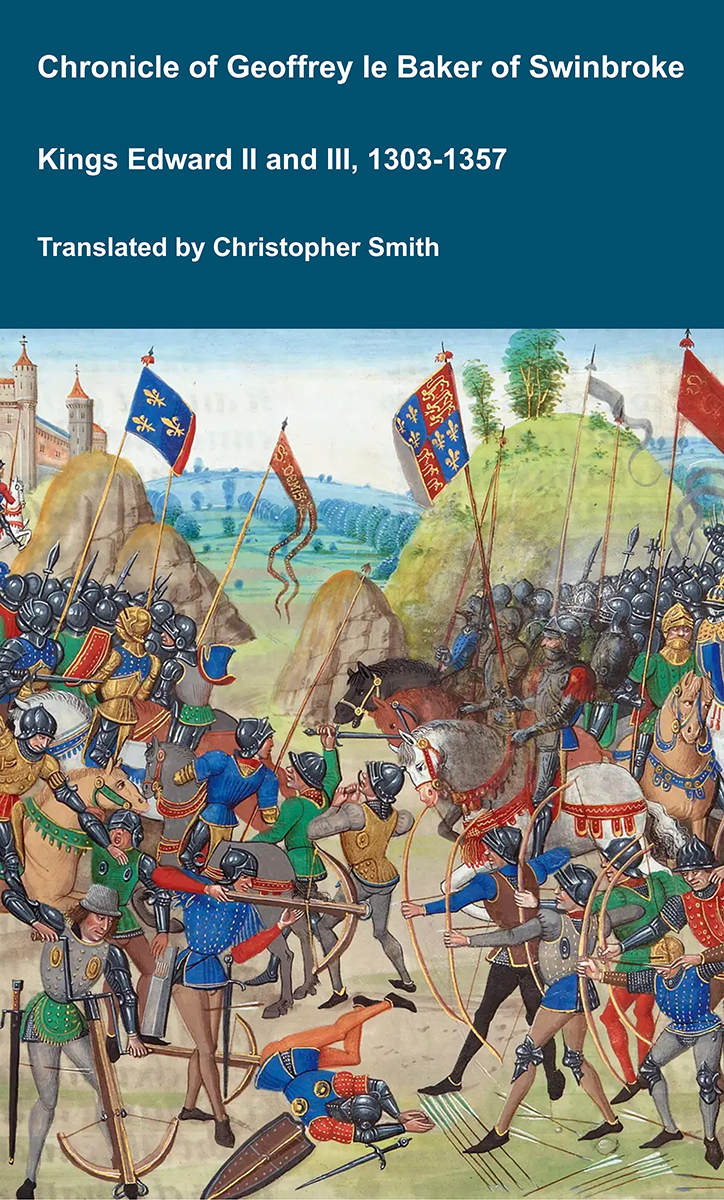
Chronicle of Geoffrey le Baker of Swinbroke
Baker was a secular clerk from Swinbroke, now Swinbrook, an Oxfordshire village two miles east of Burford. His Chronicle describes the events of the period 1303-1356: Gaveston, Bannockburn, Boroughbridge, the murder of King Edward II, the Scottish Wars, Sluys, Crécy, the Black Death, Winchelsea and Poitiers. To quote Herbert Bruce 'it possesses a vigorous and characteristic style, and its value for particular events between 1303 and 1356 has been recognised by its editor and by subsequent writers'. The book provides remarkable detail about the events it describes. Baker's text has been augmented with hundreds of notes, including extracts from other contemporary chronicles, such as the Annales Londonienses, Annales Paulini, Murimuth, Lanercost, Avesbury, Guisborough and Froissart to enrich the reader's understanding. The translation takes as its source the 'Chronicon Galfridi le Baker de Swynebroke' published in 1889, edited by Edward Maunde Thompson.
Available at Amazon in eBook and Paperback format.
In 1501 James Stewart 1st Earl of Moray [aged 2] was created 1st Earl Moray by his father King James IV of Scotland [aged 27].
In August 1529 James Stewart 1st Earl of Moray [aged 30] and Elizabeth Campbell Countess Moray and Sutherland were married. She by marriage Countess Moray. She the daughter of Colin Campbell 3rd Earl Argyll [aged 43] and Jean or Janet Gordon Countess Argyll. He the illegitmate son of King James IV of Scotland and Janet Kennedy [aged 49]. They were half second cousin once removed. He a great x 5 grandson of King Edward III of England. She a great x 5 granddaughter of King Edward III of England.