

Henrici Quinti, Angliæ Regis, Gesta, is a first-hand account of the Agincourt Campaign, and subsequent events to his death in 1422. The author of the first part was a Chaplain in King Henry's retinue who was present from King Henry's departure at Southampton in 1415, at the siege of Harfleur, the battle of Agincourt, and the celebrations on King Henry's return to London. The second part, by another writer, relates the events that took place including the negotiations at Troye, Henry's marriage and his death in 1422.
Available at Amazon in eBook and Paperback format.
 Rome, Italy
 Durham Cathedral
 St Chad's Church, Longford
 St Mary's Church, Fawsley
 St Peter's Church, Llanbedr
John Gibson is in Sculptors.
On 19th June 1790 John Gibson was born at Gyffin. He moved with his family to Liverpool aged nine.
In 1816 John Gibson (age 25) had two works exhibited in the Royal Academy's Summer Exhibition.
In October 1817 John Gibson (age 27) travelled to Rome, Italy [Map] where he studied under Antonio Canova (age 59).
In 1824 John Gibson (age 33) completed his first marble sculpture Sleeping Shepherd Boy.
On 4th November 1833 John Gibson (age 43) was elected Associate of the Royal Academy despite not meeting the criterion of being resident in Britain.
After 1836. Durham Cathedral [Map]. Monument to Bishop William van Mildert (age 70) sculpted by John Gibson (age 45).


On 10th February 1836 John Gibson (age 45) was elected Fellow of the Royal Academy. He submitted a statue of Narcissus as his Diploma Work. The subject is one from classical mythology but the figure was initially inspired by a scene Gibson observed in Rome. While out walking on the Pincian Hill, the artist caught sight of a boy looking at his reflection in water, reminding him of the story of Narcissus.
In 1844 John Gibson (age 53) visited Britain at which time he was introduced to Queen Victoria of the United Kingdom (age 24) and Prince Albert Saxe Coburg Gotha (age 24). He enjoyed their patronage for the rest of his life. Gibson produced several portraits of Queen Victoria, including a bust and a full-length statue. He also made a marble relief of Cupid and Psyche that the Queen gave to her husband as a Christmas present.

After 22nd July 1844. St Chad's Church, Longford [Map]. Monument to Anne Amelia Keppel Countess Leicester (deceased). White marble with relief carving of angels probably sculpted by John Gibson (age 54).
Anne Amelia Keppel Countess Leicester: In 1803 she was born to William Charles Keppel 4th Earl Albermarle and Elizabeth Southwell Countess Albermarle. She a great x 3 granddaughter of King Charles II of England Scotland and Ireland. In 1822 Thomas Coke 1st Earl of Leicester and she were married. The difference in their ages was 48 years. She the daughter of William Charles Keppel 4th Earl Albermarle and Elizabeth Southwell Countess Albermarle. In 1837 Thomas Coke 1st Earl of Leicester was created 1st Earl of Leicester. She by marriage Countess of Leicester. On 22nd July 1844 Anne Amelia Keppel Countess Leicester died.
After 27th July 1856. St Mary's Church, Fawsley [Map]. Monument to Selina Mary Hervey Lady Knightley sculpted by John Gibson (age 66).
Selina Mary Hervey Lady Knightley: she was born to Felton Hervey. On 24th August 1813 Charles Knightley 2nd Baronet and she were married. She by marriage Lady Knightley of Fawsley. On 27th July 1856 Selina Mary Hervey Lady Knightley died.


In 1862 John Gibson (age 71) presented the polychrome "Tinted Venus" at the 1862 Great Exhibition, provoking fierce debate about the use of colour in sculpture. Gibson himself was devoted to the work and resisted handing it over to its buyer for four years after the purchase was made.
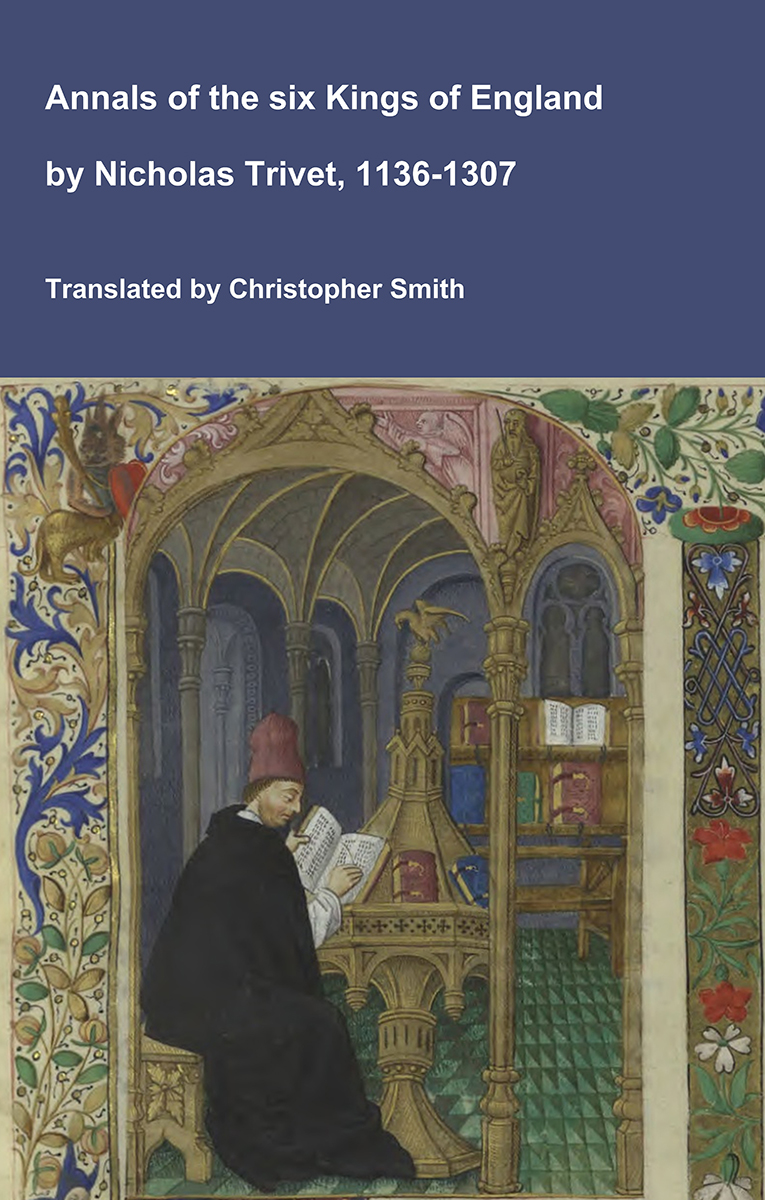
Annals of the six Kings of England by Nicholas Trivet
Translation of the Annals of the Six Kings of England by that traces the rise and rule of the Angevin aka Plantagenet dynasty from the mid-12th to early 14th century. Written by the Dominican scholar Nicholas Trivet, the work offers a vivid account of English history from the reign of King Stephen through to the death of King Edward I, blending political narrative with moral reflection. Covering the reigns of six monarchs—from Stephen to Edward I—the chronicle explores royal authority, rebellion, war, and the shifting balance between crown, church, and nobility. Trivet provides detailed insight into defining moments such as baronial conflicts, Anglo-French rivalry, and the consolidation of royal power under Edward I, whose reign he describes with particular immediacy. The Annals combines careful year-by-year reporting with thoughtful interpretation, presenting history not merely as a sequence of events but as a moral and political lesson. Ideal for readers interested in medieval history, kingship, and the origins of the English state, this chronicle remains a valuable and accessible window into the turbulent world of the Plantagenet kings.
Available at Amazon in eBook and Paperback format.
1863. St Peter's Church, Llanbedr [Map]. Monument to Edward Lloyd of Berth in Denbighshire. Sculpted by John Gibson (age 72).
Edward Lloyd of Berth in Denbighshire: Around 1778 he was born. On 14th October 1859 he died.


Before 1866. Margaret Sarah Carpenter nee Geddes (age 72). Portrait of John Gibson (age 75).
On 7th January 1866 or 27th January 1866 John Gibson (age 75) died at Rome, Italy [Map]. He bequeathed the contents of his studio, a large selection of his works and a large sum of money to the Royal Academy.