


Text this colour links to Pages. Text this colour links to Family Trees. Text this colour are links that disabled for Guests.
Place the mouse over images to see a larger image. Click on paintings to see the painter's Biography Page.
Mouse over links for a preview. Move the mouse off the painting or link to close the popup.
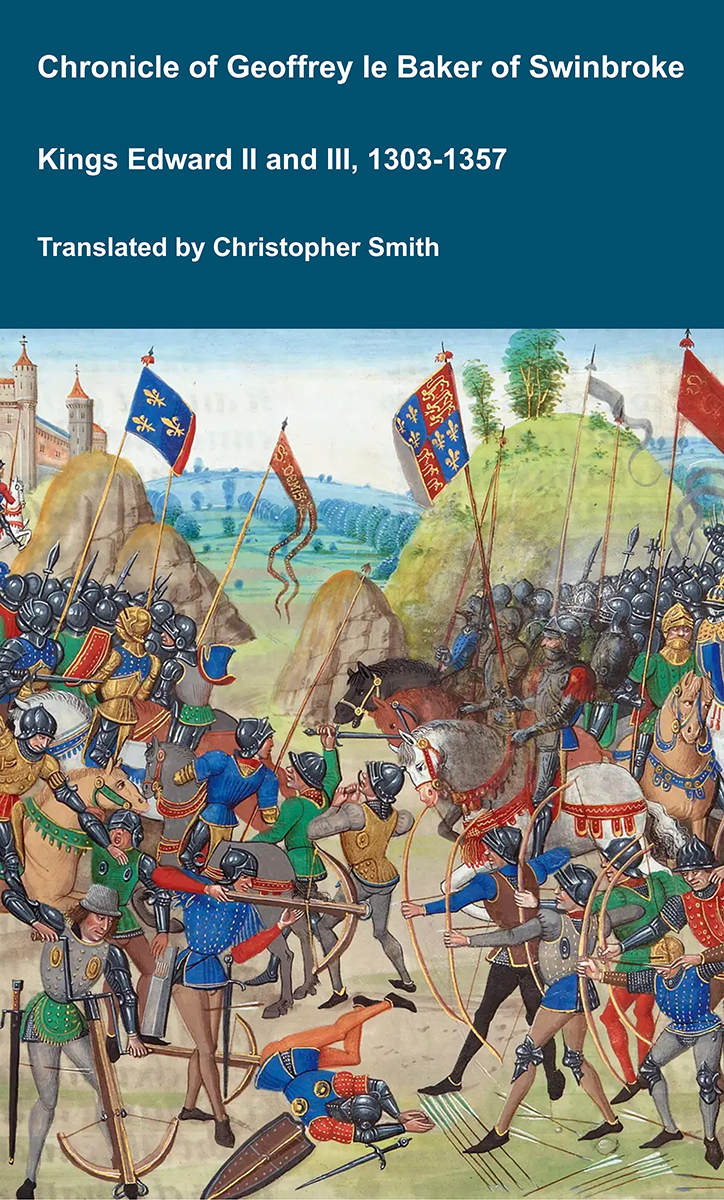
Chronicle of Geoffrey le Baker of Swinbroke
Baker was a secular clerk from Swinbroke, now Swinbrook, an Oxfordshire village two miles east of Burford. His Chronicle describes the events of the period 1303-1356: Gaveston, Bannockburn, Boroughbridge, the murder of King Edward II, the Scottish Wars, Sluys, Crécy, the Black Death, Winchelsea and Poitiers. To quote Herbert Bruce 'it possesses a vigorous and characteristic style, and its value for particular events between 1303 and 1356 has been recognised by its editor and by subsequent writers'. The book provides remarkable detail about the events it describes. Baker's text has been augmented with hundreds of notes, including extracts from other contemporary chronicles, such as the Annales Londonienses, Annales Paulini, Murimuth, Lanercost, Avesbury, Guisborough and Froissart to enrich the reader's understanding. The translation takes as its source the 'Chronicon Galfridi le Baker de Swynebroke' published in 1889, edited by Edward Maunde Thompson.
Available at Amazon in eBook and Paperback format.
Carn Goch Long Barrow is in Llangatock, Breconshire, Prehistoric Wales Neolithic Burials.
Long Barrows of the Cotswolds. Carn Goch Long Barrow [Map]
Brecknockshire, 41 N.E. Parish of Llangattock. 6a*.
Latitude 51° 57' 08" Longitude 3° 08' 38". Height above O.D., between 270 & 300 feet.
The following account presumably refers to the site marked "Garn Goch" on the O.S. map:-
Some workmen recently engaged in clearing away a large heap of stones in Llangattock Park, the seat of his Grace the Duke of Beaufort, accidentally met with a cist or cromlech, consisting of four rude stones put up in the ground on their edges, while a fifth covers the top. On its being opened, a quantity of human bones were discovered, some of which soon crumbled to dust; but the bone of the arm and also the upper part of the jaw, part of the skull, and a row of teeth, were quite perfect, all of which were carefully collected and preserved. The size of the interior was 8 feet 6 inches long, 4 feet wide, reduced to 3 feet 10 inches at the other end, and 2 feet 2 inches high."
When I first visited the neighbourhood I heard indirectly that the rnonument in question was supposed not to be an antiquity and did not visit it. On August 17th, 1924 I visited it in company with Dr. Mortimer Wheeler, Director of the National Museum of Wales, and we agreed that the cairn was a long one of the same type as the other Brecknockshire examples. On the south-eastern side are the remnants of a large capstone, but for the rest it is impossible to make out any plan or order. In the wood close by on the east are a number of cairns which may be of natural origin.
Gentleman's Magazine, 1847, Pt. 2, p. 526 (quoted above).
 Become a Member via our Buy Me a Coffee page to read more.