

Henrici Quinti, Angliæ Regis, Gesta, is a first-hand account of the Agincourt Campaign, and subsequent events to his death in 1422. The author of the first part was a Chaplain in King Henry's retinue who was present from King Henry's departure at Southampton in 1415, at the siege of Harfleur, the battle of Agincourt, and the celebrations on King Henry's return to London. The second part, by another writer, relates the events that took place including the negotiations at Troye, Henry's marriage and his death in 1422.
Available at Amazon in eBook and Paperback format.
Hanging Stone aka Burton Burial Chamber is in Rosemarket, Pembrokeshire, Prehistoric Wales Neolithic Burials.
Archaeologia Cambrensis 1844 Pages 129-144. In the volume for 1872, p. 126, are two views of the Burton Cromlech, Pembrokeshire [Hanging Stone aka Burton Burial Chamber [Map]], which has not been so often noticed as others. In 1864 it was used as a small sheepcot, and had been built round with small stones, since cleared away with advantage. The capstone lies north and south, measuring about 11 feet by 9. The capstone is unusually massive, and as far as one example can illustrate it, settles the question of capstones ever serving as altar-slabs. The two excellent illustrations here given are from drawings by Miss Tombs and her brother, of Burton Bectory.

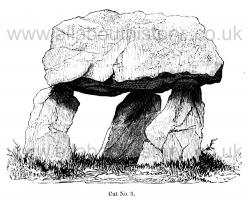
Archaeologia Cambrensis 1872 Pages 81-143. The first to be described is one [Hanging Stone aka Burton Burial Chamber [Map]] in the parish of Burton, near Haverfordwest, and on the estate of J. H. Scourfield, Esq., M.P. It was inspected when the Society, in 1864, visited the county under the presidency of that gentleman; at which time it was built round with loose stones, and used as a small sheepcot. It has since been cleared out, and is now seen to much better advantage than when visited by the Society. At that time there were some small remains of the original packing of small stones in the interstices between the slabs,—a very unusual occurrence. What was left was but a very small portion, but quite sufficient to give an idea of the firm manner in which this dry rubble-work was worked in. It is too far off to have any direct relation with the singular alignment (described by Sir Gardner Wilkinson in the Archæologia Cambrensis of 1870, p. 120) near Benton Castle, which has, however, at least one ruined dolmen connected with it. The capstone, from north to south, is 10 feet 2 inches by 81 feet, with a thickness of 4 ft. 3 ins.; and from the highest point of the exterior, from the ground, is 9½ ft. The upright stone on the south side is 6 ft. 1 inch; that on the east side is 5 ft. 3 ins.; and that on the north side, 5 ft. 5 ins. Cut No. 2 represents the south side, and is from a drawing by Mr. James Tombs.