

Abbot John Whethamstede’s Chronicle of the Abbey of St Albans
Abbot John Whethamstede's Register aka Chronicle of his second term at the Abbey of St Albans, 1451-1461, is a remarkable text that describes his first-hand experience of the beginning of the Wars of the Roses including the First and Second Battles of St Albans, 1455 and 1461, respectively, their cause, and their consequences, not least on the Abbey itself. His text also includes Loveday, Blore Heath, Northampton, the Act of Accord, Wakefield, and Towton, and ends with the Coronation of King Edward IV. In addition to the events of the Wars of the Roses, Abbot John, or his scribes who wrote the Chronicle, include details in the life of the Abbey such as charters, letters, land exchanges, visits by legates, and disputes, which provide a rich insight into the day-to-day life of the Abbey, and the challenges faced by its Abbot.
Available at Amazon in eBook and Paperback format.
Trellyffaint Burial Chamber is in Trellyffaint, Nevern, Prehistoric Wales Neolithic Burials.
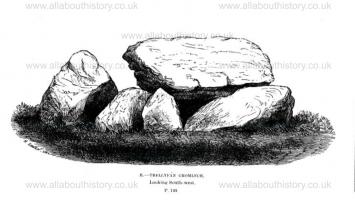
Archaeologia Cambrensis 1844 Pages 129-144. Trellyfan Cromlech [Trellyffaint Burial Chamber [Map]] (cut B) has never been engraved, and is very seldom mentioned even in the most satisfactory guide-books. The capstone has partly slipped on one side, so that it is not certain how far it resembled that of Llechytribedd, which is inclined at an angle. This is so often the case that there appears to be some reason for it; for it generally happens, as in the Newport Cromlech, that the entrance is higher, and more accessible for moving and replacing the slab that closes the entrance. This inclination of the capstone is, however, rather the exception than the general rule, the horizontal position much depending on the shape of the stone.
Archaeologia Cambrensis 1872 Pages 81-143. Nearer Nevern is the cromlech of Trellyffant or Trellyffan [Map], near Tredrysi. The capstone measures 6 ft. 10in. by 6 ft., and has an average thickness of 2 ft. 4 ins. It has been forced from its original position on the supporters, and turned sideways. Sir Gardner Wilkinson alludes to a small stone inserted between the south: south-west corner of the covering slab, and a supporter which is probably the last relic of the original dry rubble-work, and not intended to act as a wedge assisting in the support of the capstone. Sir Gardner conjectures that the raised ground on which this monument stands may be the remains of a former mound.