


Text this colour links to Pages. Text this colour links to Family Trees. Text this colour are links that disabled for Guests.
Place the mouse over images to see a larger image. Click on paintings to see the painter's Biography Page.
Mouse over links for a preview. Move the mouse off the painting or link to close the popup.
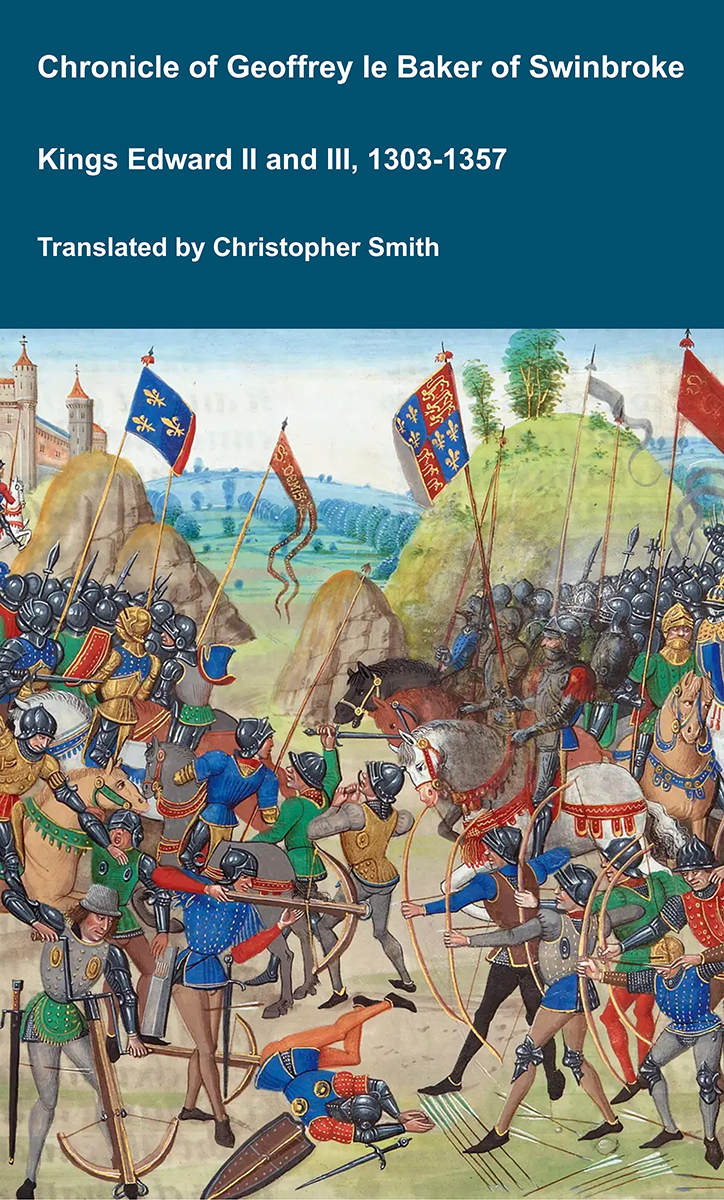
Chronicle of Geoffrey le Baker of Swinbroke
Baker was a secular clerk from Swinbroke, now Swinbrook, an Oxfordshire village two miles east of Burford. His Chronicle describes the events of the period 1303-1356: Gaveston, Bannockburn, Boroughbridge, the murder of King Edward II, the Scottish Wars, Sluys, Crécy, the Black Death, Winchelsea and Poitiers. To quote Herbert Bruce 'it possesses a vigorous and characteristic style, and its value for particular events between 1303 and 1356 has been recognised by its editor and by subsequent writers'. The book provides remarkable detail about the events it describes. Baker's text has been augmented with hundreds of notes, including extracts from other contemporary chronicles, such as the Annales Londonienses, Annales Paulini, Murimuth, Lanercost, Avesbury, Guisborough and Froissart to enrich the reader's understanding. The translation takes as its source the 'Chronicon Galfridi le Baker de Swynebroke' published in 1889, edited by Edward Maunde Thompson.
Available at Amazon in eBook and Paperback format.
Ty Illtyd Long Barrow is in Llanhamlach, Breconshire, Prehistoric Wales Neolithic Burials.

Long Barrows of the Cotswolds. Ty Illtyd Long Barrow [Map]
Brecknockshire, 34 N.E. Parish of Llanhamlach. 9 *.
Latitude 51° 55' 51'. Longitude3° 18' 41''. Height above O.D., a little more than 700 feet.
This is a most interesting Long Barrow, and in compiling the following account I have availed myself of notes made on the spot by Mr. Evan Morgan of Brecon, in addition to my own made on August 6th, 1921. Mr. Morgan also drew the plan reproduced here. One chamber of the barrow is intact and covered by a capstone. It has been rifled at some very distant date, and on three of the uprights are carved a number of symbols. They appear, however, to be of much later date than the chamber itself, and the inscription on the stone north of and outside the chamber is in lettering of apparently mediseval character. Mr. Morgan says, "Incidentally they suggest that they were made after the chamber was constructed, as they are more numerous on the western stone than on the eastern, and in my opinion better cut. I take this to mean that they were made by a person lying on his left side and using his right hand to cut. . There is on the south end-stone a crude design of what I think is a harp." (About 1½ by 2 inches). The chamber, as will be seen from the plan, is 5 feet 9 inches long by 3 feet 4 inches wide, measured inside. The capstone is 7 feet long by 6 feet wide. It more than covers the chamber.