


Bishop of St Asaph is in Bishops. See St Asaph Cathedral [Map].
Before 1st May 956 St Asaph was appointed Bishop of St Asaph.
In 1143 Bishop Gilbert was consecrated Bishop of St Asaph by Archbishop Baldwin of Forde (age 18).
On 5th January 1268 Bishop Ainan II, Prior of Rhuddlan Friary [Map], was elected Bishop of St Asaph.
On 14th June 1444 Bishop Reginald Peacock (age 49) was appointed Bishop of St Asaph.
On 13th October 1471 Bishop Richard Redman was consecrated Bishop of St Asaph.
In 1495 Bishop Michael Deacon was appointed Bishop of St Asaph.
On 6th July 1518 Bishop Henry Standish (age 43) was consecrated as Bishop of St Asaph by Archbishop William Warham (age 68) assisted by Bishop Robert Sherbourne (age 65) and Bishop John Young (age 55) (suffragan).


In 1536 Bishop William Barlow (age 38) was consecrated Bishop of St Asaph.
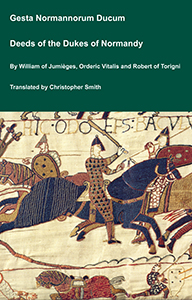
The Deeds of the Dukes of Normandy
The Gesta Normannorum Ducum [The Deeds of the Dukes of Normandy] is a landmark medieval chronicle tracing the rise and fall of the Norman dynasty from its early roots through the pivotal events surrounding the Norman Conquest of England. Originally penned in Latin by the monk William of Jumièges shortly before 1060 and later expanded at the behest of William the Conqueror, the work chronicles the deeds, politics, battles, and leadership of the Norman dukes, especially William’s own claim to the English throne. The narrative combines earlier historical sources with firsthand information and oral testimony to present an authoritative account of Normandy’s transformation from a Viking settlement into one of medieval Europe’s most powerful realms. William’s history emphasizes the legitimacy, military prowess, and governance of the Norman line, framing their expansion, including the conquest of England, as both divinely sanctioned and noble in purpose. Later chroniclers such as Orderic Vitalis and Robert of Torigni continued the history, extending the coverage into the 12th century, providing broader context on ducal rule and its impact. Today this classic work remains a foundational source for understanding Norman identity, medieval statesmanship, and the historical forces that reshaped England and Western Europe between 800AD and 1100AD.
Available at Amazon in eBook and Paperback format.
On 8th June 1536 Bishop Robert Parfew aka Warton was elected Bishop of St Asaph.
On 18th August 1629 Bishop John Owen (age 49) was elected Bishop of St Asaph.
On 17th October 1660 Bishop George Griffith (age 59) was elected Bishop of St Asaph.

On 28th October 1660 Bishop George Griffith (age 59) was consecrated Bishop of St Asaph at the King Henry VII Chapel, Westminster Abbey [Map] by Bishop Brian Duppa (age 71). It was the first consecration of bishops after the Restoration.
In 1680 Bishop William Lloyd (age 52) was appointed Bishop of St Asaph.
John Evelyn's Diary. 31st October 1680. I began and spent the whole week in examining my life, begging pardon for my faults, assistance and blessing for the future, that I might, in some sort, be prepared for the time that now drew near, and not have the great work to begin, when one can work no longer. The Lord Jesus help and assist me! I therefore stirred little abroad till the 5th of November, when I heard Dr. Tenison (age 44), the now vicar of St. Martin's [Map]; Dr. Lloyd (age 53), the former incumbent, being made Bishop of St. Asaph.
John Evelyn's Diary. 31st October 1680. I spent this whole day in exercises. A stranger preached at Whitehall [Map] on Luke xvi. 30, 31. I then went to St. Martin's [Map], where the Bishop of St. Asaph (age 53) [Note. The next post refers to Bishop William Lloyd being made Bishop of St Asaph. The previous incumbent Isaac Barrow had died 24th June 1680] preached on 1 Peter iii. 15; the Holy Communion followed, at which I participated, humbly imploring God's assistance in the great work I was entering into. In the afternoon, I heard Dr. Sprat (age 45), at St. Margaret's [Map], on Acts xvii. 11.
In 1715 Bishop John Wynne (age 48) was appointed Bishop of St Asaph.
The London Gazette 7069. Whitehall, February 29 [1731]. His Majesty has been pleased to grant unto John Baron, Master of Arts, the Archdeaconry of Norfolk, void by the Promotion of the Right Reverend Father in God Dr. Thomas Tanner (age 57) to the Bishoprick of St. Asaph.
His Majesty has been pleased to confer the Dignity of a Baronet of Great Britain upon Robert Brown of the City and Liberty of Westminster, Esq;. [Note. Created with a special remainder to his brothers.]
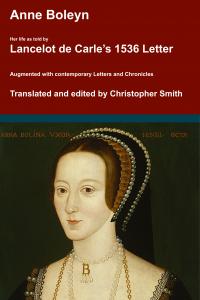
Anne Boleyn. Her Life as told by Lancelot de Carle's 1536 Letter.
In 1536, two weeks after the execution of Anne Boleyn, her brother George and four others, Lancelot du Carle, wrote an extraordinary letter that described Anne's life, and her trial and execution, to which he was a witness. This book presents a new translation of that letter, with additional material from other contemporary sources such as Letters, Hall's and Wriothesley's Chronicles, the pamphlets of Wynkyn the Worde, the Memorial of George Constantyne, the Portuguese Letter and the Baga de Secrets, all of which are provided in Appendices.
Available at Amazon in eBook and Paperback format.
On 23rd January 1732 Bishop Thomas Tanner (age 57) was appointed Bishop of St Asaph.
In 1736 Bishop Isaac Maddox (age 38) was appointed Bishop of St Asaph.
In 1783 Bishop Lewis Bagot (age 42) was appointed Bishop of St Asaph.
In 1815 Bishop John Luxmoore (age 49) was translated to Bishop of St Asaph.
In 12th March 1830 Bishop William Carey (age 60) was elected Bishop of St Asaph.