All About History Books on Amazon

The History of William Marshal, Earl of Chepstow and Pembroke, Regent of England. Book 1 of 2, Lines 1-10152.

The History of William Marshal was commissioned by his son shortly after William’s death in 1219 to celebrate the Marshal’s remarkable life; it is an authentic, contemporary voice. The manuscript was discovered in 1861 by French historian Paul Meyer. Meyer published the manuscript in its original Anglo-French in 1891 in two books. This book is a line by line translation of the first of Meyer’s books; lines 1-10152. Book 1 of the History begins in 1139 and ends in 1194. It describes the events of the Anarchy, the role of William’s father John, John’s marriages, William’s childhood, his role as a hostage at the siege of Newbury, his injury and imprisonment in Poitou where he met Eleanor of Aquitaine and his life as a knight errant. It continues with the accusation against him of an improper relationship with Margaret, wife of Henry the Young King, his exile, and return, the death of Henry the Young King, the rebellion of Richard, the future King Richard I, war with France, the death of King Henry II, and the capture of King Richard, and the rebellion of John, the future King John. It ends with the release of King Richard and the death of John Marshal.

Available at Amazon in eBook and Paperback format.

Frederick Roberts 1872-1899

On 8th January 1872 Frederick Roberts was born.

The London Gazette 27157. From the General Commanding-in-Chief the Forces in South Africa to the Secretary of State for War. Chieveley Camp, SIB, December 16, 1899.

I have the honour to bring the following cases of Distinguished Service in the Field to your notice.

At [the Battle of] Colenso, on the 15th December, the detachments serving the guns of the 14th and 66th Batteries, Royal Field Artillery, had all been either killed, wounded, or driven from their guns by Infantry fire at close range, and the guns were deserted.

About 500 yards behind the guns was a donga, in which some of the few horses and drivers left alive were sheltered. The intervening space was swept with shell and rifle fire.

Captain Congreve, Rifle Brigade, who was in the donga, assisted to hook a team into a limber, went out and assisted to limber up a gun; being wounded he took shelter, but seeing Lieutenant Roberts [aged 27] fall badly wounded he went out again and brought him in. Some idea of the nature of the fire may be gathered from the fact that Captain Congreve was shot through the leg, through the toe of his boot, grazed on the elbow and the shoulder, and his horse shot in three places. Lieutenant the Honourable F. Roberts, King's Royal Rifles, assisted Captain Congreve. He was wounded in three places.

Corporal Nurse, Royal Field Artillery, 66th Battery, also assisted. I recommend the above three for the Victoria Cross.

The London Gazette 27160. War Office, February 2, 1900. The Queen has been graciously pleased to signify Her intention to confer the decoration of the Victoria Cross on the undermentioned Officers and Non-Commissioned Officer, whose claims have been submitted for Her Majesty's approval, for their conspicuous bravery at the battle of Colenso, as stated against their names:—

The Rifle Brigade (The Prince Consort's Own). Captain W. Congreve. At Colenso on the 15th December, 1899, the detachments serving the guus of the 14th and 66th Batteries, Royal Field Artillery, had all been either killed, wounded, or driven from their guns by Infantry fire at close range, and the guns were deserted.

About 500 yards behind the guns was a donga in which some of the few horses and drivers left alive were sheltered. The intervening space was swept with shell and rifle fire.

Captain Congreve, Rifle Brigade, who was in the donga, assisted to hook a team into a limber, went out; and assisted to limber up a gun. Being wounded, he took shelter; but, seeing Lieutenant Roberts fall, badly wounded, he went out again and brought him in. Captain Congreve was shot tbrough the leg, through the toe of his boot, grazed on the elbow and the shoulder, and his horse shot in three places.

The King's Royal Rifle Corps. Lieutenant the Honourable F. H. S. Roberts (since deceased). Lieutenant Roberts assisted Captain Congreve. He was wounded in three places.

66th Royal Battery, Field Artillery. Corporal G. E. Nurse. Corporal Nurse also assisted.

7th Royal Battery, Artillery Field. Captain H. L. Reed. Captain Reed, who had heard of the difficulty, shortly afterwards brought down three teams from liis battery to see if he could be of any use. He was wounded, as were five of the thirteen men who rode with him, one was killed; and thirteen out of twenty-one horses were killed before he got half-way to the guns, and he was obliged to retire

Click to read more ...

On 17th December 1899 Frederick Roberts [aged 27] died.

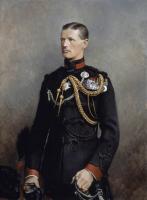
Before 1901. Julian Russell Story [aged 43]. Portrait of Frederick Roberts.