All About History Books on Amazon
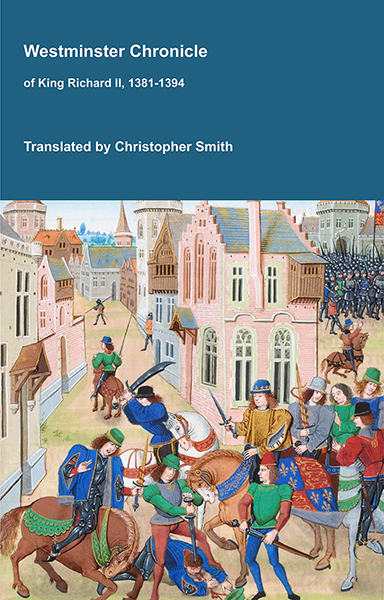
Westminster Chronicle of King Richard II, 1381-1394
The Westminster Chronicle is one of the most vivid and important narrative sources for the reign of Richard II. Written by an anonymous chronicler closely connected with Westminster Abbey, it covers the years 1381 to 1394, from the Peasants’ Revolt to the political tensions, court ceremonies, diplomatic negotiations, royal progresses, and public crises of Richard’s later reign. Rich in detail the chronicle records major events such as the conflicts between the King and Lords Appellant, King and the City of London, negotiations with France and Scotland, the death and funeral of Queen Anne of Bohemia, the illness of Charles VI of France, and the changing fortunes of leading nobles including John of Gaunt, Thomas of Gloucester, Robert de Vere, and the Earl of Arundel. The Chronicle offers readers a remarkable window into late fourteenth-century England, combining political observation, courtly spectacle, urban drama, ecclesiastical affairs, and moral judgement. It is an essential source for anyone interested in medieval monarchy, London, Westminster, and the troubled reign of Richard II.
Available at Amazon in eBook and Paperback format.
Bolsover, Derbyshire is in Derbyshire.
On 17th April 1643 Elizabeth Bassett Countess Newcastle upon Tyne [aged 51] died at Bolsover, Derbyshire [Map].
Gesta Regis Henrici by Benedict of Peterborough. Meanwhile, Richard, Duke of Normandy, gave to his brother John the daughter of the Earl of Gloucester along with the County of Gloucester, and the castle of Marlborough [Map] along with that honour; and the castle of Ludgershall [Map] along with that honour; and the castle of Peak [Map] along with that honour; and the castle of Bolsover [Map]; and all the land that belonged to William Peverel; and the town of Nottingham along with that honour, and the castle of Lancaster [Map] along with that honour, and Derbyshire, and the honour of Wallingford, and the honour of Tickhill [Map], and many other things which are too long to enumerate individually. He gave him all these things with the forests, towns, and all their other appurtenances.
Interim Ricardus dux Normanniæ dedit Johanni fratri suo filiam comitis Gloucestriæ cum comitatu Gloucestriæ, et castellum de Merleberg cum honore illo; et castellum de Lutegareshale cum honore illo; et castellum de Pech cum honore illo; et castellum de Boleshoveres; et totam terram que fuit Willelmi Peverel; et villam de Notingham cum honore illo, et castellum de Lounecastre cum honore illo, et Derebisiram, et honorem de Walinford, et honorem de Tikehil, et multa alia quae longum est enumerare per singula. Hæc omnia dedit ei cum forestis, villis et aliis omnibus pertinentiis suis.
In 1512 John Hardwick [aged 17] and Elizabeth Leeke [aged 15] were married at Hardwick Hall, Derbyshire [Map].
In 1521 Mary Hardwick was born to John Hardwick [aged 26] and Elizabeth Leeke [aged 24] at Hardwick Hall, Derbyshire [Map]. She married Richard Wingfield and had issue.
In 1523 Thomas Leeke of Hasland [aged 65] died in Hardwick Hall, Derbyshire [Map].
Archaeologia Volume V32 1847 Section X. Letter from the Viscount Mahon [aged 41], President, FRS. &c. &c., to Sir Henry Ellis [aged 68] K.H. Secretary upon the wish expressed to his Lordship by Prince Alexander Labanoff to obtain the opinion of the best English Antiquaries respecting the alleged Residence of Mary Queen of Scots at Hardwick Hall [Map].
Read 14 May 1846.
My dear Sir Henry
Grosvenor Place, May 11. 1846.
In a letter dated St Petersburg the 15th of March last, which I have received fron Prine Alexander Labanoff, the accomplished editor of the "Correspondence of Queen Mary of Scots," he expresses anxiety to ascertain the opinion of the best English antiquaries respecting the alleged residence of that princess at Hardwick Hall [Map], as is well known, the property of the Duke of Devonshire. He states, that in 1839 some doubts were expressed to him by le savant Dr. Hunter [aged 63], meaning I conclude, our esteemed brother-member of the Society of Antiquaries the Rev. Joseph Hunter, whether in reality Queen Mary had ever been at Hardwick [Map]. At the time when those doubts were expressed to him Prince Labanoff did not concur in them; but, on a further comparison of dates and consideration of circumstances, he has become convinced that those doubts are perfectly well founded. "After long research," says he, "I am bound to acknowledge that no trace exists of any visit of Mary Stuart to Hardwick Hall [Map]: on the contrary, her correspondence appears to prove that she never was at that place."
Considering the interest which is raised by every particular in the life of Queen Mary of Scots, and the minuteness of the local traditions which assert her residence at Hardwick [Map] and point to traces of her stay, I think that the question thus brought before us by Prince Labanoff is by no means undeserving the attention and research of any British antiquary conversant in the history of that period.
Believe me,
Ms dear Sir Henry,
Yours very sincerely,
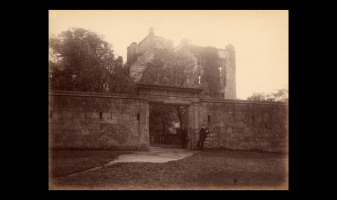
Around 1855. Benjamin Brecknell Turner [aged 40]. Hardwick Hall, Derbyshire [Map].
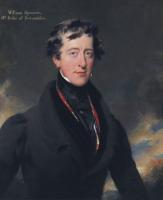
On 18th January 1858 William Cavendish 6th Duke Devonshire [aged 67] died at Hardwick Hall, Derbyshire [Map]. He was buried in the Cavendish Plot, St Peter's Church, Edensor [Map]. His first cousin once removed William [aged 49] succeeded 7th Duke Devonshire, 10th Earl Devonshire, 10th Baron Cavendish Hardwick. Baron Clifford abeyant.
Before 1868. Reuben Thomas William Sayers [aged 52]. Portrait of Harriet Elizabeth Georgiana Howard Duchess Sutherland [aged 61]. An inscription on the back of this picture states that it was painted after a portrait by Sir Thomas Lawrence. However, the only portrait of the Duchess that has been recorded is a double portrait with her daughter Elizabeth (in the collection of the Duke of Sutherland). The picture is currently at Hardwick Hall, Derbyshire [Map].
Prodigy House. A large house built in the Tudor, Elizabethan and Jacobean periods defined by their use of glass. Prodigy houses include: Longford Castle, Wiltshire [Map], Wollaton Hall, Nottinghamshire, Longleat House, Burghley House, Hatfield House, Hertfordshire [Map] and Hardwick Hall, Derbyshire [Map].
All About History Books on Amazon
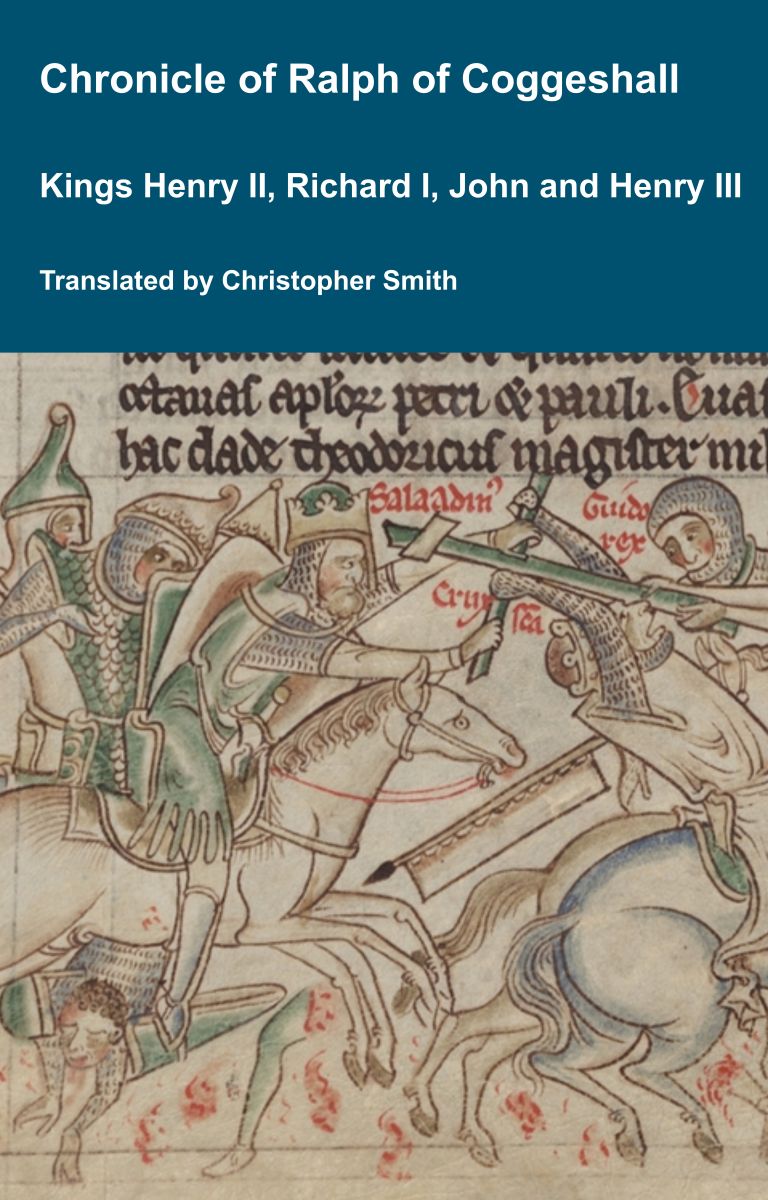
Chronicle of Abbot Ralph of Coggeshall
The Chronicle of Abbot Ralph of Coggeshall (Chronicon Anglicanum) is an indispensable medieval history that brings to life centuries of English and European affairs through the eyes of a learned Cistercian monk. Ralph of Coggeshall, abbot of the Abbey of Coggeshall in Essex in the early 13th century, continued and expanded his community’s chronicle, documenting events from the Norman Conquest of 1066 into the tumultuous reign of King Henry III. Blending eyewitness testimony, careful compilation, and the monastic commitment to record-keeping, this chronicle offers a rare narrative of political intrigue, royal power struggles, and social upheaval in England and beyond. Ralph’s work captures the reigns of pivotal figures such as Richard I and King John, providing invaluable insights into their characters, decisions, and the forces that shaped medieval rule. More than a simple annal, Chronicon Anglicanum conveys the texture of medieval life and governance, making it a rich source for scholars and readers fascinated by English history, monastic authorship, and the shaping of the medieval world.
Available at Amazon in eBook and Paperback format.
In 19th August 1900 James Sherwood Westmacott [aged 76] died at Longlands Chesterfield [Map].
After 22nd May 1330 Alice Corbet [deceased] died at Pleasley, Derbyshire [Map].
In 1484 Thomas Astley [aged 69] died in Pleasley, Derbyshire [Map].
Effigy of Lady and Child. THIS singular monument is in Scarcliffe Church, Derbyshire [Map]. The style in which it is executed shows it to be of the thirteenth century. The head is surmounted with a very elegant circlet, and rests on a couchant lion; the hair is disposed in braids; the tunic is confined at the neck by a large fermail or broach; a band appears to attach the mantle to the shoulders, and is held in the right hand; the mantle is caught up under the right arm. The left supports a male child, who displays a long scroll, on which has been inscribed in uncial characters some leonine verses, which are now much defaced.
HIC SV......MVLIER IACET INTVMVLATA:
CONSTANS.............:
...........PROLES RE....ERE HVMATA:
CVM PECC..............VACVATA:
CRIMINE PVRGATA CVM PROLE IOIIANNE BEATA:
.................DELOCATA. AMEN:
Details. 1. Profile of the head, showing the hair, &c. 2. The circlet enlarged.