All About History Books on Amazon
Chronicle of the Abbey of Evesham
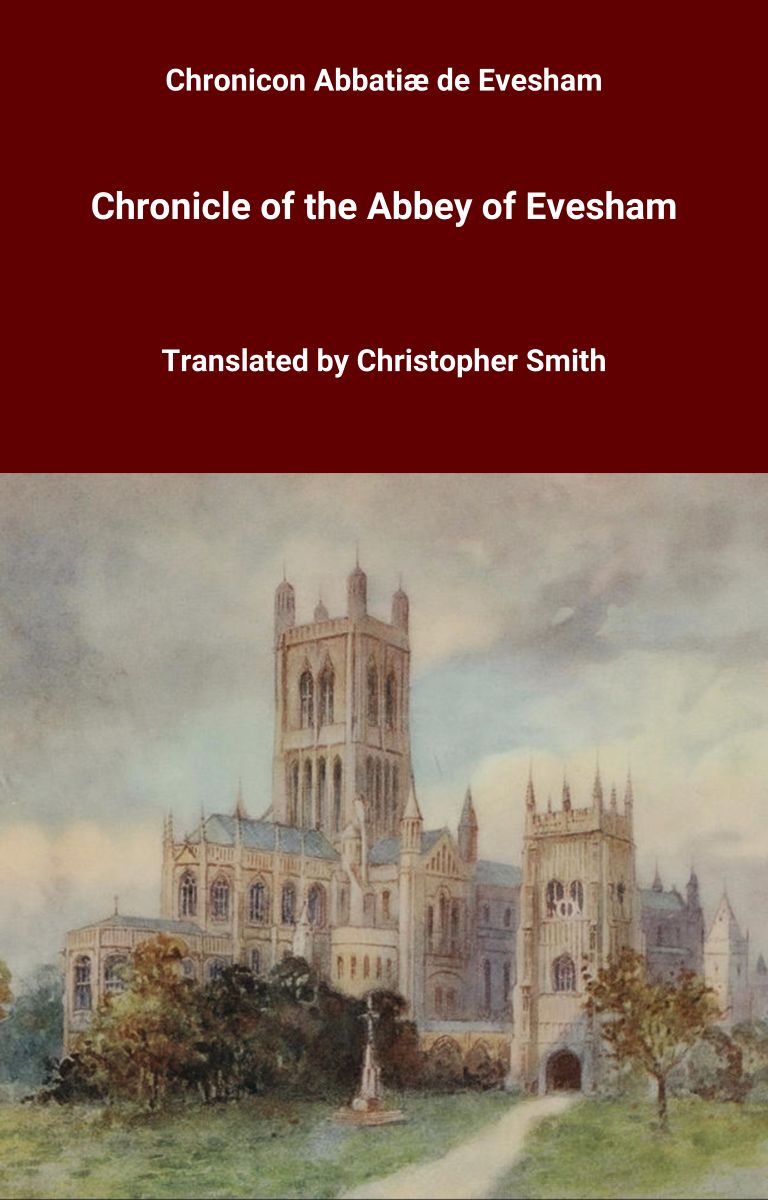
The Chronicle of the Abbey of Evesham is a remarkable medieval history of one of England’s great Benedictine monasteries. Beginning with the abbey’s legendary and royal foundations, it traces the fortunes of Evesham through centuries of religious devotion, political conflict, legal struggle, rebuilding, reform, and royal patronage. At the heart of the chronicle is the abbey’s determination to defend its ancient liberties. Its monks record disputes with bishops, appeals to popes and papal legates, contested elections of abbots, lawsuits over lands and privileges, and the long struggle to preserve Evesham’s exemption from episcopal control. Alongside these institutional battles are vivid accounts of saints and miracles, including St Ecgwine, St Odulf and the royal martyr St Wistan, whose relics and cult formed an important part of the abbey’s identity. The chronicle also preserves a wealth of detail about everyday monastic life. It describes the building and repair of churches, cloisters, chapels, halls, mills, granges and fishponds; the acquisition of estates and revenues; the making of vestments, shrines, bells and liturgical books; and the provision of food, clothing, recreation and medical care for the monks. Successive abbots emerge not merely as religious superiors but as administrators, builders, patrons, diplomats and defenders of the community. Extending into the later Middle Ages, the narrative reflects the changing political world around Evesham, from the Norman Conquest and the Angevin kings to the Wars of the Roses and the reign of Henry VIII. The result is both a history of a single monastery and a richly detailed record of medieval English religious, legal, economic and political life. This edition offers modern readers direct access to one of the most important monastic chronicles of medieval England, revealing how the monks of Evesham understood their saints, their privileges, their rulers and their place in history.
Available at Amazon in eBook and Paperback format.
Wiltshire Archaeological Magazine 1872 V13 Page 103 is in Wiltshire Archaeological Magazine 1872 V13.
Notes of a Long Barrow [Map] on Oldbury Hill
Early in the year 1864 a paragraph in one of the local papers stated that some skeletons had been found on Oldbury Hill. On visiting the spot it appeared that in digging for chalk for the purpose of making whiting, the workmen had trenched on a barrow. It is situated on the top of an elevated knoll forming a spur on the W.N.W. side of the obelisk. It is in length 60 feet, in breadth 26 feet, and about 3 feet high. The opening made by the labourers was on the S.E. They found three skeletons lying with the heads towards the east, in a large shallow grave surrounded by small blocks of sarsen stone. As far as I could ascertain nothing had been found with the bones. In the earth with which the grave had been filled up was an abundance of rude pottery and flint-flakes.
Although none of the bones had been burned, there was a considerable quantity of charcoal and wood-ashes towards the bottom of the cavity, particularly on the north side. Many of the flint-flakes were burnt, but only one was found which showed traces of having been subjected to any manipulation beyond the original flaking. The whole of the barrow had been much disturbed by the workmen, and many of the bones had been carried away by people visiting the spot. The crania were much mutilated, but Dr. Thurnam has kindly examined them and reports that one is the skull of a man, and two those of women. They are of the lengthened oval, or dolichocephalic form, such as are generally found in the long barrows of Wiltshire and Gloucestershire. Dr. Thurnham gives the measurement of these crania in his paper, "On the Two principal Forms of Ancient British Skulls"1 From this table (Table II.), it appears that the male skull has the breadth-index as low as ·68, and the two female skulls that of ·71 and ·74 respectively.
On digging in the centre of the barrow a cist six feet eight inches in depth, and about two feet wide, by three feet long, was discovered. It contained no traces whatever of human remains or art, excepting a few wood-ashes, and these may have fallen in accidentally. It is probable that this part of the barrow had been rifled at some former period. A fragment of a bone implement was found in the upper part of the barrow, just under the turf, and a rude, but well-worn muller, of sarsen-stone — both had been partially burnt. I had trenches dug on the north and north-east sides of the barrow, but no traces of any interment were seen.
22nd April 1864.
Note 1. Memoirs of Anthropological Society of London. Vol. i., p. 473.