All About History Books on Amazon

Chronicle of the Abbey of Evesham

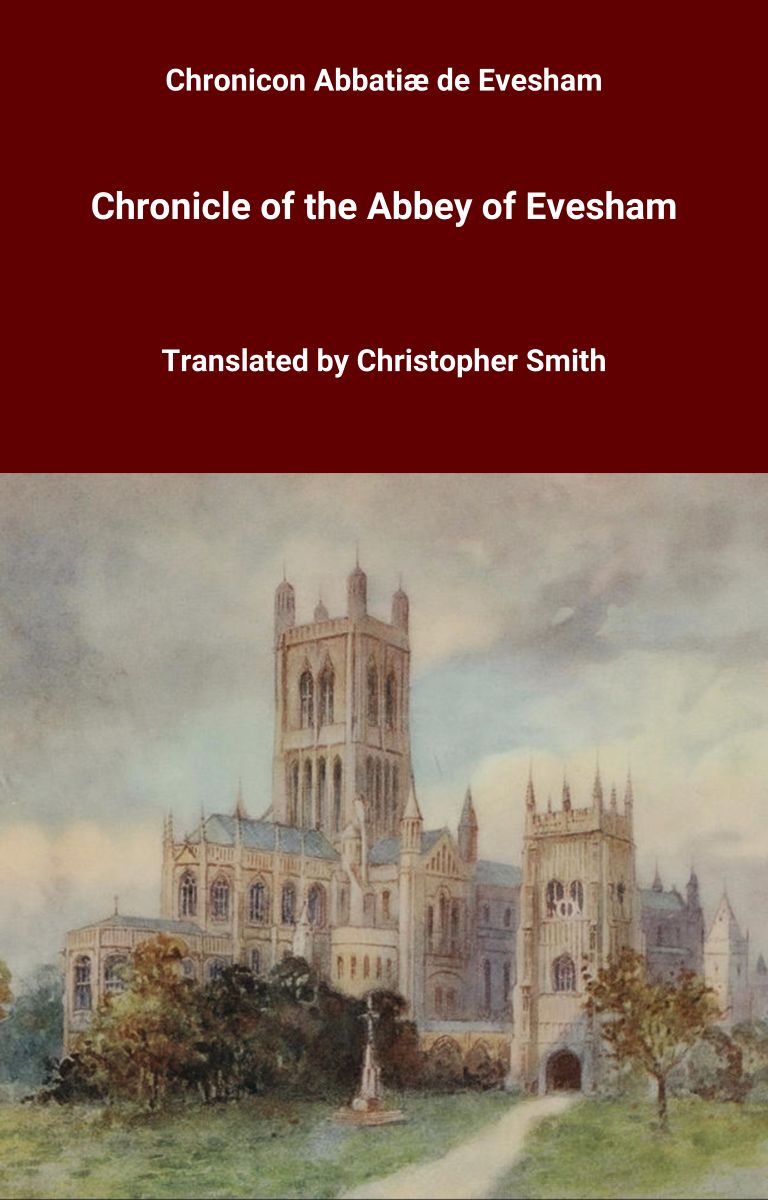
The Chronicle of the Abbey of Evesham is a remarkable medieval history of one of England’s great Benedictine monasteries. Beginning with the abbey’s legendary and royal foundations, it traces the fortunes of Evesham through centuries of religious devotion, political conflict, legal struggle, rebuilding, reform, and royal patronage. At the heart of the chronicle is the abbey’s determination to defend its ancient liberties. Its monks record disputes with bishops, appeals to popes and papal legates, contested elections of abbots, lawsuits over lands and privileges, and the long struggle to preserve Evesham’s exemption from episcopal control. Alongside these institutional battles are vivid accounts of saints and miracles, including St Ecgwine, St Odulf and the royal martyr St Wistan, whose relics and cult formed an important part of the abbey’s identity. The chronicle also preserves a wealth of detail about everyday monastic life. It describes the building and repair of churches, cloisters, chapels, halls, mills, granges and fishponds; the acquisition of estates and revenues; the making of vestments, shrines, bells and liturgical books; and the provision of food, clothing, recreation and medical care for the monks. Successive abbots emerge not merely as religious superiors but as administrators, builders, patrons, diplomats and defenders of the community. Extending into the later Middle Ages, the narrative reflects the changing political world around Evesham, from the Norman Conquest and the Angevin kings to the Wars of the Roses and the reign of Henry VIII. The result is both a history of a single monastery and a richly detailed record of medieval English religious, legal, economic and political life. This edition offers modern readers direct access to one of the most important monastic chronicles of medieval England, revealing how the monks of Evesham understood their saints, their privileges, their rulers and their place in history.

Available at Amazon in eBook and Paperback format.

Nine Stones Close Stone Circle, Middleton-by-Youlgreave, Derbyshire Dales, North-Central England, British Isles [Map]

Archaeologia Volume 6 Section XIII. Plate XV. N° 8. is a view of the remains of another Druid temple on Hartle Moor, about half a mile west of the Nine Ladies. It consists at present only of six stones; but the field they stand in goes by the name of the Nine Stone Close [Map], and if we may judge by the eye, there were formerly that number. The height of the tallest stone is seventeen feet; at seventy-five yards south stand two stones somewhat smaller.

Thomas Bateman 1846. On the 6th of March, 1847, a small excavation was made within the circle inclosed by the six stones standing in the "Nine Stone Close [Map]" upon Harthill Moor, with a view of noting the claim of such stone circles to be considered sepulchral structures. The result in this instance was favorable to this opinion of their origin and purpose as several fragments of imperfectly-baked pottery, accompanied by pieces of flint, both in a natural and calcined state, were dug up.

These remains probably would have been more complete, had not the repeated passage of the plough in the progress of cultivation materially reduced the height of the land within the inclosed area.

Transactions of the British Archaeological Association August 1845 Pages 192-195. The Druid temple of Nine Stones, on Stanton Moor, about half a mile from Rowter; known to the country people as the Nine Ladies [Map]; and which, although an undoubted early British remain, is scarcely of sufficient magnitude to entitle it to the designation of a temple, — being only eleven yards in diameter,—is now completely hidden in a plantation of firs; and the cairns in the neighbourhood, in which bones and glass beads were found a century ago, are levelled with the surrounding soil. It is remarkable that, about half a mile west of the Nine Ladies, there exists a similar circle of stones, in a close called Nine-stone close [Map]; four only, however, at present (1845) remain erect (although six existed as late as 1824). These, probably, have a reference to the mystic number 9, and may have been cenotaphs, if not cemeteries, of the chief Druids. About two hundred yards from this spot, in an adjoining field, a fine brass celt, weighing twenty-four ounces, was dug up in 1824, and is now in my possession.