All About History Books on Amazon
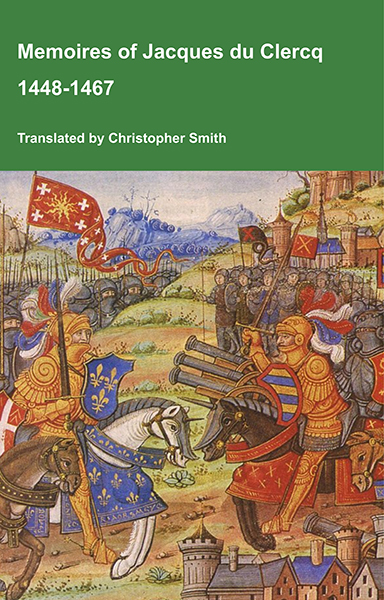
This is a translation of the 'Memoires of Jacques du Clercq', published in 1823 in two volumes, edited by Frederic, Baron de Reissenberg. In his introduction Reissenberg writes: 'Jacques du Clercq tells us that he was born in 1424, and that he was a licentiate in law and a counsellor to Philip the Good, Duke of Burgundy, in the castellany of Douai, Lille, and Orchies. It appears that he established his residence at Arras. In 1446, he married the daughter of Baldwin de la Lacherie, a gentleman who lived in Lille. We read in the fifth book of his Memoirs that his father, also named Jacques du Clercq, had married a lady of the Le Camelin family, from Compiègne. His ancestors, always attached to the counts of Flanders, had constantly served them, whether in their councils or in their armies.' The Memoires cover a period of nineteen years beginning in in 1448, ending in in 1467. It appears that the author had intended to extend the Memoirs beyond that date; no doubt illness or death prevented him from carrying out this plan. As Reissenberg writes the 'merit of this work lies in the simplicity of its narrative, in its tone of good faith, and in a certain air of frankness which naturally wins the reader’s confidence.' Du Clercq ranges from events of national and international importance, including events of the Wars of the Roses in England, to simple, everyday local events such as marriages, robberies, murders, trials and deaths, including that of his own father in Book 5; one of his last entries.
Available at Amazon in eBook and Paperback format.
Archaeologia Volume 8 Appendix is in Archaeologia Volume 8.
The Hon. Daines Barrington [aged 58] communicated the following observations by him on the Grey Weathers in Berkshire, and the Crypts in Canterbury Cathedral. Read March 17, 17 85.
In the vale of Whitehorse, and near the particular hill from which this vale is so called, are several immense stones, which are dispersed in no apparent order. It naturally suggests itself to an antiquary, that as the fields in which they lye, produce neither this particular stone, or indeed of any other kind (though often dug to a considerable depth), that they must have been brought to their present situation with great expence and labour, for some druidical purposes.
Under this idea I had long acquiesced, till during the last autumn, I paid more particular attention to these huge and detached masses, the situation of which appeared then to be the effect of mere accident, though they had been more clearly removed from the soil or bed in which they originally lay.
When these stones have been blown by gun-powder, they are of a whitish cast on the inside, but the outer covering is grey, whence they probably have received their more common name of Grey Weathers [a]. They are sometimes however called also Sarsen stones, though I never could hear of any such place in the neighbourhood. They are found in great profusion on some parts of the Berkshire and Wiltshire downs, and more particularly so in a valley near lord Craven's hunting-seat of Ashdown Park, which is about two miles distant from the pastures in Compton parish, to which I would refer those who may have curiosity to examine them.
The soil in these pastures or marshes is a deep clay, under which it is so difficult to find any materials for mending the roads, that the inhabitants are obliged to fetch chalk stones from the downs for this purpose, to avoid the expence of which they sometimes blast these enormous Grey Weathers, at least, for mending gateways. The tops of most of these are not more than an inch or two above the surface, but they are buried two or three feet under ground, so that when removed by blasting a very considerable bed or cavity is left. Others again are buried a few inches under the soil, in which case they may be discovered by the grass not looking so well as in other parts of the field.
Continues.
Note a. Some have supposed them to be thus called from their somewhat resembling a grey-wether (or sheep) when seen at a great distance.