All About History Books on Amazon

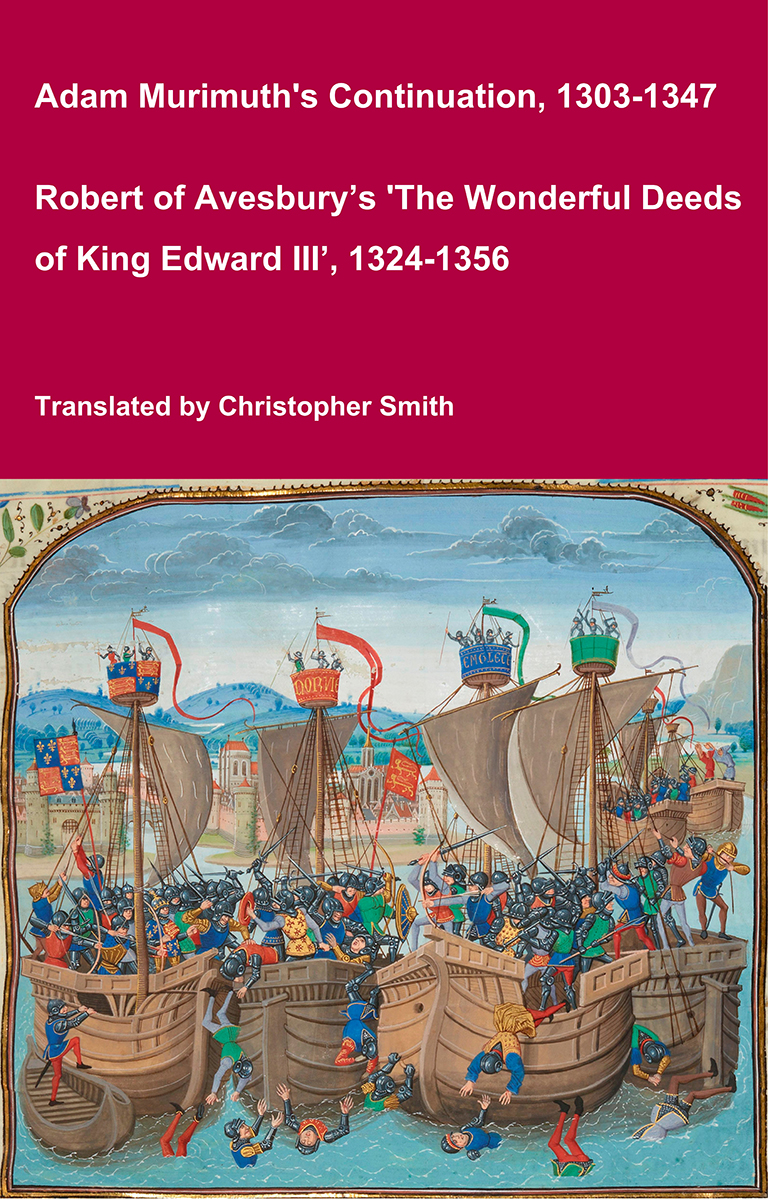
Adam Murimuth's Continuation and Robert of Avesbury’s 'The Wonderful Deeds of King Edward III'

This volume brings together two of the most important contemporary chronicles for the reign of Edward III and the opening phases of the Hundred Years’ War. Written in Latin by English clerical observers, these texts provide a vivid and authoritative window into the political, diplomatic, and military history of fourteenth-century England and its continental ambitions. Adam Murimuth Continuatio's Chronicarum continues an earlier chronicle into the mid-fourteenth century, offering concise but valuable notices on royal policy, foreign relations, and ecclesiastical affairs. Its annalistic structure makes it especially useful for establishing chronology and tracing the development of events year by year. Complementing it, Robert of Avesbury’s De gestis mirabilibus regis Edwardi tertii is a rich documentary chronicle preserving letters, treaties, and official records alongside narrative passages. It is an indispensable source for understanding Edward III’s claim to the French crown, the conduct of war, and the mechanisms of medieval diplomacy. Together, these works offer scholars, students, and enthusiasts a reliable and unembellished account of a transformative period in English and European history. Essential for anyone interested in medieval chronicles, the Hundred Years’ War, or the reign of Edward III.

Available at Amazon in eBook and Paperback format.

Siege of Harfleur

Siege of Harfleur is in 1415-1424 Henry V and Agincourt.

In September 1415 King Henry V of England [aged 28] commenced his invasion of France by undertaking the Siege of Harfleur to provide himself with a port from which to supply future operations. John Mowbray 2nd Duke of Norfolk [aged 23], John Fastolf [aged 35] and Thomas Chaucer [aged 48] fought. William "Jackanapes" de la Pole 1st Duke of Suffolk [aged 18] was wounded. Bishop Benedict Nichols was present.

On 17th September 1415 Nicholas IV Longford [aged 42] died.

On 18th September 1415 Michael de la Pole 2nd Earl Suffolk [aged 54] died of dysentery. His son Michael [aged 21] succeeded 3rd Earl Suffolk, 3rd Baron Pole. Elizabeth Mowbray Countess Suffolk [aged 17] by marriage Countess Suffolk.

Deeds of King Henry V [1413-1421]. And when nearly all had arrived the following Sunday [11th August 1415], with the wind blowing favourably, he set the sails to the winds, in about fifteen hundred ships, besides those which had been behind, about a hundred. And while we left the shores of the Isle of Wight behind, swans were seen swimming beneath the vessel, which were said to foretell, in the opinion of all, fortunate omens for the intended venture.

On 13th August 1415 King Henry V of England [aged 28] landed at Normandy [Map] at the commencement of his Agincourt Campaign.

Deeds of King Henry V [1413-1421]. And on the following Tuesday [13th August 1415], around the fifth hour after noon, the king entered the mouth of the River Seine, which flows from Paris through Rouen and Harfleur into the sea and dropped anchor before a small village called Kidecaws1, about three miles from Harfleur, where he intended to go ashore.

Note 1. "Kidecaws". An English corruption for Chef-en-Caux, now known as Sainte Adresse, five miles west of Harfleur where the Seine estuary meets the sea.

Chronicle of Gregory. 16th August 1415.... and the 16th day of the same month he landed at Kytkawys, and the Saturday he laid siege unto the town of Harfleur, and that was the Saturday next after of the Assumption of our Lady; and the siege continued unto the Sunday next before the feste of Saint Michael [29th of September], on the which Sunday the town of Harfleur was delivered up to the king, that was 22nd day of September. But it is to wit that the Tuesday before, that is to say the 16th day of the same month, at 2 of the clock within night, the lords that were the captains and governors of the town, that is to wite the lord Gawcorte, the lord Tutville, and more other lords, send out heralds of arms unto the Duke of Clarence [aged 27], praying him at the reverence of God that he would of his high lordship that he would grant them live and leave for to treat with what persons that the king would assign unto them; and the king at the reverence of God and at their request he assigned the Duke of Exeter, the lord Fehewe, and Sir Thomas Erpingham, to hear what they would say and desire.

And they desired that the king would not war on them from that hour of midnight unto the Sunday next after the feast of Saint Michael, and but it were rescued by battle by that day by the French king or by the Dauphin, else at that day to deliver the town unto the King, and they to have her lives and her goods. Ande the king sent them word if that they would deliver the town on the morne after, by the hour of midnight above said, without any condition, he would accept it, and in none other wise he bade them for to treat.

And yet the French lords prayed our lords that they would vouchsafe to beseech the King at the reverence of God and of our Lady that he would grant them respite from the same Tuesday at night unto the Sunday next after till one hour afternoon; and in the meantime the lords that were captains of the town to come to the King with twenty-four knights and squires with them, of the most sufficient men with in the town, and they to be sworn on God's body openly before all the people. But if it so were that the French King or the Dauphin rescued them by that Sunday by the hour of noon, other else anon after noon, they for to deliver the town to the king and all her bodies and goods to don with them what so them every last, with any condition. With that the King suffered them to send unto France eight persons out of the town letting him wit in what plight that they stood in, and the king granted them; and upon the Wednesday by the moon the lords come out, and twenty-two knights and squires with them; and then come the procession solemnly and stately, with twenty-four copes of clothe of gold before God's body, with many worshipful lords, knights, and squires, and other multitude of people from the king's tent, solemnly and stately as ever was done such a thing before time. But the king was not here present. And the French lords made there their oaths upon the sacrament; and, the others done, the French lords were brought unto the king's tent, and there they dined in the king's hall, but in all this time they saw not the King. And when that they had eaten they departed and delivered to certain for to keep in hostage till the Sunday on noon, as it was accordingly made before time when that they took her oaths. And the Sunday at the same hour assigned the king had a tent put upon a hill before the town, and there he sat in his estate, royally, and alle his lords about him. And then come the French lords, with sixty-four with them of the most sufficient men that were withing the town, to the king's own proper person, and delivered up the keys of the town and her bodies and her goods to the King's grace, with out any condition. And this was the 22nd day of Septembre, the year of our lord 1415

... and the xvj day of the same monythe he londyd at Kytkawys, and the Satyrday he leyde sege unto the towne of Arflewe, and that was the Satyrday nexte aftyr of the Assompsyon of our Lady; and the sege contynuyd unto the Sonday nexte be fore the feste of Synt Mychelle, on the whiche Sonday the towne of Arflewe was delyveryd uppe to the kyng, that was XXij day of Septembre. But hit is to wyte that the Tewysday before, that is to saye the xvj day of the same monythe, at xij of the clocke whytheynne nyght, the lordys that were the capytaynys and governowrys of the towne, that is to wete the lord Gawcorte14, the lord Tutvyle, and moo othyr lordys, sende out herodys of armys unto the Duke of Clarens, prayng him at the reverens of God that he wolde of his hyghe lordeschippe that he wolde graunte them lyve and leve for to trete whythe what personys that the kyng wolde a-sygne unto hem; and the kyng at the reverens of God and at hyre requeste he assygnyde the Duke of Exceter [Note. Unclear as to who this is? Possibly Thomas Beaufort 1st Duke Exeter [aged 38] who was created Duke the following year?], the lord Fehewe, and Syr Thomas Erpyngham [aged 60], to hyre whatt they wolde say and desyre. And they desyryd that the kyng wolde nought warre on them fro that our of mydnyght unto the Sonday nexte aftyr the feste of Synt Mychell, and but it were rescwyd by batayle by that day by the Frenysche kyng or by the Dolfynne, ellys at that daye to delyver the towne unto the King, and they to have her lyvys and her goodys. Ande the kyng sende them worde yf that they wolde delivery the towne on the morne aftyr, be the our of mydnyght a bove said, without any condyscyon, he wolde accepte it, and in non othyr wyse he bade them for to trete. Ande yette the Fraynysche lordys prayde our lordys that they wolde fochesave to be-seche the King at the reverens of God and of our Lady that he wolde graunte them respyte fro the same Twysday at nyght unto the Sonday nexte aftyr tylle one owre aftyr none; and in the mayne tyme the lordys that were captaynys of the towne to come to the King whithe XXiiij knyghtys and squyers with hem, of the moste suffycyent men whithe in the towne, and they to be sworne on Goddys body opynly before alle the pepylle. But yf15 hit soo were that the Fraynysche King or the Dolfynne rescwyde them by that Sonday by the owre of none, othyr ellys a-non aftyr none, they for to delyvery the towne to the kyng and alle her bodys and goodys to don whythe them what so them evyr lyste, whythe16 any condiscyon. Whythe that the King sufferde them to sende unto Frauns viij personys out of the towne lettyng him wytte in what plytte that they stode yn, and the kyng grauntyd hem; and uppe the Wanysday by [th]e mone the lordys come owte, and XXij knyghtys and squyers whythe hem; and thenne come the prosessyon solempny and stately, whithe XXiiij copys of clothe of golde by-fore Goddys body, whythe many worschipfulle lordys, knyhtis, and squyers, and othyr multytude of pepylle from [th]e kyngys tente, solempny and stately as evyr was done suche a thyng be-for tyme. But the kyng was nott here present. And the Franysche lordys made thare her othys a-pon the sacrament; and, the othys done, the Fraynysche lordys were brought unto the kyngys tente, and there they dynyd in the kyngys halle, but in alle this tyme they sawe nought the King. And whanne that they hadde etyn they departyd and delyveryd to sartayne for to kepe yn ostage tylle the Sonday on none, as it was a cordyment i-made before tyme whenne that they toke her othys. And the Sonday at the same owre a-signyd the kyng hadde a tente phyght a-pone a hylle be-fore the towne, and there he sate in his estate, ryally, and alle his lordys aboute hym. And thenne come the Fraynysche lordys, with lxiiij whythe them of the moste suffycyentt men that were whythe yn the towne, to the kyngys owne propyr person, and delyveryd uppe the keyes of the towne and her boodys and her goodys to the Kings grace, whithe out any condyscyon. And this was the XXij day of Septembre, the year of our lord Ml cccc xv.

Note 14. Sawcortein our MS. by a misreading; Gawcourte in Vit.

Note 15. But if, i. e. unless.

Note 16. whythe. withoute, Vit.

Click to read more ...

Deeds of King Henry V [1413-1421]. And when everything necessary for the journey had been unloaded from the ships on the Sabbath day [18th August 1415], and in the meantime, the royal ordinances, in their prudence, had imposed upon the army among other most honourable statutes, under penalty of death, that no more fires should be set as they were at the beginning, and that the churches and sacred buildings with their belongings should be kept intact, and that no one should lay a hand on women, nor on a priest or minister of the church, unless armed or attempting violence or an attack, the army moved toward the town of Harfleur. It was arranged in three divisions and showed itself before the town on the hillside on one side, with the main division in the centre, and the other divisions positioned on the flanks. However, on the other side, they could not yet approach due to the tide and ebb of the river on one side of the town, and a gentle stream running through the valley on the other side.

The town is situated at the edge of a valley, on the bank of the Seine River, through which the sea flows beyond the middle of the town and recedes a mile or more. A fresh river also descends through the middle of the valley, filling the ditches to a good depth and width, running outside beneath the walls on the valley side. On the side where the king showed himself, the river extends to the water's edge of the Seine, which then enters separately under the walls through the middle of the town via a main water gate and two adjacent covered canals, which can be closed or opened fully or partially at the discretion of the inhabitants. Inside the walls, two mills are turned by the force of the entering water, serving the grinding needs of the townspeople and common folk. After passing through the mills, the river flows back from the canals into the main stream and runs through the centre of the town to the harbour.

On the side opposite the king, the town is situated but fortified with a double ditch, the inner one of inestimable depth and suitable width. The town itself is not large, but very beautiful, armed and surrounded by outer angular walls, and therefore, according to Master Giles, more difficult to attack and easier and safer to defend, with high towers of decent structure, along with smaller intermediate fortifications. It has three gates for entry and exit: one on the side where the king displayed himself, and two on the opposite side. Both of these latter gates were protected by the circular courses of water in the aforementioned ditches from attacks by our forces.

The structure was circular and had a diameter larger than the throw of a stone, which in England our common people usually use to mark their boundaries. It was surrounded by water of great depth and a width of two lances at its narrowest point. There was a bridge for entry and exit towards the town, and a small wooden bridge leading outward, which the enemy could place or withdraw at will whenever they saw fit to break in upon our forces. Inside, the town was adorned with beautiful buildings nearby and was decorated with only a single parish church.

And before the entrance of each of these gates, hostile cunning had previously constructed a strong fortification, which we call a "barbican" or commonly a "bulwark." Of these, the one on the king's side was the strongest and largest, reinforced on the outside with thick, round logs nearly to the height of the town's walls, tightly secured and bound together. Inside, it was built with timber, earth, and beams, cut in a way to form recesses and hidden spaces for the reception of enemies and hostile forces. It also had narrow angles and porous chambers, through which, with their gun barrels, referred to in our common English as "Gunnys"1, and with projectiles, crossbows, and other offensive weapons, they could attack us.

Note 1. These were probably cannons of small bore, and of considerable length, resembling more "the tube" used to throw the Greek fire, than the cannon of the present day. The breech was open at the top, to receive the iron chamber containing the charge. The MS. Reg. 14, Ε. IV has representation of an artilleryman in the act of placing the chamber in a gun. Similar cannons of the time of Henry VI may be seen in the Tower Yard. Dr. Meyrick has asserted that hand fire-arms were not invented till 1430, [Archæologia Volume 22 Page 60] but recent research has brought to light proof of their existence as early as 1372. [Nicolas's Royal Navy, ii. 185.]

Henry brought with him to the siege of Harfleur, bombards, apparently of considerable size, which were named "London," "Messagère," "The King's Daughter," & c. Speaking of the first-named, Lydgate says,

"His ball well fair he gan it throw

That the steeple of Harflete and bells also

With his breath he did down blow."

The bombard was a cannon of large bore composed of bars of iron welded together, somewhat similar to a mortar, but with a long trail piece for its better direction. It was sometimes fixed upon a pintle or moveable pivot, and sometimes upon a rough wooden carriage with two wheels. [C. H. Smith's Ancient Costumes of Great Britain.] The stone shots projected were of an astonishing size. It is recorded that Peter Doria was killed by a stone shot, from a bombard called the "trevisan," which weighed 195 lbs. [Chron. della Guerra di Chioza.]

From the following entry the cannons appear to have had two or more chambers to each. "For making two cannons with three chambers in each, and two cannons with two chambers in each £51 10s 5d" [Pell. Issue Rolls, 23rd Feb. 6. Hen. V] These were probably the moveable chambers before referred to.

Click to read more ...
Deeds of King Henry V [1413-1421]. [22nd September 1415] The aforementioned Lord Ralph de Gaucourt came from the town into his presence, accompanied by those persons who had previously sworn to uphold the agreements, and he handed over to him the keys of the town, along with himself and the townspeople, to his grace. And after receiving the keys, by the king's command through the Earl Marshal1, the king promised the said Lord Ralph de Gaucourt that although he and his company, against God and all justice, had held his town, a noble portion of his inheritance, against him, yet because they had submitted themselves to his grace, although late, they would not pass entirely without mercy, which he nonetheless said he wished to moderate through deliberate counsel.

Note 1. John Mowbray, 5th Earl of Norfolk, 1392-1432, son of Thomas Mowbray, 1st Duke of Norfolk, who had died in exile in Venice for his part in the accusation of treason of Henry Bolingbroke, the future King Henry IV John succeeded to his father's titles, other than the Dukedom, 1405 when his older brother Thomas was executed for his part in the Northern Rising. He was subsequently, in 1424, restored to his father's Dukedom, becoming 2nd Duke of Norfolk.

Deeds of King Henry V [1413-1421]. [22nd September 1415] And then he sent him, along with his company and the hostages who had been brought present to his tent, in total number sixty-six, and in the next supper, he magnificently entertained them with the delicacies he had, dividing them after the meal and entrusting them to certain of his faithful men to be kept. But soon after the keys were given and received, with the banners of Saint George and the royal banners placed above the gates of the town and those of the adversaries taken down, the king appointed his illustrious uncle, Lord Thomas Beaufort1, Earl of Dorset, as the guardian and captain of the town, entrusting the keys to his care.

Note 1. Thomas Beaufort, 1377-1426. Illegitimate, subsequently legitimised in 1397, son of John of Gaunt and Katherine Roet. Knight Garter in 1400. The Earl of Dorset was brother to the Bishop of Winchester, then Chancellor, and subsequently Cardinal [Beaufort]. The earl was created Duke of Exeter November 18th, 1416. His monument is preserved in St. Catherine's Chapel, Regent's Park. Sir John Fastolf was his lieutenant at Harfleur, being then only an esquire. He was retained the preceding June to serve with ten men-at-arms and thirty archers, and was knighted the 29th January following. He had the manors and demesnes of Fritense near Harfleur given him for his services. [Anstis, Register of the Order of the Garter, i. 137.]

All About History Books on Amazon

Chronicle of a Bourgeois of Valenciennes

Récits d’un bourgeois de Valenciennes aka The Chronicle of a Bourgeois of Valenciennes is a vivid 14th-century vernacular chronicle written by an anonymous urban chronicler from Valenciennes in the County of Hainaut. It survives in a manuscript that describes local and regional history from about 1253 to 1366, blending chronology, narrative episodes, and eyewitness-style accounts of political, military, and social events in medieval France, Flanders, and the Low Countries. The work begins with a chronological framework of events affecting Valenciennes and its region under rulers such as King Philip VI of France and the shifting allegiances of local nobility. It includes accounts of conflicts, sieges, diplomatic manoeuvres, and the impact of broader struggles like the Hundred Years’ War on urban life in Hainaut. Written from the perspective of a burgher (bourgeois) rather than a monastery or royal court, the chronicle offers a rare lay viewpoint on high politics and warfare, reflecting how merchants, townspeople, and civic institutions experienced the turbulence of the 13th and 14th centuries. Its narrative style combines straightforward reporting of events with moral and civic observations, making it a valuable source for readers interested in medieval urban society, regional politics, and the lived experience of war and governance in pre-modern Europe.

Available at Amazon in eBook and Paperback format.

On 26th September 1415 William Boteler of Bewsey [aged 39] died at the Siege of Harfleur.