All About History Books on Amazon
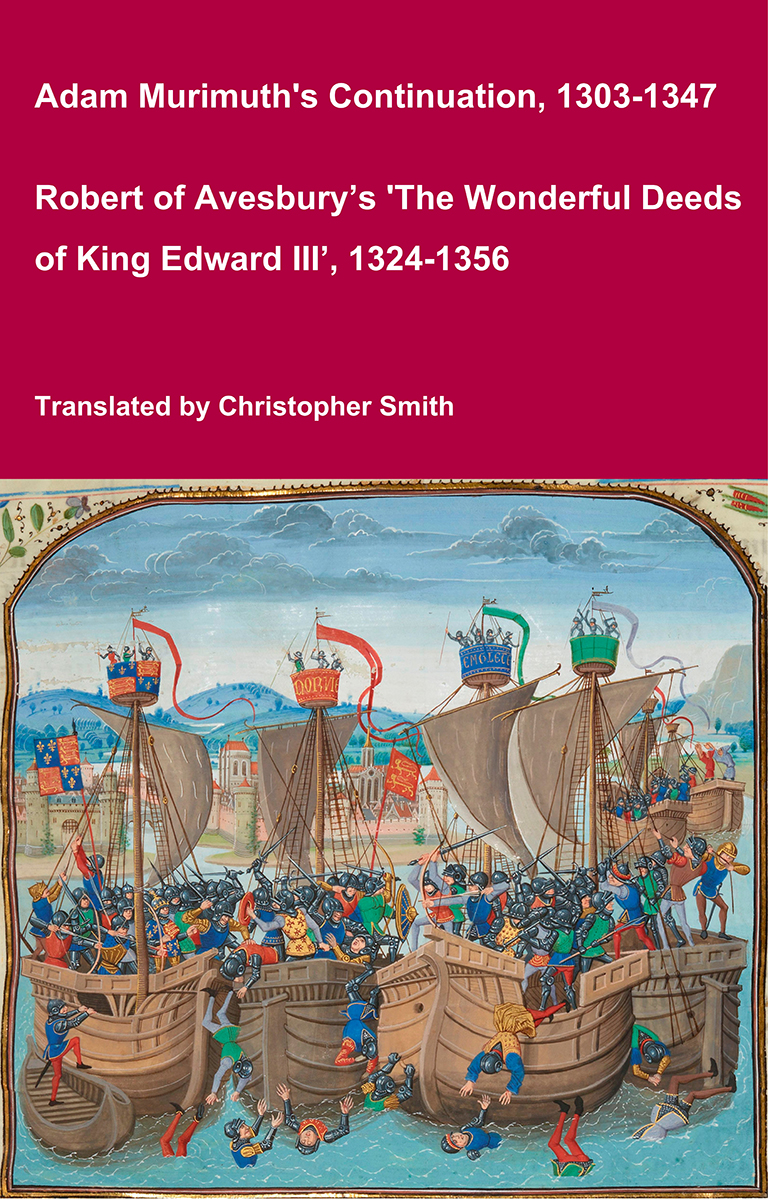
Adam Murimuth's Continuation and Robert of Avesbury’s 'The Wonderful Deeds of King Edward III'
This volume brings together two of the most important contemporary chronicles for the reign of Edward III and the opening phases of the Hundred Years’ War. Written in Latin by English clerical observers, these texts provide a vivid and authoritative window into the political, diplomatic, and military history of fourteenth-century England and its continental ambitions. Adam Murimuth Continuatio's Chronicarum continues an earlier chronicle into the mid-fourteenth century, offering concise but valuable notices on royal policy, foreign relations, and ecclesiastical affairs. Its annalistic structure makes it especially useful for establishing chronology and tracing the development of events year by year. Complementing it, Robert of Avesbury’s De gestis mirabilibus regis Edwardi tertii is a rich documentary chronicle preserving letters, treaties, and official records alongside narrative passages. It is an indispensable source for understanding Edward III’s claim to the French crown, the conduct of war, and the mechanisms of medieval diplomacy. Together, these works offer scholars, students, and enthusiasts a reliable and unembellished account of a transformative period in English and European history. Essential for anyone interested in medieval chronicles, the Hundred Years’ War, or the reign of Edward III.
Available at Amazon in eBook and Paperback format.
By 1279 Richard de Swinfield held the prebend of Hampton in the diocese of Hereford.
Shortly after 17th April 1280 Richard de Swinfield was appointed Archdeacon of London.
On 26th January 1282 Richard de Swinfield and John Peckham [aged 52] travelled to Rome to plead the case of his mentor Bishop Thomas Cantilupe [aged 64] who had been excommunicated by the Pope. Cantilupe died on the journey, and his remains were brought back to Hereford Cathedral by Swinfield.
On 1st October 1282 Bishop Richard de Swinfield was elected Bishop of Hereford.
On 7th March 1283 Bishop Richard de Swinfield was consecrated Bishop of Hereford.
Close Rolls Edward I. 1st July 1298. Chillingham Castle, Northumberland [Map]. To the treasurer and barons of the exchequer. Order to cause Richard, bishop of Hereford, to be acquitted of the demand for the service of five knights' fees in the king's army of Wales for the tenth year of his reign, as the king learns by an inquisition taken by the sheriff of Hereford that Thomas, the late bishop of Hereford, did his service in the said army by the king's order at Buelt for five knights' fees by John Tregoz and John Danyel, knights, for two fees, and by Thomas de la Mare, Nicholas le Seculer, John de Hurtesleye, Roger de Hurtesleye, John de Walford, and Robert le Venur, esquires, for three fees, to wit by each of the said knights and esquires with a barded horse, and that they continued the service fully for forty days, which service the bishop acknowledged to the king in the same army, as appears by inspection of the rolls of the marshalsea of that army. [Prynne, Records, iii, p. 787.]
To the same. Order to acquit the said Richard of scutage for five knights' fees in the kings army of Wales in the fifth, year of his reign, which the aforesaid Thomas acknowledged to him in that army, as Thomas had his service aforesaid with the king in that army, as appears to the king by inspection of the rolls of the marshalsea of that army.
On 15th March 1307 Bishop Richard de Swinfield died.