All About History Books on Amazon

Memoires of Jacques du Clercq

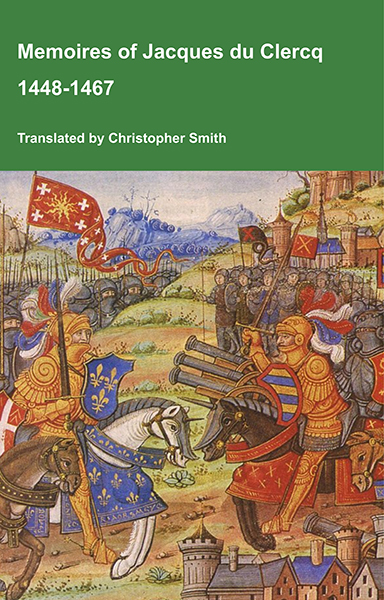
This is a translation of the 'Memoires of Jacques du Clercq', published in 1823 in two volumes, edited by Frederic, Baron de Reissenberg. In his introduction Reissenberg writes: 'Jacques du Clercq tells us that he was born in 1424, and that he was a licentiate in law and a counsellor to Philip the Good, Duke of Burgundy, in the castellany of Douai, Lille, and Orchies. It appears that he established his residence at Arras. In 1446, he married the daughter of Baldwin de la Lacherie, a gentleman who lived in Lille. We read in the fifth book of his Memoirs that his father, also named Jacques du Clercq, had married a lady of the Le Camelin family, from Compiègne. His ancestors, always attached to the counts of Flanders, had constantly served them, whether in their councils or in their armies.' The Memoires cover a period of nineteen years beginning in in 1448, ending in in 1467. It appears that the author had intended to extend the Memoirs beyond that date; no doubt illness or death prevented him from carrying out this plan. As Reissenberg writes the 'merit of this work lies in the simplicity of its narrative, in its tone of good faith, and in a certain air of frankness which naturally wins the reader’s confidence.' Du Clercq ranges from events of national and international importance, including events of the Wars of the Roses in England, to simple, everyday local events such as marriages, robberies, murders, trials and deaths, including that of his own father in Book 5; one of his last entries.

Available at Amazon in eBook and Paperback format.

Book of South Wales

Book of South Wales is in Victorian Books.

The Book of South Wales, the Bristol Channel, Monmouthshire, and the Wye. A Companion and Guide to the Watering Places, Shores, Scenery, Antiquities, Towns, Railways, Mineral Districts, Lakes And Streams, of the Southern Division of the Principality: With a Picture Of Bristol. By Charles Frederick Cliffe. Illustrated With Maps and Engravings. 1848.

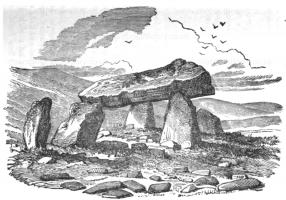
Between four and miles to the north of Caerwent on a hill forming part of a small farm, called Gaer Llwyd, about a mile from Newchurch-in which parish it is situated-is the Cromlech [Gaer Llwyd Burial Chamber [Map]], depicted in the accompanying sketch. The upper stone is twelve feet long and about three feet and a half broad, and the uprights vary from four to five feet. Vestiges of a trench and bank are discoverable round this Cromlech, which is the only one in the county, and has been strangely overlooked by Coxe and other topographers.

Some Druidical antiquities which are well worth visiting exist in the parish of St. Nicholas, a small village on the road to Cowbridge, six miles from Cardiff. Walk down the lane to the left leading to Duffryn House (the seat of Mr. Bruce Pryce), for about half a mile, then enquire at the first cottage. The principal Cromlech [Tinkinswood Burial Chamber [Map]] stands just within the edge of a wood, two fields from the lane. It was first noticed by Mr. Malkin, and is, so far as we are aware, the largest Cromlech in Britain. The superincumbent stone, which is cracked about six feet from its narrow end, is supported by five others of large size, which enclose it entirely on the east, west, and north sides, thus forming a low room, open to the south, 16 feet long, 15 wide, and 6 high, in the loftiest part; but rubbish has accumulated to the extent of probably 3 feet, in which case the height would have been 9 feet. Some other rubbish, with a heap of stones, is placed about it to a greater height on the outside. The supporting stone on the north is 16 feet long; that on the west 9 feet; the three stones on the east are set closely together. The roof or horizontal stone is 17 feet in the widest part, 10 in the narrowest, 24 in length, and about 24 thick. It overhangs about two feet, and is partly covered with ivy. This stone is computed to contain 324 square feet! The Cromlech appears once to have been covered with a heap of small stones-a remarkable circumstance. -The second Cromlech at Duffryn, in an adjoining field, is uninteresting, and consists of only four stones.-These Cromlechs, and some others in Glamorganshire, are known by the "uncouth term of greyhound bitch kennels; " Mr. Malkin conjectures that "in all probability, the first British Christians, by way of showing their detestation, wherever they met with Druidical or heathenish places of worship, converted them into dog or bitch kennels. " But there are also instances in which Cromlechs are called churches.

Click to read more ...

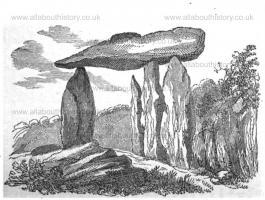
This is a land of primitive antiquities. Two miles and a half north-east of Nevern Church, on Tre Icert farm, is a Cromlech [Carreg Coetan Arthur Burial Chamber [Map]], supported by three upright stones, called Llech y Drybedd, pictured in the title of Fenton's Pembrokeshire, and which was mistaken by the late Sir S. Meyrick for the huge Cromlech of Coeton Arthur, or Arthur's Quoit [Pentre Ifan Burial Chamber [Map]], which stands on Pentre Ivan farm, two miles and a half to the south-east of Nevern Church, near the base of the fine hill, called Carn Englyn. This Cromlech once stood within a stone circle, 150 feet round. The subjoined engraving shows the character of this immense monument, which Sir R. C. Hoare considered the largest Druidical relic in Wales, but that gentleman appears not to have been aware of the Cromlech at St. Nicholas, Glamorganshire [Map], ( ante p. 133). The top stone is 18 feet long and 9 broad; the loftiest of the supporters is 8 feet high, the lowest 7; a person on horse-back can ride under.

A huge recumbent stone may be seen in a neighbouring field; and a correspondent of the Archæologia Cambrensis mentions the discovery of a curiously pitched way, called the Causeway, which tradition says formerly led to the Cromlech, from whence it is distant half a mile. A very fine Cromlech stands in a field on the left of the road from Newport to Berry Hill, two miles west from Nevern Church. A curious Druidical chamber may be seen in a field adjoining the Fishguard road, about half a mile from Newport.