

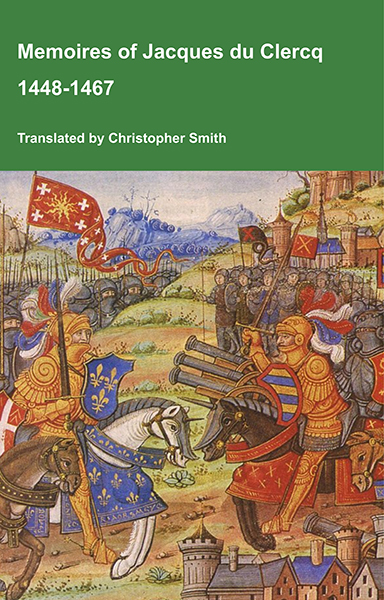
This is a translation of the 'Memoires of Jacques du Clercq', published in 1823 in two volumes, edited by Frederic, Baron de Reissenberg. In his introduction Reissenberg writes: 'Jacques du Clercq tells us that he was born in 1424, and that he was a licentiate in law and a counsellor to Philip the Good, Duke of Burgundy, in the castellany of Douai, Lille, and Orchies. It appears that he established his residence at Arras. In 1446, he married the daughter of Baldwin de la Lacherie, a gentleman who lived in Lille. We read in the fifth book of his Memoirs that his father, also named Jacques du Clercq, had married a lady of the Le Camelin family, from Compiègne. His ancestors, always attached to the counts of Flanders, had constantly served them, whether in their councils or in their armies.' The Memoires cover a period of nineteen years beginning in in 1448, ending in in 1467. It appears that the author had intended to extend the Memoirs beyond that date; no doubt illness or death prevented him from carrying out this plan. As Reissenberg writes the 'merit of this work lies in the simplicity of its narrative, in its tone of good faith, and in a certain air of frankness which naturally wins the reader’s confidence.' Du Clercq ranges from events of national and international importance, including events of the Wars of the Roses in England, to simple, everyday local events such as marriages, robberies, murders, trials and deaths, including that of his own father in Book 5; one of his last entries.
Available at Amazon in eBook and Paperback format.
In 1051 Archbishop Cynesige was appointed Archbishop of York.
Anglo-Saxon Chronicle. 15th April 1053. In this year was the king [aged 50] at Winchester, Hampshire [Map], at Easter; and Earl Godwin [aged 52] with him, and Earl Harold [aged 31] his son, and Tosty [aged 27]. On the day after Easter sat he with the king at table; when he suddenly sunk beneath against the foot-rail, deprived of speech and of all his strength. He was brought into the king's chamber; and they supposed that it would pass over: but it was not so. He continued thus speechless and helpless till the Thursday; when he resigned his life, on the seventeenth before the calends of May; and he was buried at Winchester in the old minster. Earl Harold, his son, took to the earldom that his father had before, and to all that his father possessed; whilst Earl Elgar took to the earldom that Harold had before. The Welshmen this year slew a great many of the warders of the English people at Westbury, Wiltshire [Map]. This year there was no archbishop in this land: but Bishop Stigand held the see of Canterbury at Christ church, and Kinsey that of York. Leofwine and Wulfwy went over sea, and had themselves consecrated bishops there. Wulfwy took to the bishopric which Ulf had whilst he was living and in exile.
Anglo-Saxon Chronicle. 24th October 1055. This year died Earl Siward at York; and his body lies within the minster at Galmanho76, which he had himself ordered to be built and consecrated, in the name of God and St. Olave, to the honour of God and to all his saints. Archbishop Kinsey fetched his pall from Pope Victor. Then, within a little time after, a general council was summoned in London, seven nights before mid-Lent; at which Earl Elgar, son of Earl Leofric, was outlawed almost without any guilt; because it was said against him that he was the betrayer of the king and of all the people of the land. And he was arraigned thereof before all that were there assembled, though the crime laid to his charge was unintentional. The king, however, gave the earldom, which Earl Siward formerly had, to Tosty [aged 29], son of Earl Godwin. Whereupon Earl Elgar sought Griffin's territory in North-Wales; whence he went to Ireland, and there gave him a fleet of eighteen ships, besides his own; and then returned to Wales to King Griffin with the armament, who received him on terms of amity. And they gathered a great force with the Irishmen and the Welsh: and Earl Ralph collected a great army against them at the town of Hereford [Map]; where they met; but ere there was a spear thrown the English people fled, because they were on horses. The enemy then made a great slaughter there-about four hundred or five hundred men; they on the other side none. They went then to the town, and burned it utterly; and the large minster [Map]77 also which the worthy Bishop Athelstan had caused to be built, that they plundered and bereft of relic and of reef, and of all things whatever; and the people they slew, and led some away. Then an army from all parts of England was gathered very nigh;78 and they came to Gloucester: whence they sallied not far out against the Welsh, and there lay some time. And Earl Harold [aged 33] caused the dike to be dug about the town the while. Meantime men began to speak of peace; and Earl Harold and those who were with him came to Bilsley, where amity and friendship were established between them. The sentence of outlawry against Earl Elgar was reversed; and they gave him all that was taken from him before. The fleet returned to Chester, and there awaited their pay, which Elgar promised them. The slaughter was on the ninth before the calends of November. In the same year died Tremerig, the Welsh bishop, soon after the plundering; who was Bishop Athelstan's substitute, after he became infirm.
Note 76 The church, dedicated to St. Olave, was given by Alan Earl of Richmond, about thirty-three years afterwards, to the first abbot of St. Mary's in York, to assist him in the construction of the new abbey. It appears from a MS. quoted by Leland, that Bootham-bar was formerly called "Galman-hithe", not Galmanlith, as printed by Tanner and others.
Note 77 Called St. Ethelbert's minster; because the relics of the holy King Ethelbert were there deposited and preserved.
Note 78 The place where this army was assembled, though said to be very nigh to Hereford, was only so with reference to the great distance from which some part of the forces came; as they were gathered from all England. They met, I conjecture, on the memorable spot called "Harold's Cross", near Cheltenham, and thence proceeded, as here stated, to Gloucester.
Around 3rd May 1060 Archbishop Cynesige consecrated Waltham Abbey [Map] in the presence of King Edward "The Confessor" of England [aged 57] at the invitation of Harold Godwinson [aged 38].
Anglo-Saxon Chronicle. 1060. This year was a great earthquake on the Translation of St. Martin, and King Henry [aged 52] died in France. Kinsey, Archbishop of York, died on the eleventh before the calends of January; and he lies at Peterboorugh [Map]. Bishop Aldred succeeded to the see, and Walter to that of Herefordshire. Dudoc also died, who was Bishop of Somersetshire; and Gisa the priest was appointed in his stead.
On 22nd December 1060 Archbishop Cynesige died.