

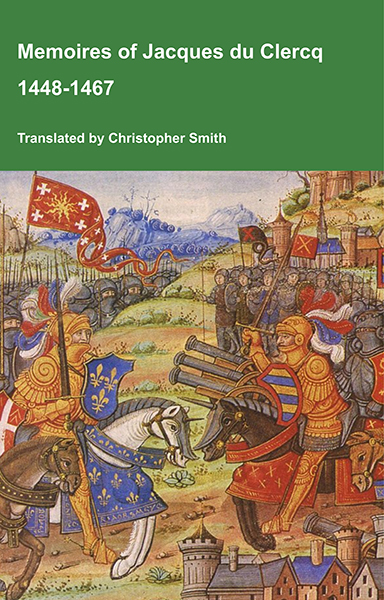
This is a translation of the 'Memoires of Jacques du Clercq', published in 1823 in two volumes, edited by Frederic, Baron de Reissenberg. In his introduction Reissenberg writes: 'Jacques du Clercq tells us that he was born in 1424, and that he was a licentiate in law and a counsellor to Philip the Good, Duke of Burgundy, in the castellany of Douai, Lille, and Orchies. It appears that he established his residence at Arras. In 1446, he married the daughter of Baldwin de la Lacherie, a gentleman who lived in Lille. We read in the fifth book of his Memoirs that his father, also named Jacques du Clercq, had married a lady of the Le Camelin family, from Compiègne. His ancestors, always attached to the counts of Flanders, had constantly served them, whether in their councils or in their armies.' The Memoires cover a period of nineteen years beginning in in 1448, ending in in 1467. It appears that the author had intended to extend the Memoirs beyond that date; no doubt illness or death prevented him from carrying out this plan. As Reissenberg writes the 'merit of this work lies in the simplicity of its narrative, in its tone of good faith, and in a certain air of frankness which naturally wins the reader’s confidence.' Du Clercq ranges from events of national and international importance, including events of the Wars of the Roses in England, to simple, everyday local events such as marriages, robberies, murders, trials and deaths, including that of his own father in Book 5; one of his last entries.
Available at Amazon in eBook and Paperback format.
Earldorman is in Anglo Saxon Titles.
Around 1020 Ealdred Northumbria Earl Bernicia succeeded Earl Bernicia.
Around 1056 Gyrth Godwinson Earl East Anglia [aged 24] was created Earl East Anglia.
Anglo-Saxon Chronicle. 1075. This year King William [aged 47] gave Earl Ralph [aged 33] the daughter of William Fitz-Osborne to wife. This same Ralph was British on his mother's side; but his father, whose name was also Ralph, was English; and born in Norfolk. The king therefore gave his son the earldom of Norfolk and Suffolk; and he then led the bride to Norwich [Map]. There was that bride-ale the source of man's bale. There was Earl Roger, and Earl Waltheof, and bishops, and abbots; who there resolved, that they would drive the king out of the realm of England. But it was soon told the king in Normandy how it was determined. It was Earl Roger and Earl Ralph who were the authors of that plot; and who enticed the Britons to them, and sent eastward to Denmark after a fleet to assist them. Roger went westward to his earldom, and collected his people there, to the king's annoyance, as he thought; but it was to the great disadvantage of himself. He was however prevented. Ralph also in his earldom would go forth with his people; but the castlemen that were in England and also the people of the land, came against him, and prevented him from doing anything. He escaped however to the ships at Norwich [Map].97 And his wife was in the castle; which she held until peace was made with her; when she went out of England, with all her men who wished to join her. The king afterwards came to England, and seized Earl Roger, his relative, and put him in prison. And Earl Waltheof went over sea, and bewrayed himself; but he asked forgiveness, and proffered gifts of ransom. The king, however, let him off lightly, until he98 came to England; when he had him seized. Soon after that came east from Denmark two hundred ships; wherein were two captains, Cnute Swainson, and Earl Hacco; but they durst not maintain a fight with King William. They went rather to York, and broke into St. Peter's minster, and took therein much treasure, and so went away. They made for Flanders over sea; but they all perished who were privy to that design; that was, the son of Earl Hacco, and many others with him.
Note 97. Whence he sailed to Bretagne, according to Flor. S. Dunelm, etc.; but according to Henry of Huntingdon he fled directly to Denmark, returning afterwards with Cnute and Hacco, who invaded England With a fleet of 200 sail.
Note 98. i.e. Earl Waltheof.
 Become a Member via our Buy Me a Coffee page to read more.
Ralph de Gael 2nd Earl East Anglia succeeded Earl East Anglia. Emma Fitzosbern Countess East Anglia by marriage Countess East Anglia.
Ælfgar Earl of Mercia and East Anglia was appointed Earl East Anglia.
Æthelwulf Mercia Earldorman Berkshire was appointed Earldorman Berkshire.
In 964 Ordgar Earldorman Devon was appointed Earldorman Devon by his son-in-law King Edgar I of England [aged 21].
Around 932 Æthelstan Half King [aged 22] was appointed Earldorman East Anglia by King Æthelstan I of England [aged 38].
In 1004 Ulfcytel Snillingr was appointed Earldorman East Anglia.
Abbot John Whethamstede’s Chronicle of the Abbey of St Albans
Abbot John Whethamstede's Register aka Chronicle of his second term at the Abbey of St Albans, 1451-1461, is a remarkable text that describes his first-hand experience of the beginning of the Wars of the Roses including the First and Second Battles of St Albans, 1455 and 1461, respectively, their cause, and their consequences, not least on the Abbey itself. His text also includes Loveday, Blore Heath, Northampton, the Act of Accord, Wakefield, and Towton, and ends with the Coronation of King Edward IV. In addition to the events of the Wars of the Roses, Abbot John, or his scribes who wrote the Chronicle, include details in the life of the Abbey such as charters, letters, land exchanges, visits by legates, and disputes, which provide a rich insight into the day-to-day life of the Abbey, and the challenges faced by its Abbot.
Available at Amazon in eBook and Paperback format.
Æthelred Mucel Mercia Earldorman Gaini was appointed Earldorman Gaini.
Æthelwulf Mercia Earldorman Gaini succeeded Earldorman Gaini.
In 994 Leofwine Mercia was created Earldorman Hwicce.
In 1007 Earldorman Eadric Streona was appointed Earldorman Mercia.
Anglo-Saxon Chronicle. 15th April 1053. In this year was the king [aged 50] at Winchester, Hampshire [Map], at Easter; and Earl Godwin [aged 52] with him, and Earl Harold [aged 31] his son, and Tosty [aged 27]. On the day after Easter sat he with the king at table; when he suddenly sunk beneath against the foot-rail, deprived of speech and of all his strength. He was brought into the king's chamber; and they supposed that it would pass over: but it was not so. He continued thus speechless and helpless till the Thursday; when he resigned his life, on the seventeenth before the calends of May; and he was buried at Winchester in the old minster. Earl Harold, his son, took to the earldom that his father had before, and to all that his father possessed; whilst Earl Elgar took to the earldom that Harold had before. The Welshmen this year slew a great many of the warders of the English people at Westbury, Wiltshire [Map]. This year there was no archbishop in this land: but Bishop Stigand held the see of Canterbury at Christ church, and Kinsey that of York. Leofwine and Wulfwy went over sea, and had themselves consecrated bishops there. Wulfwy took to the bishopric which Ulf had whilst he was living and in exile.
Before 31st August 1057 Leofric Earldorman Mercia was created Earldorman Mercia. Godgifu aka Lady Godiva by marriage Earldorman Mercia.


Around 31st August 1057 Leofric Earldorman Mercia died at Kings Bromley, Staffordshire [Map]. His son Ælfgar succeeded Earldorman Mercia.
Anglo-Saxon Chronicle. After 8th August 1065. Soon after this all the thanes in Yorkshire and in Northumberland gathered themselves together at York, and outlawed their Earl Tosty [aged 39]; slaying all the men of his clan that they could reach, both Danish and English; and took all his weapons in York, with gold and silver, and all his money that they could anywhere there find. They then sent after Morkar, son of Earl Elgar, and chose him for their earl. He went south with all the shire, and with Nottinghamshire and Derbyshire and Lincolnshire, till he came to Northampton [Map]; where his brother Edwin came to meet him with the men that were in his earldom. Many Britons also came with him. Harold [aged 43] also there met them; on whom they imposed an errand to King Edward [aged 62], sending also messengers with him, and requesting that they might have Morcar for their earl. This the king granted; and sent back Harold to them, to Northampton, on the eve of St. Simon and St. Jude; and announced to them the same, and confirmed it by hand, and renewed there the laws of Knute. But the Northern men did much harm about Northampton, whilst he went on their errand: either that they slew men, and burned houses and corn; or took all the cattle that they could come at; which amounted to many thousands. Many hundred men also they took, and led northward with them; so that not only that shire, but others near it were the worse for many winters.
On 3rd October 1066 Edwin Earl of Mercia was appointed Earldorman Mercia when Tostig Godwinson Earl Northumbria [deceased] was rejected by the Northumbrians for having acted against the law.
Before 12th June 898 Æthelhelm Earldorman Wiltshire was appointed Earldorman Wiltshire.