


Text this colour is a link for Members only. Support us by becoming a Member for only £3 a month by joining our 'Buy Me A Coffee page'; Membership gives you access to all content and removes ads.
Text this colour links to Pages. Text this colour links to Family Trees. Place the mouse over images to see a larger image. Click on paintings to see the painter's Biography Page. Mouse over links for a preview. Move the mouse off the painting or link to close the popup.
John Evelyn's Diary 1701 is in John Evelyn's Diary 1700s.

1st January 1701. I finished the sale of North Stoake in Sussex to Robert Michell, Esq, appointed by my brother to be sold for payment of portions to my nieces, and other incumbrances on the estate.
4th January 1701. An exceeding deep snow, and melted away as suddenly.
19th January 1701. Severe frost, and such a tempest as threw down many chimneys, and did great spoil at sea, and blew down above twenty trees of mine at Wotton, Surrey [Map].

9th February 1701. The old Speaker (age 53) laid aside, and Mr. Harley (age 39), an able gentleman, chosen. Our countryman, Sir Richard Onslow (age 46), had a party for him.


27th February 1701. By an order of the House of Commons, I laid before the Speaker (age 39) the state of what had been received and paid toward the building of Greenwich Hospital [Map].
27th February 1701. Mr. Wye, Rector of Wotton, died, a very worthy good man. I gave it to Dr. Bohun, a learned person and excellent preacher, who had been my son's tutor, and lived long in my family.

18th March 1701. I let Sayes Court, Deptford [Map] to Lord Carmarthen (age 42), son to the Duke of Leeds (age 69). 28th. I went to the funeral of my sister Draper, who was buried at Edmonton in great state. Dr. Davenant displeased the clergy now met in Convocation by a passage in his book, p. 40.
1st April 1701. A Dutch boy of about eight or nine years old was carried about by his parents to show, who had about the iris of one eye the letters of Deus meus, and of the other Elohim, in the Hebrew character. How this was done by artifice none could imagine; his parents affirming that he was so born. It did not prejudice his sight, and he seemed to be a lively playing boy. Everybody went to see him; physicians and philosophers examined it with great accuracy; some considered it as artificial, others as almost supernatural.
4th April 1701. The Duke of Norfolk (deceased) died of an apoplexy, and Mr. Thomas Howard of complicated disease since his being cut for the stone; he was one of the Tellers of the Exchequer. Mr. How (age 52) made a Baron.
1st May 1701. Some Kentish men, delivering a petition to the House of Commons, were imprisoned.
1st May 1701. A great dearth, no considerable rain having fallen for some months.
17th May 1701. Very plentiful showers, the wind coming west and south. The Bishops and Convocation at difference concerning the right of calling the assembly and dissolving. Atterbury (age 38) and Dr. Wake writing one against the other.

20th June 1701. The Commons demanded a conference with the Lords on the trial of Lord Somers (age 50), which the Lords refused, and proceeding on the trial, the Commons would not attend, and he was acquitted.
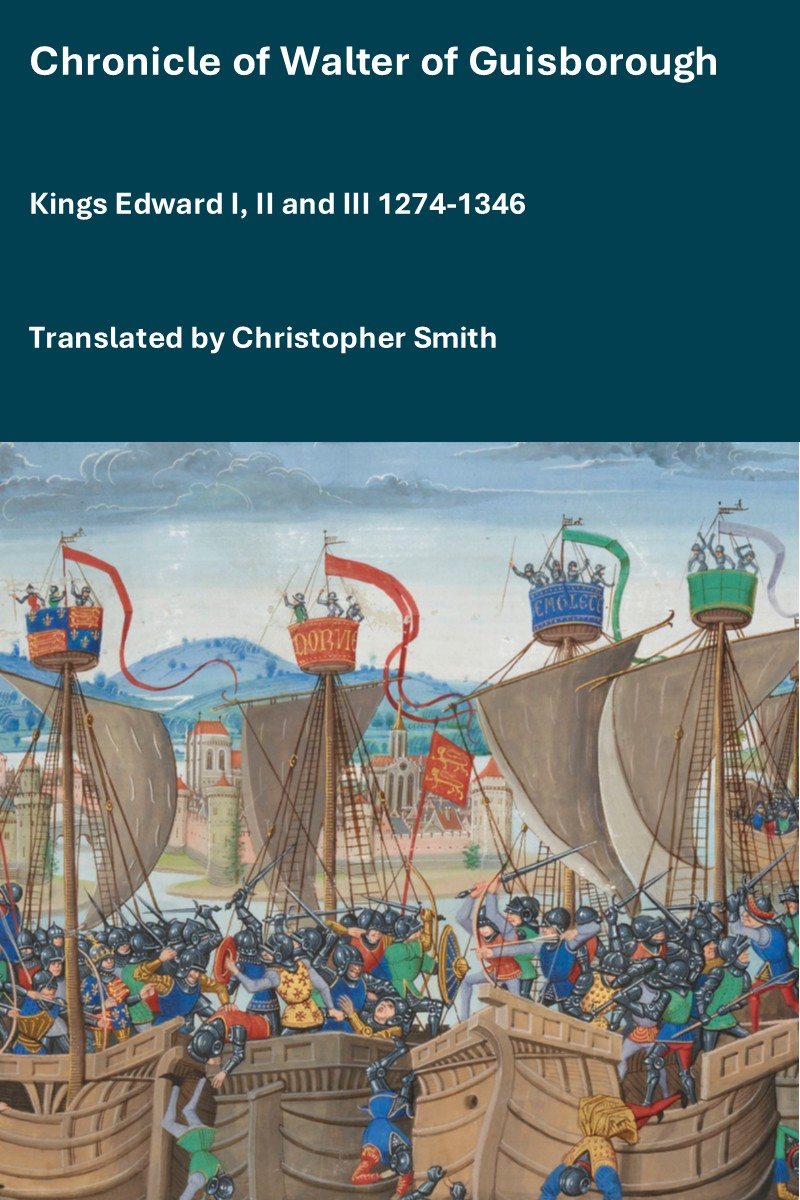
All About History Books
The Chronicle of Walter of Guisborough, a canon regular of the Augustinian Guisborough Priory, Yorkshire, formerly known as The Chronicle of Walter of Hemingburgh, describes the period from 1066 to 1346. Before 1274 the Chronicle is based on other works. Thereafter, the Chronicle is original, and a remarkable source for the events of the time. This book provides a translation of the Chronicle from that date. The Latin source for our translation is the 1849 work edited by Hans Claude Hamilton. Hamilton, in his preface, says: "In the present work we behold perhaps one of the finest samples of our early chronicles, both as regards the value of the events recorded, and the correctness with which they are detailed; Nor will the pleasing style of composition be lightly passed over by those capable of seeing reflected from it the tokens of a vigorous and cultivated mind, and a favourable specimen of the learning and taste of the age in which it was framed." Available at Amazon in eBook and Paperback.

22nd June 1701. I went to congratulate the arrival of that worthy and excellent person my Lord Galway (age 53), newly come out of Ireland, where he had behaved himself so honestly, and to the exceeding satisfaction of the people: but he was removed thence for being a Frenchman, though they had not a more worthy, valiant, discreet, and trusty person in the two kingdoms, on whom they could have relied for his conduct and fitness. He was one who had deeply suffered, as well as the Marquis, his father, for being Protestants.

1st July 1701. My Lord Treasurer (age 56) made my grandson (age 19) one of the Commissioners of the prizes, salary £500 per annum.

8th July 1701. My grandson (age 19) went to Sir Simon Harcourt (age 39), the Solicitor General, to Windsor, Berkshire [Map], to wait on my Lord Treasurer. There had been for some time a proposal of marrying my grandson to a daughter (age 26) of Mrs. Boscawen (age 58), sister of my Lord Treasurer (age 56), which was now far advanced.
14th July 1701. I subscribed toward rebuilding Oakwood Chapel, now, after 200 years, almost fallen down.
1st August 1701. The weather changed from heat not much less than in Italy or Spain for some few days, to wet, dripping, and cold, with intermissions of fair.
2nd September 1701. I went to Kensington, and saw the house, plantations, and gardens, the work of Mr. Wise, who was there to receive me.
2nd September 1701. The death of King James (age 67), happening on the 15th of this month, N. S., after two or three days' indisposition, put an end to that unhappy Prince's troubles, after a short and unprosperous reign, indiscreetly attempting to bring in Popery, and make himself absolute, in imitation of the French, hurried on by the impatience of the Jesuits; which the nation would not endure.
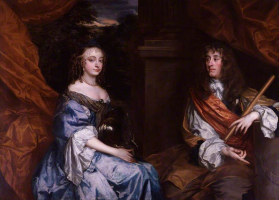


2nd September 1701. Died the Earl of Bath (deceased), whose contest with Lord Montague (age 40) about the Duke of Albemarle's estate, claiming under a will supposed to have been forged, is said to have been worth £10,000 to the lawyers. His eldest son shot himself a few days after his father's death; for what cause is not clear. He was a most hopeful young man, and had behaved so bravely against the Turks at the siege of Vienna, that the Emperor made him a Count of the Empire. It was falsely reported that Sir Edward Seymour (age 68) was dead, a great man; he had often been Speaker, Treasurer of the Navy, and in many other lucrative offices. He was of a hasty spirit, not at all sincere, but head of the party at any time prevailing in Parliament.

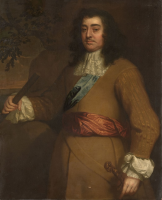
29th September 1701. I kept my first courts in Surrey, which took up the whole week. My steward was Mr. Hervey, a Counsellor, Justice of Peace, and Member of Parliament, and my neighbor. I gave him six guineas, which was a guinea a day, and to Mr. Martin, his clerk, three guineas.
31st October 1701. I was this day 81 complete, in tolerable health, considering my great age.
1st December 1701. Great contentions about elections. I gave my vote and interest to Sir R. Onslow (age 47) and Mr. Weston.
27th December 1701. My grandson (age 19) quitted Oxford.
