


The History of William Marshal was commissioned by his son shortly after William’s death in 1219 to celebrate the Marshal’s remarkable life; it is an authentic, contemporary voice. The manuscript was discovered in 1861 by French historian Paul Meyer. Meyer published the manuscript in its original Anglo-French in 1891 in two books. This book is a line by line translation of the first of Meyer’s books; lines 1-10152. Book 1 of the History begins in 1139 and ends in 1194. It describes the events of the Anarchy, the role of William’s father John, John’s marriages, William’s childhood, his role as a hostage at the siege of Newbury, his injury and imprisonment in Poitou where he met Eleanor of Aquitaine and his life as a knight errant. It continues with the accusation against him of an improper relationship with Margaret, wife of Henry the Young King, his exile, and return, the death of Henry the Young King, the rebellion of Richard, the future King Richard I, war with France, the death of King Henry II, and the capture of King Richard, and the rebellion of John, the future King John. It ends with the release of King Richard and the death of John Marshal.
Available at Amazon in eBook and Paperback format.
Paternal Family Tree: Holland
Maternal Family Tree: Clemence Roches Countess Blois
Around March 1340 [his father] Thomas Holland 1st Earl Kent [aged 26] and [his mother] Joan "Fair Maid of Kent" Princess Wales [aged 11] were married in secret. It isn't clear whether the marriage was canonical given the secrecy; there were no witnesses. She twelve years old. A subsequent investigation by papal commissioners confirmed it as valid. She the daughter of [his grandfather] Edmund of Woodstock 1st Earl Kent and [his grandmother] Margaret Wake Countess Kent [aged 42]. They were fourth cousin once removed. He a great x 4 grandson of King Henry "Curtmantle" II of England. She a granddaughter of King Edward I of England.
Around November 1340 [his step-father] William Montagu 2nd Earl Salisbury [aged 12] and [his mother] Joan "Fair Maid of Kent" Princess Wales [aged 12] were married. She was already married albeit secretly to [his father] Thomas Holland 1st Earl Kent [aged 26]. The subsequent investigation found her marriage to Thomas Holland 1st Earl Kent to be valid. She the daughter of [his grandfather] Edmund of Woodstock 1st Earl Kent and [his grandmother] Margaret Wake Countess Kent [aged 43]. He the son of William Montagu 1st Earl Salisbury [aged 39] and Catherine Grandison Countess of Salisbury [aged 36].
In 1352 John Holland 1st Duke Exeter was born to [his father] Thomas Holland 1st Earl Kent [aged 38] and [his mother] Joan "Fair Maid of Kent" Princess Wales [aged 23]. He a great grandson of King Edward I of England.
In 1352 [his father] Thomas Holland 1st Earl Kent [aged 38] was created 1st Earl Kent, 1st Baron Holand.
On 26th December 1352 [his uncle] John Plantagenet 3rd Earl Kent [aged 22] died. He was buried at Greyfriars Church, Winchester [Map]. Earl Kent extinct. His sister [his mother] Joan [aged 24] succeeded 5th Baroness Wake of Liddell. Some source suggest she also succeeded as 4th Countess of Kent but this is inconsistent with 1. her husband being created Earl of Kent as a new creation, and 2. her son not succeeding to the original Earldom?
On 26th December 1360 [his father] Thomas Holland 1st Earl Kent [aged 46] died. He was buried at Blackfriars Friary, Stamford [Map]. His son [his brother] Thomas [aged 10] succeeded 2nd Earl Kent.
On 10th October 1361 [his step-father] Edward "Black Prince" [aged 31] and [his mother] Joan "Fair Maid of Kent" Princess Wales [aged 33] were married at Windsor Castle [Map]. She by marriage Princess of Wales. His first wife, her second (or third depending on how you count them) husband. She had four children already. They had known each other since childhood. Thirty-one and thirty-three respectively. A curious choice for the heir to the throne; foreign princesses were usual. They were married nearly fifteen years and had two children. She the daughter of [his grandfather] Edmund of Woodstock 1st Earl Kent and [his grandmother] Margaret Wake Countess Kent. He the son of King Edward III of England [aged 48] and Philippa of Hainaut Queen Consort England [aged 51]. They were half first cousin once removed. She a granddaughter of King Edward I of England.
In May 1366 [his brother-in-law] John Montfort V Duke Brittany [aged 27] and [his sister] Joan Holland Duchess Brittany [aged 16] were married. She by marriage Duchess Brittany 1221 Dreux. She the daughter of [his father] Thomas Holland 1st Earl Kent and [his mother] Joan "Fair Maid of Kent" Princess Wales [aged 37]. They were third cousins. He a great x 2 grandson of King Henry III of England. She a great granddaughter of King Edward I of England.
Before 13th October 1370 [his brother] Thomas Holland 2nd Earl Kent [aged 20] and [his sister-in-law] Alice Fitzalan Countess Kent [aged 20] were married. She by marriage Countess Kent. She the daughter of Richard Fitzalan 3rd or 10th Earl of Arundel 8th Earl of Surrey [aged 64] and Eleanor Plantagenet Countess Arundel and Surrey [aged 52]. He the son of [his father] Thomas Holland 1st Earl Kent and [his mother] Joan "Fair Maid of Kent" Princess Wales [aged 42]. They were third cousins. He a great grandson of King Edward I of England. She a great x 2 granddaughter of King Henry III of England.
In 1372 [his brother-in-law] John Montfort V Duke Brittany [aged 33] was restored 6th Earl Richmond. [his sister] Joan Holland Duchess Brittany [aged 22] by marriage Countess Richmond.
On 8th June 1376 [his step-father] Edward "Black Prince" [aged 45] died of dysentery at Westminster Palace [Map]. He was buried in Canterbury Cathedral [Map]. His son [his half-brother] Richard [aged 9] succeeded as heir to his grandfather King Edward III of England [aged 63] who died a year later.


On 21st June 1377 King Edward III of England [aged 64] died of a stroke at Sheen Palace [Map]. He was buried in the Chapel of St Edward the Confessor, Westminster Abbey [Map]. His grandson [his half-brother] Richard [aged 10] succeeded II King of England.
On 16th July 1377 [his half-brother] King Richard II of England [aged 10] was crowned II King of England at Westminster Abbey [Map] by Archbishop Simon Sudbury [aged 61].
Richard Fitzalan 9th Earl of Surrey 4th or 11th Earl of Arundel [aged 31] carried the Crown.
Guichard d'Angle 1st Earl Huntingdon was created 1st Earl Huntingdon for life.
John Mowbray 1st Earl Nottingham [aged 11] was created 1st Earl Nottingham.
Edward 2nd Duke of York 1st Duke Albemarle [aged 4] and Robert Harrington 3rd Baron Harington [aged 21] were knighted.
Roger Scales 4th Baron Scales [aged 23] attended.
On 24th June 1380 John Hastings 3rd Earl Pembroke [aged 7] and [his future wife] Elizabeth Lancaster Duchess Exeter [aged 17] were married at Kenilworth Castle [Map]. She by marriage Countess Pembroke. She the daughter of [his future father-in-law] John of Gaunt 1st Duke Lancaster [aged 40] and Blanche Duchess of Lancaster. He the son of John Hastings 2nd Earl Pembroke and Anne Manny Countess Pembroke. They were half third cousins. He a great x 2 grandson of King Edward I of England. She a granddaughter of King Edward III of England.
After 24th June 1380 John Hastings 3rd Earl Pembroke [aged 7] and [his future wife] Elizabeth Lancaster Duchess Exeter [aged 17] marriage annulled since she had become pregnant by John Holland 1st Duke Exeter [aged 28] whom she subsequently married. It isn't clear whether John Holland was punished; he was half-brother to King Richard II of England [aged 13] through their mother Joan "Fair Maid of Kent" Princess Wales [aged 51].
On 23rd April 1381 John Holland 1st Duke Exeter [aged 29] was appointed 68th Knight of the Garter by [his half-brother] King Richard II of England [aged 14].

On 14th June 1381 the mob gained access to the Tower of London [Map] capturing [his mother] Joan "Fair Maid of Kent" Princess Wales [aged 52], the future [his future brother-in-law] King Henry IV of England [aged 14], [his niece] Joan Holland Duchess York [aged 1] and Archbishop Simon Sudbury [aged 65].
Archbishop Simon Sudbury was beheaded at Tower Hill [Map]. He was buried at Canterbury Cathedral [Map].
Lord Treasurer Robert Hales [aged 56], who had only been appointed on the 1st February 1381, was beheaded at Tower Hill [Map].
On 15th June 1381 [his half-brother] King Richard II of England [aged 14] met with Wat Tyler at Smithfield [Map]. During the course of the meeting Wat Tyler was wounded by William Walworth. Wat Tyler was then captured and beheaded at Smithfield [Map]. His head was placed on top a pole and carried through the city, then displayed on London Bridge.
William Walworth and John Philpot were knighted by King Richard II of England.
Jean de Waurin's Chronicle of England Volume 6 Books 3-6: The Wars of the Roses
Jean de Waurin was a French Chronicler, from the Artois region, who was born around 1400, and died around 1474. Waurin’s Chronicle of England, Volume 6, covering the period 1450 to 1471, from which we have selected and translated Chapters relating to the Wars of the Roses, provides a vivid, original, contemporary description of key events some of which he witnessed first-hand, some of which he was told by the key people involved with whom Waurin had a personal relationship.
Available at Amazon in eBook and Paperback format.
On 15th July 1381 John Ball [aged 43] was hanged, drawn and quartered in St Albans, Hertfordshire [Map] in the presence of [his half-brother] King Richard II of England [aged 14].
On 20th January 1382 [his half-brother] King Richard II of England [aged 15] and [his sister-in-law] Anne of Bohemia Queen Consort England [aged 15] were married at Westminster Abbey [Map] by Bishop Robert Braybrooke. She by marriage Queen Consort England. She the daughter of Charles IV King Bohemia Holy Roman Emperor Luxemburg and Elizabeth Pomerania Holy Roman Empress Luxemburg [aged 35]. He the son of [his step-father] Edward "Black Prince" and [his mother] Joan "Fair Maid of Kent" Princess Wales [aged 53]. They were fourth cousins. He a grandson of King Edward III of England.
It was the first royal wedding that including a Royal Procession from the Tower of London [Map] to Westminster Abbey [Map].
Arranged by Michael de la Pole 1st Earl Suffolk [aged 52] the marriage not popular since it brought no dowry and little prospect of increased trade since Bohemia not a primary English trade partner.
In 1384 [his sister] Joan Holland Duchess Brittany [aged 34] died.
Before 1385 John Holland 1st Duke Exeter [aged 32] was rumoured to be having an affair with Isabella of Castile Duchess York [aged 29] wife of Edmund of Langley 1st Duke of York [aged 43].
In May 1385 Ralph Stafford [aged 18] was murdered by John Holland 1st Duke Exeter [aged 33]. He was buried at King's Langley Priory, Hertfordshire [Map].
On 20th July 1385 Richard of Conisbrough 1st Earl Cambridge was born to Edmund of Langley 1st Duke of York [aged 44] and Isabella of Castile Duchess York [aged 30] at Conisbrough Castle [Map]. Some historians suggest the father was John Holland 1st Duke Exeter [aged 33] with whom Isabella of Castile Duchess York was suspected of having an affair since 1. Richard received no lands from his father and was not mentioned either in his father's will nor his brother's will, 2. the age gap, around ten years, between Richard and his older siblings. He a grandson of King Edward III of England. He married (1) May 1406 his first cousin twice removed Anne Mortimer, daughter of Roger Mortimer 4th Earl March 3rd Earl of Ulster and Eleanor Holland Countess March and Ulster, and had issue (2) after 21st September 1411 his third cousin twice removed Maud Clifford Countess Cambridge, daughter of Thomas Clifford 6th Baron Clifford and Elizabeth Ros Baroness Clifford.
On 6th August 1385 Edmund of Langley 1st Duke of York [aged 44] was created 1st Duke York by [his half-brother] King Richard II of England [aged 18]. Isabella of Castile Duchess York [aged 30] by marriage Duchess York.
Thomas of Woodstock 1st Duke of Gloucester [aged 30] was created 1st Duke Albemarle, and around the same time, 1st Duke Gloucester. Eleanor Bohun Duchess Gloucester [aged 19] by marriage Duchess Albemarle and Duchess Gloucester.
On 7th August 1385 [his mother] Joan "Fair Maid of Kent" Princess Wales [aged 56] died at Wallingford Castle [Map]. She was buried at Blackfriars Friary, Stamford [Map] beside her first husband [his father] Thomas Holland 1st Earl Kent. Her son [his brother] Thomas [aged 35] succeeded 6th Baron Wake of Liddell.
On 24th June 1386 John Holland 1st Duke Exeter [aged 34] and Elizabeth Lancaster Duchess Exeter [aged 23] were married at Plymouth, Devon [Map]. She the daughter of John of Gaunt 1st Duke Lancaster [aged 46] and Blanche Duchess of Lancaster. He the son of Thomas Holland 1st Earl Kent and Joan "Fair Maid of Kent" Princess Wales. They were half second cousin once removed. He a great grandson of King Edward I of England. She a granddaughter of King Edward III of England.
In 1387 [his daughter] Constance Holland Countess Norfolk and Nottingham was born to John Holland 1st Duke Exeter [aged 35] and [his wife] Elizabeth Lancaster Duchess Exeter [aged 23]. She a great granddaughter of King Edward III of England. She married (1) before 1st June 1402 her third cousin Thomas Mowbray 4th Earl Norfolk 2nd Earl Nottingham, son of Thomas Mowbray 1st Duke of Norfolk and Elizabeth Fitzalan Duchess Norfolk (2) 1410 her half third cousin twice removed John Grey, son of Reginald Grey 3rd Baron Grey Ruthyn and Margaret Ros Baroness Grey Ruthyn, and had issue.
On 2nd February 1387 King John I of Portugal [aged 35] and [his sister-in-law] Philippa of Lancaster Queen Consort Portugal [aged 26] were married. She by marriage Queen Consort Portugal. She the daughter of [his father-in-law] John of Gaunt 1st Duke Lancaster [aged 46] and Blanche Duchess of Lancaster. He the son of Peter I King Portugal and Inês Castro. They were half fourth cousins. He a great x 5 grandson of King Henry "Curtmantle" II of England. She a granddaughter of King Edward III of England.
On 19th December 1387 an army of the Lords Appellant led by the future [his brother-in-law] King Henry IV of England [aged 20] prevented the forces of [his half-brother] King Richard II of England [aged 20] commanded by Robert de Vere 1st Duke Ireland [aged 25] from crossing the bridge [Map] over the River Thames at Radcot in Oxfordshire. When Thomas of Woodstock 1st Duke of Gloucester [aged 32] arrived with further Lord Appellant's men the King's men were encircled. The King's men attempted to force the crossing of the bridge at which time the only casualties occurred including Thomas Molyneux [aged 49] who was killed by Thomas Mortimer [aged 37]. Around 800 men drowned in the marshes whilst trying to escape. Robert de Vere 1st Duke Ireland narrowly escaped to France.
In 1388 John Holland 1st Duke Exeter [aged 36] was created 1st Earl Huntingdon. [his wife] Elizabeth Lancaster Duchess Exeter [aged 24] by marriage Countess Huntingdon.
On 3rd February 1388 the Merciless Parliament commenced. It ended on 4th June 1388. Its primary function was to prosecute members of the Court of [his half-brother] King Richard II of England [aged 21]. The term "Merciless" is contemporary having been coined by the chronicler Henry Knighton.
Michael de la Pole 1st Earl Suffolk [aged 58] was sentenced to be hanged, drawn and quartered in his absence. He had escaped to France.
Archbishop Alexander Neville [aged 47] was found guilty of treason and it was determined to imprison him for life in Rochester Castle, Kent [Map]. He fled to Louvain [Map] where he became a parish priest for the remainder of his life.
On 19th February 1388 Robert Tresilian was hanged naked and his throat cut. See Chronicle of Adam of Usk.
On 25th March 1388 Nicholas Brembre was hanged. He was buried at Christ Church, Greyfriars [Map].
On 5th May 1388 Simon Burley [aged 48] was executed despite the protestations of his friend Edmund of Langley 1st Duke of York [aged 46]. See Chronicle of Adam of Usk.
On 12th May 1388 John Beauchamp 1st Baron Beauchamp [aged 69] was beheaded at Tower Hill [Map]. He was buried at Worcester Cathedral [Map]. Baron Beauchamp of Kidderminster forfeit.
Robert de Vere 1st Duke Ireland [aged 26] was attainted.
 Become a Member via our Buy Me a Coffee page to read more.
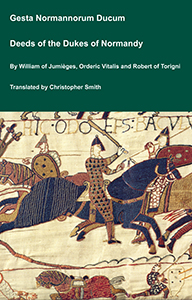
The Deeds of the Dukes of Normandy
The Gesta Normannorum Ducum [The Deeds of the Dukes of Normandy] is a landmark medieval chronicle tracing the rise and fall of the Norman dynasty from its early roots through the pivotal events surrounding the Norman Conquest of England. Originally penned in Latin by the monk William of Jumièges shortly before 1060 and later expanded at the behest of William the Conqueror, the work chronicles the deeds, politics, battles, and leadership of the Norman dukes, especially William’s own claim to the English throne. The narrative combines earlier historical sources with firsthand information and oral testimony to present an authoritative account of Normandy’s transformation from a Viking settlement into one of medieval Europe’s most powerful realms. William’s history emphasizes the legitimacy, military prowess, and governance of the Norman line, framing their expansion, including the conquest of England, as both divinely sanctioned and noble in purpose. Later chroniclers such as Orderic Vitalis and Robert of Torigni continued the history, extending the coverage into the 12th century, providing broader context on ducal rule and its impact. Today this classic work remains a foundational source for understanding Norman identity, medieval statesmanship, and the historical forces that reshaped England and Western Europe between 800AD and 1100AD.
Available at Amazon in eBook and Paperback format.
Before 17th September 1388 Henry III King Castile [aged 8] and [his sister-in-law] Catherine of Lancaster Queen Consort Castile [aged 15] were married at Palencia Cathedral [Map]. She by marriage Queen Consort Castile. She the daughter of [his father-in-law] John of Gaunt 1st Duke Lancaster [aged 48] and Constance of Castile Duchess of Lancaster [aged 34]. He the son of John I King Castile [aged 30] and Eleanor Barcelona Queen Consort Castile. They were half second cousins. She a granddaughter of King Edward III of England.
Around 1389 [his daughter] Elizabeth Holland was born to John Holland 1st Duke Exeter [aged 37] and [his wife] Elizabeth Lancaster Duchess Exeter [aged 25]. She a great granddaughter of King Edward III of England. She married her fourth cousin once removed Roger Fiennes and had issue.
In 1391 Robert Ferrers [aged 18] and [his illegitimate sister-in-law] Joan Beaufort Countess of Westmoreland [aged 12] were married at Beaufort en Vallée [Map]. She the illegitmate daughter of [his father-in-law] John of Gaunt 1st Duke Lancaster [aged 50] and Katherine Swynford aka Roet Duchess Lancaster [aged 40].
Around 1392 [his daughter] Alice Holland Countess of Oxford was born to John Holland 1st Duke Exeter [aged 40] and [his wife] Elizabeth Lancaster Duchess Exeter [aged 28]. She a great granddaughter of King Edward III of England. She married before 1399 her fifth cousin Richard de Vere 11th Earl of Oxford, son of Aubrey de Vere 10th Earl of Oxford and Alice Fitzwalter Countess of Oxford.
On 23rd December 1392 Isabella of Castile Duchess York [aged 37] died. She was buried at King's Langley Priory, Hertfordshire [Map]. She the wife of Edmund of Langley 1st Duke of York [aged 51]. Isabella had travelled to England with her sister Constance of Castile Duchess of Lancaster [aged 38] who had married Edmund's elder brother [his father-in-law] John of Gaunt 1st Duke Lancaster [aged 52]. Isabella and Edmund's marriage was not, apparently, a happy one. She is known to have had an affair with John Holland 1st Duke Exeter [aged 40] who may have been the father of Richard of Conisbrough 1st Earl Cambridge [aged 7] progenitor of the House of York.
On 7th June 1394 [his sister-in-law] Anne of Bohemia Queen Consort England [aged 28] died of plague (probably) at Sheen Palace [Map]. [his half-brother] King Richard II of England [aged 27] was so distraught at her death he ordered the destruction of Sheen Palalce [Map].
On 18th March 1395 [his son] John Holland 2nd Duke Exeter was born to John Holland 1st Duke Exeter [aged 43] and [his wife] Elizabeth Lancaster Duchess Exeter [aged 32] at Dartington, Devon. He a great grandson of King Edward III of England. He married (1) 6th March 1427 his second cousin Anne Stafford Duchess Exeter, daughter of Edmund Stafford 5th Earl Stafford and Anne of Gloucester Plantagenet Countess Eu and Stafford, and had issue (2) 20th January 1433 his half fifth cousin Beatrice Aviz Duchess Exeter (3) after 25th October 1439 his half third cousin once removed Anne Montagu Duchess Exeter, daughter of John Montagu 3rd Earl Salisbury and Maud Francis Countess of Salisbury.
On 4th November 1396 [his half-brother] King Richard II of England [aged 29] and [his sister-in-law] Isabella Valois Queen Consort England [aged 6] were married. The marriage being one of the terms of a twenty-eight year peace treaty with France. He twenty-nine, she six. The marriage sowed the seeds subsequent rebellion since there was no prospect of an heir to secure the Crown. The difference in their ages was 22 years. She the daughter of Charles "Beloved Mad" VI King France [aged 27] and Isabeau Wittelsbach Queen Consort France [aged 26]. He the son of [his step-father] Edward "Black Prince" and [his mother] Joan "Fair Maid of Kent" Princess Wales. They were half third cousins. He a grandson of King Edward III of England. She a great x 5 granddaughter of King Henry III of England.
William Ros 6th Baron Ros Helmsley [aged 26] attended.
Before 29th November 1396 Ralph Neville 1st Earl of Westmoreland [aged 32] and [his illegitimate sister-in-law] Joan Beaufort Countess of Westmoreland [aged 17] were married. She by marriage Baroness Neville Raby. She the illegitmate daughter of [his father-in-law] John of Gaunt 1st Duke Lancaster [aged 56] and Katherine Swynford aka Roet Duchess Lancaster [aged 46]. They were half fifth cousins. He a great x 5 grandson of King Henry "Curtmantle" II of England. She a granddaughter of King Edward III of England.
On 25th April 1397 [his brother] Thomas Holland 2nd Earl Kent [aged 47] died. He was buried in Bourne Abbey, Lincolnshire [Map]. His son [his nephew] Thomas [aged 23] succeeded 3rd Earl Kent, 2nd Baron Holand, 7th Baron Wake of Liddell. Joan Stafford Countess Kent [aged 19] by marriage Countess Kent.
On 29th September 1397 King Richard II [aged 30] rewarded his relations with Dukedoms, possibly for their part in downfall of Thomas of Woodstock 1st Duke of Gloucester [deceased], Thomas Beauchamp 12th Earl Warwick [aged 59] and Richard Fitzalan 9th Earl of Surrey 4th or 11th Earl of Arundel [deceased]...
His older half-brother John Holland 1st Duke Exeter [aged 45] was created 1st Duke Exeter. Elizabeth Lancaster Duchess Exeter [aged 34] by marriage Duchess Exeter.
His nephew Thomas Holland 1st Duke Surrey [aged 23] was created 1st Duke Surrey.
His first cousin once-removed Margaret was created 1st Duchess Norfolk - for life only. On the same day her grandson Thomas [aged 29] was also created Duke of Norfolk - see below.
His second cousin once removed Thomas Mowbray 1st Duke of Norfolk was created 1st Duke Norfolk. Elizabeth Fitzalan Duchess Norfolk [aged 31] by marriage Duchess Norfolk.
His first cousin Edward 2nd Duke of York 1st Duke Albemarle [aged 24] was created 1st Duke Albemarle. Beatrice Burgundy Countess Rutland and Cork [aged 24] by marriage Duchess Albemarle.
His illegitimate first cousin John Beaufort 1st Marquess Somerset and Dorset [aged 24] was created 1st Marquess Somerset, 1st Marquess Dorset. Margaret Holland Duchess Clarence [aged 12] by marriage Marchioness Somerset, Marchioness Dorset.
Ralph Neville 1st Earl of Westmoreland [aged 33] was created 1st Earl of Westmoreland. Joan Beaufort Countess of Westmoreland [aged 18] by marriage Countess of Westmoreland.
Become a Member via our Buy Me a Coffee page to read more.
On 27th November 1397 [his illegitimate brother-in-law] John Beaufort 1st Marquess Somerset and Dorset [aged 24] and [his niece] Margaret Holland Duchess Clarence [aged 12] were married. She by marriage Countess Somerset. She the daughter of Thomas Holland 2nd Earl Kent and Alice Fitzalan Countess Kent [aged 47]. He the illegitmate son of John of Gaunt 1st Duke Lancaster [aged 57] and Katherine Swynford aka Roet Duchess Lancaster [aged 47]. They were half third cousins. He a grandson of King Edward III of England. She a great x 2 granddaughter of King Edward I of England.
On 27th February 1398 [his illegitimate brother-in-law] Cardinal Henry Beaufort [aged 23] was appointed Bishop of Lincoln.
Froissart Book 4 Chapter 95. 16th September 1398. Not long after this, the [his half-brother] king of England [aged 31] summoned a large council of the great nobles and prelates at Eltham [Map]. On their arrival, he placed his two uncles of [his father-in-law] Lancaster [aged 58] and York [aged 57] beside him, with the earls of Northumberland [aged 56], Salisbury [aged 48] and Huntingdon [aged 46]. The [his brother-in-law] earl of Derby [aged 31] and the earl marshal [aged 30] were sent for, and put into separate chambers, for it had been ordered they were not to meet. The king showed he wished to mediate between them, notwithstanding their words had been very displeasing to him, and ought not to be lightly pardoned. He required therefore that they should submit themselves to his decision; and to this end sent the constable of England, with four great barons, to oblige them to promise punctually to obey it. The constable and the lords waited on the two earls, and explained the king's intentions. They both bound themselves, in their presence, to abide by whatever sentence the king should give. They having reported this, the king said, "Well then, I order that the earl marshal, for having caused trouble in this kingdom, by uttering words which he could not prove otherwise than by common report, be banished the realm: he may seek any other land he pleases to dwell in, but he must give over all hope of returning hither, as I banish him for life. I also order, that the earl of Derby, our cousin, for having angered us, and because he has been, in some measure, the cause of the earl marshal's crime and punishment, prepare to leave the kingdom within fifteen days, and be banished hence for the term of ten years, without daring to return unless recalled by us; but we shall reserve to ourself the power of abridging this term in part or altogether." The sentence was satisfactory to the lords present, who said: "The earl of Derby may readily go two or three years and amuse himself in foreign parts, for he is young enough; and, although he has already travelled to Prussia, the Holy Sepulchre, Cairo and Saint Catherine's1, he will find other places to visit. He has two sisters, queens of [his sister-in-law] Castillo [aged 25] and of Portugal [aged 38], and may cheerfully pass his time with them. The lords, knights and squires of those countries, will make him welcome, for at this moment all warfare is at an end. On his arrival in Castille, as he is very active, he may put them in motion, and lead them against the infidels of Granada, which will employ his time better than remaining idle in England. Or he may go to Hainault, where his cousin, and brother in arms, the count d'Ostrevant, will be happily to see him, and gladly entertain him, that he may assist him in his war against the Frieslanders. If he go to Hainault, lie can have frequent intelligence from his own country and children. He therefore cannot fail of doing well, whithersoever he goes; and the king may speedily recall him, through means of the good friends he will leave behind, for he is the finest feather in his cap; and he must not therefore suffer him to be too long absent, if he wish to gain the love of his subjects. The earl marshal has had hard treatment, for he is banished without hope of ever being recalled; but, to say the truth, he has deserved it, for all this mischief has been caused by him and his foolish talking: he must therefore pay for it." Thus conversed many English knights with each other, the day the king passed sentence on the earl of Derby and the earl marshal.
Note 1. The monastery on Mount Sinai. - Ed.
Become a Member via our Buy Me a Coffee page to read more.
Froissart Book 4 Chapter 96. After 19th October 1398. When the day of his exile drew near, he went to Eltham where the [his half-brother] king [aged 31] resided. [his brother-in-law] He found there his [his father-in-law] father [aged 58], the duke of York [aged 57] his uncle, and with them the earl of Northumberland [aged 56], sir Henry Percy [aged 34] his son, and a great many barons and knights of England, vexed that his ill fortune should force him out of England. The greater part of them accompanied him to the presence of the king, to learn his ultimate pleasure as to this banishment. The king pretended that he was very happy to see these lords: he entertained them well, and there was a full court on the occasion. The earl of Salisbury [aged 48], and the earl of Huntingdon [aged 46], who had married the duke of Lancaster's [his wife] daughter [aged 35], were present, and kept near to the earl of Derby [aged 31], whether through dissimulation or not I am ignorant. When the time for the earl of Derby's taking leave arrived, the king addressed his cousin with great apparent humility, and said, "that as God might help him, the words which had passed between him and the lord marshal had much vexed him; and that he had judged the matter between them to the best of his understanding, and to satisfy the people, who had murmured greatly at this quarrel. Wherefore, cousin," he added, "to relieve you somewhat of your pain, I now remit four years of the term of your banishment, and reduce it to six years instead often. Make your preparations, and provide accordingly." "My lord," replied the earl, "I humbly thank you; and, when it shall be your good pleasure, you will extend your mercy." The lords present were satisfied with the answer, and for this time were well pleased with the king's behaviour, for he received them kindly. Some of them returned with the earl of Derby to London. The earl's baggage had been sent forward to Dover, and he was advised by his father, on his arrival at Calais, to go straight to Paris, and wait on the king of France [aged 29] and his cousins the princes of France, for by their means he would be the sooner enabled to shorten his exile than by any other. Had not the duke of Lancaster earnestly pressed this matter, like a father anxious to console his son, he would have taken the direct road to the count d'Ostrevant in Hainault.
Become a Member via our Buy Me a Coffee page to read more.
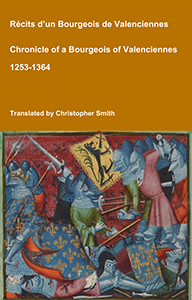
Chronicle of a Bourgeois of Valenciennes
Récits d’un bourgeois de Valenciennes aka The Chronicle of a Bourgeois of Valenciennes is a vivid 14th-century vernacular chronicle written by an anonymous urban chronicler from Valenciennes in the County of Hainaut. It survives in a manuscript that describes local and regional history from about 1253 to 1366, blending chronology, narrative episodes, and eyewitness-style accounts of political, military, and social events in medieval France, Flanders, and the Low Countries. The work begins with a chronological framework of events affecting Valenciennes and its region under rulers such as King Philip VI of France and the shifting allegiances of local nobility. It includes accounts of conflicts, sieges, diplomatic manoeuvres, and the impact of broader struggles like the Hundred Years’ War on urban life in Hainaut. Written from the perspective of a burgher (bourgeois) rather than a monastery or royal court, the chronicle offers a rare lay viewpoint on high politics and warfare, reflecting how merchants, townspeople, and civic institutions experienced the turbulence of the 13th and 14th centuries. Its narrative style combines straightforward reporting of events with moral and civic observations, making it a valuable source for readers interested in medieval urban society, regional politics, and the lived experience of war and governance in pre-modern Europe.
Available at Amazon in eBook and Paperback format.
Before 1399 [his son-in-law] Richard de Vere 11th Earl of Oxford [aged 13] and Alice Holland Countess of Oxford [aged 6] were married. She the daughter of John Holland 1st Duke Exeter [aged 46] and Elizabeth Lancaster Duchess Exeter [aged 35]. He the son of Aubrey de Vere 10th Earl of Oxford [aged 60] and Alice Fitzwalter Countess of Oxford. They were fifth cousins. He a great x 5 grandson of King Henry "Curtmantle" II of England. She a great granddaughter of King Edward III of England.
Around 1399 [his son] Edward Holland was born to John Holland 1st Duke Exeter [aged 47] and [his wife] Elizabeth Lancaster Duchess Exeter [aged 35]. He a great grandson of King Edward III of England.
On 3rd February 1399 [his father-in-law] John of Gaunt 1st Duke Lancaster [aged 58] died at Leicester Castle [Map]. Katherine Swynford aka Roet Duchess Lancaster [aged 48] was by his side. His son [his brother-in-law] Henry [aged 31] succeeded 2nd Duke Lancaster, 7th Earl of Leicester. He was buried in the Choir of St Paul's Cathedral [Map] with his first wife Blanche Duchess of Lancaster.
[his half-brother] King Richard II of England [aged 32] witheld the future Henry IV's inheritance from him giving Henry reason to return to England to claim his lands and titles.
On 16th April 1399 [his half-brother] King Richard II of England [aged 32] wrote his Last Will from which the following extracts are taken … Also we bequeath to our beloved nephew Thomas Holland 1st Duke Surrey [aged 25] ten thousand marks and to our beloved brother Edward 2nd Duke of York 1st Duke Albemarle [aged 26] two thousand marks and to our beloved brother John Holland 1st Duke Exeter [aged 47] three thousand marks and to our faithful and beloved William Scrope 1st Earl Wiltshire [aged 49] two thousand marks... we ordain and set aside for the fulfilment of all and singular the premises the sum of ninety-one thousand marks, of which sixty-five thousand marks are in the keeping of Sir John Ikelyngton and twenty-four thousand marks in the hands and keeping of our dear nephew Thomas Holland 1st Duke Surrey.
Of this our royal testament we nominate make and depute executors the venerable fathers in Christ Bishop Richard Mitford, Bishop Edmund Stafford [aged 55], Bishop Robert Tideman of Winchcombe, Bishop Thomas Merke and Bishop Guy Mone Aka Mohun; our beloved brother Edward 2nd Duke of York 1st Duke Albemarle, our nephew Thomas Holland 1st Duke Surrey, our brother John Holland 1st Duke Exeter and William Scrope 1st Earl Wiltshire to each of whom we bequeath a gold cup of the value of twenty pounds and our beloved and faithful clerks Master Bishop Richard Clifford Keeper of our Privy Seal, Master Richard Maudeleyn, Master William Fereby and Master John Painter Ikelyngton clerks and John Lufwyk and William Serle laymen, to each of whom we will shall be paid their expenses and necessary costs while it shall happen that they or any of them are employed about the execution of our present last will, but according to the discretion of their said co-executors...
Whom all and singular we have charged and charge that they shall do as much as in them is for the due execution and fulfilment of this our last will as they shall wish to answer before God. We create ordain depute and make overseers of this our will the reverend fathers in Christ Archbishop Roger Walden and Archbishop Richard Scrope [aged 49], William bishop of Winchester and William abbot of the monastery of Westminster Edward 2nd Duke of York 1st Duke Albemarle our uncle and Henry Percy 1st Earl of Northumberland [aged 57] our cousin.
Become a Member via our Buy Me a Coffee page to read more.
On 30th September 1399 [his brother-in-law] King Henry IV of England [aged 32] became King of England usurping the throne of his cousin [his half-brother] Richard II [aged 32] and Richard's heir, the seven year old Edmund Mortimer 5th Earl of March [aged 7] who was descended from Edward III's second son Lionel of Antwerp Duke of Clarence. This second usurption was to have far reaching consequences since it subsequently became the descent by which the House of York claimed precedence over the House of Lancaster being one of the causes of the Wars of the Roses. Duke Lancaster, Duke of Hereford, Earl Derby, Earl Lancaster and Earl of Leicester merged with the Crown.
Ralph Neville 1st Earl of Westmoreland [aged 35] was appointed Earl Marshal.
On 17th December 1399 the conspirators met at Abbey House Westminster Abbey [Map] including Thomas Blount [aged 47], Thomas Despencer 1st Earl Gloucester [aged 26], [his nephew] Thomas Holland 1st Duke Surrey [aged 25], John Holland 1st Duke Exeter [aged 47], Ralph Lumley 1st Baron Lumley [aged 39], John Montagu 3rd Earl Salisbury [aged 49], Edward 2nd Duke of York 1st Duke Albemarle [aged 26], Bernard Brocas [aged 45]. They plotted to capture [his brother-in-law] King Henry IV of England [aged 32] at a Tournament in Windsor, Berkshire [Map] on the Feast of Epiphany hence the Epiphany Rising.
On 16th January 1400 John Holland 1st Duke Exeter [aged 48] was executed at Pleshey Castle [Map]. Duke Exeter, Earl Huntingdon forfeit. Joan Fitzalan Countess Essex, Hereford and Northampton [aged 53] arranged for the children of her dead brother Richard Fitzalan 9th Earl of Surrey 4th or 11th Earl of Arundel, who had been executed on the orders of John Holland 1st Duke Exeter three years before, to witness the execution.
After 7th January 1400. [his brother-in-law] Henry IV's [aged 32] Parliament. 2.30. Also, be it remembered that whereas [his nephew] Thomas Holland, formerly earl of Kent [deceased], John Holland, formerly earl of Huntingdon [aged 48], John Montague, formerly earl of Salisbury [deceased], Thomas, formerly Lord Despenser [aged 26], and Ralph Lumley [deceased], knight, recently rose up in various parts of England and rode in warlike manner, treacherously, against our lord the king, contrary to their allegiance, to destroy our said lord the king and other great men of the realm, and to populate the said realm with people of another tongue, they were seized and beheaded in their armed uprising by the loyal lieges of oursaid lord the king; and for that reason all the lords temporal present in parliament, by the assent of the king, declared and adjudged the said Thomas, John, John, Thomas, and Ralph to be traitors for their armed uprising against their aforesaid liege lord, and that they should forfeit as traitors all the lands and tenements that they held in fee simple on 5 January, the eve of the feast of the Epiphany of our lord Jesus Christ, in the first year of the reign of our aforesaid lord [1400], or after, as the law of the land requires, together with all their goods and chattels, notwithstanding the fact that they were killed during the said armed uprising without due process of law.
Chronicle of the Betrayal of Richard II. [15th January 1400]. The Duke of Exeter Earl of Huntingdon [aged 48], King Richard's brother, and Sir Thomas Shelley,1 a worthy knight, who had been his steward of the household, fled into Essex, into a small town where dwelt the Countess of Hereford, the sister of the late Earl of Arundel, who had been beheaded in the great Parliament; and they went to lodge in the house where they had been accustomed to stop when they went that way;2 and the Countess, having received information that the Earl of Hantingdon had arrived, ordered the constable of the town to collect secretly all the townsmen to seize him and all his people, for she wished to take vengeance upon him for the cause of her brother. The constable accordingly did as he was commanded, and captured the Earl of Huntingdon, as well as his knight and his butler, of the name of Hugb Cade. The greater part of the knights and esquires of the Earl's army were taken here and there in different parts of the country, for they did not know which way to turn nor where to go.
Note 1. The Earl of Huntingdon made several attempts to escape with his followcrs by sea to France, But was always driven back by stress of woathcr. (Sir J. Hayward, Life of Henry IV.) Richard had given to Sir Thomas Shelley the goods and chattels of Roger Nele of Toppesham, forfeited to him. (Rot. Pat. 20 Rie. II. p. 1. 23rd Oct.) After his execution, Henry gave the mayor of London two of Sir Thomas Shelley's mantles, with doublets of red velvet, &c. (Rot. Claus. 1 Hen. IV. 14th April.)
Note 2. The Earl was captured at the house of John Pritelwell or Pritewell, at Pritelwell, Essex, on the Thames, and was thence taken by the people of the country to the Countess of Hereford at Pleshey. (See Appendix A.) Walsingham says, he was taken on the festival of St. Maur (Jan. 15th) towards evening. It does not appear whether the Countess had Henry's order for the exécution of the Earl. Sir Harris Nicolas quotes William of Malmesbury to prove that the ancient Earls had a power of legislation within their counties (Life of Chaucer, i. 157); and as late as the reign of Henry the Sixth we find the great Earls beheadiug prisoners taken in battle. But an order of council was issued by Henry to stop such irregular proceediugs,and to bring the parties offending to justice. The following is the reason stated: "Considering that the commons of the country, on account of the destruction of the Earls of Kent, of Salisbury, and of Huntingdon, and of the Lord le Despencer, and other traitors to the King, have become so proud, that they fear not to put to death of their own will many of the King's lieges without process of law." (Minutes of Council, Feb. 1400.) Henry gave the goods and chattels of the Earl to Richard Spicer of Plymoulh, and others. (Rot. Claus. 30th INLir. 1 Hen. IV.) No less than eleven commissioners were appointed to take into the King's lands the property of the Earls of Kent and Salisbury, Sir Ralph Lunley, and Sir Thomas Blount. (Pell of Issue Rolls, Jan, 1400.)
Become a Member via our Buy Me a Coffee page to read more.
Chronicle of the Betrayal of Richard II. [After 15th January 1400]. The Countess [aged 53]1 sent a letter to King Henry to acquaint him that she had seized the Earl of Huntingdon [aged 48], and to beg him to send his cousin of Arundel to take vengeance upon him for the death of his father, for she was determined to have him drawn and hung. Then the King sent the Earl of Arundel thither, and said, "Cousin, go to your aunt, and fetch the prisoners dead or alive." When the Earl of Arundel arrived at the town where the Earl of Huntingdon was taken, he found there his aunt, and eight thousand or more of the villeins of the country, before whom his aunt had led forth the Earl of Huntingdon to put him to death; and there was not one of the villeins present who did not take compassion on him.
Note 1. Joan, widow of Humphrey de Bohun Earl of Hereford, Lord Constable of England, mother of Mary de Bohun, the first wife of Henry IV, who died in 1394. This extraordinary woman, sister to the Earl of Arundel executed by [his half-brother] Richard [aged 33], and to the Archbishop of Canterbury [aged 47] whom he had banished, and mother to Aleanora Duchess of Gloucester, was completely identified by all the ties of relationship with Henry and his party. Imbued with the feelings of chivalry, she, like our Queen Philippa, the Countess of Salisbury, and some others, was equal, in case of emergency, to daring exploits at the heads of armies. (See Froissart, i. 77, 81, 134,137, 139.) Humanity, in its nobler meauing, was, however, without the circle of the sympathies of chivalry. She appears to have acted a mother's part to Henry's children after they had lost their natural protector. Henry V. bequeathed to Thomas Bishop of Durham 'the missal and portophoriuin which we had of the gift of our dear grandmother the Countess of Hereford.' He also bequeathed her 'a gold cyphus.' But she did not survive him. She died on the 7th of April 1416. [Note. Most sources give her death in 1419.]
Accounts and Extracts. 16th January 1400. The earl of Huntingdon [aged 48], the king's [half] brother, fled into the county of Essex; but passing through a small village belonging to the countess of Hereford [aged 53], sister to the late earl of Arundel, he was known and arrested. The countess sent news of it to king Henry, desiring him to send her the young earl of Arundel [aged 18], her nephew, that he might enjoy the vengeance she was going to take on the man to whose counsels she principally attributed the death of her brother; which, it appears, she should rather have imputed to the treachery of the earl of Nottingham. The young Arundel hastened thither, and loaded Huntingdon with reproaches. The countess had assembled her vassals, to the number of eight thousand, and delivered to them the earl of Huntingdon in chains, ordering them to cut him in pieces. The unfortunate man entreated for mercy, alledging, that he had never done them any injury; and all took great pity on him except the countess (of Hereford) and the earl of Arundel. The countess flew into a passion, exclaiming, "Curse on you all, villains! you have not the courage to put a man to death."
An esquire offering himself for this purpose, advanced with his hatchet in his hand; but he was so touched with the tender complaints of Huntingdon, that be trembled for fear, and returned to the countess with tears, saying, "Madam, I would not put the duke to death for all the gold in the world." — "Then," said she, "do what thou hast promised, or thy own head shall be cut off." When he heard this, he was so afraid, that he knew not what to do, and faid, "Sir, I entreat your pardon; forgive me your death." He then lifted his hatchet, and struck him so hard on the shoulder, that he made him fall with his face to the ground: The noble duke (Huntingdon had been created duke of Exeter by Richard) leaped on his feet, saying, "Alas, man! why do you treat me thus? For God's fake, kill me more easily." He then gave him eight blows on the shoulder, for he could neither hit his neck or his head; the ninth stroke was in the neck: and the worthy duke, brother to the noble king Richard, spoke yet, saying, "Alas, dear friend! have pity on me, and free me from my pain." The executioner then cut his throat with a knife, to separate his head from his body; and in this manner was the noble duke put to death.'
Become a Member via our Buy Me a Coffee page to read more.
In 1400 John Cornwall 1st Baron Fanhope 1st Baron Milbroke [aged 36] and [his wife] Elizabeth Lancaster Duchess Exeter [aged 36] were married. She the daughter of [his father-in-law] John of Gaunt 1st Duke Lancaster and Blanche Duchess of Lancaster. They were fourth cousin once removed. He a great x 3 grandson of King John of England. She a granddaughter of King Edward III of England.
On 24th November 1426 [his former wife] Elizabeth Lancaster Duchess Exeter [aged 63] died. She was buried at St Mary's Church, Burford [Map].


Parliament Rolls Richard II. 27. Be it remembered that the venerable father Thomas, archbishop of Canterbury, primate of all England, earnestly prayed to the lord king in the present parliament that whereas his church of Canterbury, by the gift and grant of his noble and holy progenitors, which the same king graciously confirmed, had such prerogative over the other churches of England that whatsoever archbishop of Canterbury for the time being had custody of all lordships, manors, tenements, and rents with appurtenances which were held of the same church in chief during the minority of the heirs of their tenants, even though the same tenants elsewhere held in chief of the lord king; and now concerning the castle and manor of Tonbridge, Kent [Map], which by virtue of this prerogative were in the custody of William de Courtenay, late archbishop of Canterbury now deceased, predecessor of the present archbishop, on the day on which he died, by reason of the minority of the heir of the earl of Stafford deceased, who held the aforesaid castle and manor from the aforesaid former archbishop in chief, dispute and controversy between the present archbishop and the executors of the will of the aforesaid late archbishop are pending at present. And whereas a certain composition was drawn up a short while ago between the archbishop of Canterbury and the prior and chapter of the church of Canterbury on the matter, it pleased the lord king, having inspected and examined that composition, to order a view and settlement of the matter for the peace and right of his said church of Canterbury, as should seem best to his royal majesty, to whose ordinance and decree on the foregoing the same archbishop proclaimed himself to be firmly obedient in all things, whereupon the same lord king immediately appointed the venerable fathers Robert archbishop of York, Robert Bishop of London and John Bishop of Ely, and John duke of Aquitaine and Lancaster, and John Earl of Huntingdon, and Thomas the earl marshal, to inspect and examine that composition, and further to discuss and settle the matter at their discretion, and fully to inform the lord king of what their deed and action should be. And later on Monday, the last day of the aforesaid parliament [10 February 1397], the archbishop of York, and the bishops, and the aforesaid duke and earls thus appointed by order of the lord king in the same parliament returned their decree and ordinance on the aforesaid matter by Walter Clopton, the lord king's justice, in this form - namely, that the third part of all manors, lands, and tenements of the inheritance of the aforesaid heir, and the issues, profits, and revenues of the same from the time of the death of the aforesaid late archbishop, should, according to the form of the aforesaid composition, remain and be in the hands of the aforesaid prior and chapter, to be used for their own purposes; and that two parts of the aforesaid lands and tenements, with the issues, profits, and revenues of the same two parts, should remain likewise in the hands of that prior and chapter, safely and securely to keep until the lord king shall have ordained to whom those said two parts of the issues, profits, and revenues shall be delivered and has declared his will thereon. And the castle of Tonbridge [Map] will be delivered to the aforesaid present archbishop of Canterbury without delay, to remain in his hands and keeping until the the coming of age of the aforesaid heir. The which ordinance and decree thus rendered by the archbishop of York, bishops, duke and earls, the aforesaid lord king, approving thereof, ordered to be placed on record on the roll of parliament at the request of the aforesaid present archbishop of Canterbury.
Become a Member via our Buy Me a Coffee page to read more.
Henrici Quinti, Angliæ Regis, Gesta, is a first-hand account of the Agincourt Campaign, and subsequent events to his death in 1422. The author of the first part was a Chaplain in King Henry's retinue who was present from King Henry's departure at Southampton in 1415, at the siege of Harfleur, the battle of Agincourt, and the celebrations on King Henry's return to London. The second part, by another writer, relates the events that took place including the negotiations at Troye, Henry's marriage and his death in 1422.
Available at Amazon in eBook and Paperback format.
Archaeologia Volume 29 Section III. THE BADGE OF THE WHITE HART was the most favourite device of King Richard, and it was that which he used for the cognizance which was profusely distributed among his courtiers and immediate dependants. It has been suggested with much apparent probability that he adopted it from the White Hind which is stated to have been borne by his mother the Fair Maid of Kenti, and which was certainly used by the Holands, the sons of her first marriagek [Thomas Holland 2nd Earl Kent and John Holland 1st Duke Exeter]. "The author of the Alliterative Poem, which has been edited by Mr. Wright for the Camden Society, reproaching the unfortunate Richard, reminds him that
First at your anointing all were your own,
Both Harts and Hinds, and held of none other.
Note i. "The bagens that he [the King] beareth by the Faire Maide of Kent, is a Whyte Hynde." Collectanea Top. et Geneal. vol. iii. p. 56, from MS. Harl. 4632, written in the time of Henry VIII.; but the same MS. attributes the White Hind to Queen Philippa (Ibid. p. 53.), and so does the MS. L. 14, in Coll. Arm. f. 27, b.
Note k. In Sandford's Genealogical History, 1677, p. 124, will be seen the seal of Thomas de Holand, Earl of Kent, where his shield is suspended from the neck of a Hind, lodged or seated, and collared with a coronet.
Parliament Rolls Richard II. 31. Whereupon the said Sir John was brought before the king in parliament between two earls, namely Huntingdon and the marshal, dressed in a cloth as a dress of honour, and his sword carried before him, the hilt uppermost. And then the king's charter of the said creation was read aloud before the king, lords, and commons in parliament. And afterwards the [his half-brother] king himself girded the said earl with his sword and took his homage, and caused him to sit in his place in parliament, that is to say, between the earls marshal and Warwick. The tenor of which charter follows:
Kings Wessex: Great x 9 Grand Son of King Edmund "Ironside" I of England
Kings Gwynedd: Great x 6 Grand Son of Owain "Great" King Gwynedd
Kings Seisyllwg: Great x 12 Grand Son of Hywel "Dda aka Good" King Seisyllwg King Deheubarth
Kings Powys: Great x 7 Grand Son of Maredudd ap Bleddyn King Powys
Kings England: Great Grand Son of King Edward I of England
Kings Scotland: Great x 8 Grand Son of King Duncan I of Scotland
Kings Franks: Great x 16 Grand Son of Charles "Charlemagne aka Great" King of the Franks King Lombardy Holy Roman Emperor
Kings France: Great x 10 Grand Son of Hugh I King of the Franks
Kings Duke Aquitaine: Great x 13 Grand Son of Ranulf I Duke Aquitaine
Great x 2 Grandfather: Thurstan de Holland 
Great x 1 Grandfather: Robert de Holand of Upholland 
GrandFather: Robert Holland 1st Baron Holand
Father: Thomas Holland 1st Earl Kent 4 x Great Grand Son of King Henry "Curtmantle" II of England
Great x 4 Grandfather: Roger Zouche 
Great x 3 Grandfather: Alan Zouche
Great x 4 Grandmother: Margaret Bisset
Great x 2 Grandfather: Roger Zouche 6 x Great Grand Son of King Henry I "Beauclerc" England
Great x 4 Grandfather: Roger de Quincy 2nd Earl Winchester
Great x 3 Grandmother: Helen or Ela Quincy 5 x Great Grand Daughter of King Henry I "Beauclerc" England
Great x 4 Grandmother: Helen Galloway Countess Winchester 4 x Great Grand Daughter of King Henry I "Beauclerc" England
Great x 1 Grandfather: Alan Zouche 1st Baron Zouche Ashby 2 x Great Grand Son of King Henry "Curtmantle" II of England
Great x 4 Grandfather: William Longespée Earl Salisbury  Son of King Henry "Curtmantle" II of England
Great x 3 Grandfather: Stephen Longespée Grand Son of King Henry "Curtmantle" II of England
Great x 4 Grandmother: Ela of Salisbury 3rd Countess of Salisbury
Great x 2 Grandmother: Ela Longespée Great Grand Daughter of King Henry "Curtmantle" II of England
Great x 4 Grandfather: Walter Riddlesford
Great x 3 Grandmother: Emmeline Riddlesford
GrandMother: Maud Zouche Baroness Holand 3 x Great Grand Daughter of King Henry "Curtmantle" II of England
Great x 4 Grandfather: Stephen Segrave 
Great x 3 Grandfather: Gilbert Segrave
Great x 4 Grandmother: Rohese Despencer 
Great x 2 Grandfather: Nicholas Segrave 1st Baron Segrave
Great x 1 Grandmother: Eleanor Segrave
Great x 3 Grandfather: Geoffrey de Lucy of Newington in Kent 
Great x 2 Grandmother: Maud de Lucy
Great x 4 Grandfather: William Cantilupe 
Great x 3 Grandmother: Nichole Cantilupe
John Holland 1st Duke Exeter Great Grand Son of King Edward I of England
Great x 4 Grandfather: King Henry "Curtmantle" II of England Grand Son of King Henry I "Beauclerc" England
Great x 3 Grandfather: King John of England Son of King Henry "Curtmantle" II of England
Great x 4 Grandmother: Eleanor of Aquitaine Queen Consort Franks and England
Great x 2 Grandfather: King Henry III of England Son of King John of England
Great x 4 Grandfather: Aymer Angoulême I Count Angoulême
Great x 3 Grandmother: Isabella of Angoulême Queen Consort England
Great x 4 Grandmother: Alice Courtenay Countess Angoulême 
Great x 1 Grandfather: King Edward I of England Son of King Henry III of England
Great x 4 Grandfather: Alfonso Barcelona II Count Provence 
Great x 3 Grandfather: Raymond IV Count Provence
Great x 4 Grandmother: Gersenda II Sabran Countess Provence
Great x 2 Grandmother: Eleanor of Provence Queen Consort England
Great x 4 Grandfather: Thomas Savoy I Count Savoy
Great x 3 Grandmother: Beatrice Savoy Countess Provence
Great x 4 Grandmother: Margaret Geneva Countess Savoy
GrandFather: Edmund of Woodstock 1st Earl Kent Son of King Edward I of England
Great x 4 Grandfather: King Louis VIII of France 3 x Great Grand Son of King William "Conqueror" I of England
Great x 3 Grandfather: King Louis IX of France Great Grand Son of King Henry "Curtmantle" II of England
Great x 4 Grandmother: Blanche Ivrea Queen Consort France  Grand Daughter of King Henry "Curtmantle" II of England
Great x 2 Grandfather: King Philip III of France 2 x Great Grand Son of King Henry "Curtmantle" II of England
Great x 4 Grandfather: Raymond IV Count Provence
Great x 3 Grandmother: Margaret Provence Queen Consort France
Great x 4 Grandmother: Beatrice Savoy Countess Provence
Great x 1 Grandmother: Margaret of France Queen Consort England 3 x Great Grand Daughter of King Henry "Curtmantle" II of England
Great x 4 Grandfather: Henry Reginar II Duke Brabant Great Grand Son of King Stephen I England
Great x 3 Grandfather: Henry Reginar III Duke Brabant 2 x Great Grand Son of King Stephen I England
Great x 4 Grandmother: Marie Swabia Duchess Brabant
Great x 2 Grandmother: Maria of Brabant Queen Consort France 3 x Great Grand Daughter of King Stephen I England
Great x 4 Grandfather: Hugh IV Duke Burgundy 4 x Great Grand Son of King William "Conqueror" I of England
Great x 3 Grandmother: Adelaide Burgundy Duchess Brabant 5 x Great Grand Daughter of King William "Conqueror" I of England
Great x 4 Grandmother: Yolande Capet Duchess Burgundy
Mother: Joan "Fair Maid of Kent" Princess Wales Grand Daughter of King Edward I of England
Great x 3 Grandfather: Hugh Wake 
Great x 2 Grandfather: Baldwin Wake
Great x 4 Grandfather: Nicholas Stuteville
Great x 3 Grandmother: Joan Stuteville
Great x 1 Grandfather: John Wake 1st Baron Wake of Liddell 2 x Great Grand Son of King John of England
Great x 4 Grandfather: Saer Quincy 1st Earl Winchester
Great x 3 Grandfather: Robert Quincy
Great x 4 Grandmother: Margaret Beaumont Countess Winchester 
Great x 2 Grandmother: Hawise Quincy Great Grand Daughter of King John of England
Great x 4 Grandfather: Llewellyn "The Great" Aberffraw
Great x 3 Grandmother: Elen ferch Llewellyn Aberffraw Countess Huntingdon and Mar Grand Daughter of King John of England
Great x 4 Grandmother: Joan Plantagenet Daughter of King John of England
GrandMother: Margaret Wake Countess Kent 3 x Great Grand Daughter of King John of England
Great x 4 Grandfather: William Fiennes 
Great x 3 Grandfather: Enguerrand Ingleram Fiennes
Great x 4 Grandmother: Agnes Dammartin
Great x 2 Grandfather: William Fiennes
Great x 3 Grandmother: Isabel Provence 
Great x 1 Grandmother: Joan Fiennes Baroness Wake Liddell 4 x Great Grand Daughter of King Henry "Curtmantle" II of England
Great x 4 Grandfather: John de Brienne I King Jerusalem
Great x 3 Grandfather: John Beaumont 2 x Great Grand Son of King Henry "Curtmantle" II of England
Great x 4 Grandmother: Beregaria Ivrea Great Grand Daughter of King Henry "Curtmantle" II of England
Great x 2 Grandmother: Blanche Beaumont 3 x Great Grand Daughter of King Henry "Curtmantle" II of England
Great x 4 Grandfather: Geoffrey Chateaudun VI Viscount Châteaudun
Great x 3 Grandmother: Jeanne Chateaudun
Great x 4 Grandmother: Clemence Roches Countess Blois