

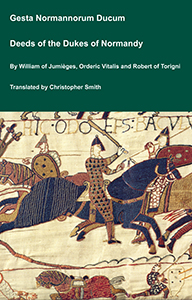
The Deeds of the Dukes of Normandy
The Gesta Normannorum Ducum [The Deeds of the Dukes of Normandy] is a landmark medieval chronicle tracing the rise and fall of the Norman dynasty from its early roots through the pivotal events surrounding the Norman Conquest of England. Originally penned in Latin by the monk William of Jumièges shortly before 1060 and later expanded at the behest of William the Conqueror, the work chronicles the deeds, politics, battles, and leadership of the Norman dukes, especially William’s own claim to the English throne. The narrative combines earlier historical sources with firsthand information and oral testimony to present an authoritative account of Normandy’s transformation from a Viking settlement into one of medieval Europe’s most powerful realms. William’s history emphasizes the legitimacy, military prowess, and governance of the Norman line, framing their expansion, including the conquest of England, as both divinely sanctioned and noble in purpose. Later chroniclers such as Orderic Vitalis and Robert of Torigni continued the history, extending the coverage into the 12th century, providing broader context on ducal rule and its impact. Today this classic work remains a foundational source for understanding Norman identity, medieval statesmanship, and the historical forces that reshaped England and Western Europe between 800AD and 1100AD.
Available at Amazon in eBook and Paperback format.
In 1215 Roger Leybourne was born.
Around 1242 [his son] William Leybourne 1st Baron Leybourne was born to Roger Leybourne [aged 27]. He married on or before 16th October 1265 Juliana de Sandwich and had issue.
In 1250 William Vaux [aged 35] and [his future wife] Eleanor Ferrers Countess Winchester [aged 14] were married. The difference in their ages was 21 years. She the daughter of William Ferrers 5th Earl of Derby [aged 57] and [his future mother-in-law] Sibyl Marshal [aged 49].
In 1252 Roger Leybourne [aged 37] took the cross to atone for having killed Arnulf de Munteny, one of the king's household knights, in a jousting tournament with a sharpened lance, avenging himself of an injury caused by Arnulf in a previous tournament. He was pardoned by King Henry III of England [aged 44].
In 1252 Roger de Quincy 2nd Earl Winchester [aged 57] and [his future wife] Eleanor Ferrers Countess Winchester [aged 16] were married. She by marriage Countess Winchester. The difference in their ages was 41 years. She the daughter of William Ferrers 5th Earl of Derby [aged 59] and [his future mother-in-law] Sibyl Marshal [aged 51]. He the son of Saer Quincy 1st Earl Winchester and Margaret Beaumont Countess Winchester. They were third cousin once removed. She a great x 4 granddaughter of King Henry I "Beauclerc" England.
In September 1263 Roger Leybourne [aged 48] was appointed Lord High Steward.
In December 1263 Roger Leybourne [aged 48] was appointed Keeper Kent Surrey and Sussex, Warden of the Cinque Ports and High Sheriff of Kent.
On 6th April 1264 the future King Edward I of England [aged 24], Philip Marmion 5th Baron Marmion [aged 30] and Roger Leybourne [aged 49] fought for the King at Northampton Castle [Map] during the Battle of Northampton. Simon de Montfort 6th Earl of Leicester 1st Earl Chester [aged 56] fought for the rebels with his son Simon "Younger" Montfort [aged 24] who was captured.
On 14th May 1264 the army of Simon de Montfort 6th Earl of Leicester 1st Earl Chester [aged 56] including Gilbert "Red Earl" Clare 7th Earl Gloucester 6th Earl Hertford [aged 20], Henry Hastings [aged 29] and Nicholas Segrave 1st Baron Segrave [aged 26] defeated the army of King Henry III of England [aged 56] during the Battle of Lewes at Lewes [Map].
King Henry III of England, his son, the future, King Edward I of England [aged 24], Humphrey Bohun 2nd Earl Hereford 1st Earl Essex [aged 60], Richard of Cornwall 1st Earl Cornwall [aged 55], John "Red" Comyn 1st Lord Baddenoch [aged 44], Philip Marmion 5th Baron Marmion [aged 30] and John Giffard 1st Baron Giffard Brimpsfield [aged 32] were captured. John Warenne 6th Earl of Surrey [aged 33], John Balliol [aged 56], Robert Bruce 5th Lord Annandale [aged 49], Roger Leybourne [aged 49] and William de Valence 1st Earl Pembroke fought for the King. Guy Lusignan was killed. Fulk IV Fitzwarin [aged 44] drowned. Bishop Walter de Cantelupe [aged 73] was present and blessed the Montfort army before the battle.
On 28th May 1265 King Edward I of England [aged 25], with the help of Roger Leybourne [aged 50], escaped from Kenilworth Castle [Map] whilst on a hunting trip. He had been held there as a hostage following the Battle of Lewes as a condition of the Mise of Lewes (the now lost peace treaty).
On 4th August 1265 the army loyal to King Henry III of England [aged 57], led by his son the future King Edward I of England [aged 26], supported by Gilbert "Red Earl" Clare 7th Earl Gloucester 6th Earl Hertford [aged 21], Warin Basingburne and John Giffard 1st Baron Giffard Brimpsfield [aged 33] defeated the rebel army of Simon de Montfort 6th Earl of Leicester 1st Earl Chester [aged 57] at the Battle of Evesham.
Roger Leybourne [aged 50] fought and reputedly saved the King's life.
Adam Mohaut rescued the King.
Alan de Plugenet of Kilpec fought for the King.
Simon de Montfort 6th Earl of Leicester 1st Earl Chester was killed. Earl of Leicester, Earl Chester forfeit. His son Henry Montfort [aged 26] was also killed.
Hugh Despencer [aged 41] was killed by Roger Mortimer 1st Baron Mortimer of Wigmore [aged 34]. Baron Despencer extinct. It may not have been created as a hereditary barony.
Simon Beauchamp [aged 31], Ralph Basset [aged 50], William Devereux [aged 46], Hugh Troyes, Richard Trussel, Peter Montfort [aged 60], William Mandeville, William Crepping, William Birmingham, Guy Balliol and Thomas Astley [aged 50] were killed. Henry Hastings [aged 30], Humphrey Bohun [aged 44], Nicholas Segrave 1st Baron Segrave [aged 27], John Vesci, John Fitzjohn and Guy Montfort Count Nola [aged 21] were captured.
John Vesci was wounded and taken prisoner.
 Become a Member via our Buy Me a Coffee page to read more.
After 4th August 1265 Roger Leybourne [aged 50] was appointed Keeper Westmoreland.
In October 1265 Roger Leybourne [aged 50] was appointed Governor of Carlisle Castle and High Sheriff of Cumberland.
Henrici Quinti, Angliæ Regis, Gesta, is a first-hand account of the Agincourt Campaign, and subsequent events to his death in 1422. The author of the first part was a Chaplain in King Henry's retinue who was present from King Henry's departure at Southampton in 1415, at the siege of Harfleur, the battle of Agincourt, and the celebrations on King Henry's return to London. The second part, by another writer, relates the events that took place including the negotiations at Troye, Henry's marriage and his death in 1422.
Available at Amazon in eBook and Paperback format.
On or before 16th October 1265 [his son] William Leybourne 1st Baron Leybourne [aged 23] and [his daughter-in-law] Juliana de Sandwich [aged 20] were married.
In January 1266 Roger Leybourne [aged 51] was captured at Sandwich, Kent [Map].
In September 1266 Roger Leybourne [aged 51] was knighted and was appointed Constable of Nottingham Castle.
Before 20th March 1267 [his son] Roger Leybourne and [his daughter-in-law] Idoine Vipont [aged 8] were married.
Before 8th September 1267 Roger Leybourne [aged 52] and Eleanor Ferrers Countess Winchester [aged 31] were married. The difference in their ages was 21 years. She the daughter of William Ferrers 5th Earl of Derby and Sibyl Marshal [aged 66].
In 1269 Roger Leybourne [aged 54] took the cross and went on a second pilgrimage.
On 26th June 1269 [his brother-in-law] Robert Ferrers 6th Earl of Derby [aged 30] and Eleanor Bohun Countess Derby [aged 26] were married. She by marriage Countess Derby. He the son of William Ferrers 5th Earl of Derby and Margaret Quincy Countess Derby. They were third cousin once removed. He a great x 4 grandson of King Henry I "Beauclerc" England.
On 29th November 1269 Roger Leybourne [aged 54] was appointed Lieutenant Gascony.
On 7th November 1271 Roger Leybourne [aged 56] died.
On 16th October 1274 [his former wife] Eleanor Ferrers Countess Winchester [aged 38] died.
The History of William Marshal was commissioned by his son shortly after William’s death in 1219 to celebrate the Marshal’s remarkable life; it is an authentic, contemporary voice. The manuscript was discovered in 1861 by French historian Paul Meyer. Meyer published the manuscript in its original Anglo-French in 1891 in two books. This book is a line by line translation of the first of Meyer’s books; lines 1-10152. Book 1 of the History begins in 1139 and ends in 1194. It describes the events of the Anarchy, the role of William’s father John, John’s marriages, William’s childhood, his role as a hostage at the siege of Newbury, his injury and imprisonment in Poitou where he met Eleanor of Aquitaine and his life as a knight errant. It continues with the accusation against him of an improper relationship with Margaret, wife of Henry the Young King, his exile, and return, the death of Henry the Young King, the rebellion of Richard, the future King Richard I, war with France, the death of King Henry II, and the capture of King Richard, and the rebellion of John, the future King John. It ends with the release of King Richard and the death of John Marshal.
Available at Amazon in eBook and Paperback format.
7xC9gnHc[his son] Roger Leybourne was born to Roger Leybourne. He married before 20th March 1267 Idoine Vipont.