

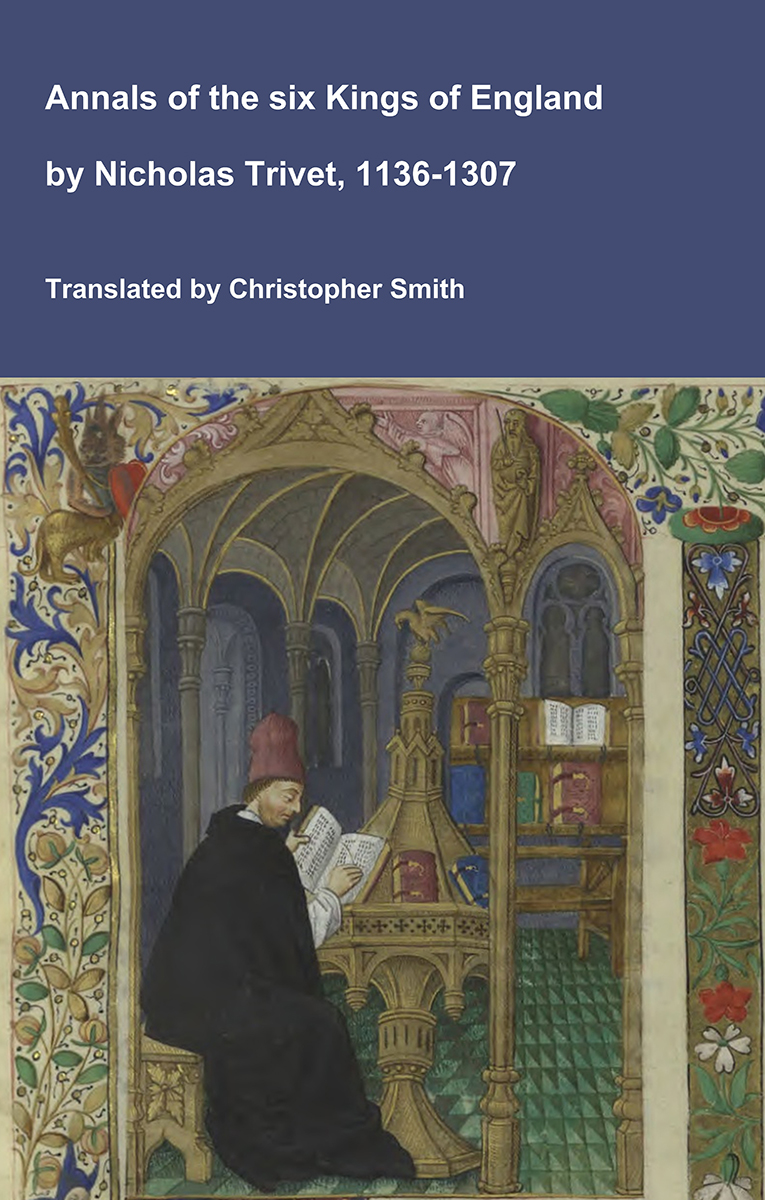
Annals of the six Kings of England by Nicholas Trivet
Translation of the Annals of the Six Kings of England by that traces the rise and rule of the Angevin aka Plantagenet dynasty from the mid-12th to early 14th century. Written by the Dominican scholar Nicholas Trivet, the work offers a vivid account of English history from the reign of King Stephen through to the death of King Edward I, blending political narrative with moral reflection. Covering the reigns of six monarchs—from Stephen to Edward I—the chronicle explores royal authority, rebellion, war, and the shifting balance between crown, church, and nobility. Trivet provides detailed insight into defining moments such as baronial conflicts, Anglo-French rivalry, and the consolidation of royal power under Edward I, whose reign he describes with particular immediacy. The Annals combines careful year-by-year reporting with thoughtful interpretation, presenting history not merely as a sequence of events but as a moral and political lesson. Ideal for readers interested in medieval history, kingship, and the origins of the English state, this chronicle remains a valuable and accessible window into the turbulent world of the Plantagenet kings.
Available at Amazon in eBook and Paperback format.
On 1st November 1254 [his father] King Edward I of England and Eleanor of Castile Queen Consort England were married at Abbey of Santa Maria la Real de Huelgas. She the daughter of Ferdinand III King Castile III King Leon and Joan Dammartin Queen Consort Castile and Leon. He the son of [his grandfather] King Henry III of England and [his grandmother] Eleanor of Provence Queen Consort England.
On 10th September 1299 [his father] King Edward I of England and [his mother] Margaret of France Queen Consort England were married at Canterbury Cathedral. She by marriage Queen Consort England. The difference in their ages was 39 years. She the daughter of [his grandfather] King Philip III of France and [his grandmother] Maria of Brabant Queen Consort France. He the son of King Henry III of England and Eleanor of Provence Queen Consort England.
Guy Beauchamp 10th Earl Warwick was present.
On 1st June 1300 Thomas of Brotherton 1st Earl Norfolk was born to [his father] King Edward I of England and [his mother] Margaret of France Queen Consort England at Brotherton.
On 25th September 1300 Edmund "Almain" 2nd Earl Cornwall died. Earl Cornwall extinct. He was buried, heart and flesh, at Ashridge, Hertfordshire. His bones were interred at Hailes Abbey during a service attended by [his father] King Edward I of England.
On 7th February 1301 [his half-brother] King Edward II of England was created Prince of Wales by his father King Edward I of England; the first English heir to receive the title. He was created 1st Earl Chester the same day.
On 14th November 1302 [his brother-in-law] Humphrey Bohun 4th Earl Hereford 3rd Earl Essex and [his half-sister] Princess Elizabeth of Rhuddlan Countess Essex, Hereford and Holland were married. She by marriage Countess Essex, Countess Hereford. Westminster Abbey. She the daughter of [his father] King Edward I of England and Eleanor of Castile Queen Consort England. He the son of Humphrey Bohun 3rd Earl Hereford 2nd Earl Essex and Maud Fiennes Countess Essex and Hereford.
Before 12th December 1306 Roger Bigod 5th Earl Norfolk died. Earl Norfolk extinct. In 1302 Roger Bigod 5th Earl Norfolk had surrendered his Earldom to [his father] King Edward I and was recreated Earl Norfolk with the remainder "to the heirs of his body" effectively disinheriting his brother John Bigod. Its not clear why he did so.
On 23rd April 1307 [his half-sister] Joan of Acre Countess Gloucester and Hertford died at Clare, Suffolk.
On 7th July 1307 [his father] King Edward I of England died at Burgh by Sands whilst on his way north to Scotland. [his half-brother] King Edward II of England succeeded II King of England. Earl Chester merged with the Crown.
Edward had gathered around him Thomas Plantagenet 2nd Earl of Leicester, 2nd Earl Lancaster, Earl of Salisbury and Lincoln, Guy Beauchamp 10th Earl Warwick, Aymer de Valence 2nd Earl Pembroke and Robert Clifford 1st Baron Clifford and charged them with looking after his son in particular ensuring Piers Gaveston 1st Earl Cornwall didn't return from exile.
On 6th August 1307 Piers Gaveston 1st Earl Cornwall was created 1st Earl Cornwall by [his half-brother] King Edward II of England; Earl Cornwall usually reserved for the heir. The earldom gave Gaveston substantial landholdings over great parts of England, to the value of £4,000 a year. These possessions consisted of most of Cornwall, as well as parts of Devonshire in the south-west, land in Berkshire and Oxfordshire centred on the honour of Wallingford, most of the eastern part of Lincolnshire, and the honour of Knaresborough in Yorkshire, with the territories that belonged to it.
On 2nd November 1307 Piers Gaveston 1st Earl Cornwall and [his niece] Margaret Clare Countess Gloucester were married. Arranged by [his half-brother] King Edward II of England. Margaret Clare Countess Gloucester grand-daughter of Edward I through his daughter [his half-sister] Joan and, as such, significantly higher than Gaveston in the nobility. She the daughter of [his former brother-in-law] Gilbert "Red Earl" Clare 7th Earl Gloucester 6th Earl Hertford and Joan of Acre Countess Gloucester and Hertford.
On 28th January 1308 [his half-brother] King Edward II of England and [his sister-in-law] Isabella of France Queen Consort England were married at Boulogne sur Mer. She the daughter of [his uncle] King Philip IV of France and Joan Blois I Queen Navarre. He the son of [his father] King Edward I of England and Eleanor of Castile Queen Consort England.
On 25th February 1308 [his half-brother] King Edward II of England was crowned II King of England at Westminster Abbey by Henry Woodlock, Bishop of Winchester. [his sister-in-law] Isabella of France Queen Consort England was crowned Queen Consort England.
Piers Gaveston 1st Earl Cornwall carried the Royal Crown.
William Marshal 1st Baron Marshal carried the Gilt Spurs.
[his brother-in-law] Humphrey Bohun 4th Earl Hereford 3rd Earl Essex carried the Royal Sceptre.
Edmund Fitzalan 2nd or 9th Earl of Arundel was Chief Butler, a heriditary office.
Henry Plantagenet 3rd Earl of Leicester 3rd Earl Lancaster carried the Royal Rod.
Thomas Plantagenet 2nd Earl of Leicester, 2nd Earl Lancaster, Earl of Salisbury and Lincoln carried the sword Curtana.
Roger Mortimer 1st Earl March carried the table bearing the Royal Robes.
Thomas Grey and Robert Fitzwalter 1st Baron Fitzwalter attended.
On 29th September 1308 (possibly 30th) in a Siblings Marriage de Clare siblings married de Burgh siblings at Waltham Abbey, Essex in the presence of [his half-brother] King Edward II of England.
John Burgh and [his niece] Elizabeth Clare Lady Verdun were married. She the daughter of [his former brother-in-law] Gilbert "Red Earl" Clare 7th Earl Gloucester 6th Earl Hertford and [his half-sister] Joan of Acre Countess Gloucester and Hertford. He the son of Richard "Red Earl" Burgh 2nd Earl of Ulster and Margaret Burgh Countess Ulster.
[his nephew] Gilbert de Clare 8th Earl Gloucester 7th Earl Hertford and Matilda Burgh Countess Gloucester and Hertford were married. She by marriage Countess Gloucester, Countess Hertford. She the daughter of Richard "Red Earl" Burgh 2nd Earl of Ulster and Margaret Burgh Countess Ulster. He the son of Gilbert "Red Earl" Clare 7th Earl Gloucester 6th Earl Hertford and Joan of Acre Countess Gloucester and Hertford.
In 1312 Thomas of Brotherton 1st Earl Norfolk was created 1st Earl Norfolk.
On 24th June 1314 the Scottish army of King Robert the Bruce I of Scotland including, James "Black" Douglas, heavily defeated the English army led by [his half-brother] King Edward II of England at the Battle of Bannockburn.
[his nephew] Gilbert de Clare 8th Earl Gloucester 7th Earl Hertford was killed. Earl Gloucester, Earl Hertford extinct.
John Comyn 4th Lord Baddenoch, Robert Felton 1st Baron Felton and William Vesci were killed.
William Marshal 1st Baron Marshal was killed. John Marshal 2nd Baron Marshal succeeded 2nd Baron Marshal.
Robert Clifford 1st Baron Clifford was killed. Roger Clifford 2nd Baron Clifford succeeded 2nd Baron de Clifford.
John Lovell 2nd Baron Lovel was killed. John Lovell 3rd Baron Lovel succeeded 3rd Baron Lovel of Titchmarsh.
Henry Bohun was killed by King Robert the Bruce I of Scotland. He was buried in Llanthony Secunda Priory, Gloucestershire.
Walter Fauconberg 2nd Baron Fauconberg possilby died although his death is also reported as being on 31 Dec 1318.
Bartholomew Badlesmere 1st Baron Badlesmere, [his brother-in-law] Humphrey Bohun 4th Earl Hereford 3rd Earl Essex, Goronwy ap Tudur Hen Tudor, Henry Beaumont Earl Buchan, Aymer de Valence 2nd Earl Pembroke and Robert Umfraville 8th Earl Angus fought.
Pain Tiptoft 1st Baron Tibetot was killed. John Tiptoft 2nd Baron Tibetot succeeded 2nd Baron Tibetot.
John Montfort 2nd Baron Montfort was killed. Peter Montfort 3rd Baron Montfort succeeded 3rd Baron Montfort.
Thomas Grey undertook a suicidal charge that contributed to the English defeat and subsequently blemished his career.
William Latimer 2nd Baron Latimer of Corby was captured.
Michael Poynings was killed.
On 2nd January 1315 Piers Gaveston 1st Earl Cornwall was buried at King's Langley Priory, Hertfordshire some two and a half years after his murder. The ceremony was attended by [his half-brother] King Edward II of England and his wife [his sister-in-law] Isabella of France Queen Consort England as well as [his brother-in-law] Humphrey Bohun 4th Earl Hereford 3rd Earl Essex, Aymer de Valence 2nd Earl Pembroke, Thomas of Brotherton 1st Earl Norfolk, Bartholomew Badlesmere 1st Baron Badlesmere, Hugh Despencer 1st Baron Despencer and his son Hugh "Younger" Despencer 1st Baron Despencer.
On 12th August 1315 Guy Beauchamp 10th Earl Warwick died. Possibly poisoned - see Thomas Walsingham. He was buried at Bordesley Abbey, Worcestershire. Thomas Beauchamp 11th Earl Warwick succeeded 11th Earl Warwick. Given his young age Thomas Beauchamp 11th Earl Warwick became a ward of [his half-brother] King Edward II of England until 1326.
On 10th February 1316 Thomas of Brotherton 1st Earl Norfolk was appointed Earl Marshal.
On 14th February 1318 [his mother] Margaret of France Queen Consort England died at Marlborough Castle. She was buried at Christ Church, Greyfriars. Her tomb was destroyed during the Reformation.
On 19th April 1319 Thomas Beauchamp 11th Earl Warwick and Katherine Mortimer Countess Warwick were married. She by marriage Countess Warwick. An arranged marriage although not clear who arranged it or whose ward Thomas Beauchamp 11th Earl Warwick was (his father Guy Beauchamp 10th Earl Warwick had died four years before) - possibly by [his half-brother] King Edward II of England as a means of securing the Welsh March. The Beauchamp family established, the Mortimer family aspirational. The marriage took place after Roger Mortimer 1st Earl March had returned from his tenure as Lord Lieutenant of Ireland and before he rebelled against King Edward II of England in opposition to Hugh "Younger" Despencer 1st Baron Despencer. She the daughter of Roger Mortimer 1st Earl March and Joan Geneville Baroness Mortimer 2nd Baroness Geneville. He the son of Guy Beauchamp 10th Earl Warwick and Alice Tosny Countess Warwick.
Around 1320 [his son] Edward Plantagenet was born to Thomas of Brotherton 1st Earl Norfolk and [his future wife] Alice Hales Countess Norfolk. He married Beatrice Mortimer, daughter of Roger Mortimer 1st Earl March and Joan Geneville Baroness Mortimer 2nd Baroness Geneville.
In 1321 [his brother] Edmund of Woodstock 1st Earl Kent was created 1st Earl Kent.
In or before May 1322 John Giffard 2nd Baron Giffard Brimpsfield was executed by [his half-brother] King Edward II of England. Baron Giffard Brimpsfield forfeit.
Around 1324 [his daughter] Alice Plantagenet was born to Thomas of Brotherton 1st Earl Norfolk and [his future wife] Alice Hales Countess Norfolk. She married before 29th August 1338 Edward Montagu 1st Baron Montagu, son of William Montagu 2nd Baron Montagu and Elizabeth Montfort Baroness Furnivall Baroness Montagu, and had issue.
In 1325 [his brother] Edmund of Woodstock 1st Earl Kent and [his sister-in-law] Margaret Wake Countess Kent were married. She by marriage Countess Kent. He the son of [his father] King Edward I of England and [his mother] Margaret of France Queen Consort England.
Before 5th February 1326 Ralph Cobham and [his future wife] Mary Brewes Countess Norfolk were married. The difference in their ages was 26 years.
Before 12th October 1326 Thomas of Brotherton 1st Earl Norfolk and Alice Hales Countess Norfolk were married. She by marriage Countess Norfolk. He the son of King Edward I of England and Margaret of France Queen Consort England.
On 25th January 1327 [his half-brother] King Edward II of England abdicated King of England. [his nephew] King Edward III of England succeeded III King of England.
On 21st September 1327 [his half-brother] King Edward II of England was murdered at Berkeley Castle. There is speculation as to the manner of his death, and as to whether he died at all. Some believe he may have lived the rest of his life in Europe - see Publications de la Société Archéologique de Montpellier 1877: Fieschi Letter.
On 31st May 1328 the Mortimer family leveraged their new status at a lavish ceremony that celebrated the marriages of two of Roger Mortimer's daughters at Hereford.
Edward Plantagenet and Beatrice Mortimer were married. She the daughter of Roger Mortimer 1st Earl March and Joan Geneville Baroness Mortimer 2nd Baroness Geneville. He the son of Thomas of Brotherton 1st Earl Norfolk and Alice Hales Countess Norfolk.
Laurence Hastings 1st Earl Pembroke and Agnes Mortimer Countess of Pembroke were married. She the daughter of Roger Mortimer 1st Earl March and Joan Geneville Baroness Mortimer 2nd Baroness Geneville. He the son of John Hastings 2nd Baron Hastings 14th Baron Abergavenny and Juliana Leybourne Countess Huntingdon.
King Edward III of England and his mother Isabella of France Queen Consort England attended as well as Roger Mortimer 1st Earl March.
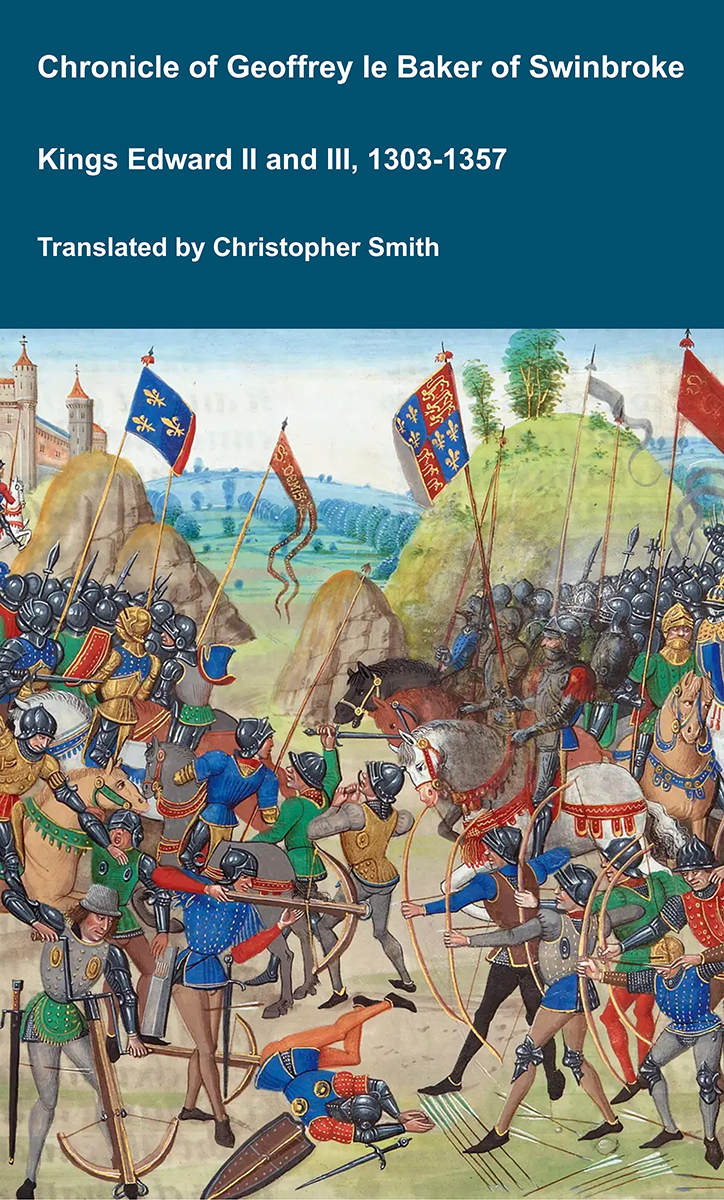 Chronicle of Geoffrey le Baker of Swinbroke. The King of England, after the aforementioned betrothal of his sister, shortly after the Feast of the Holy Trinity [31st May 1328], proceeded to Hereford, where solemn weddings were held for the daughters of Roger de Mortimer and certain noblemen,1 namely, the son of the Earl Marshal and the heir of Lord John of Hastings. There were also grand tournaments held there, in which the king's mother took part.
Rex Anglie, post predictam sue sororis desponsacionem, cito post festum sancte Trinitatis, se transtulit versus Herefordiam, ubi fuerunt solemnes nupcie inter filias Rogeri de Mortuo mari et quosdam nobiles, videlicet filium comitis Marescalli et heredem domini Iohannis de Hastinghes. Fuerunt eciam ibidem hastiludia solemnia, quibus interfuit mater regis.
Note 1. His daughter [his daughter-in-law] Beatrix was married to Edward, son of Thomas of Brotherton; and Agnes to Laurence, son of John, Lord Hastings, and afterwards earl of Pembroke. He had in all seven daughters, each of whom was married into some powerful family.
On 19th March 1330 the King's uncle Edmund of Woodstock 1st Earl Kent was beheaded at Winchester Castle. Earl Kent forfeit. Edmund had been convicted of plotting against the court believing his brother King Edward II was still alive. It later emerged the plot had been created by Roger Mortimer 1st Earl March to entrap Edmund. King Edward III of England was unable to show leniency risking complicity in the plot. He was buried at Westminster Abbey.
See
Geoffrey le Baker of Swinbroke,  Walter of Guisborough, Knighton 2555, Murimuth and Parliament Rolls.
Before 12th October 1330 [his wife] Alice Hales Countess Norfolk died.
After 1333 [his half-sister] Margaret Plantagenet Duchess Brabant died.
On 19th July 1333 [his nephew] King Edward III of England defeated the Scots army at the Battle of Halidon Hill near Berwick-upon-Tweed, Northumberland. John of Eltham 1st Earl Cornwall commanded.
English archers, just as at the Battle of Dupplin Moor one year previously, had a significant impact on the massed ranks of Scottish schiltrons. Edward's army included: Thomas of Brotherton 1st Earl Norfolk, who commanded the right wing, Hugh Courtenay 1st or 9th Earl Devon, Robert Pierrepont, Hugh Courtenay 2nd or 10th Earl Devon, Henry Beaumont Earl Buchan and John Sully. One of the few English casualties was John Neville who was killed.
The Scottish army included King David II of Scotland. Alexander Bruce, Alan Stewart, James Stewart, John Stewart, William Douglas 1st Earl Atholl, Archibald Douglas who were all killed.
Hugh 4th Earl Ross was killed. William 5th Earl Ross succeeded 5th Earl Ross.
Malcolm Lennox 2nd Earl Lennox was killed. Domhnall Lennox Earl Lennox succeeded Earl Lennox.
Kenneth de Moravia Sutherland 4th Earl Sutherland was killed. William de Moravia Sutherland 5th Earl Sutherland succeeded 5th Earl Sutherland. Johanna Menteith Countess Sutherland by marriage Countess Sutherland.
Before 9th August 1334 [his son] Edward Plantagenet died.
In 1335 [his son-in-law] John Segrave 4th Baron Segrave and Margaret Plantagenet 1st Duchess of Norfolk were married. She by marriage Baroness Segrave. She the daughter of Thomas of Brotherton 1st Earl Norfolk and Alice Hales Countess Norfolk.
Before 4th April 1336 Thomas of Brotherton 1st Earl Norfolk and Mary Brewes Countess Norfolk were married. She by marriage Countess Norfolk. He the son of King Edward I of England and Margaret of France Queen Consort England.
On 4th August 1338 Thomas of Brotherton 1st Earl Norfolk died at Framlingham Castle, Suffolk. [his daughter] Margaret Plantagenet 1st Duchess of Norfolk succeeded 2nd Countess Norfolk. She also succeeded to the title Earl Marshal, the only woman to have held this office, and inherited Framlingham Castle, Suffolk.
Around 11th June 1362 [his former wife] Mary Brewes Countess Norfolk died.
[his daughter] Margaret Plantagenet 1st Duchess of Norfolk was born to Thomas of Brotherton 1st Earl Norfolk and Alice Hales Countess Norfolk. She married (1) 1335 John Segrave 4th Baron Segrave, son of Stephen Segrave 3rd Baron Segrave and Alice Fitzalan Baroness Segrave, and had issue (2) 1354 Walter Manny 1st Baron Manny and had issue.
Parliament Rolls Richard II. 33. Also, on the same Saturday [10 February 1397], a charter of the king made to the [his great grandson] earl marshal touching his office of marshal of England, and the gold staff adorned with the emblem of the king's arms which he will carry in his office, was read and delivered to the said earl. The tenor of which charter follows:
The king to the same, greeting. Know that whereas recently by our letters patent of our special grace we granted to our beloved kinsman Thomas, Earl of Nottingham, the office of marshal of England, together with the name and honour of earl marshal, to have to him and his male heirs issuing from his body, with all the fees, profits, and appurtenances whatsoever pertaining in any way to the said office, in perpetuity; as is fully contained in the same letters. We, mindful of the gracious and laudable services often performed by the aforementioned earl, on either side of the sea, for the benefit and honour of us and our kingdom, at no small effort, cost, and charge to him; and wishing therefore to provide for the estate and honour of that earl, of our special grace have granted in our present parliament for us and our heirs to the same earl the said office, and the name, title, and honour of earl marshal of England, to have to him and his male heirs issuing from his body, together with all offices, commodities, profits and other appurtenances whatsoever, both in our courts and elsewhere, relating or pertaining in any way to the same office, in the same manner and as fully, freely, wholly, and peacefully as Thomas Brotherton, lately Earl of Norfolk and marshal of England, father of our beloved kinswoman [his daughter] Margaret Countess of Norfolk, [widow] of the aforesaid late earl, or Roger Bigod sometime Earl of Norfolk and marshal of England, or any other after the death of the same former earl, or the same present earl, had or held the said office of marshal of England in their time.
Willing further and granting for us and our heirs, that the office of marshal of our Bench before us, which John Wicks holds for the term of his life by our grant, and the office of marshal in our treasury which Richard Gascoigne holds for his life by grant of our beloved brother Thomas Earl of Kent, lately marshal of England, by our confirmation; and also the office of herald of the marshal before the steward and marshal of our household, which Guy Allesley holds for his life by grant of the lord Edward [III], late king of England, our grandfather, and by our confirmation; which offices after the death of the aforesaid John, Richard and Guy should revert to us and our heirs, after the death of the same John, Richard, and Guy shall remain to the aforementioned earl marshal, to have to him and his male heirs in perpetuity. And that the same offices, and all other offices in any of our courts and elsewhere, which pertained, and used to pertain to the said office of marshal of England in times past, shall be fully restored, annexed, and reunited to the said office of marshal of England in perpetuity. And that the same earl and his male heirs may give, grant, or confer those offices on any suitable persons freely and without hindrance as soon as they shall have fallen vacant by death, demise, resignation, surrender, or in any other way, notwithstanding any of our letters patent made to the contrary.
Considering also the vigour and nobility of that earl, and that he may in future the more fittingly and honourably perform and exercise the aforesaid office, we have granted for us and our heirs to the same present earl that he and his said male heirs, marshals of England, by virtue of their aforesaid office should have, carry, and bear, as well in the presence as in the absence of us and our heirs, a certain gold staff, with both ends enamelled in black, and with the emblem of our arms decorating the top of the said staff, and with the emblem of the arms of that earl decorating the bottom of the said staff; notwithstanding that the same present earl in his time, or the aforementioned former earls, or any other who had the said office of marshal of England before this time, used to carry or bear a wooden staff. Witnessed by these, the venerable fathers Thomas archbishop of Canterbury, primate of all England, Robert of London, William of Winchester, John of Ely, Edmund of Exeter, our chancellor, bishops; John of Aquitaine and Lancaster, Edmund of York, dukes, our beloved uncles; Henry of Derby, Edward of Rutland, Henry of Northumberland, earls; Reginald Grey of Ruthin, Ralph Neville, John Lovell, knights; Roger Walden, dean of York, our treasurer, Thomas Percy, steward of our household, and others. Given by our hand at Westminster on 10 February 1397.


