

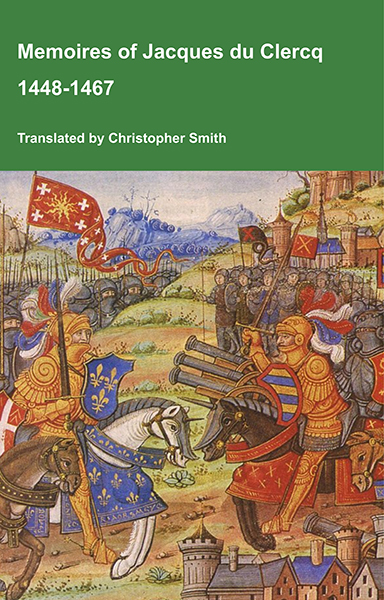
This is a translation of the 'Memoires of Jacques du Clercq', published in 1823 in two volumes, edited by Frederic, Baron de Reissenberg. In his introduction Reissenberg writes: 'Jacques du Clercq tells us that he was born in 1424, and that he was a licentiate in law and a counsellor to Philip the Good, Duke of Burgundy, in the castellany of Douai, Lille, and Orchies. It appears that he established his residence at Arras. In 1446, he married the daughter of Baldwin de la Lacherie, a gentleman who lived in Lille. We read in the fifth book of his Memoirs that his father, also named Jacques du Clercq, had married a lady of the Le Camelin family, from Compiègne. His ancestors, always attached to the counts of Flanders, had constantly served them, whether in their councils or in their armies.' The Memoires cover a period of nineteen years beginning in in 1448, ending in in 1467. It appears that the author had intended to extend the Memoirs beyond that date; no doubt illness or death prevented him from carrying out this plan. As Reissenberg writes the 'merit of this work lies in the simplicity of its narrative, in its tone of good faith, and in a certain air of frankness which naturally wins the reader’s confidence.' Du Clercq ranges from events of national and international importance, including events of the Wars of the Roses in England, to simple, everyday local events such as marriages, robberies, murders, trials and deaths, including that of his own father in Book 5; one of his last entries.
Available at Amazon in eBook and Paperback format.
Kensington Palace is in Kensington.
John Evelyn's Diary. 25th February 1690. I went to Kensington, which King William [aged 39] had bought of Lord Nottingham [aged 42], and altered, but was yet a patched building, but with the garden, however, it is a very sweet villa, having to it the park and a straight new way through this park.

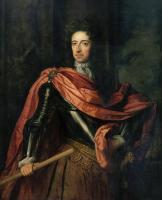
John Evelyn's Diary. 8th November 1691 to 30th November 1691. An extraordinary dry and warm season, without frost, and like a new spring; such as had not been known for many years. Part of the King's house at Kensington was burned.
On 28th December 1694 Mary Stewart II Queen England Scotland and Ireland [aged 32] died of smallpox shortly after midnight at Kensington Palace. Her body lay in state at the Banqueting House, Whitehall Palace [Map].
On 5th March 1695 she was buried in Westminster Abbey [Map]. Archbishop Thomas Tenison [aged 58] preached the sermon.
She had reigned for five years. Her husband King William III of England, Scotland and Ireland [aged 44] continued to reign for a further eight years.


John Evelyn's Diary. 23rd April 1696. I went to Eton [Map], and dined with Dr. Godolphin, the provost. The schoolmaster assured me there had not been for twenty years a more pregnant youth in that place than my grandson [aged 14]. I went to see the King's House at Kensington. It is very noble, though not great. The gallery furnished with the best pictures [from] all the houses, of Titian, Raphael, Correggio, Holbein, Julio Romano, Bassan, Vandyke, Tintoretto, and others; a great collection of porcelain; and a pretty private library. The gardens about it very delicious.
On 8th March 1702 King William III of England, Scotland and Ireland [aged 51] died of Pneumonia at Kensington Palace. His demise was the direct result of a fall from his horse, named Sorrel, which stumbled on a molehill causing King William to fall and break his collarbone. For many years afterwards, Jacobites would raise their glasses and toast "the little gentleman in the black velvet waistcoat". His first cousin Anne [aged 37] succeeded I Queen England Scotland and Ireland. She, Anne, being the sister of his wife Mary Stewart II Queen England Scotland and Ireland.


On 1st August 1714 Queen Anne of England Scotland and Ireland [aged 49] died at Kensington Palace. Her second cousin George [aged 54] succeeded I King Great Britain and Ireland.
In 1759 Matthew Blakiston 1st Baronet [aged 57] was knighted at Kensington Palace.
On 25th October 1760 King George II of Great Britain and Ireland [aged 76] died at Kensington Palace. His grandson George [aged 22] succeeded III King Great Britain and Ireland. Duke Cambridge merged with the Crown.
On 9th January 1769 William Robert Spencer was born to Charles Spencer [aged 28] and Mary Beauclerk [aged 25] at Kensington Palace. He a great x 2 grandson of King Charles II of England Scotland and Ireland. He married 1791 Susan Jenison and had issue.
On 18th February 1828 Ernst Christian Carl Hohenlohe Langenburg I Prince [aged 33] and Anna Feodora Auguste Charlotte Wilhelmine Leiningen Princess were married at Kensington Palace. She by marriage Princess of Hohenlohe Langenburg.
On 20th June 1837 King William IV of the United Kingdom [aged 71] died at Windsor Castle [Map]. His niece Victoria [aged 18] succeeded I Queen Great Britain and Ireland. His brother Ernest [aged 66] succeeded King Hanover. Frederica Mecklenburg Strelitz Queen Consort Hanover [aged 59] by marriage Queen Consort Hanover.
At 5am Francis Nathaniel Conyngham 2nd Marquess Conyngham [aged 40] and Archbishop William Howley [aged 71] went to Kensington Palace to inform the Princess she was now Queen. Francis Nathaniel Conyngham 2nd Marquess Conyngham was the first to address her as 'Your Majesty'.
On 21st April 1843 Prince Augustus Frederick Hanover 1st Duke Sussex [aged 70] died at Kensington Palace. He was buried at Kensal Green Cemetery [Map]. Duke Sussex extinct.


On 13th August 1868 Adolphus Cambridge Duke Teck was born to Francis Teck [aged 30] and Princess Mary Adelaide Hanover [aged 34] at Kensington Palace. He a great grandson of King George III of Great Britain and Ireland. He married 1894 Margaret Evelyn Grosvenor Duchess Teck, daughter of Hugh Lupus Grosvenor 1st Duke Westminster and Constance Leveson-Gower Duchess Westminster, and had issue.
In 1874 Alexander Teck 1st Earl Athlone was born to Francis Teck [aged 36] and Princess Mary Adelaide Hanover [aged 40] at Kensington Palace. He a great grandson of King George III of Great Britain and Ireland. He married 10th February 1904 his second cousin once removed Princess Alice Countess Athlone, daughter of Leopold Saxe Coburg Gotha 1st Duke Albany and Helena Waldeck Duchess Albany, and had issue.
Henrici Quinti, Angliæ Regis, Gesta, is a first-hand account of the Agincourt Campaign, and subsequent events to his death in 1422. The author of the first part was a Chaplain in King Henry's retinue who was present from King Henry's departure at Southampton in 1415, at the siege of Harfleur, the battle of Agincourt, and the celebrations on King Henry's return to London. The second part, by another writer, relates the events that took place including the negotiations at Troye, Henry's marriage and his death in 1422.
Available at Amazon in eBook and Paperback format.
In 1957 Alexander Teck 1st Earl Athlone [aged 83] died at Kensington Palace.
On 27th August 1968 Princess Marina Glücksburg Duchess Kent [aged 61] died at Kensington Palace.


On 24th June 1819 Victoria, the future Queen, was christened privately by the Archbishop of Canterbury, Charles Manners-Sutton [aged 64] in the Cupola Room, Kensington Palace.