

Abbot John Whethamstede’s Chronicle of the Abbey of St Albans
Abbot John Whethamstede's Register aka Chronicle of his second term at the Abbey of St Albans, 1451-1461, is a remarkable text that describes his first-hand experience of the beginning of the Wars of the Roses including the First and Second Battles of St Albans, 1455 and 1461, respectively, their cause, and their consequences, not least on the Abbey itself. His text also includes Loveday, Blore Heath, Northampton, the Act of Accord, Wakefield, and Towton, and ends with the Coronation of King Edward IV. In addition to the events of the Wars of the Roses, Abbot John, or his scribes who wrote the Chronicle, include details in the life of the Abbey such as charters, letters, land exchanges, visits by legates, and disputes, which provide a rich insight into the day-to-day life of the Abbey, and the challenges faced by its Abbot.
Available at Amazon in eBook and Paperback format.
Northallerton is in North Yorkshire.
In 1514 Bishop Edmund Gheast was born in Northallerton.
In 1577 Bishop Edmund Gheast (age 63) died in Northallerton.
On 11th June 1762 Frances Lascelles was born to Edward Lascelles 1st Earl Harewood (age 22) and Anne Chaloner Baroness Harewood (age 19) at Northallerton. She married 4th October 1784 John Douglas, son of James Douglas 14th Earl Morton and Bridget Heathcote Countess Morton, and had issue.
On 4th October 1784 John Douglas (age 28) and Frances Lascelles (age 22) were married at Northallerton. She the daughter of Edward Lascelles 1st Earl Harewood (age 44) and Anne Chaloner Baroness Harewood (age 42). He the son of James Douglas 14th Earl Morton and Bridget Heathcote Countess Morton.
The manor of Northallerton [Map] was granted by William II to Carileph, Bishop of Durham between 1087 and 1100. The palace was certainly in use by 1199 when the Archbishop of Canterbury stayed there as a guest of the Bishop of Durham. In common with aristocratic and high status buildings elsewhere there would have been a programme of enlargement, refurbishment and refortification often reflecting the latest architectural fashion: such renovation work happened in 1226, 1292 and 1309.
Collectanea by John Leland [1502-1552]. The XVIIIth Day of the Monneth [18th July 1503] the said Quene (age 13) departed fro the said Newbrough, to Allerton; and at the Intrynge of the said Place, sche was receyved by the Vicayr and Folks of the Church [White Friars Priory, Northallerton [Map]] with the Freres Carmelits in Processyon, and the Byschop Morray did as before. From that Place she was conveyd, as Custome was, to the Manayr of the said Bisschop of Durham [Map].
On 22nd August 1138 an English army commanded by William of Blois 1st Earl Albemarle 1st Earl York (age 37), William "The Younger" Peverell (age 58) and Robert III Stuteville defeated a Scottish army led by King David I of Scotland (age 54) and his son Henry Dunkeld 3rd Earl Huntingdon 1st Earl of Northumbria (age 24). The battle was fought at Cowton Moor, Northallerton. The name "Battle of the Standard" refers to the standard i.e. mast, pole, mounted on a cart on which the banners of the Bishops of Durham, York, Beverly and Ripon which were flown.
Robert III Stuteville: he was born to Robert Stuteville at Estouteville. Before 1186 Robert III Stuteville and Helewise de Murdac were married. In 1186 Robert III Stuteville died. Before 1186 Robert III Stuteville and Sibilla Valognes were married.


The River Swale rises on the moors at the top of the Birkdale [Map] after which it flows broadly east past Marrick Priory, North Yorkshire [Map], Ellerton Priory, North Yorkshire [Map], Richmond Castle, North Yorkshire [Map], under Catterick Bridge, North Yorkshire [Map], past Great Langton, North Yorkshire [Map], Moreton-on Swale, North Yorkshire [Map], Gatenby, North Yorkshire [Map], Maunby, North Yorkshire [Map], Holme, North Yorkshire [Map], Baldersby St James, North Yorkshire [Map], past Topcliffe Castle, North Yorkshire [Map], under Thornton Bridge [Map] to its confluence with the River Ure near Myton-on-Swale [Map].
Harsley Castle is also in Castles in North Yorkshire.
Around 1395 Thomas Strangeways was born to Robert "Henry" Strangeways (age 40) at Harsley Castle [Map]. He married before 1437 Katherine Neville Duchess Norfolk, daughter of Ralph Neville 1st Earl of Westmoreland and Joan Beaufort Countess of Westmoreland, and had issue.
Around 1410 James Strangeways was born to James Strangeways (age 28) at Harsley Castle [Map].
After 21st March 1442 Thomas Strangeways (deceased) died at Harsley Castle [Map].
On 20th August 1480 James Strangeways (age 70) died at Harsley Castle [Map].
Mount Grace Priory, North Yorkshire is also in Priories in England.
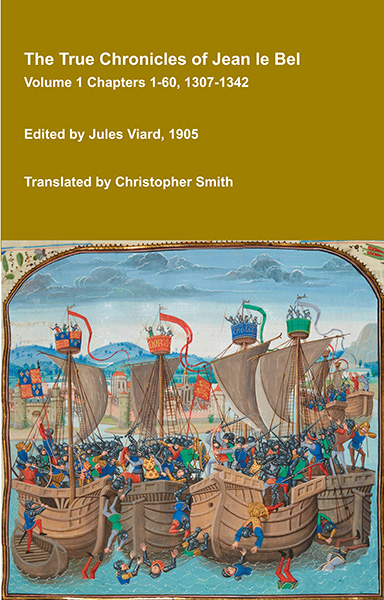
The True Chronicles of Jean le Bel Volume 1 Chapters 1-60 1307-1342
The True Chronicles of Jean le Bel offer one of the most vivid and immediate accounts of 14th-century Europe, written by a knight who lived through the events he describes, and experienced some of them first hand. Covering the early decades of the Hundred Years’ War, this remarkable chronicle follows the campaigns of Edward III of England, the politics of France and the Low Countries, and the shifting alliances that shaped medieval warfare. Unlike later historians, Jean le Bel writes with a strong sense of eyewitness authenticity, drawing on personal experience and the testimony of fellow soldiers. His narrative captures not only battles and sieges, but also the realities of military life, diplomacy, and the ideals of chivalry that governed noble society. A key source for Jean Froissart, Le Bel’s chronicle stands on its own as a compelling and insightful work, at once historical record and literary achievement. This translation builds on the 1905 edition published in French by Jules Viard, adding extensive translations from other sources Rymer's Fœdera, the Chronicles of Adam Murimuth, William Nangis, Walter of Guisborough, a Bourgeois of Valenciennes, Geoffrey le Baker of Swinbroke and Richard Lescot to enrich the original text and Viard's notes.
Available at Amazon in eBook and Paperback format.
Mount Grace Priory, North Yorkshire [Map] was founded in as a Carthusian Charterhouse in 1398 by Thomas Holland 1st Duke Surrey (age 24). It was the last monastery established in Yorkshire, and one of the few founded anywhere in Britain in the period between the Black Death and the Reformation.
On 7th January 1400 at Cirencester, Gloucestershire [Map] Ralph Lumley 1st Baron Lumley (age 40) was beheaded by the townspeople following an unsuccessful attempt to seize the town. Baron Lumley forfeit.
Thomas Holland 1st Duke Surrey (age 26) was beheaded. He had to forfeit the honours and estates he had gained after the arrests of Gloucester and Arundel: Duke Surrey extinct. He retained those he had received before: His brother Edmund (age 16) succeeded 4th Earl Kent, 3rd Baron Holand, 8th Baron Wake of Liddell. He was buried, or re-buried, at his foundation Mount Grace Priory, North Yorkshire [Map].
John Montagu 3rd Earl Salisbury (age 50) was captured, tried and beheaded. Earl Salisbury, Baron Montagu, Baron Montagu, Baron Monthermer forfeit.
Bernard Brocas (age 46) was captured.
In 1539 Mount Grace Priory, North Yorkshire [Map] was dissolved. The last prior, John Wilson, handed the keys over to Henry VIII's representatives. The site then passed into private ownership. It was valued at £382 5s. 11½d. gross (£323 2s. 10½d. net) which included £104 6s. 8d. from spiritualities in Lincolnshire, £164 from lands outside Yorkshire and the rest from its home county of Yorkshire.
In August 1612 Francis Lascelles was born to William Lascelles (age 38) at Stank Hall, Northallerton. He married before 6th November 1655 Frances St Quintin and had issue.
White Friars Priory, Northallerton is also in Priories in England.
White Friars Priory, Northallerton [Map], situated in the east part of the town, was founded in 1356 by the king, who, with the consent of the Prior and convent of Durham, on 8 November gave to Walter Kellaw, provincial prior, and the friars a croft called Tentour Croft, with an adjacent meadow, which John Yole, merchant, of Northallerton, had granted to him for this purpose.