

Chronicle of Walter of Guisborough
A canon regular of the Augustinian Guisborough Priory, Yorkshire, formerly known as The Chronicle of Walter of Hemingburgh, describes the period from 1066 to 1346. Before 1274 the Chronicle is based on other works. Thereafter, the Chronicle is original, and a remarkable source for the events of the time. This book provides a translation of the Chronicle from that date. The Latin source for our translation is the 1849 work edited by Hans Claude Hamilton. Hamilton, in his preface, says: 'In the present work we behold perhaps one of the finest samples of our early chronicles, both as regards the value of the events recorded, and the correctness with which they are detailed; Nor will the pleasing style of composition be lightly passed over by those capable of seeing reflected from it the tokens of a vigorous and cultivated mind, and a favourable specimen of the learning and taste of the age in which it was framed.'
Available at Amazon in eBook and Paperback format.
Reading Abbey, Berkshire is in Reading, Berkshire [Map], Abbeys in England.
On 3rd January 1136 King Henry I "Beauclerc" England was buried at Reading Abbey, Berkshire [Map]. The Archbishop of Canterbury William of Corbeil [aged 66], Bishop of Winchester Henry of Blois [aged 38], Bishop Roger of Sailsbury and Edwar,d Abbot of Reading, were present at the burial, where masses were sung, rich offerings made and alms were distributed to the poor of Reading. The dead king's effigy was displayed on a hearse, and his body was buried in a tomb before the abbey church's High Altar, while King Stephen [aged 42] sat enthroned watching the rituals. The abbey church and the ground immediately outside became a desirable location for other royals and nobles to be buried.
Flowers of History by Roger of Wendover 1135. The corpse of the king lay a long time above ground at Rouen, where his entrails, brain, and eyes are buried; the rest of his body, cut with knives and seasoned with salt to destroy the offensive smell, which was great, and annoyed all who came near it, was wrapped in a bull's skin; and the physician who was engaged for a large sum of money to open his head with a hatchet, and extract the brain after it was already too much corrupted, notwithstanding that the head was wrapped up in several napkins, was poisoned by the noisome smell, and thus the money which he received was fatal to him; he was the last of king Henry's victims, for he had killed many before. The royal body was conveyed from thence to Caen, where it was placed in the church before the tomb of his father, who also reposes there. Immediately, a bloody and frightful liquor began to ooze through the bull's skin, which the attendants caught in basins, to the great horror of the beholders. At length the king's corpse was brought to England, and buried with royal pomp on his birth-day [3rd January 1136], at Reading [Map], in the church which he had himself founded. The archbishops, bishops, and nobles of the kingdom were present at the ceremony.
Chronicle of Henry of Huntingdon 1135. [3rd January 1136]. At last, the royal remains were brought over to England, and interred, within twelve days of Christmas, in the abbey at Reading [Map], which King Henry had founded and richly endowed. There, King Stephen, after holding his court at London during Christmas, came to meet the body of his uncle, and William, archbishop of Canterbury, with many earls and great men, buried King Henry with the honours due to so great a prince.
On 23rd April 1151 Adeliza of Louvain Queen Consort England [aged 48] died. She was buried at Reading Abbey, Berkshire [Map].
In April 1156 William Plantagenet IX Count Poitiers [aged 2] died at Wallingford Castle [Map]. He was buried at Reading Abbey, Berkshire [Map] at the feet of his great-grandfather King Henry I "Beauclerc" England.
On 1st July 1175 Reginald de Dunstanville Fitzroy 1st Earl Cornwall [aged 65] died at Chertsey, Surrey. He was buried at Reading Abbey, Berkshire [Map]. Earl Cornwall extinct. His son appears to have predeceaseed him by months.
In 1227 Hugh Mortimer died in a tournament. He was buried at Wigmore Abbey [Map]; his viscera were buried at Reading Abbey, Berkshire [Map]. His widow Eleanor Braose became a nun at Iffley.
On 22nd September 1232 John Cornwall died at Marlow, Buckinghamshire. He was buried at Reading Abbey, Berkshire [Map].
After 13th March 1271 Henry "Almain" Cornwall [deceased] was buried at Reading Abbey, Berkshire [Map].
On 19th May 1359, or thereabouts, a double-royal wedding celebration took place at Reading Abbey, Berkshire [Map] whereby two children of King Edward III of England [aged 46] were married:
John of Gaunt 1st Duke Lancaster [aged 19] and Blanche Duchess of Lancaster [aged 17] were married. She by marriage Countess Richmond. She the daughter of Henry of Grosmont 1st Duke Lancaster [aged 49] and Isabel Beaumont Duchess Lancaster [aged 39]. He the son of King Edward III of England and Philippa of Hainaut Queen Consort England [aged 48]. They were half second cousin once removed. She a great x 2 granddaughter of King Henry III of England.
John Hastings 2nd Earl Pembroke [aged 11] and Margaret Plantagenet Countess of Pembroke [aged 12] were married. At the time John Hastings 2nd Earl Pembroke was a ward of King Edward III of England who would enjoy the benefit of the substantial revenue of the Earldom of Pembroke until John came of age nine years later in 1368. She died two or so years later probably of plague. She the daughter of King Edward III of England and Philippa of Hainaut Queen Consort England. He the son of Laurence Hastings 1st Earl Pembroke and Agnes Mortimer Countess of Pembroke [aged 42]. They were half fourth cousins. He a great x 5 grandson of King John of England.
On 24th August 1369 Edmund Mortimer 3rd Earl March, Earl of Ulster [aged 17] and Philippa Plantagenet Countess March 2nd Countess Ulster [aged 14] were married at Reading Abbey, Berkshire [Map]. She by marriage Countess March. He by marriage Earl of Ulster. She the daughter of Lionel of Antwerp 1st Duke of Clarence and Elizabeth Burgh Duchess of Clarence. He the son of Roger Mortimer 2nd Earl March and Philippa Montagu Countess March [aged 37]. They were fourth cousins. She a granddaughter of King Edward III of England.
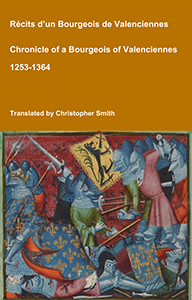
Chronicle of a Bourgeois of Valenciennes
Récits d’un bourgeois de Valenciennes aka The Chronicle of a Bourgeois of Valenciennes is a vivid 14th-century vernacular chronicle written by an anonymous urban chronicler from Valenciennes in the County of Hainaut. It survives in a manuscript that describes local and regional history from about 1253 to 1366, blending chronology, narrative episodes, and eyewitness-style accounts of political, military, and social events in medieval France, Flanders, and the Low Countries. The work begins with a chronological framework of events affecting Valenciennes and its region under rulers such as King Philip VI of France and the shifting allegiances of local nobility. It includes accounts of conflicts, sieges, diplomatic manoeuvres, and the impact of broader struggles like the Hundred Years’ War on urban life in Hainaut. Written from the perspective of a burgher (bourgeois) rather than a monastery or royal court, the chronicle offers a rare lay viewpoint on high politics and warfare, reflecting how merchants, townspeople, and civic institutions experienced the turbulence of the 13th and 14th centuries. Its narrative style combines straightforward reporting of events with moral and civic observations, making it a valuable source for readers interested in medieval urban society, regional politics, and the lived experience of war and governance in pre-modern Europe.
Available at Amazon in eBook and Paperback format.
On 29th November 1416 Constance York Countess Gloucester [aged 42] died at Reading Abbey, Berkshire [Map].
On 3rd June 1449 Anne Beauchamp 15th Countess Warwick [aged 5] died at Ewelme, Oxfordshire aged four whilst in the care of Alice Chaucer Duchess Suffolk [aged 45]. She was buried at Reading Abbey, Berkshire [Map]. Baron Burghesh abeyant between her three-half aunts and her full aunt Anne Beauchamp 16th Countess Warwick [aged 22]. It isn't clear why the barony was not subject to the same legal dispute that the Earldom of Warwick was subject to - see following.
After a prolonged legal dispute between her three half-aunts, Margaret Beauchamp Countess Shrewsbury and Waterford [aged 45], Eleanor Beauchamp Duchess Somerset [aged 40], Elizabeth Beauchamp Baroness Latimer [aged 32] and her full aunt Anne Beauchamp 16th Countess Warwick, the courts decided her full aunt Anne Beauchamp should succeed. Anne Beauchamp succeeded 16th Countess Warwick. Her husband Richard Neville [aged 20] by marriage Earl Warwick; the first step on his journey to becoming Kingmaker.
The decision of the court was not subscribed to by Edmund Beaufort Earl Somerset [aged 43] who was married to Anne's half-sister Eleanor; he wanted his share of the considerable Beauchamp inheritance.