

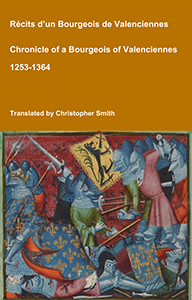
Chronicle of a Bourgeois of Valenciennes
Récits d’un bourgeois de Valenciennes aka The Chronicle of a Bourgeois of Valenciennes is a vivid 14th-century vernacular chronicle written by an anonymous urban chronicler from Valenciennes in the County of Hainaut. It survives in a manuscript that describes local and regional history from about 1253 to 1366, blending chronology, narrative episodes, and eyewitness-style accounts of political, military, and social events in medieval France, Flanders, and the Low Countries. The work begins with a chronological framework of events affecting Valenciennes and its region under rulers such as King Philip VI of France and the shifting allegiances of local nobility. It includes accounts of conflicts, sieges, diplomatic manoeuvres, and the impact of broader struggles like the Hundred Years’ War on urban life in Hainaut. Written from the perspective of a burgher (bourgeois) rather than a monastery or royal court, the chronicle offers a rare lay viewpoint on high politics and warfare, reflecting how merchants, townspeople, and civic institutions experienced the turbulence of the 13th and 14th centuries. Its narrative style combines straightforward reporting of events with moral and civic observations, making it a valuable source for readers interested in medieval urban society, regional politics, and the lived experience of war and governance in pre-modern Europe.
Available at Amazon in eBook and Paperback format.
South Yorkshire is in Yorkshire.
Around 1495 Arthur Darcy was born to Thomas Darcy 1st Baron Darcy Templehurst [aged 28] and Dousabella Tempest [aged 28] at Aston. He married in or before 1532 his fifth cousin once removed Mary Carew and had issue.
Around 1540 John Darcy 2nd Baron Darcy Aston was born to George Darcy 1st Baron Darcy Aston [aged 43] and Dorothy Melton Baroness Darcy [aged 34] at Aston. He married before 18th October 1602 his sixth cousin Anne Babington and had issue.
On 18th October 1602 John Darcy 2nd Baron Darcy Aston [aged 62] died at Aston. His grandson John [aged 30] succeeded 3rd Baron Darcy of Aston. Rosamund Freschville Baroness Darcy [aged 26] by marriage Baroness Darcy of Aston.
On 20th January 1829 John Roddam Spencer-Stanhope was born to John Spencer-Stanhope [aged 41] and Elizabeth Wilhelmina Coke [aged 33] at Cannon Hall, South Yorkshire. He married 10th January 1859 Elizabeth King and had issue.
William de Morgan and his Wife Chapter 5. Mary Evelyn Pickering was the eldest daughter of Percival Andree Pickering [aged 45], Q.C., Recorder of Pontefract, Attorney General for the County Palatine and sometime Treasurer of the Inner Temple. He married in 1853 Anna Maria Spencer-Stanhope [aged 31], who was herself the eldest daughter of John [aged 68] and Lady Elizabeth Spencer-Stanhope [aged 60], of Cannon Hall, Yorkshire.
On 8th November 1873 John Spencer-Stanhope [aged 86] died. Walter Spencer-Stanhope [aged 45] inherited Cannon Hall, South Yorkshire.
Around 1852 Abel Hold [aged 37] moved to Cawthorne, South Yorkshire where he and Walter Spencer-Stanhope [aged 24] of nearby Cannon Hall, South Yorkshire became friends.

All Saints Church, Cawthorne is also in Churches in South Yorkshire.
All Saints Church, Cawthorne [Map].
All the woodwork, including the waggon headed roof and the pulpit carved in Florence (which features beautiful pre Raphaelite panels), is from this time and was created to Bodley's design. He also installed the lovely marble reredos and a notable tracker action organ still in its original condition. There is a lovely carved black oak screen, bearing the sacred emblems of the Passion. To the west of the village is the imposing Cannon Hall, now a museum.
The church contains memorials to the Spencer-Stanhopes of Cannon Hall. The bowl of the 15th century octagonal font was rediscovered in the grounds of the hall in the late 1800's. The square font in the south aisle is 10th century. There are some lovely stained glass windows, again dedicated to the Spencer-Stanhopes. In the churchyard are notable carved Saxon crosses as well as the mausoleum of the Spencer-Stanhopes.
On 29th March 1853 Percival Andrée Pickering [aged 43] and Anna Spencer-Stanhope [aged 28] were married at All Saints Church, Cawthorne [Map].
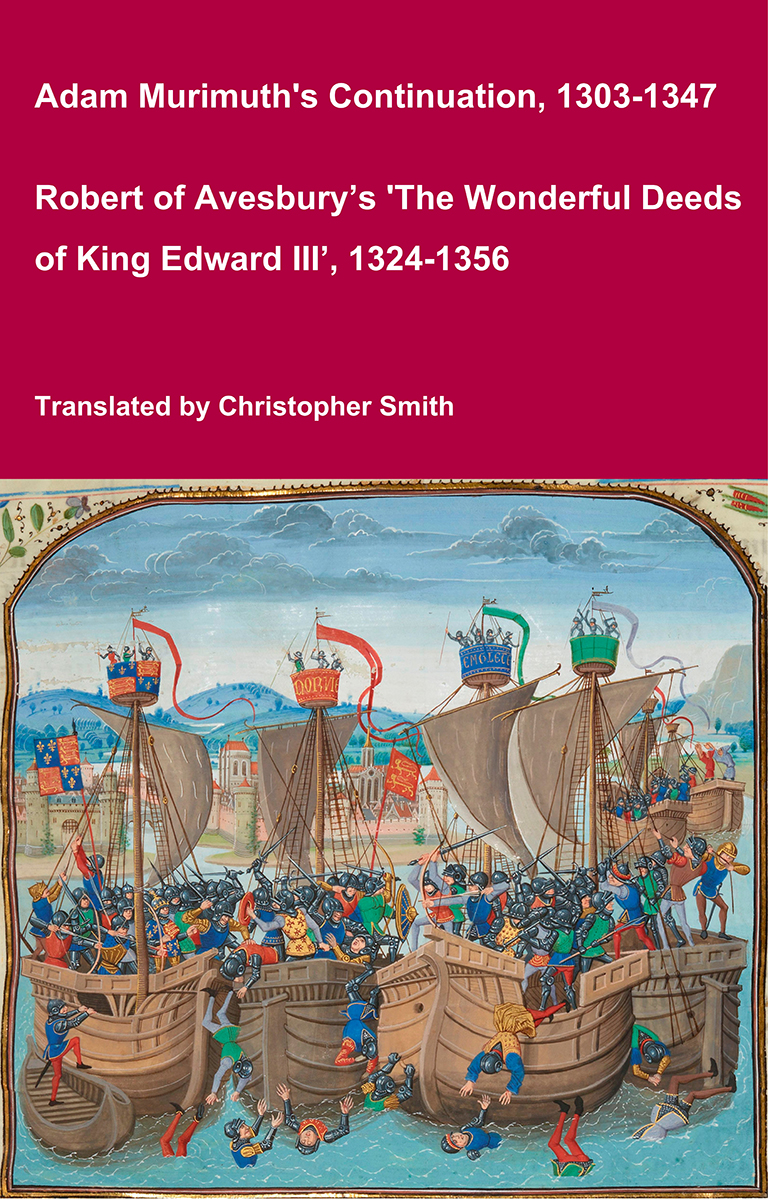
Adam Murimuth's Continuation and Robert of Avesbury’s 'The Wonderful Deeds of King Edward III'
This volume brings together two of the most important contemporary chronicles for the reign of Edward III and the opening phases of the Hundred Years’ War. Written in Latin by English clerical observers, these texts provide a vivid and authoritative window into the political, diplomatic, and military history of fourteenth-century England and its continental ambitions. Adam Murimuth Continuatio's Chronicarum continues an earlier chronicle into the mid-fourteenth century, offering concise but valuable notices on royal policy, foreign relations, and ecclesiastical affairs. Its annalistic structure makes it especially useful for establishing chronology and tracing the development of events year by year. Complementing it, Robert of Avesbury’s De gestis mirabilibus regis Edwardi tertii is a rich documentary chronicle preserving letters, treaties, and official records alongside narrative passages. It is an indispensable source for understanding Edward III’s claim to the French crown, the conduct of war, and the mechanisms of medieval diplomacy. Together, these works offer scholars, students, and enthusiasts a reliable and unembellished account of a transformative period in English and European history. Essential for anyone interested in medieval chronicles, the Hundred Years’ War, or the reign of Edward III.
Available at Amazon in eBook and Paperback format.
On 10th January 1859 John Roddam Spencer-Stanhope [aged 29] and Elizabeth King [aged 23] were married. She the widow of Captain George Frederick Dawson. They lived at Hillhouse, Cawthorne until their house Sandroyd House, Cobham was completed.
In 1724 William Wrightson of Cusworth [aged 47] inherited the Cusworth estates from his brother and commissioned George Platt to build Cusworth Hall, South Yorkshire between 1740 and 1845.
On 4th December 1760 William Wrightson of Cusworth [aged 83] died. Isabella Wrightson inherited Cusworth Hall, South Yorkshire. Her husband John Battie aka Wrightson changed his name from Battie to Wrightson.
The River Don rises at Dunford Bridge [Map] after which it flows broadly east through Penistone [Map] then south through Oughtibridge [Map], Sheffield [Map] then east through Rotherham [Map], past Conisbrough Castle [Map], Doncaster [Map] and Stainforth [Map] before joining the River Ouse at Goole [Map]. Originally the River Don was a tributary of the River Trent forming the northern boundary of the Isle of Axholme [Map] but was re-engineered by Cornelius Vermuyden as the Dutch River in the 1620s.
On 21st May 1382 Edward Hastings 8th Baron Hastings was born to Hugh Hastings 7th Baron Hastings [aged 32] and Anne Despencer Baroness Hastings, Marshal and Morley [aged 24] at Fenwick. He a great x 4 grandson of King Edward I of England. He married (1) before 1412 his half third cousin once removed Muriel Dynham Baroness Hastings and had issue (2) after 1412 his fourth cousin once removed Margery de Clifton Baroness Hastings.
In 1471 Anne Morley Baroness Hastings [aged 58] died at Fenwick.
Mary Fenwick Lady Millom was born to Henry Fenwick at Fenwick. She married John Huddlestone 7th Lord Millom and had issue.
Around 1437 Hugh Hastings 10th Baron Hastings was born to John Hastings 9th Baron Hastings [aged 24] and Anne Morley Baroness Hastings [aged 24] at Fenwick Manor. He married in or before 1466 Anne Gascoigne Baroness Hastings and had issue.
On 7th June 1488 Anne Gascoigne Baroness Hastings [aged 52] died at Fenwick Manor.
On 6th January 1321 William Greystoke 2nd Baron Greystoke was born to Ralph Greystoke 1st Baron Greystoke [aged 21] and Alice Audley Baroness Greystoke and Neville [aged 17] at Grimthorpe. He a great x 4 grandson of King Henry "Curtmantle" II of England. He married (1) after 14th July 1323 Lucy de Lucy Baroness Greystoke (2) before 18th October 1353 Joan Fitzhenry Baroness Greystoke and had issue.
On 6th December 1592 William Cavendish 1st Duke Newcastle upon Tyne was born to Charles Cavendish [aged 39] and Catherine Ogle 8th Baroness Ogle [aged 22] at Handsworth Manor. He a great x 4 grandson of King Edward IV of England. He married (1) 1618 Elizabeth Bassett Countess Newcastle upon Tyne and had issue (2) 1645 his fourth cousin Margaret Lucas Duchess Newcastle upon Tyne.
On 24th June 1630 Henry Cavendish 2nd Duke Newcastle upon Tyne was born to William Cavendish 1st Duke Newcastle upon Tyne [aged 37] and Elizabeth Bassett Countess Newcastle upon Tyne [aged 38] at Handsworth Manor. He married 1652 his second cousin once removed Frances Pierrepont Duchess Newcastle upon Tyne and had issue.


On 16th February 1337 William of Hatfield was born to King Edward III of England [aged 24] and Philippa of Hainaut Queen Consort England [aged 26] at Hatfield [Map]. He died shortly afterwards around 3rd March 1337. He was buried at York Minster [Map] where there is a monument to him in the north aisle. Coefficient of inbreeding 3.00%.
Chronicle of a Bourgeois of Valenciennes
Récits d’un bourgeois de Valenciennes aka The Chronicle of a Bourgeois of Valenciennes is a vivid 14th-century vernacular chronicle written by an anonymous urban chronicler from Valenciennes in the County of Hainaut. It survives in a manuscript that describes local and regional history from about 1253 to 1366, blending chronology, narrative episodes, and eyewitness-style accounts of political, military, and social events in medieval France, Flanders, and the Low Countries. The work begins with a chronological framework of events affecting Valenciennes and its region under rulers such as King Philip VI of France and the shifting allegiances of local nobility. It includes accounts of conflicts, sieges, diplomatic manoeuvres, and the impact of broader struggles like the Hundred Years’ War on urban life in Hainaut. Written from the perspective of a burgher (bourgeois) rather than a monastery or royal court, the chronicle offers a rare lay viewpoint on high politics and warfare, reflecting how merchants, townspeople, and civic institutions experienced the turbulence of the 13th and 14th centuries. Its narrative style combines straightforward reporting of events with moral and civic observations, making it a valuable source for readers interested in medieval urban society, regional politics, and the lived experience of war and governance in pre-modern Europe.
Available at Amazon in eBook and Paperback format.
On 2nd September 1761 Thomas Hinchcliffe was born at High Hoyland.
Around 1791 Thomas Hinchliffe was born to Thomas Hinchcliffe [aged 29] at High Hoyland. He married before 27th September 1811 Hannah Langley and had issue.
On 2nd October 1818 Thomas Hinchcliffe [aged 57] died at High Hoyland.
Icknield Street 18e Chesterfield to Templeborough. The route of Icknield Street from Chesterfield, Derbyshire [Map] to Templeborough [Map] is unknown. Speculatively it passed through Old Whittington [Map], Hundall, Derbyshire [Map], Highlane, South Yorkshire [Map], Orgreave [Map].
Roche Abbey is also in Abbeys in England.
Chronica Majora by Matthew Paris. May 1236. About this same time, in the month of May, near an abbacy called Roche [Map], in the northern part of England, there appeared bands of well-armed knights, riding on valuable horses, with standards and shields, coats of mail and helmets, and decorated with other military equipments: they issued from the earth, as it appeared, and disappeared again into the earth. This vision lasted for several days, and attracted the eyes of those who beheld it, as if by fascination; they rode in arrayed troops, and sometimes engaged in conflict; sometimes as if at a tournament, they shivered their spears into small fragments with a crash; the inhabitants saw them, but more from a distance than near them, for they never remember to have seen such a sight before, and many said that the occurrence was not without its presage. This occurred more plainly in Ireland and its confines, where they appeared as if coming from battle, and dragged their horses after them wounded and broken down, without a rider, and the knights themselves were severely wounded and bloody; and what was more wonderful, their track plainly appeared impressed on the ground, and the grass was borne down and trampled on. Many people on seeing this vision fled before them in alarm, and betook themselves to the churches and castles, thinking that it was not an illusion, but a real battle. These occurrences came to our knowledge some years after they happened, from a report and true account of the event obtained from the earl of Gloucester, and by the evidence of many other persons.

Before 1899. William Richardson [aged 84]. "The Gateway at Roche Abbey [Map]".
On 27th May 1714 George Saunderson 5th Viscount Castleton [aged 82] died at Sandbeck Park Maltby. His son James [aged 47] succeeded 6th Viscount Castleton.
In 1470 Bishop Robert Blyth was born at Norton, South Yorkshire [Map].
Memorials of Francis Chantrey RA in Hallamshire and Elsewhere Part IV The in Sheffield. To Norton [Map], as the birth-place of Chantrey, I have already adverted at length, and to that village, as his selected burial-place, I shall return hereafter; meanwhile, it has been shown that Hallamshire had a parental claim on the Painter - as the facts of this chapter will prove it had on the Sculptor also.
Bishop Geoffrey Blythe was born to William Blythe and Unknown Rotherham at Norton, South Yorkshire [Map].
On 7th April 1781 Francis Leggatt Chantrey was born to Francis Chantrey [aged 33] and Sarah Leggatt [aged 36] in Jordanthorpe Hall Farm, Norton, South Yorkshire [Map]. He married 23rd November 1808 Mary Ann Wale.
Icknield Street 18e Chesterfield to Templeborough. The route of Icknield Street from Chesterfield, Derbyshire [Map] to Templeborough [Map] is unknown. Speculatively it passed through Old Whittington [Map], Hundall, Derbyshire [Map], Highlane, South Yorkshire [Map], Orgreave [Map].
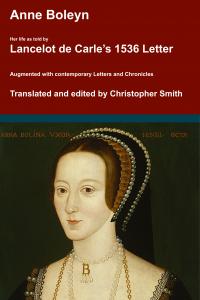
Anne Boleyn. Her Life as told by Lancelot de Carle's 1536 Letter.
In 1536, two weeks after the execution of Anne Boleyn, her brother George and four others, Lancelot du Carle, wrote an extraordinary letter that described Anne's life, and her trial and execution, to which he was a witness. This book presents a new translation of that letter, with additional material from other contemporary sources such as Letters, Hall's and Wriothesley's Chronicles, the pamphlets of Wynkyn the Worde, the Memorial of George Constantyne, the Portuguese Letter and the Baga de Secrets, all of which are provided in Appendices.
Available at Amazon in eBook and Paperback format.
The River Don rises at Dunford Bridge [Map] after which it flows broadly east through Penistone [Map] then south through Oughtibridge [Map], Sheffield [Map] then east through Rotherham [Map], past Conisbrough Castle [Map], Doncaster [Map] and Stainforth [Map] before joining the River Ouse at Goole [Map]. Originally the River Don was a tributary of the River Trent forming the northern boundary of the Isle of Axholme [Map] but was re-engineered by Cornelius Vermuyden as the Dutch River in the 1620s.
The River Don rises at Dunford Bridge [Map] after which it flows broadly east through Penistone [Map] then south through Oughtibridge [Map], Sheffield [Map] then east through Rotherham [Map], past Conisbrough Castle [Map], Doncaster [Map] and Stainforth [Map] before joining the River Ouse at Goole [Map]. Originally the River Don was a tributary of the River Trent forming the northern boundary of the Isle of Axholme [Map] but was re-engineered by Cornelius Vermuyden as the Dutch River in the 1620s.
The River Don rises at Dunford Bridge [Map] after which it flows broadly east through Penistone [Map] then south through Oughtibridge [Map], Sheffield [Map] then east through Rotherham [Map], past Conisbrough Castle [Map], Doncaster [Map] and Stainforth [Map] before joining the River Ouse at Goole [Map]. Originally the River Don was a tributary of the River Trent forming the northern boundary of the Isle of Axholme [Map] but was re-engineered by Cornelius Vermuyden as the Dutch River in the 1620s.
On 14th April 1634 John Reresby 2nd Baronet was born to John Reresby 1st Baronet [aged 23] and Frances Yarburgh at Thrybergh.
On 12th May 1689 John Reresby 2nd Baronet [aged 55] died. He was buried at St Leonards Church, Thrybergh. His son William [aged 21] succeeded 3rd Baronet Reresby of Thribergh in Yorkshire.

Tickhill Castle is also in Castles in South Yorkshire.
Chronicle of Roger de Hoveden. [Around March 1194] All those who had been assigned to besiege Count John's castles then returned to their own lands. However, the Bishop of Durham [aged 69], who had been entrusted with the siege of the castle of Tickhill [Map], gathered a great army from Yorkshire, Northumbria, and his other territories, and laid siege to the castle.
Omnes igitur, quibus commissa fuerant comitis Johannis castella obsidenda, reversi sunt in patrias suas. Episcopus vero Dunelmensis, cui commissum fuit castellum de Tikehill obsidendum, magnum congregavit exercitum Eboraci siriæ, et de Northimbria, et de aliis terris suis, et obsedit illud.

Vesta Monumenta. 1737. Plate 1.46. Tickhill Castle [Map]. Engraving by George [aged 53] Vertue after a drawing originally produced for a survey of the properties of the Duchy of Lancaster conducted by the Chancellor of the Duchy, Ambrose Cave, in 1561.
On 14th January 1788 Frederick Lumley-Savile was born to Frederick Lumley-Savile [aged 26] at Tickhill Castle [Map]. He married before 27th February 1837 Charlotte Mary Beresford and had issue.

On 16th November 1857 Aldred Beresford Lumley 10th Earl Scarborough was born to Richard Lumley 9th Earl Scarborough [aged 44] and Adeliza Drummond Countess Scarborough at Tickhill Castle [Map]. He married 8th April 1899 Lucy Cecilia Dunn-Garnder Countess Scarborough and had issue.
Gesta Regis Henrici by Benedict of Peterborough. Meanwhile, Richard, Duke of Normandy, gave to his brother John the daughter of the Earl of Gloucester along with the County of Gloucester, and the castle of Marlborough [Map] along with that honour; and the castle of Ludgershall [Map] along with that honour; and the castle of Peak [Map] along with that honour; and the castle of Bolsover [Map]; and all the land that belonged to William Peverel; and the town of Nottingham along with that honour, and the castle of Lancaster [Map] along with that honour, and Derbyshire, and the honour of Wallingford, and the honour of Tickhill [Map], and many other things which are too long to enumerate individually. He gave him all these things with the forests, towns, and all their other appurtenances.
Interim Ricardus dux Normanniæ dedit Johanni fratri suo filiam comitis Gloucestriæ cum comitatu Gloucestriæ, et castellum de Merleberg cum honore illo; et castellum de Lutegareshale cum honore illo; et castellum de Pech cum honore illo; et castellum de Boleshoveres; et totam terram que fuit Willelmi Peverel; et villam de Notingham cum honore illo, et castellum de Lounecastre cum honore illo, et Derebisiram, et honorem de Walinford, et honorem de Tikehil, et multa alia quae longum est enumerare per singula. Hæc omnia dedit ei cum forestis, villis et aliis omnibus pertinentiis suis.
On 8th February 1822 Alexander Barker of Edensor [aged 77] died at Totley, South Yorkshire.
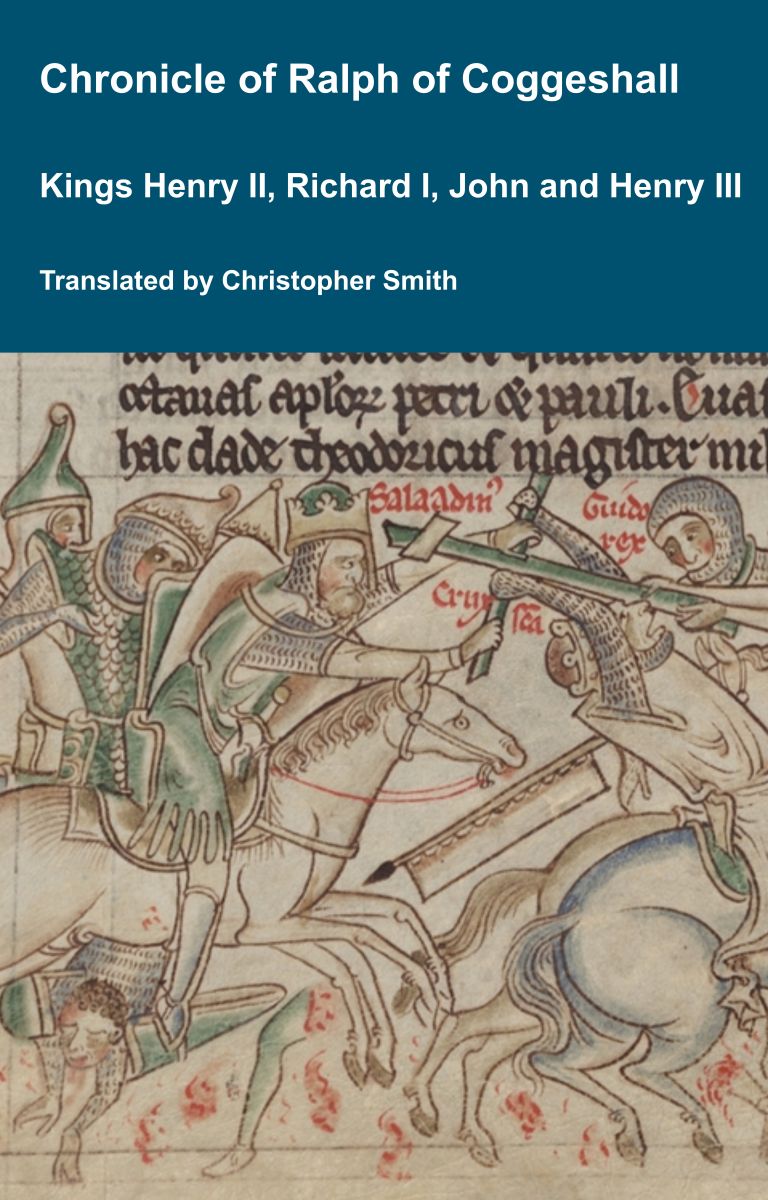
Chronicle of Abbot Ralph of Coggeshall
The Chronicle of Abbot Ralph of Coggeshall (Chronicon Anglicanum) is an indispensable medieval history that brings to life centuries of English and European affairs through the eyes of a learned Cistercian monk. Ralph of Coggeshall, abbot of the Abbey of Coggeshall in Essex in the early 13th century, continued and expanded his community’s chronicle, documenting events from the Norman Conquest of 1066 into the tumultuous reign of King Henry III. Blending eyewitness testimony, careful compilation, and the monastic commitment to record-keeping, this chronicle offers a rare narrative of political intrigue, royal power struggles, and social upheaval in England and beyond. Ralph’s work captures the reigns of pivotal figures such as Richard I and King John, providing invaluable insights into their characters, decisions, and the forces that shaped medieval rule. More than a simple annal, Chronicon Anglicanum conveys the texture of medieval life and governance, making it a rich source for scholars and readers fascinated by English history, monastic authorship, and the shaping of the medieval world.
Available at Amazon in eBook and Paperback format.
On 12th September 1891 Richard Heber Wrightson [aged 91] died. He was buried at St Peter's Church, Warmsworth.
Around 1507 William Wentworth was born to Thomas "Golden Thomas" Wentworth [aged 43] and Beatrix Woodruffe [aged 19] at Wentworth.
On 22nd July 1611 Anne Atkins Baroness Wentworth Woodhouse [aged 44] died in Wentworth.
In February 1612 William Wentworth 1st Baronet [aged 50] died at Wentworth. His son Thomas [aged 18] succeeded 2nd Baronet Wentworth of Wentworth Woodhouse in Yorkshire.


On 8th June 1626 William Wentworth 2nd Earl Strafford was born to Thomas Wentworth 1st Earl Strafford [aged 33] and Arabella Holles at Wentworth. He married 27th February 1654 his fourth cousin Henriette Stanley Countess Strafford, daughter of James Stanley 7th Earl of Derby and Charlotte Thouars Countess Derby.


On 8th October 1629 Anne Wentworth Baroness Rockingham was born to Thomas Wentworth 1st Earl Strafford [aged 36] and Arabella Holles at Wentworth. She married 13th November 1654 her fifth cousin once removed Edward Watson 2nd Baron Rockingham, son of Lewis Watson 1st Baron Rockingham and Eleanor Manners Baroness Rockingham, and had issue.
After 8th October 1629 Arabella Wentworth was born to Thomas Wentworth 1st Earl Strafford [aged 36] and Arabella Holles at Wentworth. She married before 1st July 1694 Justin McCarthy 1st Viscount Mountcashel, son of Donough MacCarty 1st Earl Clancarty and Ellen Butler Countess Clancarty.
On 15th February 1943 William Charles de Meuron "Billy" Wentworth-Fitzwilliam 7th and 5th Earl Fitzwilliam [aged 70] died at Wentworth Woodhouse. His son William [aged 32] succeeded 8th Earl Fitzwilliam, 6th Earl Fitzwilliam, 10th Baron Fitzwilliam of Liffer in Donegal.
On 13th May 1948 Kathleen "Kick" Kennedy [aged 28] and William Henry Lawrence Peter Wentworth-Fitzwilliam 8th and 6th Earl Fitzwilliam [aged 37] died in a plane crash at the Plateau du Coiron, Saint-Bauzile during the course of their journey from Paris [Map] to the French Riviera for a vacation aboard a de Havilland DH.104 Dove.. His first cousin once removed Eric [aged 64] succeeded 9th Earl Fitzwilliam, 7th Earl Fitzwilliam, 11th Baron Fitzwilliam of Liffer in Donegal. His wealth, estimated at 45 million pounds, including half of the Wentworth Woodhouse estate, the Coolattin estate in County Wicklow, Ireland, and a large part of the Fitzwilliam art collection went to his daughter Ann Juliet Dorothea Maud Wentworth-Fitzwilliam Marchioness Bristol [aged 13].