

Jean de Waurin's Chronicle of England Volume 6 Books 3-6: The Wars of the Roses
Jean de Waurin was a French Chronicler, from the Artois region, who was born around 1400, and died around 1474. Waurin’s Chronicle of England, Volume 6, covering the period 1450 to 1471, from which we have selected and translated Chapters relating to the Wars of the Roses, provides a vivid, original, contemporary description of key events some of which he witnessed first-hand, some of which he was told by the key people involved with whom Waurin had a personal relationship.
Available at Amazon in eBook and Paperback format.
Associate of the Royal Academy is in Royal Academy.
In 1784 Thomas Banks [aged 48] was elected Associate of the Royal Academy.

In 1792 Thomas Stothard [aged 36] was elected Associate of the Royal Academy.
In 1798 Martin Archer Shee [aged 28] was elected Associate of the Royal Academy.
In 1805 Richard Westmacott [aged 29] was elected Associate of the Royal Academy.
In 1812 Alfred Edward Chalon [aged 31] was elected Associate of the Royal Academy.
In 1816 Francis Leggatt Chantrey [aged 34] was elected Associate of the Royal Academy.
On 4th November 1833 John Gibson [aged 43] was elected Associate of the Royal Academy despite not meeting the criterion of being resident in Britain.
In 1838 Richard "The Younger" Westmacott [aged 39] was elected Associate of the Royal Academy at which time he was living at 21 Wilton Place, Belgravia.
In 1844 William Calder Marshall [aged 30] was appointed Associate of the Royal Academy. He participated in an exhibition held at Westminster Hall to select artists to decorate the rebuilt Palace of Westminster. It proved to be the turning point of his career, leading to many commissions for public monuments not only for the new Houses of Parliament - for which he made statues of the Lord Chancellors Clarendon and Somers, and of Chaucer.
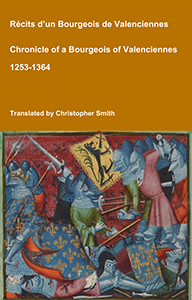
Chronicle of a Bourgeois of Valenciennes
Récits d’un bourgeois de Valenciennes aka The Chronicle of a Bourgeois of Valenciennes is a vivid 14th-century vernacular chronicle written by an anonymous urban chronicler from Valenciennes in the County of Hainaut. It survives in a manuscript that describes local and regional history from about 1253 to 1366, blending chronology, narrative episodes, and eyewitness-style accounts of political, military, and social events in medieval France, Flanders, and the Low Countries. The work begins with a chronological framework of events affecting Valenciennes and its region under rulers such as King Philip VI of France and the shifting allegiances of local nobility. It includes accounts of conflicts, sieges, diplomatic manoeuvres, and the impact of broader struggles like the Hundred Years’ War on urban life in Hainaut. Written from the perspective of a burgher (bourgeois) rather than a monastery or royal court, the chronicle offers a rare lay viewpoint on high politics and warfare, reflecting how merchants, townspeople, and civic institutions experienced the turbulence of the 13th and 14th centuries. Its narrative style combines straightforward reporting of events with moral and civic observations, making it a valuable source for readers interested in medieval urban society, regional politics, and the lived experience of war and governance in pre-modern Europe.
Available at Amazon in eBook and Paperback format.
In 1868 William Quiller Orchardson [aged 35] was elected Associate of the Royal Academy.
On 16th January 1875 Henry Hugh Armstead [aged 46] was elected Associate of the Royal Academy.
In 1891 Frank Bernard Dicksee [aged 37] was appointed Associate of the Royal Academy.
In 1895 John William Waterhouse [aged 45] was appointed Associate of the Royal Academy.

In 1899 Alfred East [aged 54] was elected Associate of the Royal Academy.
In 1907 Frank Cowper [aged 57] was elected Associate of the Royal Academy.
In 1909 Adrian Scott Stokes [aged 54] was elected Associate of the Royal Academy.
In 1924 Ambrose McEvoy [aged 46] was appointed Associate of the Royal Academy.