Chronicle of Walter of Guisborough
A canon regular of the Augustinian Guisborough Priory, Yorkshire, formerly known as The Chronicle of Walter of Hemingburgh, describes the period from 1066 to 1346. Before 1274 the Chronicle is based on other works. Thereafter, the Chronicle is original, and a remarkable source for the events of the time. This book provides a translation of the Chronicle from that date. The Latin source for our translation is the 1849 work edited by Hans Claude Hamilton. Hamilton, in his preface, says: 'In the present work we behold perhaps one of the finest samples of our early chronicles, both as regards the value of the events recorded, and the correctness with which they are detailed; Nor will the pleasing style of composition be lightly passed over by those capable of seeing reflected from it the tokens of a vigorous and cultivated mind, and a favourable specimen of the learning and taste of the age in which it was framed.'
Available at Amazon in eBook and Paperback format.
Commissioners is in Royal Household.
John Evelyn's Diary. 26th March 1663. I sat at the Commission of Sewers, where was a great case pleaded by his Majesty's [aged 32] counsel; he having built a wall over a water course, denied the jurisdiction of the Court. The verdict went for the plaintiff.
John Evelyn's Diary. 10th December 1685. To Greenwich [Map], being put into the new Commission of Sewers.
In 1689 Thomas Papillon Merchant [aged 65] was appointed Commissioner for Victualling the Navy which post he held until 1699.
In 1642 Francis Hawley 1st Baron Hawley [aged 33] was appointed Commissioner of Array for Somerset.
In 1484 Edward Redman Lord Harewood [aged 29] was appointed Commissioner of Array for Dorset.
In 1673 Henry Brouncker 3rd Viscount Brounckner [aged 46] was appointed Commissioner of Trade and Plantation.
On 15th April 1645 Christopher Wray [aged 44] was appointed Commissioner of the Admiralty.
John Evelyn's Diary. 25th June 1679. The new Commissioners of the Admiralty came to visit me, viz, Sir Henry Capell [aged 41], brother to the Earl of Essex [aged 47], Mr. Finch [aged 31], eldest son to the Lord Chancellor [aged 57], Sir Humphry Winch [aged 57], Sir Thomas Meeres [aged 45], Mr. Hales, with some of the Commissioners of the Navy. I went with them to London.


John Evelyn's Diary. 15th October 1662. I this day delivered my "Discourse concerning Forest Trees" to the Society, upon occasion of certain queries sent to us by the Commissioners of his Majestie's Navy, being the first book that was printed by order of the Society, and by their printer, since it was a corporation.

Chronicle of a Bourgeois of Valenciennes
Récits d’un bourgeois de Valenciennes aka The Chronicle of a Bourgeois of Valenciennes is a vivid 14th-century vernacular chronicle written by an anonymous urban chronicler from Valenciennes in the County of Hainaut. It survives in a manuscript that describes local and regional history from about 1253 to 1366, blending chronology, narrative episodes, and eyewitness-style accounts of political, military, and social events in medieval France, Flanders, and the Low Countries. The work begins with a chronological framework of events affecting Valenciennes and its region under rulers such as King Philip VI of France and the shifting allegiances of local nobility. It includes accounts of conflicts, sieges, diplomatic manoeuvres, and the impact of broader struggles like the Hundred Years’ War on urban life in Hainaut. Written from the perspective of a burgher (bourgeois) rather than a monastery or royal court, the chronicle offers a rare lay viewpoint on high politics and warfare, reflecting how merchants, townspeople, and civic institutions experienced the turbulence of the 13th and 14th centuries. Its narrative style combines straightforward reporting of events with moral and civic observations, making it a valuable source for readers interested in medieval urban society, regional politics, and the lived experience of war and governance in pre-modern Europe.
Available at Amazon in eBook and Paperback format.
In 1664 William Brouncker 2nd Viscount Brounckner [aged 44] was appointed Commissioner of the Royal Navy.
Calendar of State Papers Charles II 1665 13 May 1665. 13th May 1665. 41. Jonas Shish [aged 60] to the Navy Comrs. Recommends Robt. Withers [aged 47], shipwright, for the survey of the new ship. [Adm. Paper.].
Calendar of State Papers Charles II Oct 1667. October 1667. 102. Proposals by Sir Thomas Strickland [aged 45] to the Navy Comrs., to build three third-rate frigates in Foudray Pill, to be completed by 1 Aug. 1671, upon a similar contract to that of Mr. Baylie, of Bristol. [Adm. Paper.] Enclosing,.
102. i. Edward Tyldesley to Sam. Pepys [aged 34]. Robt. Withers [aged 49] and the writer have viewed Foudray Pill, where they proposed to build ships for the King's service. Sends a draft sketch thereof, leaving the rest of the business to be transacted by his partners, Sir Thomas Strickland and Mr. Withers. Has such timber as all England cannot show. Lodge in the Forest of Meirscough, 1st October 1667.
102. ii. Sketch of Walney Island, the pill, bar, &c., in coloured chalks.


John Evelyn's Diary. 20th July 1685. The Trinity House met this day, which should have ben on ye Monday after Trinity, but was put off by reason of the Royal Charter being so large that it could not be ready before. Some immunities were super-added. Mr. Pepys [aged 52], Secretary to ye Admiralty, was a second time chosen Master. There were present the Duke of Grafton [aged 21], Lord Dartmouth [aged 12], Master of ye Ordnance, the Commissioners of ye Navy, and brethren of the Corporation. We went to Church according to costome, and then took barge to the Trinity House [Map], in London, where we had a great dinner, above 80 at one table.
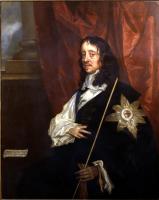
John Evelyn's Diary. 27th August 1663. Dined at Sir Philip Warwick's [aged 53], Secretary to my Lord Treasurer [aged 56], who showed me the accounts and other private matters relating to the revenue. Thence, to the Commissioners of the Mint, particularly about coinage, and bringing his Majesty's [aged 33] rate from fifteen to ten shillings for every pound weight of gold.
John Evelyn's Diary. 10th March 1687. His Majesty [aged 53] sent for the Commissioners of the Privy Seal this morning into his bedchamber, and told us that though he had thought fit to dispose of the Seal into a single hand, yet he would so provide for us, as it should appear how well he accepted our faithful and loyal service with many gracious expressions to this effect; upon which we delivered the Seal into his hands. It was by all the world both hoped and expected, that he would have restored it to my Lord Clarendon; but they were astonished to see it given to Lord Arundel, of Wardour [aged 79], a zealous Roman Catholic. Indeed it was very hard, and looked very unkindly, his Majesty (as my Lord Clarendon protested to me, on my going to visit him and long discoursing with him about the affairs of Ireland) finding not the least failure of duty in him during his government of that kingdom, so that his recall plainly appeared to be from the stronger influence of the Papists, who now got all the preferments.